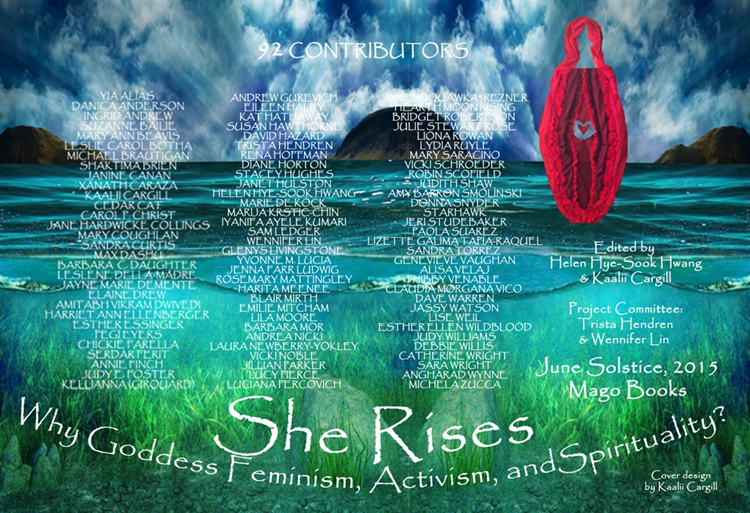
How we Began the Movement of Goddess Feminist Activist Spirituality in the 21st Century (Part 1) by Helen Hye-Sook Hwang

Mago is an East Asian/Korean word for the Cosmic Mother or the Creatrix. This piece is written as the first of a four-part essay. In this series I am surveying the past 9 years of The Mago Work (A collective effort to restore the consciousness of Mago, the Creatrix), which birthed the Movement of Goddess Feminist Activist Spirituality, while being shaped by the latter.

Continue reading “How we Began the Movement of Goddess Feminist Activist Spirituality in the 21st Century (Part 1) by Helen Hye-Sook Hwang”

Archive From the FAR Founders: Qu(e)erying Our Lady By Xochitl Alvizo

This post was originally published on July 6, 2011. Xochitl’s very first FAR post!

I love art. I especially love women’s art – women such as Frida Kahlo, Cathy Ashworth, Sudie Rakusin, and Alma Lopez. To me, their art is a reflection of women’s strength, creativity, and beauty. Frida Kahlo, for example, expressed so many aspects of herself and her experience through her art. In it one can glimpse her passionate love for Diego Rivera, her continuous physical pain, her search for meaning, and the unending hopefulness she maintained throughout it all. Frida Kahlo’s art, like her person, was vibrant and full of life, colorful and yet broken. She expressed the wide spectrum of her experience not in words only but in color and images, texture, paint and print. As she put it, “I paint my own reality” – her own reality is what she knew and it is what she painted.

Continue reading “Archive From the FAR Founders: Qu(e)erying Our Lady By Xochitl Alvizo”

From the Archives: Writing: Changing the World and Ourselves. By Ivy Helman

This was originally posted on October 12, 2014

20140903_180423

I still remember the first time I read Mary Daly’s Gyn/Ecology. It awoke something within me. Her use of language, the power of her writing and the ease with which she created new words taught me so much about the world around me and about the way the language, and subsequently its use in writing, shapes lives, choices, abilities and destinies. She also taught me about myself.

I was hooked, but not just on Mary Daly. Shortly after I finished her book, I moved onto other feminists writing about religion like Katie Cannon, Judith Plaskow, Alice Walker, Carol Christ, Rita Gross, Gloria Anzaldua, Audre Lorde, Adrienne Rich, Margaret Farley and Starhawk to name just a few. All of them, in fact every feminist I’ve ever read, has shown me the way in which words have power and how words speak truth to power. Ever since, I’ve wanted to be the kind of writer whose words carry a power that not only affects people but also inspires a more just, more equal, more compassionate and more humane world. In other words, I wanted to be a writer activist.

Continue reading “From the Archives: Writing: Changing the World and Ourselves. By Ivy Helman”

Mothers and Dragon-ing by Sara Frykenberg

But what if there was a space for the danger of dragon-ing? What if society expected it, welcomed it, and made room for our, women’s, subsequent growth? It might still be hard and risky, as is all growth and change. But as I believe Barnhill is trying to suggest, it might also be less traumatic, less splitting, and give us so much more space to be.

Knowing that I like dragons and feminism, a friend of mine recently recommended the book, When Women Were Dragons (2022) by Kelly Barnhill. I have been reading it (okay listening to it on audiobook, but that counts right?) all week. The premise of the book is that women dragon, as an act, and can do so by choice or spontaneously; and in the “Mass Dragon-ing of 1955” over 600,000 women flew away from American homes, “wives and mothers all” (Barnhill, 2022). But despite the destruction, eaten husbands and bosses, and destroyed homes that dragons leave in their wake, society, the government, and individual families do everything they can to forget it happened. The history is repressed. Individual memory is policed and repressed. The dragon-ing goes on.

 Beginning this book the week before Mother’s Day, I found the recommendation timely, or even fateful, because with every chapter and hour that I listen, I find myself thinking of my mother. And I wonder if or when she would have dragon-ed if given the chance.

Continue reading “Mothers and Dragon-ing by Sara Frykenberg”

Legacy of Carol P. Christ: Why a Goddess Pilgrimage?

This was originally posted on October 1, 2012

What is a Goddess Pilgrimage and why are so many US, Canadian, and Australian women making pilgrimages to ancient holy places in Europe and Asia?  The simple answer is that women are seeking to connect themselves to sources of female spiritual power that they do not find at home.

Traditionally pilgrims leave home in order to journey to a place associated with spiritual power.  “Leaving home” means leaving familiar physical spaces, interrupting the routines of work and daily life, and leaving friends and family behind.  For the pilgrim, “home” is a place that has provided both comfort and a degree of discomfort that provokes the desire to embark on a journey.  The space of pilgrimage is a “liminal” or threshold space in which the supports systems of ordinary life are suspended, as Victor Turner said.  A pilgrim chooses to leave the familiar behind in order to open herself to the unfamiliar—in hopes that she will return with new insight into the meaning of her life. 

Continue reading “Legacy of Carol P. Christ: Why a Goddess Pilgrimage?”

My Pilgrimage to Crete – September 2023, Part 2 by Terry Folks

Part 1 was posted yesterday.

Stage Four – Mentor Appears

Joseph Campbell spoke of ‘mentors’ appearing to help the sojourner, and what Maureen Murdock called the gathering of allies. In my hybrid of these two archetypal journeys, there may be several mentors – human, power animals, divine guides or a combination. She could be a wise elder who helps the heroine prepare for the journey or gives her a gift for later use. In my case the wise elder was my 93 year old mom who became one of my mentors. When I expressed my excitement and fears, she said what she always says when I – one of her seven children – am facing a challenge: “Go get’em Tiger!” She also offered financial support so I could take time away from my psychotherapy practice.

Two other mentors showed up in what Carl Jung called my ‘active imagination’: Carol Christ and Marija Gimbutas. Both have transitioned so my active imagination conjured their support as divine intervention. I reread Carol’s reflections and teachings on the pilgrimage, and watched the videos she made as inspiration. I felt her invitation. I was ready to change.

Continue reading “My Pilgrimage to Crete – September 2023, Part 2 by Terry Folks”

Legacy of Carol P. Christ: As It Might Have Been: Ancestor Stories in the Dreamtime

This was originally posted January 9, 2017

In the middle of the night in waking sleep, I asked my great-great grandmother Annie Corliss to tell me the story of how she met and married James Inglis. This story came through me in a place I have come to call the Dreamtime. The Aboriginal term feels right. As I understand it, this is not a place where the dead speak to the living but rather a space where boundaries blur as the ancestors speak in us.

Annie Corliss’s Story: As It Might Have Been

Continue reading “Legacy of Carol P. Christ: As It Might Have Been: Ancestor Stories in the Dreamtime”

From the Archives: Rosh Hashanah and the Goddess by Joyce Zonana

Moderator’s Note: This was originally posted on Rosh Hashanah Sept 10, 2015. Rosh Hashanah this year begins on Sept. 15th but FAR will be taking a 16 day hiatus at that time so we are posting today.

When I was growing up in the 1950s in my Egyptian Jewish immigrant

My father, an Orthodox man who prayed each morning and went regularly to the local Sephardic synagogue in Brooklyn, privately followed the tenets of his faith.  But it was my mother, unconsciously devout, who brought the public rituals of our religion to life.  As a child, I longed to be at prayer with my father and was envious of the men and boys who studied and recited the sonorous ancient Hebrew; I did not want to be confined to polishing the silver and setting the table.  But today, as an adult, I am grateful for the silent teachings bequeathed to me by my mother.

Continue reading “From the Archives: Rosh Hashanah and the Goddess by Joyce Zonana”

Bathsheba: From Survivor of Sexual Abuse to Queen Mother by Linda Cooper Costelloe

Bathsheba by Artemisia Gentileschi, wikimedia commons, public domain

The image we have of Bathsheba is that of a scheming temptress. That’s the way she’s been portrayed in media, such as the 1951 movie, David and Bathsheba, and Leonard Cohen’s song, Hallelujah. She deliberately bathed on a rooftop in sight of King David. She caught his eye and he was helpless to withstand her charms. The Bible does not support that image of Bathsheba, however. It says that Bathsheba was used and abused by David, and God was displeased.

The Bible says that David was on his rooftop. It does not say where Bathsheba was, only that she was bathing to purify herself after her period (2 Samuel 11:2-4). She was probably in an inner courtyard. In their book, Flawed Families of the Bible. How God’s Grace Works Through Imperfect Relationships, David E. Garland and Diana R. Garland write: “The laws required ritual washing at the conclusion of her menstrual period. A woman would be highly unlikely to conduct such a cleansing from her menstrual period as a come-on. If she were in public view, she would have washed without disrobing. There is no reason even to assume that she was naked. Public nudity was not acceptable in this ancient Jewish culture but instead was considered shameful. There is no foundation for assuming she was some kind of exhibitionist.”i

Continue reading “Bathsheba: From Survivor of Sexual Abuse to Queen Mother by Linda Cooper Costelloe”

Durga Rising: Feminism as Fierce Compassion By Beth Bartlett

In her FAR post earlier this year,[i] “Why Feminism Needs the Fierce Goddesses,” Susan Foster argues that a “flagging” feminist movement needs the revitalizing energy of the “fierce goddesses” of ancient times to challenge the patriarchal forces that seem to be on the rise as increasingly we find women’s lives and freedoms constrained. She writes, “the dark goddesses of ancient times have been submerged in our psyches, but they serve as a repository of fierce energy, of female rage against injustice.”  She continues, “It’s important and healthy for us as women to reclaim our anger, using it to protect ourselves and fight for our rights in systems that are oppressive.”

Reading this, I immediately thought of Beverly Wildung Harrison’s, “The Power of Anger in the Work of Love,” and China Galland’s, The Bond Between Women: A Journey to Fierce Compassion. Anger as the work of love; fierce compassion.  In this time of mass shootings, insurrection, the ongoing assault on women, LGBTQ, and BIPOC peoples, when rage seems so easily fueled by hate, envy, and greed, it is the rage based in love and compassion that is most needed.  This is the rage of the fierce dark goddesses who are moved to act against injustice, the rage of the feminism I love. With its source in love and compassion, it is a rage that rebels in the best sense of the word – that at once refuses injustice and affirms dignity and respect, that speaks truth to power, that is grounded in solidarity and friendship, and values the immanence of the earth, the water, the body, and the divine spark in all beings.[ii] 

Continue reading “Durga Rising: Feminism as Fierce Compassion By Beth Bartlett”