My dear friend Carol Lee Sanchez once told me that the women of the Laguna Pueblo– whose culture is an egalitarian matriarchy–taught her that women must choose their men, not wait for the men to choose them.* This was a new idea for me, and though I was attracted to it, I found it difficult to assimilate. The reason I did not understand what Carol Lee was teaching me was that I was still operating out of a patriarchal binary: either the man was in control, or the woman must be.
Like many otherwise independent women, I have often reverted to a kind of passivity in love affairs. As a girl, I was taught to wait for the man to choose me. As a feminist I knew better, but I didn’t know how to change this cultural pattern, especially when most of the men I knew still expected –even if only unconsciously– to be in charge. In addition, having learned that a man who wants an independent feminist woman is hard to find, I often gave up on ever finding a man. Not actively looking, I would be pleasantly surprised when a man took an interest in me. Then, all too often, I would give myself to him, hoping that he was the right one. Continue reading “Claiming the Power to Choose Our Lovers and Partners by Carol P. Christ”
When I learned about the Navajo Beauty Way, I understood it to be a path in which human beings respect all beings in the web of life and live in harmony with them. But I didn’t understand why this path was called the “Beauty Way.” As a young woman, I knew that my worth was defined by many in terms of my ability to conform to ideals of female beauty promulgated in movies, tv, and advertising. I didn’t believe the Navajos were talking about beauty in that sense, but because of my conditioning, I was not yet able to fully grasp what they might mean by beauty. I would have called the way they were describing a “Way of Harmony” or a “Way of Respect for Life.”
Still, I wondered: why the Beauty Way?
Marija Gimbutas described the societies of Old Europe as peaceful, settled, agricultural, highly artistic, matrifocal and probably matrilineal, and worshipping the Goddess as the power of birth, death, and regeneration in all of life. Though I am impressed with the beauty of the many small works of art Gimbutas reproduced and interpreted in The Language of the Goddess, I sometimes inadvertently omit the words “highly artistic” when repeating in her definition of the culture of Old Europe. I have tended to view the fact that Old Europe was peaceful and matrifocal as more important than the fact that it was highly artistic.Yet this judgment is wrong. In calling the cultures of Old Europe “highly artistic,” Gimbutas was trying to convey her understanding that appreciation of the beauty of life was fundamental within them.
We have been taught that “high” or “great” art is most often monumental in size. The Pyramid of Giza is over 230 meters (756 feet) tall. The Great Sphinx of Giza is 20 meters (66 feet) high. The Parthenon rose to 14 meters (45 feet) and the statue of Athena inside it was 9 to 11 meters (35-40 feet). It is telling that we use the words “high” and “great” (originally measures of size) to describe the value of artistic creations.
Statue of Athena in Parthenon reproduction in Nashville, Tennessee
The purpose of monumental works of art is to diminish the viewer, to make the her feel small, to induce her to bow down, to worship, and to obey a power or powers greater and higher than herself.
In contrast, the small scale of the art of Old Europe does not diminish anyone or anything. Its purpose is not to make anyone one want to bow down. Instead small works of art make the viewer feel comfortable, welcomed, and part of the beauty of life that is depicted.
Goddesses of Old Europe c. 5000 BCE
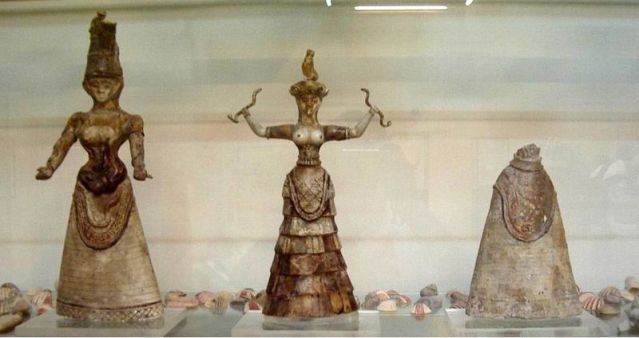
Marija Gimbutas viewed ancient Crete in the Bronze age as the final flowering of the culture of Old Europe. In Crete too, everything is on a small scale. Though the so-called Palaces or Sacred Centers are large, the rooms within them are small. There is not a single room where crowds could have bowed down to a King or Queen. Nor are there images of deities larger than life. The famous Minoan Snake Goddesses are less than 15 inches tall and the well-known pitcher Goddesses are even smaller. Such objects would have been held in hands during rituals or set on low benches in small rooms lit by oil lamps.
Snake Goddesses of Bronze Age Crete c. 1500 BCE
When my friend’s daughter Klia was seven years old, she spent her afternoons collecting stones by the sea. One day I asked her if the stones spoke to her. “Of course,” she replied. “What do they say?” “They say, ‘we are very beautiful.’”
Heart of stones in Lesbos
Klia intuited the meaning of the Beauty Way. It has nothing to do with artificial beauty standards. It has nothing to do with size. It is recognizing beauty everywhere and in everything. When we do so, we walk in beauty, in the grace and joy of life. And yes, the Beauty Way has ethical implications, for no one who truly recognizes beauty could want to harm it. This was understood by the Navajos, the Old Europeans, and the ancient Cretans, and many others. Only we seem to have forgotten. We can remember.
In Part 1, I presented a spectrum of male behaviors and attitudes, from violently misogynistic to safe ally. Next it is time to think about how we – as women, male allies, and society – can help men move up that scale to become increasingly safer for women. The strategies will differ depending on where a man starts out. However, using current research about change theory, we can find some concrete strategies to help us start to make progress.
The Research
Social scientists have conducted many studies about persuasion and social change, and I encourage everyone to follow these research trends. For this piece, I will focus on a few simple ideas about what works. I’m gearing this advice mainly toward men who want to become safer and to help other men become safer, but some of it applies to women as well. It also applies to religious communities – if they prioritize this issue, the men who attend will learn to be safer.
Just the other day, I realized that discussion of my housekeeping has been a fairly regular conversation throughout my life. One of my earliest memories is being about four years old in my yellow bedroom on Ruth Avenue in North Canton, Ohio, sitting amidst what seemed like a mountain of stuff. I was trying to organize and put it away at my mother’s behest. I had a red bandana tied across the top of my hair, and I was pressed up against a large cardboard box decorated with Disney’s slapstick hero, Donald Duck. I was young and apparently had not learned how to differentiate all my consonants, because, as the story goes, I complained that all I ever did was “cwean, cwean, cwean!”
As a teenager in my mauve bedroom on Demington Avenue in Canton, Ohio, my sister and I, who shared a bedroom, were under the constant scrutiny of our stepfather. I don’t remember it being exceptionally messy in there; the space was probably maintained better than average for kids our age, but the house was managed like the army. Once, the appearance of the room was sufficiently troubling as to result in the removal of our bedroom door from its hinges. I am still not sure what the purpose of this weird punishment was (humiliation?), but I recall feeling this to be one of the lowest points in my whole housecleaning career. Continue reading “Neither My Duty nor My Honor by Natalie Weaver”
Some time ago, trans-activist F. was the target of bullying and harassment via social networks that lasted months and included defamation on Twitter and Facebook, articles in feminist blogs and web sites, and letters to women’s organizations and public institutions to request they ban the presence of F. from feminists spaces. Who did this? Feminists who had been F. friends. Why? For a disagreement with F.
In fact, F. was obliterated from women’s movements and even lost job opportunities. The most serious, perhaps, was the deep depression that affected her and the loneliness in which she had to live this experience.
Cases like these are examples of a behavior that is not strange, but instead is pitiful and very harmful — the destructive socialization of females to please patriarchy and to reproduce patriarchy and oppression at the expense of our integrity as women.
Women fight with the guns of patriarchy
We have been domesticated, trained to obtain the approval of a man and of the patriarchal system at any cost, to do whatever it takes to have a place at his side. We are the result of centuries of pedagogy that creates mistrust between women, and the validation and reproduction of our oppression and conditioning towards mutual competition. This is the root of our inability to deal with conflicts between us in a constructive and non-dehumanizing way. We can only give of what we have and as long as we have an identity as objects instead of individual people, women will be expert agents of misogyny.
Yesterday I sat in my car, buckled and ready to reverse just when I looked out my side window to see the people getting into their car next to mine.
There was a very elderly lady being seated in the back ever so gingerly. Her caretaker (that is what she appeared to be) carefully buckled her in, and then offered her a sip of ice water. Meanwhile I was in mid reverse, my engine running, on the go, and yet the ladies didn’t notice anything around them.
Simultaneously the elderly lady’s wheelchair didn’t have its brakes on and rolled into my rear side door. Instantly, I thought OK a little rude, these people aren’t really being considerate of the tight space we are sharing, should I roll down my window and say with as much patience as I can “excuse me”? Or should I let it go? I let it go. Those immediate feelings of impatience and annoyance washed over me, because I made myself stop and observe the situation, and the details of these ladies. Continue reading “Consideration by Valentina Khan”
My students are taking their final exams this week, which means I will be spending the week frantically, but attentively grading in order to make our grade submission deadline next week. End of semester grading is a mountain of careful criticism we educators scale one step at a time, with deliberateness, towards an ultimate goal of student success (if not in our classes, then in the next, or in life, relationships, etc.). Thus, I often find myself returning to the question: what am I hoping to create in what I say and write, and in how I critique?
One of the goals of feminist pedagogies is to help us prevent recreating the domination of kyrio-patriarchy in classroom spaces. While activism is not the same thing as education, and strategies of resistance are different than pedagogy in important ways, the concern for careful critique is warranted in both praxes. What do we create in how we critique, resist, and protest? What do we recreate, wittingly or no? I have found myself concerned with this since the election of Trump, DT (cause I can only write that name so many times), to the presidency. Continue reading “Careful Criticism: Resisting Hetero-Patriarchy while Resisting Trump by Sara Frykenberg”
In my last post, Trump’s Misogyny – A Case for the Contempt-Oriented Personality, I wrote about disgust, claiming that media diagnosticians failed to identify disgust- contempt as part of Donald Trump’s psychological profile. At the end of the piece, I said that the statement “Make America Great Again” was misogynistic. I maintain this claim but now want to consider disgust a little more closely – particularly when it constitutes self-disgust underlying or complicit in misogyny. Confronting and ameliorating self-disgust provides an entrance into combating misogyny.
Self-disgust interferes with self-love. As a result, self-disgust impedes connection and empathy in human relationships. Self-disgust also attenuates intimacy –self and other directed. Self- disgust manifests in multiple ways – in withdrawal, refusal to engage, self and other directed violence, addictions (including those to negative affect), etc.: the list is a long one. Self-disgust which manifests as hubris motivates the projection of disgust onto others, so that the other becomes the source of disgust; the abject unwanted object present in the self – rejected and discarded –becomes transported, launched to rest on the back of another.
The simple way to describe this mechanism emerges in self-help literature that suggests that the thing that one dislikes most in others is that which one cannot tolerate in oneself. This negatively perceived part of self can also be conceptualized in terms of Carl Jung’s notion of the shadow – the unknown dark side of the personality which we all carry but whose integration into conscious life defines its denseness, or the weight of its impact. The more conscious we are of our shadow, the more we are able to identify that what we recognize as a deficiency in another is actually what we understand as a personal inferiority. Continue reading “Encountering and Countering Self-Disgust by Stephanie N. Arel”
This past week, I was listening to Krista Tippett’s podcast On Beingas she spoke with Pádraig Ó Tuama. He is a poet, theologian, and leader in the Corrymeela community of Northern Ireland. As he spoke about several things related to the challenges of belonging, reconciliation, and fractured communities, he said, ”The measure of Christian fidelity is more than the positions we take.”
I agree. I interpreted his statement as a condemnation of the ways Christian doctrines and moral positions too often take priority over other matters of faith.
There comes a time in all of our lives when we have to make important decisions. What do I believe in? Who do I want to be? What and who will I stand up for? There has been a lot going on in the world lately and a lot of it, sadly, is pretty awful. While people are learning pretty quickly that elections have very real and long-lasting consequences, what is critical to make clear in the next 4 years of this fascist regime isn’t just that we are taking to the streets to make our voices heard, but that we are willing to disrupt society at every turn to make sure that people on the other side of the proverbial political coin know we will not go gently into that good night.
I’ve been questioning G-d a lot lately; wondering what has happened to that shining “City on a hill” that John Winthrop called for in his 1630 sermon “A Model of Christian Charity.” The idea that the United States of America is “G-d’s country” is based in an American exceptionalism based not only the rich bounty of land and resources many would soon benefit from, but also on the potential for a different kind of society that America represented in a world full of monarchs. Continue reading “Welcome to the Resistance by John Erickson”


 My dear friend Carol Lee Sanchez once told me that the women of the Laguna Pueblo– whose culture is an egalitarian matriarchy–taught her that women must choose their men, not wait for the men to choose them.* This was a new idea for me, and though I was attracted to it, I found it difficult to assimilate. The reason I did not understand what Carol Lee was teaching me was that I was still operating out of a patriarchal binary: either the man was in control, or the woman must be.
 When I learned about the Navajo Beauty Way, I understood it to be a path in which human beings respect all beings in the web of life and live in harmony with them. But I didn’t understand why this path was called the “Beauty Way.” As a young woman, I knew that my worth was defined by many in terms of my ability to conform to ideals of female beauty promulgated in movies, tv, and advertising. I didn’t believe the Navajos were talking about beauty in that sense, but because of my conditioning, I was not yet able to fully grasp what they might mean by beauty. I would have called the way they were describing a “Way of Harmony” or a “Way of Respect for Life.”



 Just the other day, I realized that discussion of my housekeeping has been a fairly regular conversation throughout my life. One of my earliest memories is being about four years old in my yellow bedroom on Ruth Avenue in North Canton, Ohio, sitting amidst what seemed like a mountain of stuff. I was trying to organize and put it away at my mother’s behest. I had a red bandana tied across the top of my hair, and I was pressed up against a large cardboard box decorated with Disney’s slapstick hero, Donald Duck. I was young and apparently had not learned how to differentiate all my consonants, because, as the story goes, I complained that all I ever did was “cwean, cwean, cwean!”
 Yesterday I sat in my car, buckled and ready to reverse just when I looked out my side window to see the people getting into their car next to mine.
 My students are taking their final exams this week, which means I will be spending the week frantically, but attentively grading in order to make our grade submission deadline next week. End of semester grading is a mountain of careful criticism we educators scale one step at a time, with deliberateness, towards an ultimate goal of student success (if not in our classes, then in the next, or in life, relationships, etc.). Thus, I often find myself returning to the question: what am I hoping to create in what I say and write, and in how I critique?

 There comes a time in all of our lives when we have to make important decisions. What do I believe in? Who do I want to be? What and who will I stand up for? There has been a lot going on in the world lately and a lot of it, sadly, is pretty awful. While people are learning pretty quickly that elections have very real and long-lasting consequences, what is critical to make clear in the next 4 years of this fascist regime isn’t just that we are taking to the streets to make our voices heard, but that we are willing to disrupt society at every turn to make sure that people on the other side of the proverbial political coin know we will not go gently into that good night.
 Feminism and Religion