Anne Hutchinson, America’s First Feminist Theologian: 1591-1643 by Carol P. Christ

Carol Christ in Lesbos“She had rather been a husband than a wife; and a preacher than a hearer; and a magistrate than a subject.” Reverend Hugh Peter of Salem

Anne Hutchinson was banished from the Massachusetts Bay Colony for heresy in 1637 and excommunicated from the Puritan Church of Boston in 1638. Her banishment came just three years after she, her husband, and eleven living children arrived in America seeking the freedom to practice their religion as they saw fit. Governor Michael Dukakis pardoned her in 1987. Historian Howard Zinn called her a true American hero.

anne hutchinson trialI managed to get through graduate school in Religious Studies without ever having studied the theology of Anne Hutchinson,* though I vaguely remember references (probably with smirks of disapproval) to the “Antinomian Controversy” which is associated with her name. I recall Anne Hutchinson’s name because of an article published in Feminist Studies in the 1970s, when I had just begun to study women and religion. However it was not until recently that I learned of her place in history through reading American Jezebel by Eve LaPlante.

Hutchinson was accused of theological errors in her trials. The Calvinist doctrine of predestination figured heavily in the accusations. But the real issue at stake was that Anne dared to follow her own inner knowing, to articulate it theologically, and to teach her views against the grain of the Puritan authorities in Boston. Continue reading “Anne Hutchinson, America’s First Feminist Theologian: 1591-1643 by Carol P. Christ”

Writing: Changing the World and Ourselves. By Ivy Helman

I still remember the first tim20140903_180423e I read Mary Daly’s Gyn/Ecology. It awoke something within me. Her use of language, the power of her writing and the ease with which she created new words taught me so much about the world around me and about the way the language, and subsequently its use in writing, shapes lives, choices, abilities and destinies. She also taught me about myself.

I was hooked, but not just on Mary Daly. Shortly after I finished her book, I moved onto other feminists writing about religion like Katie Cannon, Judith Plaskow, Alice Walker, Carol Christ, Rita Gross, Gloria Anzaldua, Audre Lorde, Adrienne Rich, Margaret Farley and Starhawk to name just a few. All of them, in fact every feminist I’ve ever read, has shown me the way in which words have power and how words speak truth to power. Ever since, I’ve wanted to be the kind of writer whose words carry a power that not only affects people but also inspires a more just, more equal, more compassionate and more humane world. In other words, I wanted to be a writer activist.

Yet, I’ve always carried around with me a sneaky suspicion that people don’t consider writers true activists. If you aren’t holding a sign, screaming or participating in some sort of public demonstration or civil disobedience, then you have no right to call yourself an activist. Is that really true? Continue reading “Writing: Changing the World and Ourselves. By Ivy Helman”

My Take On “Feminist Theology: Four Perspectives” by Grace Yia-Hei Kao

I recently had the honor of serving on a panel entitled “Feminist Theology: Four Perspectives” with three of my faculty colleagues: Rosemary Radford Ruether, Monica A. Coleman, and Najeeba Syeed. It had been organized by the Claremont School of Theology Alumni/ae Association in partnership with the La Plaza United Methodist Church and the Los Angeles United Methodist Museum of Social Justice (where the event had taken place).

We had an incredible time. La Plaza UMC, led by CST alum Rev. Vilma Cruz-Baez (’07), graciously hosted a reception before our panel discussion. As we feasted on hearty Mexican food (my favorite was the watermelon agua fresca), we perused the Exodus exhibition in the Museum of Social Justice, which featured dramatic black and white photographs of migrants and others who had made their lives in Los Angeles (n.b., the Museum is located in the basement of the Church, which is itself located on historic Olvera Street). I was grateful for the warm welcome and short history of the Museum that Director Leonara Barron provided.

Continue reading “My Take On “Feminist Theology: Four Perspectives” by Grace Yia-Hei Kao”

More than Individual Concerns by Elise M. Edwards

Elise EdwardsWell, the fall semester of the school year has begun. I’m teaching undergraduate classes in Christian Ethics and Bioethics this fall. I’ve designed my classes so that they are much more discussion-based than they have been in previous semesters and as a result, I’m noticing the things that challenge and confuse my students fairly early. I have readings from feminist, womanist, and mujerista thinkers in these courses, and unsurprisingly, some of my students don’t know what to do with the arguments feminists make about how we arrive at moral decisions and live them out. I hope that as we work through the essays together, my students and I learn from each other.

I assigned an essay called “Theology’s Role in Public Bioethics” by Lisa Sowle Cahill that was included in the Handbook of Bioethics and Religion edited by David E. Guinn (2006). Cahill, a feminist thinker, asserts that theology can be a conversation partner in public debate about bioethics and also an advocate for just, compassionate, and inclusive health care practices. Citing the work of another feminist, Maura Ryan, Cahill argues that ethical questions about reproductive technologies should be examined not only as individual dilemmas but as issues that exist within a social justice context. In the conclusion of the essay, she states, ”Specifically, one of [theology’s] most important and distinctive contributions to public discourse is a critique of the ways in which modern biomedicine and biotechnology have become luxury items marketed to economically privileged classes, while the world’s poor majority lacks basic health needs.” (55).

I suppose because I’ve been reading feminist thought, theology, and social ethics for years, some of the claims that my students see as radical and new are commonplace and go unquestioned by me. I expected some of my students to disagree with Cahill and Ryan’s particular positions about assisted reproduction. But I was surprised by students’ rejection of the idea that debates about reproductive technologies include MORE than individual considerations.

I’ve blogged on this site about reproductive rights before, and let me be clear that I do not think that the church, state, or any institution should have more governance over a person’s body than that person herself. But while respecting individuals’ rights to make health decisions for themselves, I also acknowledge that these “individual” decisions have broader social implications and meanings. This is one reason second-wave feminists have insisted that “the personal is political.”

Feminists routinely relate individual, “personal” acts and beliefs to larger constructs and the too-often asymmetrical power dynamics at work within them. This is why we are disturbed by video of a man who knocks his fiancée out and drags her unconscious body from an elevator and pop stars who gain commercial success by graphic displays and descriptions of sexuality that is objectifying or exploitative. And, in response to one of my students who wondered if feminist interpreters of religious texts go too far, that is why they point to patriarchy in a story that seems to be about devotion (referring to the Book of Ruth).

I’m grateful to my students for prompting me to explain some of these convictions that feminists hold. Certainly feminism is not monolithic. We feminists disagree on many issues including the scope of individual rights, the role of religion in public debate, and the extent of harm (or lack thereof) in media portrayals of female sexuality. But I believe we tend to agree that our personal decisions as well as our societal issues should be addressed with a consciousness that as humans we are beings-in-relation. Our conviction that we are connected and affected by each other lies behind our motivation to make the world a better place for women and girls and others who suffer from patterns of dominance.

What do you think?

Elise M. Edwards, PhD is a Lecturer in Christian Ethics at Baylor University and a graduate of Claremont Graduate University. She is also a registered architect in the State of Florida. Her interdisciplinary work examines issues of civic engagement and how beliefs and commitments are expressed publicly. As a black feminist, she primarily focuses on cultural expressions by, for, and about women and marginalized communities. Follow her on twitter, google+ or academia.edu.

In the Face of Despair, Choose Life by Carol P. Christ

carol mitzi sarahYesterday I had a delightful swim with a friend in the cool Aegean Sea. In in the evening I met two dear friends at an open air restaurant for a delicious meal and good conversation. Last night a beautiful moon rose over the sea and a soft breeze caressed my skin. All of this made me very happy. However, the state of the world does not.

Michael Brown. Trayvon Martin. The Ferguson police. Hold your ground laws. Bombing in Gaza. War in Ukraine. War in Iraq. War in Afghanistan. War in Syria. Wars that are not on my radar. Rape as a part of war. Joe Biden threatening to chase ISIL “to the gates of hell.” Citizens United. A rash of laws restricting voting rights. A rash of laws restricting abortion rights. Police brutality. Police brutality that is racially motivated. Young men being sentenced to prision for minor drug offenses. The brutality of the prison system. A woman with children being paid $8.50 an hour working at McDonalds and not even knowing when she will be called in to work. Open carry laws allowing Americans to walk the streets with loaded weapons. And that’s just off the top of my head this morning.

When I was young and protesting poverty, racism, and the War in Vietnam, I thought that it would be a relatively simple matter to change the world. It turned out that I was not only wrong: I was very wrong. The world has changed all right, but not for the most part for the better. In fact, despite the diligent efforts of social justice activists, in many respects the world has changed for the worse. Continue reading “In the Face of Despair, Choose Life by Carol P. Christ”

Facing Depression by Carol P. Christ

carol mitzi sarahThe suicide death of Robin Williams prompted me to reflect again on my own experience with depression and to share my story in the hope that it can help others.

In my twenties, thirties, and forties, I suffered severe intermittent depressions. My life in those days was a series of ups and downs. When I feel in love and was having good sex, I was in love with the world and could literally feel energy radiating from my body connecting it to the world. When I was dumped, the energy retreated, and I crawled into a dark hole of despair and self-pity from which there seemed to be no escape. In the in-between times, I carried on my life with neither the highs or the lows.

In recent days, a number of people have tried to describe what depression feels like. Here is what it felt like to me.

It was as if my mind had a single track on which were repeated a few deadly words: “No one loves me. No one will ever love me. I might as well die.” I could not erase the track or jump to another one. The words repeated themselves relentlessly in my mind.

Although I usually managed to get up and go to work during those times, these words were ever present: they would take over when my mind wandered on the bus or the subway and whenever I was alone. I could go through the motions of life, but I could not connect to the wellsprings of my creativity.

In the low times, I thought often about suicide. Indeed the words “I might as well die” encouraged them. Thoughts of my mother usually stopped me.

One time I decided to slit my wrists (slightly) to see if committing suicide would hurt. When I found that it didn’t, I immediately called two friends and asked them to take me to their home for the weekend.

When I was depressed, well-meaning friends told me that “this too will pass” and assured me that “you will find someone else.” I didn’t believe them. When I was in the place of depression those words did not help at all.

In therapy I learned that depression often masks enormous anger. Sometimes I screamed out my rage at my latest boyfriend in the confines of my apartment. But when the depression had taken hold, this did not help either.

I also tried all kinds of spells and divination to see “if our love was meant to be,” “to bring him back,” and “to find my true love.” None of this worked. (Readers of this blog who have wondered why I put little faith in divination and spells have their answer: not from lack of trying!)

Just as I was coming out of my last serious bout with depression, a friend who had suffered in similar ways told me that she had resorted to anti-depressant pills. She explained to me that the pills seemed to move her mind away from her depressing thoughts. When she felt stronger, she weaned herself off of them gradually. She said that she would go back to the pills if the depression came back. I was elated to learn that there was something that could work, and I filed this information in the back of my mind.

I don’t suffer from depression any more. Yes, life has its ups and downs, and I sometimes feel lonely or under-appreciated. I never did find “the right” man. But my disappointments no longer spiral down into depression and not wanting to live.

What happened?

It was like a miracle.

When my mother died, I felt the room fill with love. From that day to this I have never doubted that there is enough love to go around and that I am loved.

Thinking about the change that “happened” in my life, I can now say that I was suffering from an “error in thought.” I had equated “being loved” with finding my “true love.” In the process I was discounting all the many other forms of love in my life—including the love of my mother and grandmothers that had sustained my childhood years, and the love of friends, family, animals, plants, and the universe itself that continued to sustain it.

Soon after that, I realized that I had compounded my suffering with a major “error in theology.” When I bemoaned my inability to find “true love,” I was blaming the universe. I was blaming the divine power.

When, years earlier, I expressed my anger at God for not “saving” women from patriarchy, I heard the words: “In God is a woman like yourself. She shares your suffering.” These words inspired my journey to the Goddess.
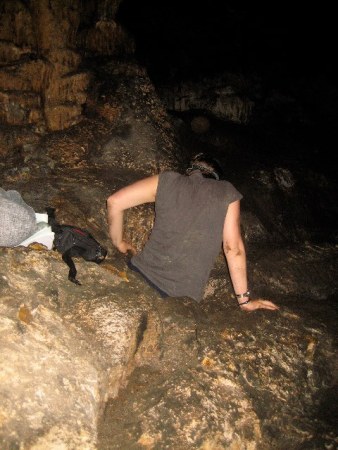
cave woman climbingBut I needed to take another step.

I was still angry at the universe for not giving me what I wanted and thought I needed in my life. I was angry at Goddess because I thought She could make my life better and She was not doing it!

When I finally expressed my enormous anger to Her, I learned that I had been making the “theological error” of attributing omnipotence to Goddess. However She sympathized with my suffering, She did not have the power to “send my true love to me” when I poured out my heart to Her.

“The path you are on is not easy,” She said to me, “but I will be with you all the way.” Reflecting on those words, I understood that Her power is not omnipotence, but omnipresence, not power over, but power with.

So what advice would I give to those are in the throes of depression. (I am speaking here to those who suffer as I did from “garden variety” depression, not its more serious forms.)

• I would tell them that I understand how they are feeling. I would tell them that I understand how bad it really can feel. Not: “oh come on, it’s not that bad.”

• I would recommend getting in touch with the anger and sadness that underlies depression with the help of therapy, spirituality, family, and friends. A depressed person often feels that whatever underlies depression is too horrible to be faced. Yet there is nothing that cannot be faced “with help” from someone who can listen. However, this might have to wait until the depression has lifted.

• I would encourage exercise, singing, and dancing. Sometimes moving the body can also move the mind off the fixed track that leads to depression.

• I would suggest anti-depressant drugs not for the long-term, but for their short-term power to move the mind off a fixed track.

• After the depression has lifted, I would ask if “errors in thought” led to the conclusion that life is not worth living. I would urge them to open new tracks in their minds that lead to different conclusions—while they are healthy enough and strong enough to do so. Repeating a mantra like, “my true love is me,” “life is worth living,” or “life is a gift” just might help.

• I would also ask them to examine their “theology”–even if they think they don’t have one. Feelings that “God” could make things right, but in “this particular case” chooses not to, are one of the pathways to depression.

• I would urge them to be open to miracles.

Carol is looking forward to the fall Goddess Pilgrimage to Crete–$150 discount for the next two women to sign up for the fall 2014 tour–www.goddessariadne.org.  Carol can be heard in a recent interviews on Voices of the Sacred Feminine, Goddess Alive Radio, and Voices of Women.  Carol is a founding voice in feminism and religion and Goddess spirituality. Her books include She Who Changes and Rebirth of the Goddess and with Judith Plaskow, the widely-used anthologies Womanspirit Rising and Weaving the Visions.  Follow Carol on GoddessCrete on Twitter.

 

Thealogy of the Ordinary by Molly

crop027

The Goddess Gaia is alive
In this time and in this space
She speaks in sunrises
And waves against the shore
She sings with the wind
She dances in moonlight
She holds you close
Your heart beats in time with hers
A great, grand hope and possibility
For this planet…

Over the last two months, I have been listening to a wonderful telesummit about priestesses. I am also a huge fan of the radio show, Voices of the Sacred Feminine. However, as I listen to both, I sometimes find myself wondering if walking a Goddess path is also viewed as synonymous with, “believe everything, question nothing.” Crystal essences, gemstone healing, soul contracts, past lives, spirit guides, astrology, the many realms and dimensions of the occult, mystical, New Age and metaphysical. Is wholesale suspension of logic required to join hands with the Goddess? Is deft management of the tarot essential to the priestess path?  Is excavating my “inner masculine” relevant or appropriate? Must I ascribe to “enlightened” tenets like, “you are not your body,” “I am a spiritual being having a spiritual experience” and “we made an agreement to do this work before we showed up in this body at this time and place” in order to move forward? Continue reading “Thealogy of the Ordinary by Molly”

A Radical Conclusion: We Are Our Own Authorities by Carol P. Christ

Carol Christ in LesbosElisabeth Schussler Fiorenza articulated a widely held tenet of feminist theology when she stated that feminism places a question mark over all inherited texts and traditions. This means that feminists cannot and must not accept any teaching or traditional way of performing religious acts simply because “the Bible [or the Koran or the minister or the priest or the rabbi or the imam or the guru] tells me so.”

Instead, feminists must question every text and tradition and the words of every religious leader to see whether or not they promote the full humanity of women. The implication of this is that we must acknowledge and take responsibility for becoming our own authorities—as individuals and in communities.

A tongue –in-cheek letter that began circulating on the internet in 2000 under the title “Why Can’t I Own a Canadian?” makes the point that even those who claim to be adhering to every “jot and tittle” of the Holy Book are in fact choosing to accept some aspects of tradition while rejecting others. Continue reading “A Radical Conclusion: We Are Our Own Authorities by Carol P. Christ”

Transcendence, Immanence, and the Sixth Great Extinction by Carol P. Christ

carol christIn my recent blog “The Flourishing of Life and Feminist Theology” I discussed Grace Jantzen’s view that theology should focus on “natality” or birth and life, rather than life after death or life apart from this world. This week Tikkun magazine published its summer issue with a feature called “Thinking Anew about God.” In it two male thinkers, one Buddhist and one Christian, argue for a similar turn toward the world in their traditions. Their calls for religions to focus on this world were published the same week scientists warned that the world stands on the brink of the sixth great extinction.

I have come to believe that any religion espousing cosmological dualism (devaluing this world in favor of a superior reality such as heaven) and individual salvation (the idea that what ultimately happens to me is disconnected from what ultimately happens to you) is contributing to our world’s problems rather than offering a solution. … [Religions should] stop emphasizing the hereafter and focus instead on how to overcome the illusion that we are separate from this precious, endangered earth. –David Loy, Buddhist, writing in Tikkun Summer 2014

My aim in this regard is to reawaken in each of us an emotionally felt and primordial sense of spiritual belonging within the wider natural world. In turn, my hope is that this deep sense of belonging to the earth — to God’s body, as it were — will en-flame our hearts and empower our wills to commit us to healing and saving the earth.—Mark I. Wallace, Christian, writing in Tikkun Summer 2014 Continue reading “Transcendence, Immanence, and the Sixth Great Extinction by Carol P. Christ”

The Flourishing of Life and Feminist Theology by Carol P. Christ

carol christI first encountered the image and concept of “flourishing” in Grace M. Jatzen’s feminist philosophy of religion, Becoming Divine. For Jantzen “flourishing” is a symbol of a theology of “natality” or birth and life, which she contrasts to the focus on death and life after death in traditional Christian theologies.

Jantzen argues that the focus on death and life after death is a rejection of birth. Birth is rejected because birth through a body into a body implies finitude. Birth ends in death.  Jantzen argues that embracing natality means embracing finitude and death.

Jantzen is not arguing that motherhood is the highest calling or saying that all women must be mothers. Rather she is calling us—women and men—to embrace finite life in the body and the material world as the final and only location for spirituality. Defending pantheism as an alternative to transcendent theism, she argues further that divinity is to be found “in” the physical and material world—and nowhere else. Though she speaks of natality, Jantzen is no essentialist.  Rather she is a metaphysician making claims about the nature of life. Continue reading “The Flourishing of Life and Feminist Theology by Carol P. Christ”