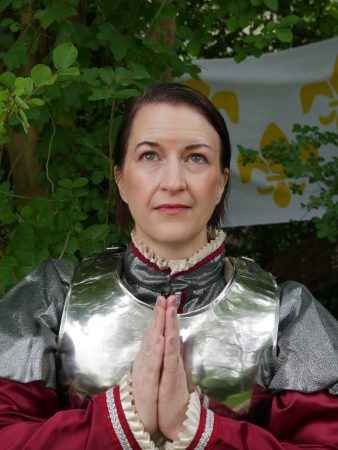
Joan of Arc from The Goddess Project: Made in Her Image by Colette Numajiri

“I’m not afraid. I was born to do this.” -Joan of Arc

Women are inherently valiant. In extreme situations we armor up and lead others through whatever we are battling at the time.

Joan of Arc was a human woman with otherworldly faith who, as a young teenager, listened to Divine voices and lead an army that eventually ended the 100 Years War.  “The real Joan of Arc is an uncomfortable fit as an icon of female solidarity or democratic rights. She achieved what should have been impossible for someone of her gender and class in 15th-century France.” wrote Helen Castor in her book Joan of Arc: A History. She was so respected and revered that 20 years AFTER Her death, 115 people testified on behalf of Joan of Arc (Jeanne d’Arc) and overturned the ruling.

Enbodying the Divine Feminine on Earth, women look to Joan as an inspiring example of a brave and active woman.  Joan inspired the Suffragettes, they held her banner and wore white (as Joan chose to wear white for purity when She was taken to the stake to be burned for the crime of cross-dressing) as they marched for women’s right to vote. Just as, a few months ago our newly elected Congresswomen all wore white in solidarity.

Continue reading “Joan of Arc from The Goddess Project: Made in Her Image by Colette Numajiri”

Adoring God in Labor by K Kriesel

The day before the 2019 Nevertheless She Preached conference at First Baptist Church of Austin, TX my own Catholic church’s young adult ministry hosted Eucharistic Adoration. Although I’ve enjoyed Adoration dozens of times, several factors made this evening different. I was preparing for cervical surgery for one. My Hebrew Bible class at Austin Presbyterian Theological Seminary was grappling with Rebekah, Rachel, Leah, and the voiceless Dinah. The call to write the history of 20th century Catholic women theologians had been at my ear all day. The catalyst was when two men at the Adoration began leading a song about God the Father.

Maybe it was just the incense but I swear I saw something. An image of the baby crowning from the womb, God gasping in labor, as the Eucharist wore the gold of the monstrance as a crown before the tabernacle. God was pushing the Body of Christ into creation while I prayed for my own sick body. God was crying out with the voices of these thousands of unheard women. We were all there. I snuck out my phone and took a picture, determined to put the scene to paper.

Continue reading “Adoring God in Labor by K Kriesel”

“If All Knowledge Must be Reinterpreted, Why Not Religion?” Says Islamic Feminist

xcelina-feminismo.jpg.pagespeed.ic._RyiiQg3TR.jpg

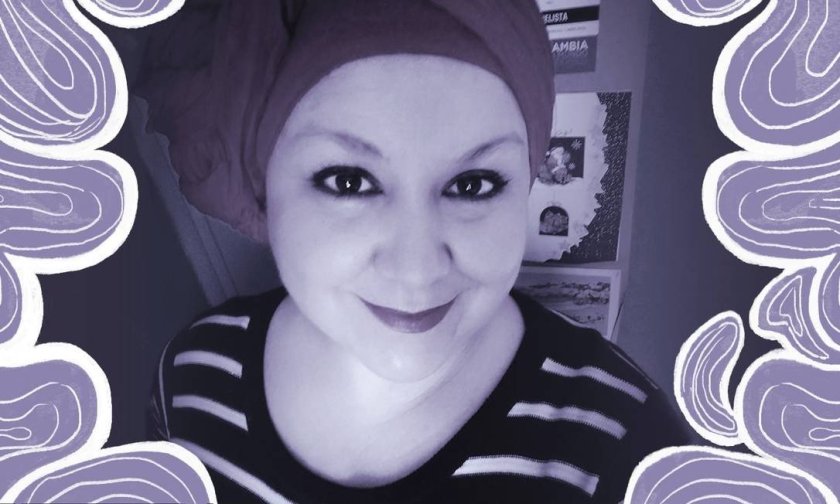
Vanessa Rivera de La Fuente is Muslim, feminist, and a human rights activist
Photo: Personal archive

Background: Journal O ‘Globo, one of the most important newspapers in Brazil, belonging to the transnational media group of the same name, published this interview with Vanessa Rivera de la Fuente on Islamic Feminism. Given its relevance to the discussion on the subject, it was translated by prominent Islamic feminist and scholar Keci Ali to share it with English-speaking readers.

The Muslim women’s movement has different agendas in accordance with the reality of each country. In Latin America, the Muslim Vanessa Rivera fights against prejudice about Islam.

by Isabela Aleixo*

Vanessa Rivera de La Fuente is Chilean and Muslim. Besides being an academic researcher, she’s also an Islamic feminist engaged with questions of gender, human rights, and social development. Vanessa has wide experience in social projects in Latin American countries.

In an interview with CELINA, she discusses the prejudices that Muslim women face in Latin America, explains the movement’s demands, destroys stereotypes, and declares: “I’m a woman and I demand to be treated as a person.”

Do you consider yourself an Islamic feminist? Why?

I consider myself a feminist woman, who lives feminism in all the distinct facets of her life: I’m Muslim; I’m a single mother; I’m a professional woman, an academic; and I’m a women’s rights activist. I’m feminist with all my life experiences. I think being a woman in male-dominated society is itself a political fact, so everything that I am as a woman can be resignified by feminism, including being Muslim. Islam is integrated into my life and my political struggle, which is intersectional. It’s based on the radical idea that all women are people and we deserve equal rights and a world free of violence.

Continue reading ““If All Knowledge Must be Reinterpreted, Why Not Religion?” Says Islamic Feminist”

Greenness, Whiteness, Blackness, and the Nature of the World by Marisa Goudy

There’s magic in hiking alone, but as women, we’ve been taught to worry about venturing far on our own. In fact, we’ve been taught to worry about a lot more than that.

Though once I merely shrugged off the warnings and the horror stories, confident that I was wrapped in some sort of “not me” protective veil, I don’t usually take my safety for granted anymore. Maybe it’s because I’ve outgrown the belief that I’m invincible. Maybe it’s because I’m a mother and have a different understanding of the fragility of life and the female body. Maybe it’s because that murderer on the Appalachian Trail went by the nickname “Sovereign,” appropriating the powerful, beautiful word that is so essential to my life’s work.

This particular day, however, my desire to be outside was more compelling than my new bend toward caution. I called my husband to tell him just where I’d be, joking that he needed to know where to look for me if I didn’t pick up the girls from camp on time.

Continue reading “Greenness, Whiteness, Blackness, and the Nature of the World by Marisa Goudy”

Sappho’s Poems as an Ethos for Women’s Ritual by Jill Hammer

Photo by: Zac Jaffe

For by my side you put on

many wreaths of roses

and garlands of flowers

around your soft neck


and with precious and royal perfume

you anointed yourself.


On soft beds you satisfied your passion.


And there was no dance

no holy place

from which we were absent.


–Sappho (trans. Julia Dubnoff)


Sappho, the poet from Lesbos (630-570 BCE), was considered one of the greatest poets of her time—one of her epithets was “the tenth Muse.” I discovered the poems of Sappho in my thirties and was utterly captivated.  I had newly embarked on a relationship with a woman and Sappho’s love poetry (though by no means exclusively lesbian) supported the expression of eros between women.  Yet even more than that, Sappho’s poems supported an erotic relationship between self and world—a relationship that included ritual as a form of intimacy.  I’m not a Greek scholar—I experience Sappho’s poems in translation. Yet the translations I read back then were a revelation: a world in which women lived in circle with one another.

Continue reading “Sappho’s Poems as an Ethos for Women’s Ritual by Jill Hammer”

We Won’t Go Back by John Erickson

Bottom line: abortion is healthcare. Nearly a fourth of women in America will have an abortion by age 45. Every day, people across the United States make deeply personal decisions about their pregnancies. Those decisions deserve respect.

Someone once asked me: John, why are you a feminist?  It is always a jarring question because I believe all people should be feminists and we should all fight for gender equality no matter what.  I’ve been drawn to Martin Niemöller’s prolific quote:
First they came for the socialists, and I did not speak out—because I was not a socialist.
Then they came for the trade unionists, and I did not speak out— because I was not a trade unionist.
Then they came for the Jews, and I did not speak out—because I was not a Jew.
Then they came for me—and there was no one left to speak for me.

Right now, it seems like a full on frontal assault against all of us.  No matter what community you’re in, you can draw back to an instance of discrimination you’ve faced both pre-2016 as well as after the election of President Trump. Continue reading “We Won’t Go Back by John Erickson”

If Holly Near’s Simply Love Album Were a Musical by Elisabeth Schilling

For many of us, listening to women-loving-women songs is a spiritual experience. That is because somehow it makes us feel seen, puts a sense of hope into our world as well as daydreams of romance. We can understand the challenges and the regret or guilt that comes with disappointing others and ourselves, them for not being who they wanted us to be and for us, not being who we are for far too long. Holly Near’s Simply Love album narrates a story that I might envision as a musical theatre production, and I really wish someone would ask me to write it and then hold the casting call (yeah, I’d want to be in it too, so save me a part). I offer some of my thoughts on two central songs in the would-be musical in hopes of sacred liturgy on a potential stage.

Simply Love has 28 songs and was released (according to Spotify) in 2000. I think the synopsis would be surrounding Cassandra, in a loving relationship with her partner, reflecting on her journey to this place of authenticity. I can imagine how it might be living one’s live in an exploratory way and coming to new revelations later in life.

Continue reading “If Holly Near’s Simply Love Album Were a Musical by Elisabeth Schilling”

Moments by Katie M. Deaver

The phone rings loud on the bedside table near my head, and I wake with that tiny heart attack that only truly jarring things, like middle of the night phone calls, seem to trigger. It takes me a moment to gather myself, to remember who I am, where I am, and what that sound is… and then I grab the phone, hop out of bed and cross the hall into the office where I can finally answer.

It’s a familiar voice, Eli, my colleague and friend from the domestic violence and sexual assault shelter where I volunteer. They’ve just received a call from the emergency room about a sexual assault survivor asking for an advocate and I’m the volunteer on-call this week.

Eli handles himself so very well, knowing that while he is awake working the night shift I am still trying to grasp his words, trying to shake the sleep from my body and my mind. As his words sink in I write down the survivor’s name and start pulling on clothes to head to the hospital.

Though I’ve taken a fair amount of these calls during daylight hours, this middle of the night call is a new experience for me. I live in the upper peninsula of Michigan and while I love it here, this particular night also happens to be yet another night with significant snowfall, and it takes me quite a while to dig my car out enough to get it out of the tiny alley next to our house and up the hill toward the emergency room.

Continue reading “Moments by Katie M. Deaver”

Surviving My Recovery by Esther Nelson

For the past fourteen months, I’ve been going from doctor to doctor trying to figure out what ails me.  Specialists I’ve seen included wonderfully competent people immersed in their individual disciplines of nephrology, cardiology, rheumatology, and neurology.  At long last, the neurologist diagnosed my condition (accurately, I believe), and I’m slated to have surgery in July.

I’m overjoyed to finally have a diagnosis, with a positive prognosis no less, offered to me.  My everyday life has become more and more constricted over this past year.  I can’t walk far without pain.  I can’t stay in one position for long without pain.  I can’t practice yoga without pain.  I can’t do those everyday chores—grocery shopping, vacuuming, laundry, scrubbing the bathroom, and washing dishes—without pain.  Pain wakes me throughout the night as I attempt to sleep.

I do have concerns about how well I’ll tolerate the upcoming surgical procedure, but am even more concerned about my recovery period.  For six weeks after the procedure:  No lifting.  No bending.  No twisting.  No exercise except for frequent, short walks.  How will I ever manage?

Continue reading “Surviving My Recovery by Esther Nelson”

Re-Imaging Three Marys by Janet Sunderland

The recent #metoo movement, along with young women entering Congress, has pointed to an important question. Why, in this 21st Century, are these achievements remarkable? Why has it taken so long for women to be recognized as capable for these positions? One possible reason is the Christian mythology around women. However, to recreate the way women are viewed, we must re-imagine the women who have been standard-bearers for two thousand years.


Continue reading “Re-Imaging Three Marys by Janet Sunderland”