Leonora Carrington’s THE HEARING TRUMPET – Book Review by Sally Abbott

Sally Abbott

Long a fan of Surrealist artist Leonora Carrington, I was initially hesitant when the New York Review of Books reissued her 1974 novel, The Hearing Trumpet.  I didn’t know what to expect when this extraordinary painter picked up a pen.

To my delight and surprise, Carrington shows the same artistry and whimsy in her writing that she does in her painting.  She also reveals herself to be an astute feminist and aficionado of the Goddess, well-versed in arcane lore, with which she accents her fantastical world.  The Hearing Trumpet is full of British humor and eccentricity, set in a finely spun, other-worldly landscape.

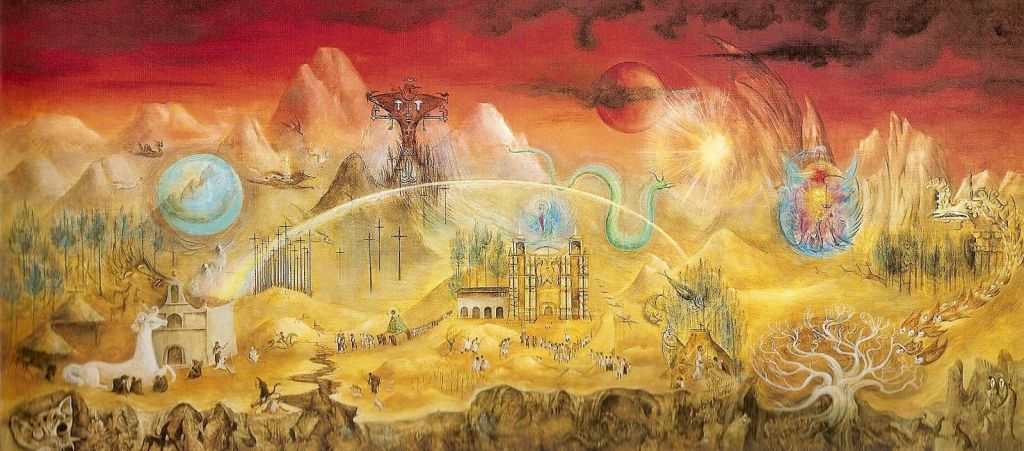
The World of the Maya

Her heroine Marian Leatherby is a 92-year-old, who lacks teeth, is hard of hearing, and sports a beard–a whimsical, endearing character who loves cats.  She has been given a hearing trumpet by her great friend Carmella, and thereby learns that her son and his wife plan to send her away to an old folks’ home run by a Dr. Gambit and the Well of Light Brotherhood.

Continue reading “Leonora Carrington’s THE HEARING TRUMPET – Book Review by Sally Abbott”

Shofetim: The Divine Feminine, Magic, and the Role of Gender by Ivy Helman.

This post is dedicated to Carol P. Christ. I knew her first as my professor and then my friend for over 15 years. May her memory be a blessing.

This week’s Torah portion is Shofetim (also spelled Shoftim), or Deutoronomy 16:18-21:9.  I have written about this parshah before.   In that post from August of 2018, I reflect on how the patriarchal elements of the portion should not detract from its larger concern for justice, compassion, and peace. Yet, there is more to the parshah.  In fact, I have recently begun exploring Judaism’s connection to all things magical, and interestingly enough, this parshah fits right into my recent inquiries.   Let me share with you some of what I have learned as it relates to this parshah.  

Where Shofetim and magic meet is idolatry.  There are three instances in Shofetim where idolatry is condemned, punished by stoning to death.  All three of these prohibitions involve polytheism, either directly worshiping other deities or participating in practices associated with the worship of those deities.  What are they?

Continue reading “Shofetim: The Divine Feminine, Magic, and the Role of Gender by Ivy Helman.”

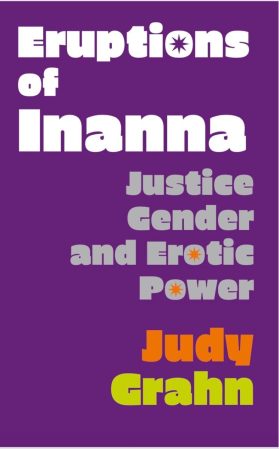
Eruptions of Inanna: Justice, Gender, and Erotic Power by Judy Grahn BOOK REVIEW by Carolyn Lee Boyd

Judy Grahn Eruptions of Inanna

Any new book by Judy Grahn is cause for celebration. For decades, Grahn has been a lyrical and passionate poet, author, mythographer, and cultural theorist whose work  features both goddess wisdom and contemporary culture centering on women and queer people. Nightboat Books has just published her newest book, Eruptions of Inanna: Justice, Gender, and Erotic Power, which offers ancient yet fresh world views with which to approach such issues as injustice, sexuality and gender, climate change, and more just when we need it most. 

In Eruptions of Inanna, she brings what she calls her “poet’s eye” to eight stories featuring the Sumerian goddess Inanna as well as religious practices of those devoted to her. She explores how these have directly influenced our world and, in her words, can continue to “feed our needs and help us take better care of each other and our world.” According to Grahn, Inanna “is a combination of human, creature, erotic and other energetic forces, and civilization. She also inherited very old powers that grew out of women’s rituals” (55).  Her essence engenders sovereignty and self-worth, especially in women and queer people.  She is a goddess of love, espousing passion and the joy of eroticism as integral to both life and society. She practices an expansive justice that creates positive outcomes in response to horrific acts. She creates a civilization of the arts, beautiful and useful crafts, abundance, and a jubilant communal life. She demands respect for nature and ecological sustainability.  

Continue reading “Eruptions of Inanna: Justice, Gender, and Erotic Power by Judy Grahn BOOK REVIEW by Carolyn Lee Boyd”

Buddhist Misogyny Revisited – Part II by Barbara McHugh

Read Part I here first

Webster defines myth as “a usually traditional story of ostensibly historical events that serves to unfold part of the world view of a people or explain a practice, belief, or natural phenomenon,” and in this way myths tell us who we are. Unfortunately, they include stories, from Adam and Eve to Cinderella and Sleeping Beauty, that define women by using criteria such as gullibility, passivity, and the size of their feet.

But today women are shining light on the likes of Circe, Mary Magdalene, and Briseus, the young woman dismissed by Homer as an impediment to Achilles’s higher purposes. These stories counter the traditional narratives that restrict women, as well as men, to roles that rob them of their full humanity. In my novel, Bride of the Buddha, the Buddha’s wife embarks on a spiritual journey of her own. When her quest leads her to the Buddha’s all-male sangha, she disguises herself as a monk, eventually becoming Ananda, who in the scriptures is the Buddha’s attendant, the one who struggles with all the questions unenlightened practitioners face today.  The answers to these questions cannot be stated as propositions; they must be felt and lived. Hopefully, my version of Ananda suggests new possibilities for feeling and living these responses. If this “violates” the myth, it does not violate the Buddha’s fundamental views.

Continue reading “Buddhist Misogyny Revisited – Part II by Barbara McHugh”

Buddhist Misogyny Revisited – Part I by Barbara McHugh

Recently, I wrote a novel about the Buddha’s wife disguising herself as a man to join his religious community. When I showed the manuscript to a Buddhist friend, whose knowledge and practice I respect greatly, he expressed apprehension that it violated the basic myth of Buddhism. I assumed he meant that my storyline of gender deception strays too far from the versions of the Buddha’s life as recorded in the traditional canon, which adherents regard as the Buddha’s inviolable teachings. The last thing I wanted to do was to misrepresent these teachings.

What does it mean “to violate a myth”?  If I had portrayed the Buddha as a psycho-killer or wife-beater, I could appreciate this charge, but I had presented an enlightened Buddha whose values were in alignment with standard scripture and the mores of his day. The change I made was to tell the story from a woman’s point of view, and to do so, I modified some of the traditional legends and created new material to make my choices plausible. Predictably, my modifications came up against many of the stories’ misogynistic elements.

Continue reading “Buddhist Misogyny Revisited – Part I by Barbara McHugh”

Deb Haaland, the Secretary of the Interior We Need by Anjeanette LeBoeuf

Wet Plate Collodion Image of the Congresswoman Haaland Taken by Shane Balkowitsch in Bismarck, North Dakota on June 23rd, 2019.

This past week brought an announcement from the 46th President Elect’s office on the nomination for the Secretary of Interior position, House of Representative Debra Haaland of New Mexico. This nomination has solidified President-Elect Biden and Vice President-Elect Harris’ promise to be a more inclusive, progressive, and diverse cabinet. This appointment is revolutionary, outstanding, and diverse. If this nomination is accepted, Deb Haaland will become the first Native American and first Native American woman to hold this position.

Continue reading “Deb Haaland, the Secretary of the Interior We Need by Anjeanette LeBoeuf”

Fierce Friendship and the Holidays by Stephanie Arel

It is the weekend before Thanksgiving, in the ominous year of 2020. The CDC urges people not to gather with others outside of the household on Thursday. COVID infections rise exponentially. Schools are closing, and in the much of the country, winter is foreboding.
If you live in a cold climate, Thanksgiving dinner outdoors is hardly an option. For, Chanukah, Christmas, and New Year’s, we will likely endure the same conditions. I have tried to center myself, mediate, do things to calm my nervous system, using some of my personal tools for stimulating the vagus nerve so as to not feel toxic. I think that is what the cortisol in my body is telling me: slow down, gather, go inward. But I also sense a missingness – a loneliness – alongside a desire to reach out, call people, and connect. (See the effects and remedies for social isolation here.) Away from people, traditions, anticipation of my favorite time of year, I brace for a deeper sense of loss. Continue reading “Fierce Friendship and the Holidays by Stephanie Arel”

Post-Hysterectomy Reflections: Not All Women Bleed by Ivy Helman

Around the age of 8, or maybe 10, I learned my aunt had had a hysterectomy.  I remember visiting her house either shortly before or after the operation.  I can’t remember which, and it doesn’t really matter.  At the time, I don’t think I even knew what a uterus was or that I too had one.  

Just like me, she had suffered from uterine fibroids. This year, at the end of May, after nearly two years of various treatments including a failed myomectomy and ineffective prescription medication, I followed in her footsteps.  It was really the only option for me, although it was not an easy decision.  After surgery, there was the usual post-op pain and restrictions, but luckily my body has been healing well.  

Since the surgery, and as I prepare to teach “Gender and Religion” again in the fall, I’ve been thinking about a conversation I had with a student the first time I offered the class at Charles University.  We were about to begin discussing the article, “Why Women Need a Feminist Spirituality,” by Judith G. Martin, when a student pressed me on why we weren’t acknowledging that not all women bleed.  What he really wanted was to make sure that in our category of women, we were including transwomen.   Continue reading “Post-Hysterectomy Reflections: Not All Women Bleed by Ivy Helman”

The Messy, Wild Mystery that’s Stronger than Wrong by Trelawney Grenfell-Muir

I am an annoying feminist. I annoy pretty much everyone about it, because I’m never NOT applying a feminist lens to every aspect of life: science (looking at you, Larry Summers), politics (Joe Biden is a rapist), art (objectification is NOT empowerment), culture (make-up is a prison), and, of course religion. I’m perhaps most annoying of all when it comes to religion. I annoy Christians by raving about Christ The Cosmic Vagina, and I annoy secularists by raving about feminist Jesus. I especially annoy my church friends and colleagues by refusing to use the (male) word “God” to talk about the Infinite Divine Mystery, much less male pronouns or oppressive symbols such as Lord, King, or Kingdom.

Yep, I’ve been cheerfully annoying the hell out of everyone for decades, drawing vagina art during male-centric worship services, changing lyrics on the fly, slipping female words and symbols into prayers and startling whomever sits near me… I am a feminist. Not the fun kind. Continue reading “The Messy, Wild Mystery that’s Stronger than Wrong by Trelawney Grenfell-Muir”

I Hope “This Changes Everything” by Elise M. Edwards

elise-edwardsLast week, I attended a film festival in Waco, Texas that showed the 2019 documentary This Changes Everything. Spending Friday evening at a film festival seemed like an enjoyable and appropriate way to kick off a weekend that would culminate with the Academy Awards (the Oscars).  I had no idea that this film would inform the way I viewed the movie industry and its most celebrated awards show.  It did change everything for me.

This Changes Everything is about the representation of women in film, particularly their underrepresentation and misrepresentation on screen and in the film- and television-making process.  It is not the first time this theme has been explored in a documentary. What struck me at this viewing, though, was the way the film portrayed patterns that resonated with my experiences in academia and in religious communities.  There are parallels between the way sexism manifests in entertainment and  I, along with other members in the (predominantly female) audience, couldn’t help but see parallels in Hollywood’s patterns of exclusion and the discriminatory conditions we confront in numerous other industries and professions.  What were these patterns?

Continue reading “I Hope “This Changes Everything” by Elise M. Edwards”