Trigger warning: rape, sexual assault, domestic abuse, graphic sexual content
In Part 1 of this story, I introduced a discussion of Johan Galtung’s theory of cultural violence as it relates to my experience as a young woman in an abusive relationship. To recap:
Cultural violence is: “…any aspect of a culture that can be used to legitimize violence in its direct or structural form. Symbolic violence built into a culture does not kill or maim like direct violence or the violence built into the structure. However, it is used to legitimize either or both.”[1]
Cultural violence against women is: Normalization and promotion of pornography, prostitution, degradation, and sexual objectification of females in media, predominantly male language in civic, business, and religious institutions, gender roles and stereotypes, misogynist humor, gaslighting, minimizing or denying any of these forms of violence.
Part 1 ended right before my ex convinced me to leave MIT and move with him to Minnesota. I had been trying my best to please him by sculpting my appearance to match his preferences, believing that it was my job as a female partner to try to satisfy my male partner sexually.
I am a woman, a feminist, a Muslim. These three things are me, they are things that I have become, in that order. One is born with feminine sex, but it is only a biological determinism. I was born female and I have chosen to continue living as a woman. I decided to be and live as a feminist. I felt called to be a Muslim and I chose to listen to that call.
I love to be a woman, even in a world that hates me. The woman that I am, with my way of thinking, acting and feeling, my way of seeing the world and myself, is not a product of my sex, but of the story that I have gone through since I left my mother’s womb. The same goes for all women. Even beings born in the same country, city, year, even those who are sisters of blood, do not have the exact same story.
I had a startling experience in church recently. It was Father’s Day, and the pastor was talking about how “God is our heavenly Father.” For the first time in 17 years, that idea held some appeal to me. But no sooner did the thought enter my mind, then it was ripped away by the realization that my church will never allow me to symbolize the divine as a “father.”
I grew up with “God the Father” language saturating my churches. I also grew up with a rageful, unsafe, sometimes abusive father, who was also wonderful, empowering, and feminist in many ways. Seventeen years ago, I attended my first seminary lecture on the topic of Feminist Theology. That day changed my life, as did my exposure to feminist theology throughout seminary and at a queer Methodist congregation. My journey took me through more scholarship and liturgy, jobs as chaplain or as assistant pastor struggling to convince my communities that sexism matters, parenting young daughters who lament their own subconscious male divine programming, and finding a prophetic call to speak, write, and sing the Female Divine. Continue reading “My Church Won’t Let Me Call the Divine “Father” by Trelawney Grenfell-Muir”
For over ten years, I’ve been teaching a work of early Jewish mysticism known as Sefer Yetzirah, or the Book of Creation. There are widely differing opinions on the book’s origin and dating, but many scholars date it to the sixth century. Its core concept can be described simply: the Divine used the Hebrew letters as metaphysical channels to create the different aspects of reality: the directions, the elements, the planets, the months of the year, and so forth. Each letter is a channel by which God creates a unique form or entity, and meditating on the letters provides us with a connection to divine creative power. In its discussion of the letters, Sefer Yetzirah shows a strong connection to feminine imagery, and thus helps the later kabbalah develop its own link to the feminine.
Sefer Yetzirah shows influences from Aristotle to Gnosticism, and is often viewed as a work of Jewish philosophy. However, it is also a work of meditation, giving the reader instruction on how to focus and connect to the divine. Scholars such as Richard Hayman and Marla Segol have noted that the book’s structure and content connect it to magical literature: for example, the book has a deep concern with “sealing” the space of the world: letters of the Divine Name are used to seal the six directions of the universe. In a similar way, ceremonial magicians of the ancient world used sealing ritual, including the incantation bowls that were buried in the corners of a home to keep out evil forces. The book, like much ceremonial magic of the region, also discusses the elements. However, Sefer Yetzirah has a three-element system rather than a four or five-element system. The three formative elements are air, water, and fire.
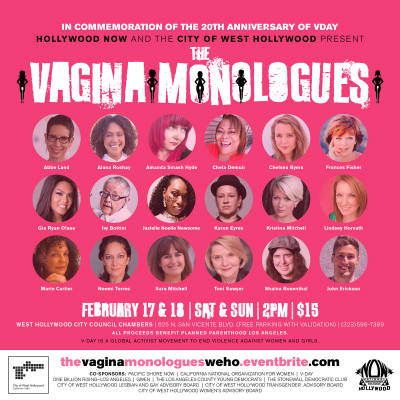
A month ago, the Hollywood Chapter of the National Organization for Women (NOW) and the City of West Hollywood presented the Vagina Monologues. The event was a complete success and we raised over $5,000 for Planned Parenthood Los Angeles! While the cast and crew worked together and formed a community in West Hollywood, communities were being ripped apart by senseless gun violence that took the lives of 17 beautiful souls at the Marjory Stoneman Douglas High School in Parkland, Florida
The cast and crew began to have discussions over a specific monologue and whether or not the audience, or cast members, would be triggered by its use of gun specific language in relation to the power of the vagina.
Aasiya Zubair Hassan was an architect and business woman of Pakistani origin, resident in the United States, motivated to contribute to the end of cultural stereotypes about Muslims and to a better coexistence in post-9-11 American society. For this reason, together with her husband Muzzamil Hassan, she decided to found Bridges TV in 2004, a satellite channel to connect the life of Muslim communities with American society.
The couple had been married for 9 years and had two children. But the reality between Aasiya and Muzzamil was not exactly that of an ideal marriage, as of those in novels and TV series. Aasiya Zubair lived between her career, community activism, the TV channel and the spiral of domestic violence. On February 12, 2009 her body was found beheaded in New York State, after his own husband informed the police where to find it.
Prosecutors argued that Hassan was abusing his wife and planned to attack her in a Bridges TV hallway. He was arrested in 2009 after he entered a police station in the city of Buffalo, in the state of New York, and told officers that his wife was dead. Muzzamil was found guilty and sentenced on February 7, 2011 to 25 years to life in prison.
In February 2010, and while Hassan was waiting to be sentenced, American Muslim women began the Purple Hijab Day, that since 2011 has become international, commemorated in Canada, England and Libya. It is a day of remembrance and support for victims of domestic violence and femicide, but it is more than that: it is a struggle to eradicate violence against women in Muslim communities and to challenge the patriarchal religious narratives that support it.
The date is commemorated each year between the 12th and the 16th of the month with different activities such as prevention talks, vigils, community education days, and cyberactivism through social networks such as Facebook or Twitter. It is a tradition to wear the hijab or Islamic headscarf in purple, but it is also possible to wear any purple garment.
Prevention of domestic violence is just as important as denouncing misogynistic narratives that enable it, because as Amina Wadud says:“To define religion is to have power in it.” One of the most widespread and disastrous stereotypes that exists about Islam is that which holds that religion legitimizes violence against women and authorizes husbands to punish their wives and dispose of the lives of the women in their households.
While these prejudices are held by voices outside of Islam and part of the narrative of Islamophobia, it is no less true that there are some currents within Islam that encourage men to punish their wives and for many Muslim men these interpretations are believed to be an almost un-appealable form of justification for the abuses they commit against women.
Memory is important when it comes to counting women. Not only because our presence has been historically invisible, but also because language that erases our lives still exists. Every act of violence that has a woman as a target is treated as an isolated event and the victim as anonymous. “A woman was found dead” is the recurring headlines in the news of the world. The reality is that we women do not appear dead, we are murdered. And, although society treats us as serialized and replaceable elements, our unique subjectivity is summed up in our names. Speaking our names is to make visible our struggles, hopes, and pains.
“Aasiya Zubair, a career woman, community’s value and mother was murdered by Muzzamil Hassan” and almost 10 years later there is still outrage and sadness because every day somewhere in the world, another Aaziya adds her name to the list.
The International Purple Hijab Day is an initiative started by Muslim women, but it does not belong only to them. It belongs to all women and everyone who is in the side of women rights. It is a day of activism and memory, an opportunity to find new ways to end gender violence in a context of its acceleration and increase in all parts of the world, because no civilization has the exclusive privilege of misogyny.
Vanessa Rivera de la Fuente is a specialist in training and community outreach in Gender, Communication and Interculturality. She’s also a learning and social projects designer and a qualitative researcher; an awarded activist for women’s rights who too does independent scholarship in Religion, Gender and Social Discourses. Nomadic writer. A woman with stories and geographies, lover of books, cats and spicy Chai.
It certainly is a busy time of year for me, but I’m fortunate that many of the events I am participating in offer a chance to share what is important to me. Next week, I’ll be speaking to a group of students in one of my campus’ residence halls about feminism and Christianity. For this informal setting, I was allowed to choose my own topic under the broad heading of “Questions That Matter.” I’ve decided to take on the f-word in religion and attempt to explain why it’s important to me and how it relates to my religious identity. Although I’m still trying to figure out what to say, I’d like to share my thoughts so far and get some insight from you. Continue reading “Questions that Matter: What is Feminism? by Elise M. Edwards”
On Sunday, January 7th, a highly visible and poignant protest and stance was made. The 75th Golden Globes was the frontline to which the privileged Hollywood A-Listers took a stance. They collectively drew a line, a call for change. A straightforward act of wearing the color black, spoke volumes. Gone were the entertainment commentators stating which color was bold or trendy. The focus was on the collective statement that was being made on the red carpet. Countless actors voiced their own stories of #WhyWeWearBlack, they called out executives who are complicit in maintaining pay inequality, in hiding sexual abuse and intimidation, in the unequal job opportunities, and even in the lack of recognition.
When I was in my late teens, I discovered midrash: the Jewish exegetical process by which commentators weave creative and additive interpretations into the sacred text. Midrash comes from the word “to ask,” “to seek,” or “to divine.” For example, the tale in which a well follows the prophetess Miriam through the wilderness is an ancient midrash. The story in which God stops the angels from singing as the Egyptians drown in the Sea of Reeds is a midrash. Each of these stories derives from a particular close reading of text, whether a Torah text or a verse elsewhere in the Bible. Each of them allows a new generation to add its own perspectives to the tradition.
Contemporary feminists, and many other contemporary artists, writers, and exegetes, have used a modern form of midrash to add liberatory perspectives to Jewish tradition and to biblical lore. From Miriam to Vashti, female biblical characters shine in the creative interpretations of feminist midrashists. Judith Plaskow’s “The Coming of Lilith” made a huge impact on the reading of the story of Eve and the legend of Lilith. Anita Diamant’s The Red Tent changed the conversation on Dinah forever. Alicia Ostriker, Norma Rosen, Veronica Golos, and many others have joined in this creative play which highlights marginalized voices within the text. Wilda Gafney has made contributions to a Christian and womanist form of midrash. Voices like Andrew Ramer and Joy Ladin have invited us to see queer and trans themes in the text. And of course many others, from poet Yehuda Amichai to bibliodramatist Peter Pitzele, have added to this rich tapestry.



 I had a startling experience in church recently. It was Father’s Day, and the pastor was talking about how “God is our heavenly Father.” For the first time in 17 years, that idea held some appeal to me. But no sooner did the thought enter my mind, then it was ripped away by the realization that my church will never allow me to symbolize the divine as a “father.”


 On Sunday, January 7th, a highly visible and poignant protest and stance was made. The 75th Golden Globes was the frontline to which the privileged Hollywood A-Listers took a stance. They collectively drew a line, a call for change. A straightforward act of wearing the color black, spoke volumes. Gone were the entertainment commentators stating which color was bold or trendy. The focus was on the collective statement that was being made on the red carpet. Countless actors voiced their own stories of #WhyWeWearBlack, they called out executives who are complicit in maintaining pay inequality, in hiding sexual abuse and intimidation, in the unequal job opportunities, and even in the lack of recognition.
 Feminism and Religion