Clean Tent Ceremony for Imbolc by Deanne Quarrie

Deanne Quarrie

The Clean Tent ritual[1] is done among the Samoyed peoples of northern Siberia. It is a group ritual invoking blessing and protection for each of the participants, traditionally all the inhabitants of a camp or village. You may choose for whom this work will be done.

This is best done outside but can be modified for indoors. Needed in your circle:

Fire – it can be in a cauldron
A mound of dirt
5 – 2″ strips of ribbon and a 3″ red cord
Rocks to create a circle
2 large rocks for gate in the South
Pitcher of milk and ladle
Your drum if you wish
Any vows you wish to make

This ceremony is normally be done during what is called the White Moon.  This is the lunar cycle closest to the time of Imbolc. It also coincides with the Chinese New Year.  It is called the Clean Tent Ceremony because traditionally a special tent is erected for the ritual. In some cases, this ritual is performed outside using a stone circle to enclose the ritual space in lieu of the tent, which is what you will do. Continue reading “Clean Tent Ceremony for Imbolc by Deanne Quarrie”

Delilah, Lost by Janet Maika’i Rudolph


Delilah is a beautiful name on its own merits. As a biblical personage Delilah is forever connected to Samson for their tales are intertwined. As it is told in Judges, Samson is the clear hero of the tale and Delilah is merely the temptress who betrays him. But as in all spiritual accounts there is more here than meets the eye. A spiritual journey is never a linear affair. When reading the story of Samson and Delilah, it immediately becomes clear that something mythical is afoot. The root of Samson’s name is the same as the word shamash, the Hebrew word for sun. The root of Delilah is lila, meaning night. Right away we understand that this story contains apparent opposites, heavenly aspects, the sun and the night, light and dark . . . Continue reading “Delilah, Lost by Janet Maika’i Rudolph”

Winter Solstice: Can We Celebrate the Restful, Welcoming Darkness?

The days are slowly winding down toward Winter Solstice in the northern hemisphere, the longest night of the year. Today the sun rose at 7:20 and will set at 5:08 in Crete. In Sweden, the sun will rise at 9:25 and set at 2:12. Though I light candles in the darkness of morning and have lights on my tree, I am not celebrating the “return of the light,” but rather welcoming the restful dark.

In The Spiral Dance, Starhawk writes that Winter Solstice is about the rebirth of the sun. This interpretation has taken hold. For most pagans, Summer Solstice also is a celebration of the sun on the longest day. Few are those mark it as the time of the dying of the sun or the rebirth of night.

In our culture we have learned to celebrate the light and to avoid and disparage the darkness. We have inherited this habit of mind from the Indo-Europeans who, as Marija Gimbutas wrote, celebrated the shining light of the sun as reflected in their shining bronze weapons. When the Indo-Europeans rewrote the myths of the land that came to be called Greece, they placed the “Olympian” deities on Mount Olympus while relegating many of the oldest female deities to the underworld, which became a fearful place. New Age spiritualities follow this pattern, celebrating “light and love.” This habit of mind reinforces racism. Continue reading “Winter Solstice: Can We Celebrate the Restful, Welcoming Darkness?”

Altars Everywhere, Part 2 by Carol P. Christ

This is a continuation of an earlier blog in which I discuss home altars as a way to bring beliefs about women’s spiritual power into the body and daily life.

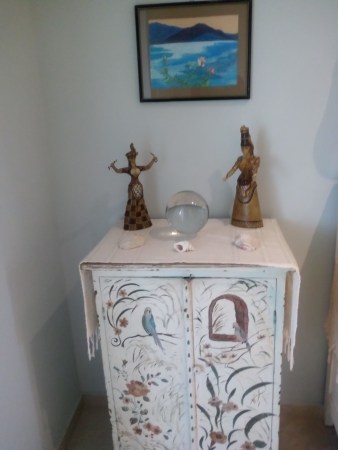
In my bedroom, images of the Snake Goddesses of Knossos sit on a cabinet painted by a Greek woman with images of birds and flowers. Between them is a crystal ball, while before them are three shells, the smaller of which was given to me by a Maori woman from New Zealand. Above them is an image of the sea in Molivos, Lesbos, painted by my friend Judith Shaw in the year we were both living in the village.

Continue reading “Altars Everywhere, Part 2 by Carol P. Christ”

Altars Everywhere, Part 1 by Carol P. Christ

In a recent blog, Carolyn Boyd invited us to reflect on how our women’s spiritual power is activated through symbols that help us to remember and manifest the “deep well” of our inner knowing. According to historian of religion Mircea Eliade, the sacred and the profane were not separated in premodern cultures because all of life was considered to be sacred. Many in the Women’s Spirituality and Goddess communities have advocated this earlier more wholistic understanding. Although it is not always easy to overcome the dualism between sacred and profane, we attempt to do so.

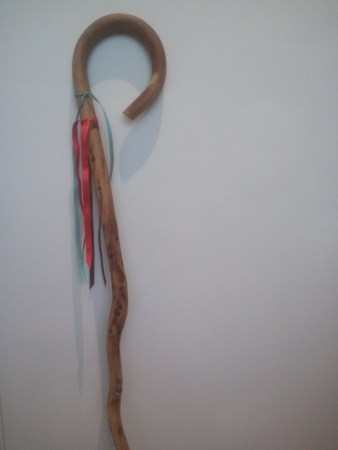
One of the symptoms of my chemotherapy is neurasthenia or partial numbness in my right foot. When it first occurred, I fell three times in my apartment because I was not lifting my foot automatically. I became afraid to move without holding onto the walls or furniture. I resisted my friends’ advice to get a walker, but finally agreed that I needed some form of physical support. I arranged for my friend Eirini Kouraki to have a rubber tip added to the shepherd’s cane I sometimes use walking in the mountains. When she brought it too me, I decorated it with three ribbons I saved from rituals at the Holy Myrtle Tree at the Paliani monastery in Crete. The most recent were brown, the color of the earth, and red, the strong energy I will need to heal. I added a light green-blue ribbon, representing the calm and clear optimism I feel as I face a crisis of life and death. The ribbons remind me of the healing power of the Holy Tree that I have called upon many times, turning a symbol of my infirmity into a symbol of healing and hope.

In the past weeks as my cancer treatment continues, I have been feeling strong enough to finish unpacking (with the help of Vera, my cleaning lady) and organizing my new home in Crete. As I rediscover sacred objects, I create altars. Altars are physical reminders of our spiritual beliefs. Creating and tending them helps to create the embodied knowing that brings the spirit into our daily lives.

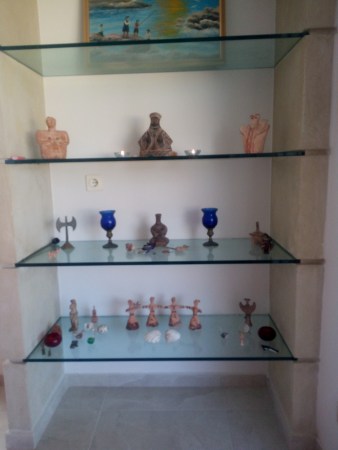
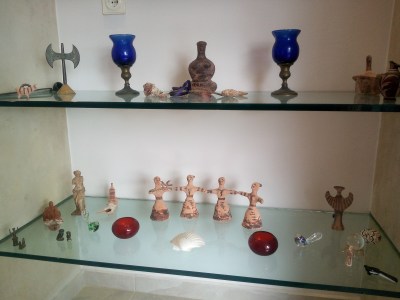
The living area of my new apartment has 3 glass shelving units. In one of them, I created a triple altar with images of the Goddess and female power from ancient Crete. Because the apartment is sleek and modern yet welcoming to my antique furniture, I kept the altar minimal.

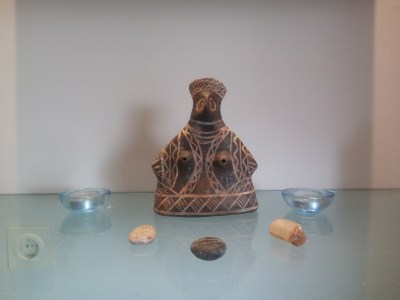
On the top shelf I placed three pre-palatial “pitcher” Goddesses, two with breasts from which liquid pours and one that is holding a water jug from which liquid can also be poured. These images, dated before 2000 BCE, express the Old European insight that the Goddess represents the powers of birth, death, and regeneration in all of life. Though they have human qualities, they are more than human. The Goddess from Malia who sits in the center of this altar has a beaked face and wings and her triangular shape evokes the mountains from which water flows to villages and fields. These images remind me that the Goddess is the Source of Life, provider of gift of life that is our embodied being and the gifts of life—including food and water–that nourish us daily.

The second shelf holds one of the oldest images from ancient Crete, the Neolithic Goddess from Ierapetra. She is seated on massive buttocks, securely rooted in the earth. Her face is beaked, symbolizing her connection to the birds that fly in the air. Her body is decorated with lines identified by archaeologist Marija Gimbutas as the flowing water that nourishes all of life. Her body too is shaped like the mountain. She represents the never-ending powers of birth, death, and regeneration in all of nature.

In front of the Neolithic Goddess I placed a twig from Paliani with a dark blue ribbon reminding me that my friend Tina Nevans is sending the healing energy of the Blue Buddha to me in her daily meditations, as well as several handsewn triangles holding leaves from the Holy Myrtle tree, and a crystal extracted from the Trapeza Cave, found on the path outside of it. To Her right is a small image of the long-necked turtle Goddess from Myrtos who holds a pitcher recalling women’s daily visits to water sources, and a small copy of a Kamares ware pitcher used to pour libations in the Sacred Centers. To the left are a bronze copy of a labrys, originally the double sacred female triangle transformed into wings and also a happy little bull who reminds us that animals experience the joy of life.

On the lower shelf, copies of dancing women from post-Minoan Paliakastro symbolize the transmission of Old European values of community, lack of hierarchy, and most of all, celebration of the joy of life as Laura Shannon has written. The dancing women are surrounded by images of later Mycenaean Goddesses and of Aphrodite who was worshiped at the Minoan site of Kato Symi in classical times, and a small reproduction of the Neolithic Goddess from Catal Huyuk, who reminds us that Crete was settled c.7000 BCE by farmers from Anatolia.

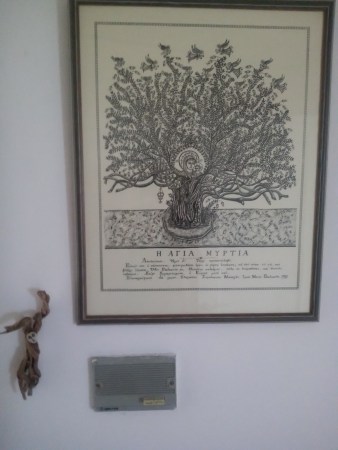
In the hallway I placed a copy of a drawing of the Holy Myrtle Tree of the monastery of Paliani created by one of the nuns. According to the story told, the area where the monastery was later built was burned in a fire but a small myrtle bush survived. It was watered by girls who saw the image of the Panagia (Mary the Mother of Jesus) in its charred branches. So, the monastery which was known as ancient in 668 CE was built. The monastery is a sacred place for the surrounding villages. The sacred tree and the icon of the Panagia in the church are said to have performed many miracles. Below the drawing of the Sacred Myrle Tree is a small image of a face in a twig from tree given to me by German artist Carla Randel.

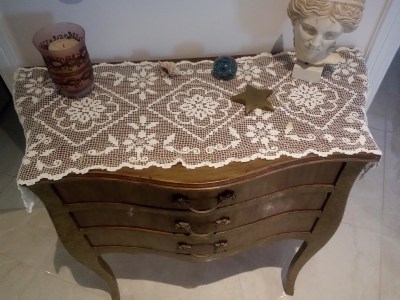
On a small table under the drawing, I placed an image of Aphrodite who was earlier associated with myrtle trees, along with a candle, a star, a blue glass paperweight, and a triton shell, symbolizing Aphrodite as the morning and evening star, and her relation to the sea.

When I light candles in translucent glass holders on the altar with the pitcher Goddesses as the day dawns and in the evening as day turns to night, and when I gaze at my other altars, I remember that I am always surrounded by the nurturing love of the Goddess. This love takes root in my body, and I am inspired to share it with others.

To be continued.

Women’s Spiritual Power Is All Around Us by Carolyn Lee Boyd


Carolyn Lee Boyd

In this most challenging time, women are showing the world what women’s spiritual power can do. They are guiding nations, states, and communities through the pandemic and towards environmental sanity; feeding the hungry bodies and spirits of their neighbors by organizing community assistance projects; offering hope and care to vulnerable family members; and leading and healing in so many other ways. They are calling on their inherent, profound belief in their own sacredness and that of others to gain access to the strength and clarity that leads to wisdom and effective action.

Yet, finding and using your spiritual power is easier when it is affirmed by the people and subtle messages you experience every day.  In our society, too often girls and women may struggle to find encouragement to identify and use their spiritual power, whether because of present or past experiences or the sheer overwhelming nature of our individual and societal challenges.  Yet, symbols of women’s spiritual power are all around us, everyday, and can help guide us to that deep well within we have all carried since birth.

Continue reading “Women’s Spiritual Power Is All Around Us by Carolyn Lee Boyd”

Wisdom from our Ancient Female Lawgiver and Judge Traditions by Carolyn Lee Boyd

Carolyn Lee Boyd


As I have witnessed both the joy of so many across the world at the nomination of Kamala Harris for Vice President and the deep sorrow at the death of Ruth Bader Ginsburg, I am struck by the fact that, in 2020, supremely qualified women still need to be trailblazers to hold high office. After all, goddesses and wise women gave a number of cultures their systems of laws and governance and have been celebrated for their wisdom as judges for millennia. 

Here are a few of the goddesses and wise women lawgivers:

The Goddess Themis
  • the Italian goddess Egeria gave Rome its first laws and taught the correct rules for Earth worship; 
  • the Babylonian Kadi, was goddess of Earth and justice; 
  • Ala of the Ibo people of Nigeria is both the Earth Mother and lawgiver of society; 
  • the Greek Themis, daughter of Gaia, symbolized the social contract and cohesion of people living on Earth; 
  • the Inuit Sedna both gave humanity abundance from the ocean for life from her own body and withheld it when her laws were broken;
  • Marcia Proba, whose historical reality is unclear, is said to have created the ancient Celtic system of laws known as the Marcian Statutes that may have influenced later British law;
  • past and present Women’s Councils and Clan Mothers of the Iroquois and other Indigenous peoples as well as those of Societies of Peace have brought harmony and well being to their people for tens of thousands of years.

Continue reading “Wisdom from our Ancient Female Lawgiver and Judge Traditions by Carolyn Lee Boyd”

Yes, there are Goddesses in the Bible, Part 5 by Janet Maika’i Rudolph


As I wrote my last blog post, the Great Goddess of the Canaanites, Ashera was honored and worshipped (according to the bible) within and through groves of trees. Ashera and El, the “great bull god” were deeply connected. In fact, in Canaanite mythology, El and Ashera were married.

But before delving into their relationship, I would like to start in a different (but connected) direction – the lovely archetype of the morning star and the evening star. The planet Venus, named for her namesake Goddess (or vice versa), is both the planetary vision of the morning star and the evening star. Whether She be Goddess, planet or evening/morning star, when She appears in one form, She embodies them all. Continue reading “Yes, there are Goddesses in the Bible, Part 5 by Janet Maika’i Rudolph”

October Magic, by Molly Remer

In was in October that my last grandmother died, my last living grandparent. As the leaves turn to red and gold once more, I wake thinking of her each morning. I wake thinking of my maternal grandmother too, who died seven years ago, in springtime as the iris bloomed. I dream of my husband’s grandfather, he stands shoulder to shoulder with my oldest son, white hair and smile flashing as he compares their heights and laughs.

We’ve just returned from a two week long trip to Florida and have arrived back in Missouri to a life in full swing, books to write, projects to plan, new products to develop for our shop, old requests waiting for our attention. But, the leaves will only be this color for a moment. The air will only be this sweet and pleasant for a moment. The sun will only glint across the cedar branches in this way that brings my soul to life right now, the colors of the day so sharp and vivid, clear and bright to my eyes, that it is almost like stepping into another reality. We have only this moment to join hands and slip off into the woods beneath the early morning sun, stepping past pools of slowly dripping water, over sharp and uncertain stones, soft green moss, and carpets of fallen leaves. It is only this moment in which we will hear the hawk’s cry ring out across the trees. Only now in which we will turn over leaves and discover shining mushrooms, gleaming in the October sun.

I stepped into the woods holding memories of my grandmothers next to my heart. The leaves were lit gold from within and below, forming an enchanted tunnel into the trees near where we have built our new work studio. As I moved into the clearing, I heard two crows raise an alarm call. I stood silently and looked, curious about the source of their alarm. They called again sharply, once, twice, and right in front of me a quiet brown deer, previously unseen, lifted its white tail and leaped gracefully away through the trees. It took a breath, a beat of time, for me to realize that it was me, my own small form standing relatively motionless among the trees watching the morning sun illuminate the yellow leaves, that was the cause of the raised alarm, this communication between species, sharing the same ground.
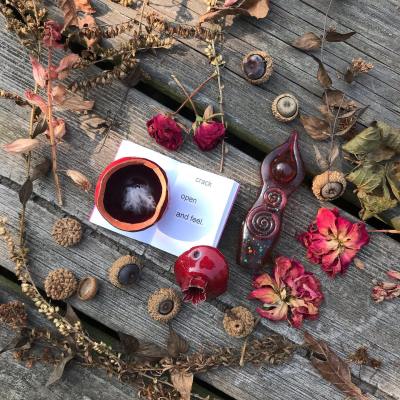
We set off along a stony gully that bisects the land of my parents, pausing by a series of small pools and gazing through the backs of dogwood leaves turning to rich red with veins of green still lightly tracing through their round centers. Suddenly, the scent of cedar filled the air and I crouched beneath the tree to see the ground beneath it littered with small snippets of evergreen, strewn across a thick blanket of brown oak leaves and yellow maple, glowing in a stained glass impersonation in the perfect touch of the sun upon their surfaces. My breath made a fog in the air and I looked up into the tree to see that it, too, was breathing in this cool morning, steam lifting off its trunk and rising into its thin fingered branches. There are small blue juniper berries brightly laid against the wet green moss beneath the tree and I turn to see the peachy-rose globes of persimmons hanging on thin branches against the sky. I have the sensation that they are watching me there, kneeling on the wet ground, caught between rays of sunlight and enchantment.

We continued picking our way carefully across the lichen-laden gray stones until we came to fallen tree, carpeted with a beautiful array of fungus. Small brown knobs that look like new potatoes spring from what was once the top of the trunk and a panoply of beautifully spiraled whorls of turkey tail mushrooms form small cups which hold last night’s raindrops.

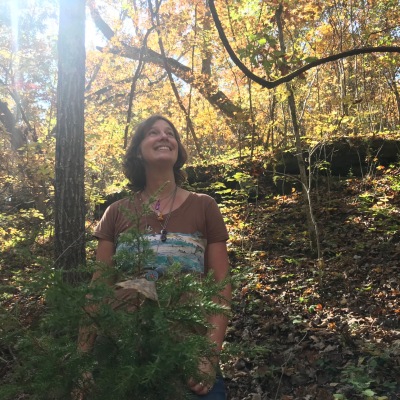
As we descended into the gully, the view opened up before us, slabs of stone forming a naturally terraced series of platforms dropping lower and lower into the round stone pools. The trees are yellow here, sun gleaming on the leaves, forming a temple bower of golden branches. I felt full of delight and joy, so pleased that we had chosen to lay aside the to-dos and come on this ramble together. I asked my husband to take a picture of me in the trees and stones telling him with a smile that this is the only moment in which the leaves will be this color and in which I will be this fabulous.

Being in the world, noticing what blooms and breathes and flows around us, is the fullest expression of my spirituality to me. Seeing what emerges, what fades, what rises and falls, this is a living magic. Honoring the passage of time, the turn of the wheel, the cycles of the land, the earth as an ensouled presence, and my own footsteps on her an act of devotion, these are the cornerstones of feminist spirituality for me. Look. Learn. Listen. Feel. Care. Act. Goddess worship and the symbol of the Goddess plays an important role in re-conceptualizing and restructuring the role of women, the value of nature, and the social order. In her book Ecofeminist Philosophy, Karen Warren writes: “Many spiritual ecofeminists invoke the notion of ‘the Goddess’ to capture the sacredness of both nonhuman nature and the human body…the symbol of the Goddess ‘aids the process of naming and reclaiming the female body and its cycles and processes.” Rather than something to dominate and control, the earth becomes the body of the Goddess and is acknowledged as both literal and spiritual home and is something inseparably linked to personal well-being—planetary health and personal health become synonymous—and both are treated with reverence and respect.
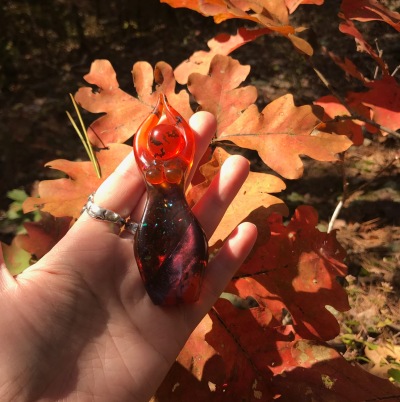
I have wondered if I try too hard to make my life be magical, to make it meaningful and then I realize, if you look for evidence that the world is made of magic, for evidence that your life is magical, that you will find it everywhere. This isn’t wrong. This is beautiful and powerful and real. Yes, my life is magical. So is yours. The whole world is magical. We need only step right up to it and look, to see that we are surrounded by magic, woven right into the threads of it.

The stones were slippery with water and moss as we skirted our way carefully to the bottom of the gully, where a wide, curving, bowl-shaped basin has been formed of rock and rain and time. Gazing at it, tranquil and still, gently rippled rocks forming the sides and leaves filling its bowl, I said aloud:  “When I die, you can leave me curled up here and I’ll be happy.” For a crisp moment I could clearly see my own bones lying nestled, smoothed and ivory, across this bed of leaves and sunbeams.

Something bright red caught my eye then, looking at first like the domed half of a large cherry tomato partially covered by brown leaves and I squatted down to discover a burst of crimson mushrooms grouped together and bright against the decaying foliage.

Mark didn’t answer me, but he laid his hand across my hip and together we scrambled like mountain goats past the crimson mushrooms and up the steep slope, the oak leaves giving way to a carpet of pine needles as we climbed, the now bare stems of lowbush blueberries catching on our socks and pants. At the top of the hill, we sat on the stones, chests heaving, breath fast from our ascent, smiling silently as we looked at the sunshine through the pines.
 

Molly Remer’s newest book of poems, Sunlight on Cedar, was published in March. Molly has been gathering the women to circle, sing, celebrate, and share since 2008. She plans and facilitates women’s circles, seasonal retreats and rituals, mother-daughter circles, family ceremonies, and red tent circles in rural Missouri. She is a priestess who holds MSW, M.Div, and D.Min degrees and wrote her dissertation about contemporary priestessing in the U.S. Molly and her husband Mark co-create Story Goddesses, original goddess sculptures, ceremony kits, mini goddesses, and more at Brigid’s Grove. Molly is the author of WomanrunesEarthprayerthe Goddess DevotionalShe Lives Her Poems, and The Red Tent Resource Kit and she writes about thealogy, nature, practical priestessing, and the goddess at Patreon, Brigid’s Grove, Feminism and Religion, and Sage Woman Magazine.

“Fertility” and the Regeneration of Life by Carol P. Christ

Prehistoric and indigenous religious traditions are often disparagingly mischaracterized as primitive fertility religions, concerned not with higher morality, but rather with the processes of reproduction of humans, animals, and plants. When these religions feature a Great Mother Goddess, it may be assumed that these religions are primarily focused on birthing human babies. Nothing could be farther from the truth.

Indeed, archaeologist Marija Gimbutas discovered that in the symbol systems of Old Europe, the Goddess is only rarely imaged as pregnant or giving birth. Nor is She portrayed solely in human form. Rather, She is portrayed with a bird head, wings, and a plethora of other animal and plant features. If She is a Great Mother Goddess, She is revered as the Source of Life, not simply as a mother of human babies. Gimbutas states that in Old Europe the Goddess was worshiped in as a symbol of the powers of birth, death, and regeneration in all of life. Gimbutas said these societies were matrilineal and probably matrilocal. Continue reading ““Fertility” and the Regeneration of Life by Carol P. Christ”