WOMEN ARTISTS AND RITUALISTS IN THE GREAT CAVES: THE BEGINNING OF THE END OF INDOLENT ASSUMPTIONS by Carol P. Christ

carol-christIn an earlier blog, I suggested that women might have blown red ocher around their hands to leave their marks in prehistoric caves.

At the time I thought this was a rather bold suggestion.

Had I been asked why I thought the images were made by women, I might have said that people have understood caves to be the womb of the Great Mother, the Source of All Life, from time immemorial. I might have added that those who performed rituals in the caves cannot have been performing simple “hunting magic,” but must also have been thanking the Source of Life for making life possible for them and for the great beasts they hunted.  Still I am not certain that I imagined women as the artists in the Paleolithic caves.

handprint peche merle cave

In recent days the news wires have been carrying a story titled “First Cave Artists May Have Been Women, New Study Suggests.”   According to retired anthropological archaeologist Dean Snow, the handprints made by Paleolithic ancestors 40,000-20,000 years ago may have been made primarily by women. Snow spent a decade gathering and analyzing photographs of the handprints left in caves. The scientific fact that women’s first and ring fingers are generally of the same length, while men’s ring fingers are generally longer their index fingers, led him to the conclusion that ¾ of the handprints in the caves were made by women! If women were painting their hands on the caves in larger numbers than men, then isn’t likely that they were also painting the images of the great beasts on the walls of the caves? Continue reading “WOMEN ARTISTS AND RITUALISTS IN THE GREAT CAVES: THE BEGINNING OF THE END OF INDOLENT ASSUMPTIONS by Carol P. Christ”

She Who Has Faith in the Unknown by Jassy Watson

Jassy_Agora1-150x150I am sharing the following story, that with a few recent alterations, I wrote as a university paper last year in a course on Ancient Religions. It is significant for me presently because it is a year almost to the day that I embarked on Carol Christ’s Goddess Pilgrimage to Crete. Seeds of transformation were planted on Greece, therefore naturally I have been reflecting and reminiscing not only on my Odyssey, but also on the full circle I have come since.

Today, from my hometown of Delphi, I will make pilgrimage to the Temple of Apollo. I will make this journey alone for I seek answers to questions of a personal nature. I have waited patiently through the cold and barren days of winter, even coming summer and autumn past, failing to see the Pythia with each visit, for during these times of uncertainty the Temple has been busy with representatives from many cities. All recognise the importance of Apollo as a mediator of disputes and a champion of law and stability. Everyday concerns like mine are least important compared to those matters of war and men. I come however, not seeking answers from Apollo, but rather from our great mother Gaia, for all know that it is she who has resided here since the beginning. I feel it in my heart that I will be heard today, for spring has arrived, and concerns over battle have been put aside for the festival ‘Theophania’, a celebration of Apollo’s return. The countryside is bursting with new life, the sky is clear and the womb of the great mother is abundant; I sense blessings for a brighter future. Continue reading “She Who Has Faith in the Unknown by Jassy Watson”

Balance and the Autumn Equinox by Deanne Quarrie

Deanne QuarrieWe are in the season of the Autumn Equinox.  The Autumn Equinox occurs on a specific day each year, as does the Spring Equinox. While it may be a precise moment in time, it is also a season. Nothing happens quickly in time and space. Without getting scientific as an explanation of what happens at both, here is a quick one – the name ‘equinox’ comes from the Latin aequus,  meaning equal and nox, meaning night. Earth’s two hemispheres are receiving the sun’s rays equally at the equinoxes. This causes night and day to be approximately equal in length. Continue reading “Balance and the Autumn Equinox by Deanne Quarrie”

Truths My Mother Taught Me by John Erickson

I never gave much credence to religion but through my mother, I met G-d, and through her I understood that I’m not a feminist because of the books I’ve read but rather because of the woman I call mom.

Graduation PhotoThe first question I always get asked when I’m in feminist spaces is: “What inspired you to become a feminist?”  Although I could go into the various histories revolving around men’s involvement in the early stages of the women’s movement to the similarities between the LGBTQ and women’s movements, my simple answer has always relied on one person: my mother.

I’ll be the first to admit (as well as many other people who will join me in the same chorus) that my mother deserves Sainthood for having put up with all the shenanigans I have, and still continue to, put her through. From running away from our local Catholic church the moment she dropped me off at Sunday School, to swearing like a sailor on leave at a very early age in front of Father Schmidt (who still fondly remembers me and the list I brought in with me to the confessional booth). Continue reading “Truths My Mother Taught Me by John Erickson”

Flidais, Celtic Earth Goddess, Lady of the Forest and Much More by Judith Shaw

gugg jude72This year the fall equinox occurs on September 22.  In the Pagan calendar it is a time for giving thanks called Mabon.  Mabon celebrates the end of the harvest season and is a time to honor our wild nature and nature spirits. It is a day of perfect balance when the hours of daylight and darkness are equal. Mabon ushers in our journey into the dark night of winter.

Flidais (pronounced flee-ish) is a complex Celtic Goddess with many differing stories and aspects.  She represents both our domestic and our wild natures and is an appropriate Goddess to call on on this day of balance.  She first appears in the ancient mythological cycles as an Earth Mother. She was the  mother of the Irish cultivator heroes, Arden, and Bé Téite and the “she-farmers” Bé Chuille and  Dinand.   From Her they gained the power to cultivate and work the earth for the community.

Flidais, Celtic Goddess painting by Judith Shaw Continue reading “Flidais, Celtic Earth Goddess, Lady of the Forest and Much More by Judith Shaw”

An Equinoctial Ritual for Balance by Barbara Ardinger

Day and night are in balance twice a year, at the spring and fall equinoxes. (The word “equinox,” of course, comes from Latin words meaning “equal” and “night.) I think most of us will agree that balance is a good thing—after all, many of us are writing these blogs at Feminism and Religion to bring some balance to the ideas and institutions of religion. Many spiritual teachers in many faiths tell us that it’s good to bring ourselves into balance—our physical, emotional, mental, and spiritual bodies are healthier and we’re happier when they’re in balance. This is one reason we try to live healthy lives. Note that the fall equinox is also the day the sun moves into the astrological sign Libra, the symbol of which is the scale with its balance pans.

Working on achieving personal balance is a way we can act locally as we think globally. If we can get ourselves into balance, then maybe our personal balance will ripple out into our family, our extended family, our community, our church, our workplace…heck, maybe eventually into local, state, and federal governments. In this age of civil wars, terrorists, drones, and what seems like universal spying, balance is something devoutly to be wished for. And worked for. To celebrate the equinox (September 22), therefore, let’s do a modest ritual of balance. Continue reading “An Equinoctial Ritual for Balance by Barbara Ardinger”

A New Glossary for Crete: The Power of Naming and the Study of History by Carol P. Christ

carol-christThe words we use affect our thinking. In the case of ancient Crete the repetition of the terms “Palace,” “Palace of Knossos,” “King Minos,” “Minoan,” “Priest-King,” and “Prince of the Lilies” shape the way we understand history–even when we ourselves know these terms are incorrect. We must engage in “new naming.”

Ariadne. May have been a name of the Goddess of pre-patriarchal Crete. The ending “ne” signifies that Ariadne is not of Greek or Indo-European origin and thus predates the later Greek myths.

Ariadnian. The name I have given to the Old European pre-patriarchal culture of Crete, from arrival of the Neolithic settlers from Anatolia c.7000 BCE to the Mycenaean invasion c.1450 BCE. Arthur Evans named the Bronze Age (c.3000-1450 BCE) culture of Crete “Minoan” after King Minos of Greek mythology, son of Zeus and Europa, husband of Pasiphae, father of Ariadne, whose gift of the secret of the labyrinth to Theseus led to the downfall of her culture. Evans assumed that Minoan Crete was ruled by a King.

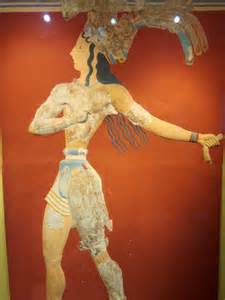
This image I call “Ariadne Dancing” could become the new “icon” of Ariadnian Crete.

minoan woman dancing

It could and should replace the “icon” of  the “Priest-King” Arthur Evans’ “imaginatively” reconstructed and named the “Prince of the Lilies.”

 prince of the lilies

Once we remove the crown which probably belonged to a Sphinx, the figure’s white color and athletic body suggests it was intended to portray a young female bull-leaper leading a bull. Continue reading “A New Glossary for Crete: The Power of Naming and the Study of History by Carol P. Christ”

Earth Connection & Healing the Bees by Jassy Watson

Jassy_Agora1-150x150

I’m an avid gardener. I must, need, long to have my hands in the soil. The sweet smell and feel of the earth connects me to something greater, to a sense of ‘other’; a source divine. I am interwoven, connected, at one and in reverence of a greater mystery.  When I think about my connection to the earth and its origins, I find it is a connection I have had my entire life. As a young girl I spent many hours, days, in fact years, exploring the Australian bush – it was my backyard. Some of my most prominent memories are the smell of Eucalypt and the crescendo of cicada song that would permeate my entire surroundings throughout summer. As a teen, time and time again, I bushwalked our families property that backed onto mountainous National forest. I often sensed the indigenous ancestral spirits of our land watching attentively.

It is this deep connection that I have to the earth that not only leaves me feeling exultant, it leaves me troubled. I am troubled by the continuing problems caused to the environment. I admit to feeling quite disturbed recently when I read a number of reports about the persisting problems with the Fukushima Nuclear plant – radiated water still leaking into the ocean. Birdlife and ocean animals found suffering from radiation burns. Should we even be eating fish from the pacific? I can’t begin to fathom the enormity of the repercussions from this disaster that will be seen for many generations to come. My inner activist wants to be out there on the frontline, riding the waves on the Rainbow Warrior, tied to an ancient tree in protest of lopping; but I know my place is here, nurturing my little ones. So what can I do with these troubled feelings, with the frustration and with the love I have for Mother earth and all her beings? Action starts from home. So I let it fuel my fire and I get creative. I paint, I write, I garden; with intention. My intention is to play a role, no matter how small, that aids in the healing of the planet. I hold hope that it inspires other to do the same. Continue reading “Earth Connection & Healing the Bees by Jassy Watson”

GODDESS WITH US: IS A RELATIONAL GOD POWERFUL ENOUGH? by Carol P. Christ

carol-christLast week I wrote about Protestant Neo-Orthodoxy’s deification of male power as power over.  This week I want to ask why the relational Goddess or God* of process philosophy has not been more widely embraced, both generally and in feminist theologies.

Could it be that a relational God just isn’t powerful enough? Are some of us still hoping that an omnipotent God can and will intervene in history to set things right?  Do we believe an omnipotent God can save us from death?

Process philosophy provides an attractive alternative to the concept of divine power modeled on male power as domination.  According to leading process philosopher Charles Hartshorne, the power to coerce, power as power over and domination, is not the kind of power God has.

The concept of divine power as omnipotent (having all the power) leads to what Hartshorne called “the zero fallacy.”  If God has all the power and can dominate in all situations, then the power of individuals* other than God is reduced to zero.  In effect, this means that individuals other than God do not really exist, but at most are puppets whose strings are pulled by the divine power.

Moreover, as Hartshorne argued, the power to coerce is not the kind of power Goddess “should” have.  Although many have been forced to submit to them, tyrants and bullies do not empower others.  Should we not understand the “highest power in the universe” as empowering of others?

For process philosophy Goddess is understood to be the most sympathetic or empathetic of all relational beings.  Continue reading “GODDESS WITH US: IS A RELATIONAL GOD POWERFUL ENOUGH? by Carol P. Christ”

September: Holy Month by Barbara Ardinger

The Venerable Bede (673–735), a Christian scholar and historian of Anglo-Saxon England who lived 200 years before Beowulf was written, describes the heathen beliefs and customs of his time. Because his interest is in converting the pagans, however, he says that Haligmonath is called “holy month” because that’s when “the heathens pay tribute to their devil.” The real reason the month is holy probably lies in the harvest and the thanksgiving feasts celebrated in honor of the gods and goddesses of the earth. Harvest Home (the final harvest) was celebrated in September in England and other lands.

Goddess Ceres-Demeter PlaqThe Angles, Saxons, and Jutes were pre-Christian tribes who lived in northern Germany and the Baltic lands. The most famous leaders of the Jutes were Hengist and Horsa, whose names roughly translate as “horse” and “mare.” These Germanic tribes were invading and settling in Britain about the time King Arthur (or whoever the tribal chief was who was amalgamated into the medieval legends of Arthur) might have lived. This was during the fifth and sixth centuries, about the same time as the Merovingians (of Holy Blood Holy Grail fame) were ruling the Franks of Germany and France and St. Brigit (also the goddess Brigid) was founding her abbey in Cill Dara (known today as Kildare) in Ireland. Starting with Edward Gibbon’s History of the Decline and Fall of the Roman Empire (published ca. 1776), historians have been calling the centuries following the fall of the Rome the Dark Ages. This is when civilization somehow came to a halt, they say, and barbarian tribes galloped around looting and pillaging and destroying cities. Peter S. Wells disagrees. Continue reading “September: Holy Month by Barbara Ardinger”