Birth as a Shamanic Experience by Molly

editMollyNov 083Childbirth is a rite of passage so intense physically, psychologically, emotionally, spiritually, that most other events in a woman’s life pale next to it. In our modern lives, there are few remaining rituals of initiation, few events that challenge a person’s mettle down to the very core. Childbirth remains a primary initiatory rite for a woman.” –Maren Hansen (MotherMysteries)

When I was pregnant with my first baby, I read an article with the theme of “Birth as a Shamanic Experience.” I can no longer find the exact article (online or printed), but I distinctly remember my feeling upon reading it: I was entering into a mystery. Giving birth was big. Bigger than anything I’d ever done before and it went beyond the realm of a purely biological process and into something else. Like shamanic experiences, giving birth is often described as involving a sense of connection to the larger forces of the world as well as being in an altered state of consciousness or even a trance state. While shamanic experiences may involve “journeying” to other realms of reality, giving birth requires the most thoroughly embodied rootedness of being that I’ve ever experienced. It, too, is a journey, but it is a journey into one’s own deepest resources and strongest places. The sensation of being in a totally focused, state of trance and on a soul work mission is intense, defining, and pivotal.

Shamanic journeys may be embarked upon for the purpose of soul retrieval and I can’t help but think that this is the purpose of giving birth as well—the birthing woman travels into herself to bring forth the soul of her child.  Continue reading “Birth as a Shamanic Experience by Molly”

Unblocking Abundance: A Ritual by Sara Frykenberg

Sara Frykenberg

Rather than release the sadness, heartache and struggle we put into the bowl out into the world, we meditated …to transform what we could of this energy, re-membering the parts of ourselves that had helped to create these blocks and are responsible for transforming them.  We took the transformed energy back into ourselves.

As I have written about many times before, I believe that contemporary Western society operates within a largely abusive paradigm.  I often think of oppression in terms of an abusive cycle.  Theologians like Cater Heyward and Rita Nakashima Brock describe the impact of the theologies that generate such abusiveness, noting how we become smaller to ourselves and smaller to one another.  We do not believe that we are enough, nor are the people or the planet around us ‘enough’ to fill the vacuous alienation that substitutes itself for real relational need in an abusive context.  Judith Shaw wrote eloquently about the environmental impact of conflating need with greed in her Friday post, “Can We Honor Inanna and Her Gifts?”

Shaw writes, “At first glance we appear to be abundant with things, energy, experiences.  But in our mad desire for more and more and always more we neglect the balance of the very earth who provides us with all.”  Many people, particularly in industrialized nations, have been taught to fill the need for a sense of abundance, connection and ‘enough-ness’ with more stuff: more things, more money, more food, more land, etc.  And yet, ironically, this quest for ‘more’ can also prevent us from experiencing the very abundance we seek.  We can create blocks to abundance by trying to fill the vacuum instead of our actual needs: and difficultly, abusive patterns and cycles can prevent us from seeing the difference between the two.  Continue reading “Unblocking Abundance: A Ritual by Sara Frykenberg”

June—a Month Ruled by Feminine Principles by Barbara Ardinger

Let’s celebrate the Matronalia in the 21st century by demanding money from our male relatives, our male religious leaders, and the men in our local, state, and federal governments to support causes that help women—young girls, married women, new mothers, poor and oppressed and abused women, artists and actors and other performers, philosophers and scholars…all of us. Let us seek out and use Juno’s powers to improve the lives of modern women.

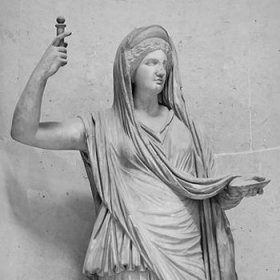
June, Juno, Hera, Barbara Ardinger, marriage, honeymoon, Rome, Hellenistic Period, MatronaliaJust as each Roman man had his genius, or guardian spirit of masculinity, so did each woman have her juno, or guardian spirit of femininity. Juno rules every woman’s entire life and every feminine occasion. In fact, it’s because she’s in charge, so to speak, of married life that we have our June weddings and our honeymoons. Our modern “honeymoon” dates perhaps back to the fifth century and is based on the custom that the newly married couple sweetening the beginning of their life together by drinking a lot of mead (which is made with honey) and making merry. (Honey is sometimes considered to be an aphrodisiac.) Continue reading “June—a Month Ruled by Feminine Principles by Barbara Ardinger”

Can We Honor Inanna and Her Gifts? by Judith Shaw

Judith Shaw photoSpring has arrived and my garden begins to emerge once more.  The world greens and blooms all around, reminding me that Mother Earth remains constant in Her desire to bless us with Her bountiful abundance. I am also reminded of Inanna and Her love for humanity.

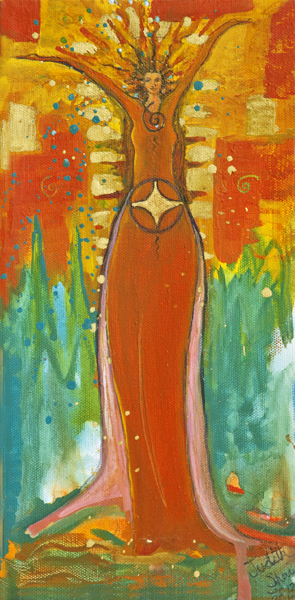
Inanna, Goddess of Heaven and Earth, a Sumerian Goddess who encompasses all aspects of life, was greatly revered by the  people of Uruk as she brought them the gifts of civilization.

Inanna painting by judith shaw
Inanna in Her Boat of Heaven, pastel and beeswax on paper

This part of her story begins when she visits her father, Enki, God of Wisdom.   As they share drinks and a meal, Inanna proceeds to drink Enki under the table.  Once he’s well into His cups He gives Her the sacred me, the gifts of civilization.   Inanna rejoices as she claims these gifts for Her people, gifts such as:
kingship, the divine queen priestess,
the art of the hero, the art of treachery,
the rejoicing of the heart, the art of lovemaking,
the craft of the builder, the perceptive ear,
fear, dismay,
the kindling of fire, the making of decisions.

Continue reading “Can We Honor Inanna and Her Gifts? by Judith Shaw”

The Breath of Goddess by Deanne Quarrie

Deanne Quarrie

I am a child of the Earth.
I live and breathe, walk and dance upon Her face.
She is my source and I learn from Her each day. This I know…

Life begins in the dark as Desire.
Deep in that dark place life begins to form, taking root and becoming…..

As life stirs…… deep in the Mother’s Belly,
there is a gentle quickening, movement
that alerts us to a “knowing”
of the presence of something yet to come.

As the Earth prepares Herself with warmth,
the rains and waters come to flood the land,
nourishing the soil in which She is creating new life.

Earth and Water and Fire
come together and Form continues to take shape.

One last thing is needed.
Just as new form emerges,
She breathes Air upon it.
Her Breath, giving Life to all. Continue reading “The Breath of Goddess by Deanne Quarrie”

Creiddylad, Welsh Goddess of Flowers and Love by Judith Shaw

judith Shaw photo

May Day/Beltane (Calan Mai to the ancient Celts) is almost here and our hearts turn to thoughts of love, flowers and the bounty of our Mother Earth. Both Beltane and Halloween/Samhain (Calan Gaeaf) were liminal or threshold days, considered to be outside of normal time. These sacred, mystic days were more important than the solstices in the Celtic world view.

Creiddylad painting by Judith Shaw

Creiddylad, Welsh Goddess of Flowers and Love, is celebrated at this time. (Her name is pronounced cree-THIL-ahd)  She is the eternal May Queen, always seeking peace and stability.  She remains eternally constant in the face of all change.  She is the promise of love, golden glowing moon-flowing love, enduring through all hardship and despair.  Creiddylad also shows us the necessity of self-love. Only by truly loving ourselves can we love another.

Creiddylad is mentioned only briefly in The Mabinogion but her symbolism reveals that she is surely an ancient and important Goddess, whose original stories have been lost to the mists of time.

Creiddylad, the daughter of Lludd Silver-hand, was promised in marriage to her heart’s desire, Gwythyr ap Greidawl. But before the marriage could be consummated she was abducted by Gwyn ap Nudd, who possessed many dark aspects akin to the Lord of the Underworld.

Gwythyr gathered together his warriors and set out to rescue his love, Creiddylad, from Gwyn.  A fierce battle ensued, during which Gwyn, who emerged as the victor, committed horrendous acts of brutality and butchery.

Continue reading “Creiddylad, Welsh Goddess of Flowers and Love by Judith Shaw”

Goddess Mother by Molly

Mamapriestess

She who changes
She who expands and contracts
She who stretches her limits
She who digs deep
She who triumphs and fails
Every day
Sometimes both within a single hour
She who tends her own hearth
She who comforts and connects and enfolds
She who opens wide

She whose heart cracks open at birth
She who tension bunches her shoulders
And lines her face
She who laughs
She who carries the world
She who sings with her sisters
Molly Remer mamapriestess Triple goddessAnd circles in ceremony
She who holds precious her daughters and her sons

She who defends and protects
She who opens her heart just a little wider
She who trusts
She who tries again
She who gathers to her breast
She who gathers women in ritual
She who hopes
Prays
Fears
She who loves so deeply
That it crosses all boundaries
To eternity. Continue reading “Goddess Mother by Molly”

The Green Man By Barbara Ardinger

The Green Man’s message about rebirth is why he is so popular today. He’s come to symbolize the green movement. He’s a friend of the earth who is whispering to us to wake up and grow up, to march and dance with him in celebration of our relationship with nature. What green thing can we do today?

The Green Man’s message about rebirth is why he is so popular today. He’s come to symbolize the green movement. He’s a friend of the earth who is whispering to us to wake up and grow up, to march and dance with him in celebration of our relationship with nature. What green thing can we do today?
The Green Man

Spring has, as they say, has  sprung, and we who live in the Northern Hemisphere are witnessing the annual greening of the earth. Grasses and grains are growing, trees are leafing, flowers are budding. I like to imagine the goddesses who rule the springtime—Anna Perenna (classical Roman, probably Etruscan), Butterfly Maiden (Hopi), Freya (Norse), Hu-Tu (Chinese), the Rusalky (Russian), and others—calling their worshippers and gatheringthem on the village green to dance and celebrate the revival of the earth. Continue reading “The Green Man By Barbara Ardinger”

Gender in Kabbalah by Judith Laura

Judith LauraI first started delving into both Jewish Kabbalah and Hermetic Qabalah in the 1990s, after friends told me these forms of mysticism included both female and male representations of divinity and therefore were gender equitable. They were right about the first part: Kabbalah/Qabalah contain both divine masculine and feminine imaging and male and female images.  But as far as gender equity goes, to use today’s slang, not so much!

tree of life kabbalah

Though they are both transliterations of the same Hebrew word, as is common I use “Kabbalah” for the Jewish versions, and “Qabalah” for the Hermetic version, best known through its association with the British Hermetic Order of the Golden Dawn, which began in the 19th Century. The word means “that which is received,” with the understanding that it was “received” from ancient times. Though there is one tradition that says Adam was given Kabbalah in the Garden of Eden, the first written material for Kabbalah, Sefir Yetsirah (Book of Creation), is dated to between 200 and 500 C.E. Kabbalistic concepts changed over the centuries, with writings becoming more significant in the 13th century and even more popular in the 16th and 17th centuries.

Beginning with the Sefir Bahir (Bright Book) in late 12th century France, Kabbalah is represented by the Tree of Life, which has round areas transliterated sefirot (Heb. pl.; sing. sefirah) that I think of as fruit and others call “spheres,” but which in the Bahir, are more accurately translated “sapphires.”*  These “divine emanations,” as they are often called in English, are gendered. How equal is the gender representation? Continue reading “Gender in Kabbalah by Judith Laura”

Cosplay and Choice by Sara Frykenberg

Sara FrykenbergCosplay is often a deliberate, interpretive and self-chosen performance of gender and power.  Like drag performers, cosplayers put on a show of the characters they represent; and in my experience, they often do so within diverse, supportive and principally, inclusive communities. 

This week my husband sent me a great blog post he found about cosplay and one woman’s determination that she would no longer tolerate being demeaned, objectified or trivialized because of what she chooses to wear.  Blogger Megan Marie’s post, entitled “What would you do if you weren’t afraid,” inspires me.  She points out and refuses the trappings of rape culture: victim blaming, assumed male control over female sexuality and shame; and claims her right to be who she is.  I, as fellow (what is the female equivalent for fellow???) cosplayer, was also moved by her defense of this creative art.  I have been cosplaying a long time, but I have been too afraid to speak much about this or to directly protest the rejection of these fantasy images within some feminist communities.  So to answer Megan Marie’s question* in her own words, “What would you do if you weren’t afraid? My answer.  I’d write this blog.”

Coplay = costume + play!  It is the recreation of popular characters from video games, comic books, anime, scifi series, fantasy literature or the like.  Cosplayers do this for the fun of it, the craft involved, to express one’s fandom and sometimes, professionally, usually within an arena where fans can enjoy one another’s recreations.  The attempt to embody these characters involves a great deal of work and artistic expression.  Many conventions, like Fanime Con in San Jose, CA, host panels in which fans can learn cosplay skills, such as armor construction, wig making and costume design.  I have cosplayed the following characters: Sailor Star Healer, Eudial and Sailor Iron Mouse from the anime Sailor Moon, Misa

Death Note Cosplay: Misa and Light are in the center, flanked by their respective "Shinigami," or the death gods they are working with
Death Note Cosplay: Misa and Light are in the center, flanked by their respective “Shinigami,” or the death gods they are working with

from the manga Death Note, the Sorceress from He-man, a Star Fleet officer from Star Trek: The Original Series, and most recently, a giant “Angel,” Sachiel from Neon Genesis Evangelion.

Sachiel from Neon Genesis Evangelion: I am trying on my almost finished costume here!

I am currently planning a to make a Metroid out of an umbrella and to cosplay Nyan-kitty at the May conference that my husband (who will be playing Tac-nyan), my sister and many of my friends attend.

So, why the feminist-anxiety?  Continue reading “Cosplay and Choice by Sara Frykenberg”