The Mask and the Mirror – Part 2 by Sara Wright


Artist Debra Fritts

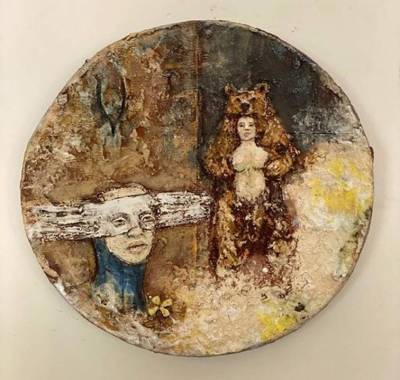
When I asked Debra about this circle she said “the circle around the eye is symbolic of the moon, a nightly ritual of seeing the moon.”  Curiously, women as ‘seers’ have an intimate relationship with the moon. Both eyes seem to be able to stare directly through the mask. The woman’s lips are parted; she is breathing but there is no sense that she is about to speak.

The length of the woman’s neck is accentuated by its distinct slate blue tones. This neck seems especially vulnerable – stretched perhaps to endurance. Suddenly it occurs to me that it is also a neck, like a chicken’s neck, that is ready for the chopping block. Has this woman lost her voice? Her ability to breathe? Is there a threat of being separated from her body? The suggestion of a body ends at the woman’s shoulders so we are left wondering…

Since our feelings and emotions reside in our bodies the suggestion here is that this woman may be without access to her body on an instinctual level. If so she is unable to protect herself. Blue is a color that is sometimes associated with death. In some Native traditions, like that of the Zuni and the Lakota Sioux blue is the color of the Underworld. Particularly touching is the pale four petaled flower to the lower right of the left half of the relief, a flower without a stem or root, or is this a wheel of some kind, one that is in motion – whirling – chaos? To my mind a number of aspects of this portrayal speak to the presence of death. Continue reading “The Mask and the Mirror – Part 2 by Sara Wright”

Wisdom from our Ancient Female Lawgiver and Judge Traditions by Carolyn Lee Boyd

Carolyn Lee Boyd


As I have witnessed both the joy of so many across the world at the nomination of Kamala Harris for Vice President and the deep sorrow at the death of Ruth Bader Ginsburg, I am struck by the fact that, in 2020, supremely qualified women still need to be trailblazers to hold high office. After all, goddesses and wise women gave a number of cultures their systems of laws and governance and have been celebrated for their wisdom as judges for millennia. 

Here are a few of the goddesses and wise women lawgivers:

The Goddess Themis
  • the Italian goddess Egeria gave Rome its first laws and taught the correct rules for Earth worship; 
  • the Babylonian Kadi, was goddess of Earth and justice; 
  • Ala of the Ibo people of Nigeria is both the Earth Mother and lawgiver of society; 
  • the Greek Themis, daughter of Gaia, symbolized the social contract and cohesion of people living on Earth; 
  • the Inuit Sedna both gave humanity abundance from the ocean for life from her own body and withheld it when her laws were broken;
  • Marcia Proba, whose historical reality is unclear, is said to have created the ancient Celtic system of laws known as the Marcian Statutes that may have influenced later British law;
  • past and present Women’s Councils and Clan Mothers of the Iroquois and other Indigenous peoples as well as those of Societies of Peace have brought harmony and well being to their people for tens of thousands of years.

Continue reading “Wisdom from our Ancient Female Lawgiver and Judge Traditions by Carolyn Lee Boyd”

Yes, there are Goddesses in the Bible, Part 5 by Janet Maika’i Rudolph


As I wrote my last blog post, the Great Goddess of the Canaanites, Ashera was honored and worshipped (according to the bible) within and through groves of trees. Ashera and El, the “great bull god” were deeply connected. In fact, in Canaanite mythology, El and Ashera were married.

But before delving into their relationship, I would like to start in a different (but connected) direction – the lovely archetype of the morning star and the evening star. The planet Venus, named for her namesake Goddess (or vice versa), is both the planetary vision of the morning star and the evening star. Whether She be Goddess, planet or evening/morning star, when She appears in one form, She embodies them all. Continue reading “Yes, there are Goddesses in the Bible, Part 5 by Janet Maika’i Rudolph”

October Magic, by Molly Remer

In was in October that my last grandmother died, my last living grandparent. As the leaves turn to red and gold once more, I wake thinking of her each morning. I wake thinking of my maternal grandmother too, who died seven years ago, in springtime as the iris bloomed. I dream of my husband’s grandfather, he stands shoulder to shoulder with my oldest son, white hair and smile flashing as he compares their heights and laughs.

We’ve just returned from a two week long trip to Florida and have arrived back in Missouri to a life in full swing, books to write, projects to plan, new products to develop for our shop, old requests waiting for our attention. But, the leaves will only be this color for a moment. The air will only be this sweet and pleasant for a moment. The sun will only glint across the cedar branches in this way that brings my soul to life right now, the colors of the day so sharp and vivid, clear and bright to my eyes, that it is almost like stepping into another reality. We have only this moment to join hands and slip off into the woods beneath the early morning sun, stepping past pools of slowly dripping water, over sharp and uncertain stones, soft green moss, and carpets of fallen leaves. It is only this moment in which we will hear the hawk’s cry ring out across the trees. Only now in which we will turn over leaves and discover shining mushrooms, gleaming in the October sun.

I stepped into the woods holding memories of my grandmothers next to my heart. The leaves were lit gold from within and below, forming an enchanted tunnel into the trees near where we have built our new work studio. As I moved into the clearing, I heard two crows raise an alarm call. I stood silently and looked, curious about the source of their alarm. They called again sharply, once, twice, and right in front of me a quiet brown deer, previously unseen, lifted its white tail and leaped gracefully away through the trees. It took a breath, a beat of time, for me to realize that it was me, my own small form standing relatively motionless among the trees watching the morning sun illuminate the yellow leaves, that was the cause of the raised alarm, this communication between species, sharing the same ground.
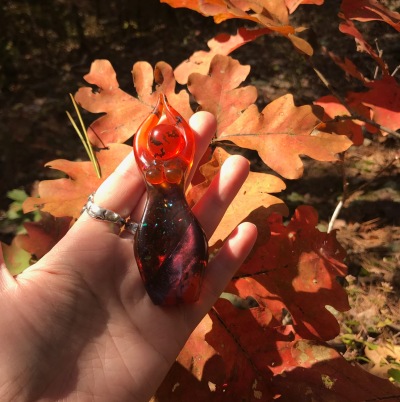
We set off along a stony gully that bisects the land of my parents, pausing by a series of small pools and gazing through the backs of dogwood leaves turning to rich red with veins of green still lightly tracing through their round centers. Suddenly, the scent of cedar filled the air and I crouched beneath the tree to see the ground beneath it littered with small snippets of evergreen, strewn across a thick blanket of brown oak leaves and yellow maple, glowing in a stained glass impersonation in the perfect touch of the sun upon their surfaces. My breath made a fog in the air and I looked up into the tree to see that it, too, was breathing in this cool morning, steam lifting off its trunk and rising into its thin fingered branches. There are small blue juniper berries brightly laid against the wet green moss beneath the tree and I turn to see the peachy-rose globes of persimmons hanging on thin branches against the sky. I have the sensation that they are watching me there, kneeling on the wet ground, caught between rays of sunlight and enchantment.

We continued picking our way carefully across the lichen-laden gray stones until we came to fallen tree, carpeted with a beautiful array of fungus. Small brown knobs that look like new potatoes spring from what was once the top of the trunk and a panoply of beautifully spiraled whorls of turkey tail mushrooms form small cups which hold last night’s raindrops.

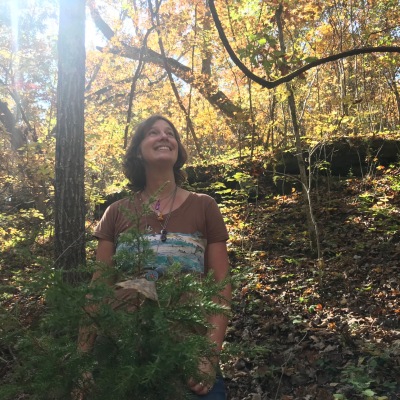
As we descended into the gully, the view opened up before us, slabs of stone forming a naturally terraced series of platforms dropping lower and lower into the round stone pools. The trees are yellow here, sun gleaming on the leaves, forming a temple bower of golden branches. I felt full of delight and joy, so pleased that we had chosen to lay aside the to-dos and come on this ramble together. I asked my husband to take a picture of me in the trees and stones telling him with a smile that this is the only moment in which the leaves will be this color and in which I will be this fabulous.

Being in the world, noticing what blooms and breathes and flows around us, is the fullest expression of my spirituality to me. Seeing what emerges, what fades, what rises and falls, this is a living magic. Honoring the passage of time, the turn of the wheel, the cycles of the land, the earth as an ensouled presence, and my own footsteps on her an act of devotion, these are the cornerstones of feminist spirituality for me. Look. Learn. Listen. Feel. Care. Act. Goddess worship and the symbol of the Goddess plays an important role in re-conceptualizing and restructuring the role of women, the value of nature, and the social order. In her book Ecofeminist Philosophy, Karen Warren writes: “Many spiritual ecofeminists invoke the notion of ‘the Goddess’ to capture the sacredness of both nonhuman nature and the human body…the symbol of the Goddess ‘aids the process of naming and reclaiming the female body and its cycles and processes.” Rather than something to dominate and control, the earth becomes the body of the Goddess and is acknowledged as both literal and spiritual home and is something inseparably linked to personal well-being—planetary health and personal health become synonymous—and both are treated with reverence and respect.
I have wondered if I try too hard to make my life be magical, to make it meaningful and then I realize, if you look for evidence that the world is made of magic, for evidence that your life is magical, that you will find it everywhere. This isn’t wrong. This is beautiful and powerful and real. Yes, my life is magical. So is yours. The whole world is magical. We need only step right up to it and look, to see that we are surrounded by magic, woven right into the threads of it.

The stones were slippery with water and moss as we skirted our way carefully to the bottom of the gully, where a wide, curving, bowl-shaped basin has been formed of rock and rain and time. Gazing at it, tranquil and still, gently rippled rocks forming the sides and leaves filling its bowl, I said aloud:  “When I die, you can leave me curled up here and I’ll be happy.” For a crisp moment I could clearly see my own bones lying nestled, smoothed and ivory, across this bed of leaves and sunbeams.

Something bright red caught my eye then, looking at first like the domed half of a large cherry tomato partially covered by brown leaves and I squatted down to discover a burst of crimson mushrooms grouped together and bright against the decaying foliage.

Mark didn’t answer me, but he laid his hand across my hip and together we scrambled like mountain goats past the crimson mushrooms and up the steep slope, the oak leaves giving way to a carpet of pine needles as we climbed, the now bare stems of lowbush blueberries catching on our socks and pants. At the top of the hill, we sat on the stones, chests heaving, breath fast from our ascent, smiling silently as we looked at the sunshine through the pines.


Molly Remer’s newest book of poems, Sunlight on Cedar, was published in March. Molly has been gathering the women to circle, sing, celebrate, and share since 2008. She plans and facilitates women’s circles, seasonal retreats and rituals, mother-daughter circles, family ceremonies, and red tent circles in rural Missouri. She is a priestess who holds MSW, M.Div, and D.Min degrees and wrote her dissertation about contemporary priestessing in the U.S. Molly and her husband Mark co-create Story Goddesses, original goddess sculptures, ceremony kits, mini goddesses, and more at Brigid’s Grove. Molly is the author of WomanrunesEarthprayerthe Goddess DevotionalShe Lives Her Poems, and The Red Tent Resource Kit and she writes about thealogy, nature, practical priestessing, and the goddess at Patreon, Brigid’s Grove, Feminism and Religion, and Sage Woman Magazine.

Yes, there are Goddesses in the Bible, Part 4 by Janet MaiKa’i Rudolph

This is the 4th in a series of blog posts about finding goddesses in the bible who had been hidden away through translation or denigration or other means. In my last blog post I discussed Lilith as a Great Goddess symbolized by both tree and bird. You can see it here

Today I continue with the topic of trees along with an examination of reversals and how many of beautiful, female pagan symbols were changed or removed from the texts. Perhaps the most obvious and pernicious has been that Eve “caused the fall” of humankind through a sinful act. Thus, the logic goes, it was Her action that has created the “grand curse” that we have labored under ever since. As I wrote in my last blog post, Lilith is another example, being portrayed as a demon in order to denigrate her Great Goddess roots. Lilith originally embodied both bird and tree energies. In my last blog post I showed one image of the Goddess in the tree which was a common theme in ancient Levantine cultures. The image today shows the goddess breast in the tree, which is identified as Isis suckling the future pharaoh Tutmose III. These images show the “Goddess in the Tree” as freely bestowing Her gifts and nurturing (not cursing) humankind. Continue reading “Yes, there are Goddesses in the Bible, Part 4 by Janet MaiKa’i Rudolph”

Yes There are Goddesses in the Bible, Part 3

This blog post is the 3rd in a series of looking for female deities in the bible who have been translated out of easy reach or otherwise hidden within its words. In my last blog post I discussed bird imagery and the bible. It is available here

 You can’t complete a discussion about birds without also bringing up Lilith. She appears by name only in one place in the bible; Isaiah 34:14. Isaiah uses the word liyliyth as a feature in a hellish landscape. Although it is also a name, liyliyth is treated as a common noun. The most prevalent translation is “screech owl” although others have included such names as night creature, night monster, night hag, and she-vampire. Continue reading “Yes There are Goddesses in the Bible, Part 3”

Yes, There are Goddesses in the Bible – Part 2 by Janet Maika’i Rudolph


As I wrote in my last blog post, there are female deities and goddesses sprinkled all throughout the bible. They just aren’t obviously in plain sight.

One example is the Goddess and Her association with birds. Many ancient creation myths have stories about life emerging from a cosmic egg and the Goddess who carries and/or lays that primordial egg-of-life. Like the bird, women carry the eggs of life’s creation within our bodies. This has given rise to numerous cultural symbolisms that have come down to us associating the Goddess with birds. The dove is Venus’ hallmark. Mother Goose is the keeper of our cultural stories. It is the stork who brings us babies. As I will show below, divinity, or the biblical LORD is sometimes depicted as a bird, making this biblical description of god a female. Continue reading “Yes, There are Goddesses in the Bible – Part 2 by Janet Maika’i Rudolph”

Women, like Goddesses, Come in All Colors, Shapes, and Sizes…by Vanessa Soriano


I wish I could have gotten this phrase tattooed on my arm when I started the serpentine journey into womanhood.  Like most of us, growing up, all I ever saw in media were thin female bodies with impossible proportions.  As one article put it:

Although body size and weight perception differ across race and ethnicity, women in western society are subject to images of women as not only thin, but also athletic and toned, with small waists, large buttocks, and large breasts, a body type that is largely unattainable.  Because of this ideal, all girls and women typically have weight concerns that ultimately shape body image, satisfaction, and appreciation. Continue reading “Women, like Goddesses, Come in All Colors, Shapes, and Sizes…by Vanessa Soriano”

To Bless One Another, by Molly Remer

May you allow yourself to
taste your longings
and to bravely honor them.
May you make wise sacrifices.
May you trust in abundance.
May you savor the many flavors
of this sweet life before your eyes,
beneath your feet,
below your skin,
within your soul,
around your heart.

I had imagined making beautiful loaves of herbed and flowered breads, but instead we hold scraps of plain white biscuits in our hands. Homemade, yes, but not as seasonally resplendent as I envisioned. It is Lammas, the festival of First Fruits, a celebration of sacrifice, gratitude, abundance, and renewal. I remind my four children of these themes as we stand in our small family circle on our back deck at sunset. There has been rain and the air is cool and beautiful, unseasonably delightful for August. The mulberry trees are broad leaved and heavy, leaning over the rails of the deck, where the last of the blackberries also hang, black and red beneath rusted red, gold, and green leaves, spotted with last month’s heat, brambles twined through the railings in a way that delights me—the wild’s insistence on creeping steadily closer and closer to enfold our home.

I have made four extra little biscuits, round and a bit lumpy, an offering for each of the four directions. I extend my hand into the center of our circle, cupping one small round biscuit at a time. My children and my husband extend their hands over and under mine and we offer our gratitude into each morsel in turn, one for each direction and each element. For North, we speak of stability and strength, the health of our bodies, the safety and security of our foundation, the earth on which we live. For East, we speak of air, our mental states, how we will be mindful of how we speak and think and focus our energy and time. For the South, we speak of fire, of tending the flames of our inspiration, nourishing our passions, and watching for burnout. In the West, we speak of water, of being emotionally stable and loving. In the last seventeen years of parenting, if there is one thing I have learned is that rituals with children need to always involve action. The kids are eager to toss the biscuits into the air, in the directions we are honoring.  In past years we have tossed pinches of cornmeal, at other times of the year grains of corn or flower seeds or dried herbs or petals, at the Winter Solstice we toss pieces of our annual golden “sun bread.” This bread, washed with egg and laden with butter is one we make together on solstice morning, shaping the smooth dough into a large sun face with a spiraled corona of rays. After it has baked, we offer scraps to the sun at noon, tossing them high into the air as we shout “Thank you! Thank you!” again and again into the crisp winter air. Last year, my garnet bracelet, a symbol of the path I walk with the goddess Persephone, flies off as I toss my sun bread and disappears into the waving stalks of wild grasses. We are never able to find it and the unexpected symbolism of Persephone becoming joined anew with the amber waves of Demeter’s grains delights me.

On the summer solstice this year, I made a cake in the shape of a honeycomb, decorating the hexagons with wild blackberries and rose petals. And, now on Lammas, there are these small white biscuits in our hands. My oldest son is almost seventeen. He is nearly as tall as his father, six feet. He has the biscuit for the south, which from where we stand on the deck is our house. He winds up his arm and lets the biscuit fly up, up and over the roof.

We offer our own small personal pieces of biscuit next, pinched as the first bite from each of our servings at dinner, as representative of a sacrifice we will make this season. And then, we cup our open hands close to our hearts and one by one we speak of what we are grateful for and what abundance we are welcoming, what we are making space to harvest in our open hands.

We join hands and sing, our six year old son requesting “We Are a Circle,” and following his lead, we sway from side to side as we sing, eventually all kicking our legs back and forth into the center of the circle and laughing. We say our closing prayer next, as we do each time we celebrate together: may goddess bless and keep us, may wisdom dwell within us, may we create peace* and then I extend my arms and gather them to me, for a large family hug. There is a sense of connection and renewal around us as we laugh and smile and I tell them thank you for participating.

This ritual was largely spontaneous, all I knew when I stepped outside was that we wanted to offer our gratitude symbolized by our four tiny loaves of biscuit-bread and that we wanted to acknowledge this next turn on the wheel of the year.

Several years ago, when I was still teaching at a local college, one of my students objected to the fact that material on working with LGBTQ clients was part of my class outline. She went through my personal Facebook page and those of my family members, where she noticed photos of the wedding ceremony I performed for my brother and his wife. A message arrived in my email: “by whose authority do you think you have the right to perform marriages?” she inquired. By my own authority, I thought, though in my reply I also cited that I am a legally ordained priestess and as such am recognized by the state of Missouri as capable of solemnizing legal marriages. Not much later, she dropped my class explaining in writing that to continue taking it would be to turn her back on Jesus Christ.

At mother blessing ceremonies, we often sing a song called “Call Down a Blessing.”** After one ceremony, I was asked, “but WHOSE doing the blessing?” and my answer was simple: We are. We are blessing one another.

These are radical acts. These are feminist acts. This is feminism and religion. To express gratitude for the earth, to name the elements as holy, to honor the cycles of the seasons and our lives, to design our own ceremonies, to hold our own circles, to be our own authorities, to bless one another and the spaces between us.

I have two teenage sons now, one seventeen and one fourteen. We have lifted our arms to the rising moon, tossed scraps of bread to the noontide solstice sun, and dabbed sweet spring water on one another’s faces in blessing since they were born. This is what they know.

And, even though they are now teenage boys, each night without fail they come to me and to their dad in turn to be kissed on the forehead in our nightly ritual, a benediction of love. Good night, sleep good, I love you, we each say. My seventeen year old usually drops his return kiss on the top of my head in my hair, speaking the familiar words back to me, good night, sleep good, I love you. Sometimes as I’m getting ready for bed, brushing my teeth in the bathroom, I look up to see him standing in the doorway, “mom,” he says, “did I forget to kiss you?” and I proffer my forehead, just in case we’ve forgotten. The boys each kiss their dad goodnight too and he them—on the forehead, a kiss, and the words, spoken and returned, good night, sleep good, I love you. Sometimes I think this is most potently feminist act of all, these two boys rapidly becoming men beneath our roof, going to bed each night with a kiss and the affirmation that they are loved.

Molly Remer’s newest book of poems, Sunlight on Cedar, was published in March. Molly has been gathering the women to circle, sing, celebrate, and share since 2008. She plans and facilitates women’s circles, seasonal retreats and rituals, mother-daughter circles, family ceremonies, and red tent circles in rural Missouri. She is a priestess who holds MSW, M.Div, and D.Min degrees and wrote her dissertation about contemporary priestessing in the U.S. Molly and her husband Mark co-create Story Goddesses, original goddess sculptures, ceremony kits, mini goddesses, and more at Brigid’s Grove. Molly is the author of WomanrunesEarthprayerthe Goddess DevotionalShe Lives Her Poems, and The Red Tent Resource Kit and she writes about thealogy, nature, practical priestessing, and the goddess at Patreon, Brigid’s Grove, Feminism and Religion, and Sage Woman Magazine.

*Thanks, Carol Christ! We’ve used this family blessing to close our ceremonies for about ten years.

**Originally by Cathy Barton and Dave Para.

Yes, There are Goddesses in the Bible by Janet Maika’i Rudolph

“Freud once asserted that mortals are not made to keep secrets;
what they would like to conceal oozes from all their pores.”
Psychoanalyst Theodore Reik[1]

It’s remarkable how much female imagery there is in the Bible hidden within its wording. The more I delve into its passages, the more that I have found these hidden/not so hidden sacred feminine images, even deities. I have begun a project of digging in and rooting out these little gems. When people think about the sacred feminine or female deities in the Bible the most well known is the Shekinah. The Shekinah is a lovely presence. The word means “dwelling” and usually represents “god’s divine presence” or a place where the divine resides.

The problem is that the Shekinah as a feminine essence of the divine is never stated explicitly, it is an interpretation of how the word is used.  I love the concept of the Shekinah but as an essence that upholds the entire weight of the feminine divine in the bible, I find it unsatisfying by itself. Luckily for me, Goddess Shekinah has lots of company. Sometimes they are indeed hiding in plain sight. Sometimes they hide in the translations. The passage I am presenting today has some of both going on. The following is the King James Version of Genesis 49:25. Jacob has been giving blessings to each of his sons and this is part of the blessing he gives to Joseph: Continue reading “Yes, There are Goddesses in the Bible by Janet Maika’i Rudolph”