Human, Just Human by Xochitl Alvizo

Mary Daly and other feminist scholars of her time knew that taking away the power of naming, whether oneself or the world, is one of the primary ways to take a people’s power away, to subjugate them to a world they do not help form or create.[1] Control over their bodies, their sexuality, and their relationships, is another. It has happened throughout history that not all people are allowed the same level of sovereignty over their bodies. Women, children, black people, indigenous and enslaved people, and whoever is deemed a threat to the social, economic, and cultural status quo being advanced (enforced) at a given place and time, have been forcibly and violently legislated against and policed into submission through varying implicit, explicit, informal, and institutionally sanctioned ways.

Continue reading “Human, Just Human by Xochitl Alvizo”
Human by Xochitl Alvizo

I’ve written about my existentialist leanings and how these are very much a reflection of my upbringing, and particularly my papa’s influence on me. He always talked about how we are all “just human.” He would humph disapprovingly at the use of categories or identity labels for people; he wanted to always affirm that all people are human, nothing more, nothing less. For my dad, labels and categories fixed people to a particular aspect of themselves.

He did not like the idea of reducing a person’s being, or limiting their many possibilities, with an overarching label. There were times with me when he would grumble if I referred to myself as Mexican-American or lesbian, for example, and he would say, “Argh, you’re human, that’s what you are, human.” He was always on guard about how a given identity can serve to limit my own imagination about myself or, worse, allow others to box me into their preconceived ideas of what that identity means.

Continue reading “Human by Xochitl Alvizo”

From the Archives: The Hunger Games, Holy Week, and Re-imaging Ritual by Xochitl Alvizo

This was originally posted on April 3, 2012 and serves as a nice follow up to my recent posts, and to the Christian holy days being celebrated this week.

Being passive spectators of violence and injustice, even if mournfully so, is not just a thing of Panem, it is our everyday reality.

In The Hunger Games Suzanne Collins takes the reality of an unjust society and gives it an imaginative makeover. In Panem, most people are kept at such extreme levels of hunger that even when they do eat they cannot fill the hollowness that has settled in their stomachs, while others are deciding on the next cosmetic alteration they will undertake – whiskers, jewel implants, or green-tone skin color? The disparate conditions between the rich and the poor, the few and the many are absurdly and starkly portrayed but done so in a way that we can still recognize our world in theirs. And at the center of this world is the state imposed ritual of punishment and control, the yearly Hunger Games – a nationally televised competition that all the people of Panem are required to watch. The 12 districts watch mournfully as two kids from each of their districts compete to the death, and the wealthy watch gleefully, for the games are the height of their excesses and entertainment. The yearly Games conclude when one kid, the lone ‘victor’, is left standing. All while the nation watches.

Continue reading “From the Archives: The Hunger Games, Holy Week, and Re-imaging Ritual by Xochitl Alvizo”

From the Archives: Rape is Not a Political Platform – Rape is a Violent Crime! By Michele Stopera Freyhauf

Moderator’s note: This marvelous FAR site has been running for 10 years and has had more than 3,600 posts in that time. There are so many treasures that have been posted in this decade. They tend to get lost in the archives. We are beginning this column so that we can revisit some of these gems. Today’s blogpost was originally posted August 23, 2012. You can visit it here to see the original comments.

Just when you think you have heard it all, here we go again – another politician with “open mouth-insert foot” syndrome.  Discussing his zero-tolerance policy for abortion, Missouri Representative Todd Akin made the following statement last Sunday about pregnancies that result from rape:

“from what I understand from doctors, that’s really rare.  If it’s a legitimate rape, the female body has ways to try to shut that whole thing down.  But let’s assume that maybe that didn’t work or something.  I think there should be some punishment, but the punishment ought to be on the rapist and not attacking the child.”

Continue reading “From the Archives: Rape is Not a Political Platform – Rape is a Violent Crime! By Michele Stopera Freyhauf”

From the Archives: Genderqueering by John Erickson

Moderator’s note: Today’s blogpost was originally posted March 24, 2015. You can visit the original post here to see the comments.

This post is a response to a recent blog entry titled “Who is Gender Queer?” on this site from Carol Christ. It was posted yesterday. I want to thank my friend, advocate, and upcoming scholar Martha Ovadia for reasons only she knows!  Stay brave, speak up, be heard!

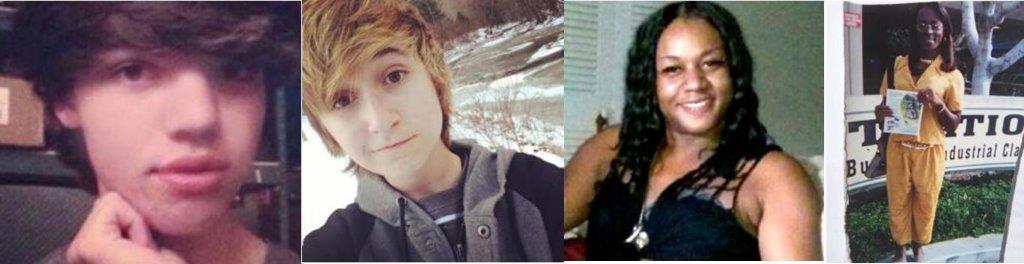
Leelah Alcorn, Ash Haffner, Aniya Knee Parker, Yaz’min Shancez

It is terrifying to know that something is wrong but not be able to speak truth to power.

Continue reading “From the Archives: Genderqueering by John Erickson”

From the Archives:“Vaginas are Everywhere!”: The Power of the Female Reproductive System by John Erickson

Moderator’s note: This marvelous FAR site has been running for 10 years and has had more than 3,600 posts in that time. There are so many treasures that have been posted in this decade that they tend to get lost in the archives. We are beginning this column so that we can all revisit some of these gems. Today’s blogpost was originally posted June 19, 2012. You can visit it to see the original comments here.

I have a beautiful picture of vagina hanging on my wall.  However, for the longest time it was in the back of my closet, with a plastic bag covering it.  I wasn’t ashamed of it but my ex-boyfriend, like most gay men, refused to have it on the wall where he could see it.  He is now long gone; the vagina is now out and proud.

I bid on the picture one fall during a showing of the Vagina Monologues at Claremont School of Theology.  One of my best friends was in the show and I had always loved its powerful message.  I walked out of the theatre, waiting for my friend, and there it was: the picture of the vagina.  I found myself caught up in its beauty.  Its gaze had mesmerized me.  The outlying layers of red, the contours of its shape, they all began to mold into a figure before my eyes.  While I have never thought of myself as a religious person, I realized that at that moment I was no longer looking the old photo but rather I was staring at the outline of the Virgin Mary.  At that moment, I realized that I had to have the picture.

Continue reading “From the Archives:“Vaginas are Everywhere!”: The Power of the Female Reproductive System by John Erickson”

Strength by Chasity Jones Selenga

To be transparent, these last four weeks have unintentionally flown by and have been filled with great pain, sorrow, depression, loss, and grief to be honest. I can feel my own spirit at the beginning of a long healing process and have a feeling that these words kept between you and I will be a tremendous part of my healing. Healing in itself is an essential aspect of Womanism and how I found my way to it. I have been privileged to develop spiritual practices that encourage and assist with healing in emotional, physical, mental, and wisdom ways!

Today, I acknowledge the Africana Womanism (Clenora Hudson-Weems) characteristic of strength. I must admit I have a strained relationship with the word as a Black woman. I was raised by strong women to be strong in an environment in which we will always have to strong. As a result, being soft is interpreted as weak. I mourn that Black women rarely find spaces in which they can turn off their survival mode- fight or flight nervous system responses and relax while being soft. It is so foreign. At this point in my life softness is so inconvenient and also something that I don’t even know how to maintain consistently.

Continue reading “Strength by Chasity Jones Selenga”

Forgiveness is a choice-Part 2 by Vibha Shetiya

It’s been over five years since I wrote the first part of this topic. A lot has happened since then; I have changed for the better or so I would like to believe, but I guess the real question is – have I changed my mind, my perspective on forgiveness? The answer is simple: No.

Why then did I even bother to write this post, you may ask. I guess I have gotten a better, deeper insight into why I continue to feel the way I did five years ago. Of course, even now I hear what philosophers have to say, and can understand, often even agree with, their arguments in favour of forgiveness: that forgiveness is not about setting someone else free; it is about setting yourself free.

But I’m still not ready.

Continue reading “Forgiveness is a choice-Part 2 by Vibha Shetiya”

Star Trek: Discovery Season Two: On Characters, Action, and Faith by Ivy Helman.


Season two of Star Trek: Discovery incorporates religion differently than season one.  While there are religious overarching themes running throughout, like how actions to shape the future and faith not as convictions but as empowerment, a more fitting and interesting way of addressing religion throughout this season is to look at the individual characters and what their stories have to stay about religion.  

Captain Pike knows and understands religion.  He also often believes.  Michael is the persistent skeptic.  The Red Angel plays many roles: an illogical mystery, a revelation, a savior or a intentional sign. Saru is the convert, physically transformed with a newfound confidence and power, while Hugh is the reincarnated, whose bodily existence begets loneliness and struggle.  Spock is the logic wrestler, who as Pike says asks “amazing questions.”  Finally, not a character per se, episode two, entitled “New Eden,” represents a typical Western understanding of organized religion, replete with sacred writings and a church.  

Like season one, religion is present in the opening scene of the season, this time in the form of mythology, as Michael tells a tale of an African girl who threw embers from a fire into the air creating the Milky Way.  Michael says that she left a message in the stars if one was willing and open to receiving it.  

Continue reading “Star Trek: Discovery Season Two: On Characters, Action, and Faith by Ivy Helman.”

Dancing for Forgiveness and Reconciliation – Part Two By Laura Shannon

In Part One of this article, I described dancing Jewish, Romani, and Armenian dances for forgiveness and reconciliation with groups in Germany and all over the world. I also offered danced rituals of remembrance at former concentration camps and other places scarred by the atrocities of war.
I went to camps including Dachau and Auschwitz, to genocide memorials and sites of massacre throughout Eastern Europe, in Australia, and the Americas. At first, my prayers were private: I brought flowers, lit candles, danced my grief, and spent time in meditation. I tried to visualise the prisoners in those places, sending them my deep sorrow and regret back through time. I wanted to let them know that they are remembered and mourned by people from their future. My prayers contained a fervent apology as well as a soul commitment to do my part in this lifetime to overcome prejudice and stand for peace.
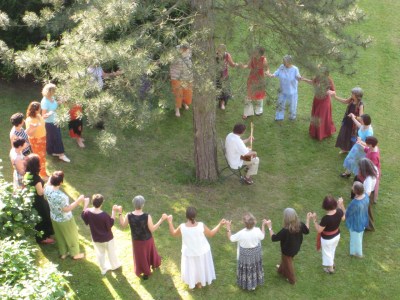
In time I invited others to dance with me for healing and peace. We danced at former camps in Germany, including Bad Gandersheim, a subcamp of Buchenwald, and on many occasions in Steyerberg, a former prison camp and forced-labour munitions factory which is now the site of an intentional community called Lebensgarten (‘Garden of Life’), a centre for permaculture, non-violent communication, and other ecologically and spiritually oriented ways of living.

Continue reading “Dancing for Forgiveness and Reconciliation – Part Two By Laura Shannon”