An Omer Calendar of Biblical Women by Jill Hammer

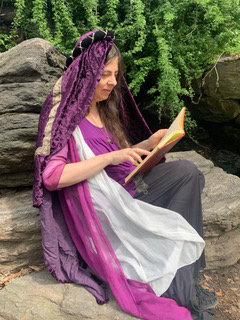
Jill as the prophetess Huldah

Right before Passover every year, my wife and I visit a botanical garden to look at the spring flowers: daffodils, tulips, cherry and apple blossoms, magnolia.   One year, in 2004 or so, we were on our way there when I had an idea. I grabbed a pen and started scribbling long lists of biblical women.

“What are you doing?” my wife asked.

“Making an Omer Calendar,” I said. 

Since biblical times, there is a Jewish practice of counting the forty-nine days between the holiday of Passover (the barley harvest and festival of freedom) and the holiday of Shavuot (the first fruits festival and the season of receiving Torah).  These forty-nine days were the time of the barley and wheat harvest and were a fraught time for biblical farmers.  According to the Talmud, each day of the Omer must be counted along with a blessing.  One must count consecutively each day (usually in the evening) and one loses the right to say the blessing if one misses a full day of the count.  The Omer is often understood as a time of semi-mourning because of plagues said to occur during this time, but it is also a joyful season when nature’s abundance is at the forefront.  This seven-week period embodies both fear that the harvest will be damaged and gratitude for the harvest.

Continue reading “An Omer Calendar of Biblical Women by Jill Hammer”

Pedukei: A Complex Interplay of Human, Divine, and Nature.


The Torah portion for March 29, 2025 was Pekudei.  Quite often this parshah is read with Vayakhel.  In fact, I have written about the double parshah Vayakhel-Pekudei before, but focused on only Vayakhel.  Now, it is Pekudei’s turn.  

Like parshot Vayakhel and Terumah as well as other parts of the book of Exodus, Pekudei focuses on haMishkan, the Tent of Meeting or Tabernacle.  We read about calculations concerning the costs of the constructions, instructions for the high priest’s garb, ritual washing of hands and feet, when to construct and when to deconstruct the traveling tent, and the divine presence as cloud and fire.  In Pekudei, we have no mention of women and no mention of any Israelite men barring the religious elite: Moses, Aaron, and Aaron’s sons.  Therefore, in this commentary, I want to discuss contradictions in the text that speak to (1) a consistent divine presence that seems to argue against animal sacrifices and (2) the ways in which the natural world and Israelite religion went hand-in-hand.

Continue reading “Pedukei: A Complex Interplay of Human, Divine, and Nature.”

Sacred Secrets: The Legacy of Women’s Wisdom Across Generations by Rabbi Nadya Gross

From my earliest memories, I saw things that others didn’t see and knew things I had no business knowing. But at the time, I didn’t realize that others didn’t witness the dance of light around their bodies or the life forms at the base of trees. I didn’t know that the insights I had into people’s emotions were not universally shared. My curiosity led me to ask questions about these things… until my grandmother, Savta (Heb), took me into the kitchen (where everything important happened), closed the doors, and told me never to talk about these things with anyone except her. And so, my training began.

Savta was gifted in ways different from mine. She had grown up in a circle of women and their daughters, a circle where women educated each other, shared their unique gifts and insights, and passed down a legacy of wisdom.

The wisdom she shared with me was as ancient as the land on which we lived. We began with reverence for the Earth and all her elements—pre-patriarchal Goddess wisdom. We explored what it means to be intimately connected to all aspects of Creation, understanding that we are interdependent. Harm to a tree, an insect, or the water harms us. We learned that the respect we wish to receive from others must first be shown by us. I learned to never pick up a beautiful stone that caught my attention without first asking permission to remove it from its resting place. When harvesting fruit from one of the many trees in my grandparent’ yard, I expressed deep gratitude to the mother-tree whose body nurtured that fruit to ripeness.

Continue reading “Sacred Secrets: The Legacy of Women’s Wisdom Across Generations by Rabbi Nadya Gross”

On Terumah: (Eco)Feminist Reflections on the Tent of Meeting.

The Torah portion for March 1, 2025 is Terumah, consisting of Exodus 25:1-27:19. Terumah in Hebrew means contribution, and the parshah begins with the deity requesting donations from the willing hearts of men (yes, only men) of precious metals and stones as well as dyes, linens, wools, and skins.  Terumah then provides the instructions for how to build the Tent of Meeting and all of its components.  In this post, I want to focus on four aspects of the post from the perspective of ecofeminism and feminism: beauty; the misuse of nature, the concept of home, and the indwelling or immanence of the divine.

Continue reading “On Terumah: (Eco)Feminist Reflections on the Tent of Meeting.”

From the Archives: “Shemot: Women’s Misbehaving and Disobeying as the Key to Liberation.”

Author’s Note: This blog was originally published five years ago to the day (12 January 2020). It rings as true then as it does today.

Shemot will be read in synagogues on 18 January 2025.

This week’s Torah portion, or parshah, is Shemot (Exodus 1:1-6:1).  This parshah sets the scene for the liberation of the Israelites from slavery both by introducing main characters and elaborating on just how difficult life was for the Isrealites under Pharoah’s rule.  The parshah contains many noteworthy aspects: the death of Joseph and the multiplication of the Isrealites in Egypt; the increasing wrath of the Egptians; the birth and adoption of Moses; Moses’ encounter with the Divine in the form of a burning, yet unconsumed, bush; the revelation of the divine name, G-d’s plan for Moses’ role in the liberation of the Israelites from slavery; Moses’ attempts to get out of his assigned role; and Moses’ first confrontation with Pharoah.   

In addition, there are many women, who are integral to the salvation of the Israelites, in this parshah.  For the most part, Jewish tradition has acknowledged their part when it comes to discussions of this parshah, especially Shifra and Puah.  Yet, their role is often overshadowed by Moses’ varied miracles, the mighty power of the divine, the revelation of the Torah, the wanderings in the desert, and so on.  However, the Israelites’ liberation from slavery would have looked quite different without women.  

Continue reading “From the Archives: “Shemot: Women’s Misbehaving and Disobeying as the Key to Liberation.””

From the Archives: Tree of Life: The Festival of the Trees in an Age of Treefall by Jill Hammer

This was originally posted on January 22, 2019

Almost every day, I walk in Central Park.  There are certain trees there I’ve come to know: the gnarled cherry trees by the reservoir, the bending willows and tall bald cypress by the pond, the sycamores that drop their bark each summer, the hawthorn not far from Central Park West.  Lately I’ve been taking photos of the trees to try to capture their essence, their posture in the world.  The trees around me feel like friends, which is what an ancient midrash (interpretation/legend) called Genesis Rabbah says about trees: that they are friends to humankind.  To me, they’ve always been a central manifestation of Mother Earth.

Currently, the national parks in the United States have no staff because of the government shutdown. Some people have taken the opportunity to cut down the rare and endangered Joshua trees in the Joshua Tree National Park—just for fun, I guess, or as a trophy of some kind.  Meanwhile, President Bolsonaro of Brazil recently has indicted that he wants to remove protection for the rainforest, in order to allow development.  It appears that my friends the trees have enemies.  Sometimes the enmity is for personal/corporate gain, and sometimes the enmity seems to have no reason at all.

Continue reading “From the Archives: Tree of Life: The Festival of the Trees in an Age of Treefall by Jill Hammer”

Bo: On Passing Over.

On August 12, 2018, I announced that I would begin my feminist reflections on Torah portions. I have seven left, but the timing of them are all in the beginning months of the year. This means, that the following seven posts about the parshot will not be aligned with the actual calendar dates in which they are read, especially since I only post once a month. But, in each post, I will note when they will be read next (in 2025). I hope that is not too much of a bother for the reader as I complete this project.

The parshah for Feburary 1, 2025 is Bo. It covers the final three plagues (locusts, darkness, and death of the firstborn males), the instructions for Pesach (Passover), and the beginning of the flight out of Egypt. The parshah makes two mentions of women. First, Moses includes the daughters of Israel among those who will leave Egypt (10:19). This mention comes in a list of opposites: young and old, sons and daughters, and (what I assume to have been considered opposites at the time) flocks and cattle. To me, this stylistic set-up signals that the entirety of the Israelite community would leave Egypt – a combination of seeming opposites thus represent the whole (that would be an interesting post for another time!). The second mention of women is in verse 11:2; men and women will ‘borrow’ gold and silver items from their (Egyptian) friends. This borrowing allows them to later leave Egypt with the items and thus rob Egypt of its riches (13:35). I do not find this necessarily all that interesting except to note that it helps to tell the story of how an oppressed, enslaved people had enough gold to build a golden calf (Ki Tisa), Exodus 32:2-3. 

Continue reading “Bo: On Passing Over.”

The US Election Results and Justice: What Will You Do? A Jewish Feminist Perspective by Ivy Helman

I met with a new friend/colleague of mine this past week.  We were discussing the election results, and I was discussing the work I do in the field of religion.  Living and teaching in Central Europe, I have quite a lot of experience navigating the study of religion in a place that is quite atheist and/or actually anti-religion.  In fact, it has been somewhat of a struggle to have the study program, Gender Studies, in which I teach, recognize its importance.  Many of my colleagues, I think, are under the impression that religion is personally not important and/or just not that important in general.  Yet, as I have mentioned here, and as my new friend brought up as we sat over coffee, religion underpins so many aspects of our patriarchal society.  

Continue reading “The US Election Results and Justice: What Will You Do? A Jewish Feminist Perspective by Ivy Helman”

On Noach and its Ecofeminist Potential.

The Torah portion for November 2, 2024 is Noach.  The portion includes the stories of Noah’s ark and the tower of Babel and ends with Abraham and Sarai settling in the land of Canaan.  In my feminist analysis of Noach, I will focus on the ecofeminist potential of divine acknowledgements and how the divine is portrayed.

As ecofeminists at the intersection with religion, one task we have is to interpret those sacred texts which have something to say about nature and animals.  Within Judaism, there are numerous such texts, and parshah Noah is one of them.  Afterall, most of Noach revolves around a great flood in which the deity destroys the earth and most of its inhabitants, animal and human.  

The divine destruction of the material realm is problematic.  The deity blames the divine decision to destroy creation on the rampant corruption of the flesh: human and animal alike (6:13).  In feminist thinking, linking material existence to corruption is unsettling since patriarchy often disavows material existence by linking it to evil.  In addition, in Noach, an aspect of the material world, water, is used in bringing about that destruction.  However, water is also ironically what all flesh depends on for life.    

Continue reading “On Noach and its Ecofeminist Potential.”

Even Now: Creativity, Possibility and the Renewal of the World by Rabbi Adina Allen

October 3, 2024 // 1 Tishre, 5785

“Rosh Hashanah is the anniversary of the creation of the world,” wrote the Eish Kodesh, Rabbi Kalonymous Kalman Shapira, Rebbe of the Warsaw Ghetto. Writing at a time of unimaginable suffering, even against the backdrop of impossible circumstances, he knew this moment, the day in which we inhabit right now, to be one of creativity, possibility and renewal. 

This theme of creativity and Rosh Hashanah is perhaps expressed nowhere more poignantly than in the phrase Hayom Harat Olam. One of the many names by which Rosh Hashanah is known, these words come from one of the holiday’s most ancient piyyutim, recited in the sacred center of the Rosh Hashanah service, the haunting, evocative Musaf Amidah. To conclude each of the three special sections for Rosh Hashanah: Malchuyot (Sovereignty), Zichronot (Remembrances), and Shofarot (marking the appearances and meanings of shofar across Torah), the shofar is sounded in the proscribed pattern — wholeness, breakage, shattering, wholeness, followed by Hayom Harat Olam.

Continue reading “Even Now: Creativity, Possibility and the Renewal of the World by Rabbi Adina Allen”