Recently, in response to the excellent conversation following Nancy Vedder-Shults’ post on the goddess Kali, Carol Christ commented to Nancy, “I too love our conversations, wish there was more in depth talk on our blog [FAR], maybe there will be.” Carol’s comment* struck a deep chord within me. One of the main objectives that the FAR co-founders had in creating Feminism and Religion was that it be a place where we could and would engage with one another across a diversity of feminist issues and the broad range of feminist passions and work – where we could discuss, critique, and build upon on each other’s efforts.

So two things came to mind as I reflected on Carol’s comment. The first was my personal lament that I have not been as actively participating in the discussions that follow the FAR blog posts as I did when we first started Feminism and Religion. FAR has such rich and valuable material – it really does provide a great opportunity for conversation and dialogue – and sadly I have been a passive participant as of late. I read and learn from the discussions, but I have not been joining in. I lament that. FAR is definitely a place where I could engage with others in deep conversations, but how actively am I actually doing this? Continue reading “We are Worth the Time it Takes to Create a Practice by Xochitl Alvizo”
I had an entire blog ready to go for posting this week, but as news broke of Jennifer Lawrence’s stolen pictures, I couldn’t bring myself not to speak up.
If you have not heard yet, hackers broke into Jennifer Lawrence’s personal accounts and uploaded quite a stash of private photos on to the internet. They are currently threatening to upload stolen videos as well. You can find the story chronicled here. I’ve decided to link to a feminist website that is withholding the photos because, trust me, you do NOT want to wade the waters of what is out there in regards to this story. It is rage inducing. Continue reading “We Are All Jennifer Lawrence by Martha Cecilia Ovadia”
Recently Michele Stopera Freyhauf posted an important blog about the ALS Ice Bucket Challenge and parallel challenges that are making use of this medium; including Orlando Jones’ reimagining of this challenge, in which he dumped a bucket of bullet shell casings over his head to “bring attention to the disease of apathy.” In her blog, Michele asks us to critically consider the way a person’s privilege may impact one’s response to such campaigns. She proposes that we use good stewardship in our enacting of a given challenge, highlighting ways in which charitable giving must be a product of deliberate, liberative praxis.
I agree with Michele: deliberate praxis (action + reflection!) is essential to justice making. And justice-making, solidarity and allyship are all kinds of work that take continual action and reevaluation. In light of such discussions of privilege and solidarity, I would like to use this blog to lift up another important reimagining of the ice bucket challenge: Mia McKenzie’s BGD White Privilege Media Bucket Challenge!
A few days ago I had the pleasure of giving a talk at the Secular Student Alliance Conference on how non-believing persons can work with Churches. Amidst the chaos of conferences–managing your time, deciding which talks to attend, and making sure you have enough water (it was a Burning Ring of Fire outside in Tempe, AZ)–I got to meet some pretty incredible secular women.
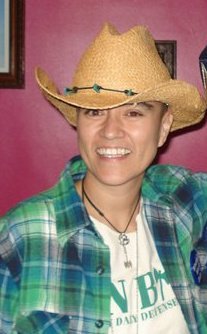
One of them was Heina Dadabhoy.
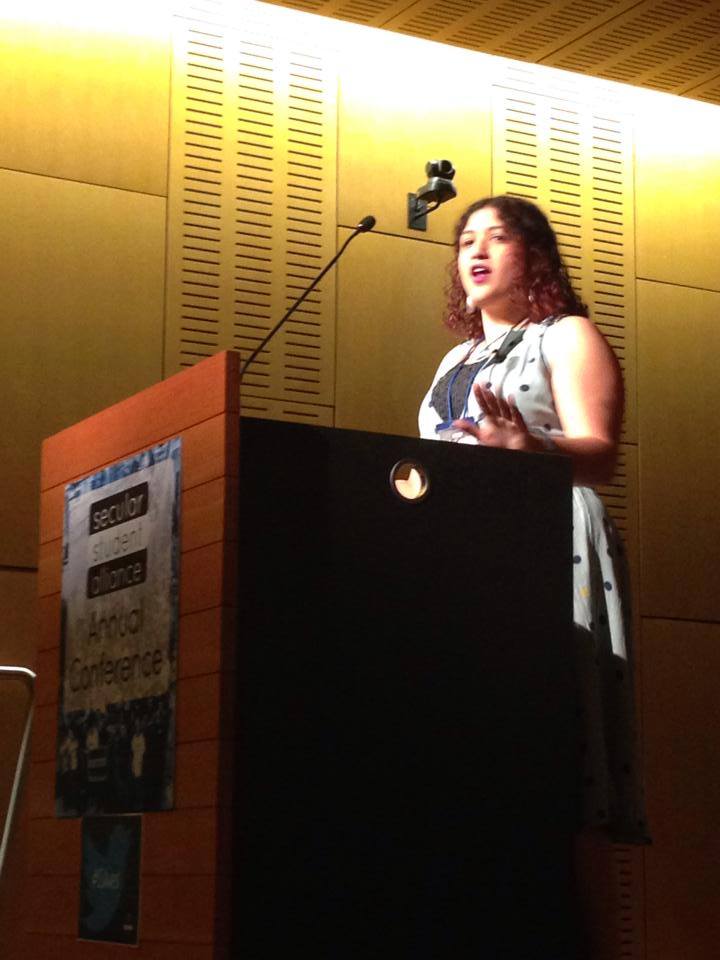
Heina speaking at SSA.
Former Muslim, blogger at Freethought Blogs, and overall bad-ass, Heina spoke about ways in which secular groups can create a more welcoming environment for ex-Muslims and Muslims beginning to doubt. Her talk, “Of Murtids and Muslims,” (a “murtid” is a public apostate) was not only about her experiences coming out as a secular humanist, but considered some of the absurd questions people ask her (and other ex-Muslims) about leaving Islam. “So did your parents try to honor kill you?” “Have you gone through FGM?” It was disturbingly humorous.
What I considered to be Heina’s main point, was that we should respect each others’ individual differences and not generalize and caricature all Muslims with the depictions of some. “Just because you read Ayaan Hirsi Ali’s book,” Heina notes, “does not make you an expert on Islam.” Heina made sure to emphasize the radical diversity that exists in Islam. She also spoke of the some of the issues that people go through when they leave Islam: How do I create a new identity when my old one was intricately tied up in my Muslim community, family, and culture? How do I navigate popular culture when I have missed a bunch of it? How do I find myself in this new secular world? Heina’s answers were refreshingly honest and insightful.
P.S. Aisha (one of Muhammed’s wives) should not simply be reduced to the young person Muhammed married; she was also a war leader, influential Muslim thinker, and someone who contributed greatly to early Islam. This is, of course, Heina’s insight.
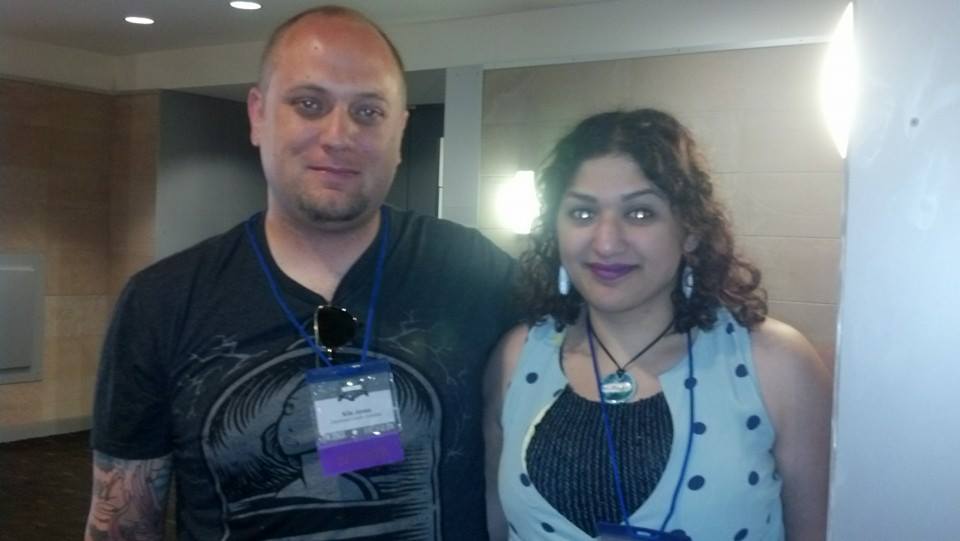
Me and Heina at SSA
Another awesome secular woman I met, was Sarah Morehead.
Sarah. Photo from Apostacon.
Sarah is a former evangelical Southern Baptist, Executive Director of the “Recovering From Religion” project, and another overall bad-ass. She spoke on how to start up a Recovering From Religion group on your campus. Here is a blurb about Recovering From Religion,
“If you are one of the many people who have determined that religion no longer has a place in their life, but are still dealing with the after-effects in some way or another, Recovering From Religion (RR) may be just the right spot for you. Many people come to a point that they no longer accept the supernatural explanations for the world around them, or they realize just how much conflict religious belief creates. It can be difficult to leave religion because family and culture put so much pressure on us to stay and pretend to believe the unbelievable. If this is you, we want to help you find your way out. Don’t let people convince you that you just didn’t have ‘enough’ faith, or that you just haven’t found the “right” religion.”
Sarah and I chatted (and often laughed) about our old experiences as conservative Christians. We discussed some of the funny language (Christian-eze) we used to use, the various levels of guilt and shame that were cast upon us, and how science helps explain some of the interesting displays of piety often seen at Pentecostal services. Sarah’s jovial and welcoming demeanor was calming, and as an Executive Director for a project aimed at helping people “recover” from religion, I cannot think of a better person for the job.
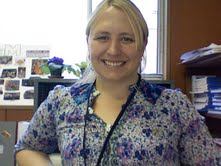
Lyz. Photo by SSA.
The last woman I have in mind is Lyz Liddell.
Lyz is the Director of Campus Organizing for the Secular Student Alliance. I have an interview I did with her a while back, on this very blog! Besides running around with her headset on, standing on chairs for announcements, and generally keeping the world of SSA from not crumbling into oblivion, Lyz is a great motivation and example. If you are ever interested in starting a SSA group on your campus, talk to her.
To all those who attended this years SSA West, or who are involved with helping secular students: Unite!
Kile Jones holds a Bachelors of Theology (B.Th.) from Faith Seminary, a Masters of Theological Studies (M.T.S.) and a Masters of Sacred Theology (S.T.M.) from Boston University, and is a current Ph.D. in Religion student at Claremont Lincoln University. He also holds a Certificate in Science and Religion from the Boston Theological Institute. Mr. Jones has been published in Zygon: Journal of Religion and Science, Philosophy Now, Free Inquiry, World Futures, Human Affairs, and the Secular Web. He is the Founder/Editor-in-Chief of Claremont Journal of Religion (www.claremontjournal.com), and is the Founder/Director of Interview an Atheist at Church Day (interviewatheists.wordpress.com).
On June 11, 2014 the New York Times made waves in the world of Mormondom with their breaking news that two members of the Church of Jesus Christ of Latter-day Saints (LDS) are facing excommunication on the grounds of apostasy. Active Church members Kate Kelly and John P. Dehlin both received letters from their local church officials in early June summoning them to participate in scheduled Church hearings to discuss their so-called heretical public activism. By many accounts, this appears to be Dehlin’s first notice of formal disciplinary action for his faith-mending work with Mormon Stories, but Kelly has been under official fire from the LDS Church since late May for her efforts in founding and operating Ordain Women (OW)—a pro-women’s ordination group of active believers—more than a year prior. The excommunication threats came on the heels of a church-wide trend that preaches acceptance and diversity among members and beyond, but sends a mixed message to those who, like Kate Kelly, find themselves asking sincere questions only to be either silenced or rejected by their Church and cut off from communal worship of their God.
Ever since the New York Times story broke, the web has seen a swarm of responses in the form of news, interviews, blog posts, and social media discussion; watching everything unfold has been a fascinating study in feminist thought. Kelly herself responded publicly to her disciplinary letter here, saying that she had been transparent about Ordain Women with her bishop from the group’s inception and that not once had she been called in to discuss her work. The formal letter came only after Kelly had moved across the country, and the disciplinary hearing is scheduled to occur with or without her on June 22, 2014. On June 23, Kelly received the word that the trial had resulted in her excommunication.
As I’ve read through the slew of ideas and arguments surrounding what amounts to Kate Kelly’s spiritual fate, I can’t help but notice a strong underlying theme of patriarchy at work in squelching what Kelly believes are sincere questions about the lives of Mormon women. Commentators have tried hard—in classic anti-feminist fashion—to discredit Kelly’s work with Ordain Women, making certain that readers see her as a disingenuous religious deviant worthy of silencing. Throughout the spill of voices about Kelly’s Church standing the underlying point seems to be that as a Latter-day Saint she has no right to contest her Church’s doctrine or its patriarchy, that she is imagining inequality into the Church, that the Church’s discipline will be for her own spiritual good, and even that her group, Ordain Women, is lying in its claims about inequality. Continue reading “Anne Hutchinson, Sor Juana, and Kate Kelly: Reflections on Equality and Excommunication by Erin Seaward-Hiatt”
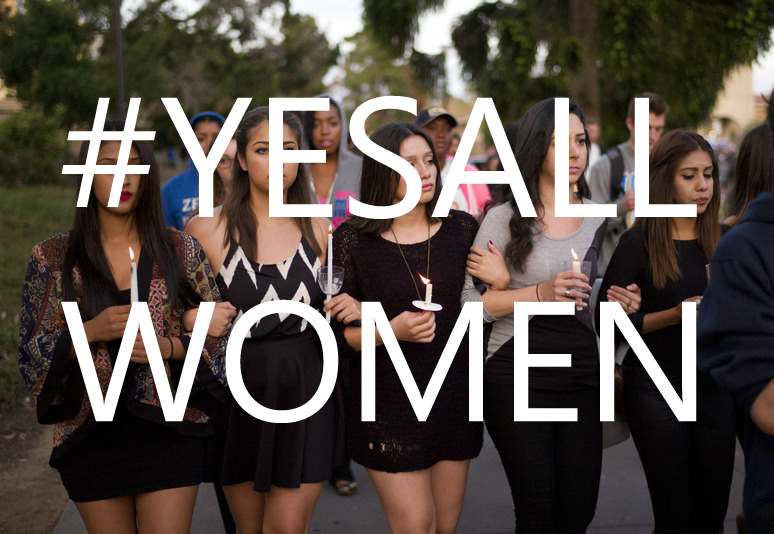
#YesAllWomen proved that although not all men commit horrible crimes against women, the men that often get the headlines and create the most controversy are the ones that need to be watched out for.
The one thing I typically will choose to do on the rare occasion that I’m able to sit down and relax is to watch a documentary. While some people may go to the gym, read a book, or hang with friends, I typically choose to stay in, nestle up on my couch, and learn. While on my last bout of relaxation, I chose to watch the HBO documentary Questioning Darwin. Although it offers very little new insight into the evolution vs. creationism debate, it does offer an interesting new way to look at the recent social media hashtag war feminists, allies, and supporters found themselves in over the #YesAllWomen movement that took the world by storm.
Now, before I discuss #YesAllWomen, I have to admit that I did not enter into the safe space women created for themselves to tell tales of the horrible things they have and have had to face on a daily basis. I firmly believe that men should not have entered into the digital space Continue reading “#YesAllWomen, the Darwin Debate, and the God Complex by John Erickson”
As I return home from a busy day signing off on proofs and churning out cutesy paper patterns, I find my husband, Neil, at the kitchen table. He wears a complicated frown as he pores over a score of tiled browser windows telling various iterations of a singular story. “Come here,” he says, flipping to a second tab, “you’ve got to see this.” It’s The Daily Show, and as I poise for Tea Party zingers and Obamacare barbs, I see instead a girl in hijab, a brilliant smile, and a whole new hope for world politics.
The story was all about a girl. Malala Yousafzai achieved international fame one day when she took a Taliban bullet to the head. Her vocal support for girls’ education had earned her a spot on the Taliban’s hit list. It’s a group with an all-too-familiar radical bent that thrives, among other things, on the cultural ideal of women’s inferiority and silence. One moment Malala was boarding a bus and the next, she faced a hopeful assassin, eager to erase her words and her work from the world. Continue reading “The Girl Who Lived: Reflections on Malala, the Middle East, and Feminism by Erin Seaward-Hiatt”
The effects on the world of the loss of the Feminine, the loss of Soul, are incalculable. Instinctive knowledge of the holy unity of things, reverence for the interconnection of all aspects of life, trust in the power of the imagination and the faculty of the intuition — all this as a way of relating to life through participation rather than through dominance and control, has almost been lost. We can see the effects of this loss of soul everywhere today, not only in the devastation and pollution of vast swathes of the earth, but in the unhappy, impoverished and hopeless existence that people endure in the hideous and ever-expanding suburbs of our cities, in the increase of diseases like cancer, diabetes and mental illness — particularly depression. The old are neglected and even ill-treated in a culture more interested in achieving targets than caring for people. The young are offered nothing to aspire to beyond the material goals promoted by the media.
My dissertation: The Wal-Martization of African American Religion and much of my work talks about the social construction of identity, racism, sexism and the power of brand®ed identities and celebrity. I keep seeing images and hearing those WORDS or sound bites of Donald Sterling—owner of the Los Angeles Clippers. His “racist” WORDS kept playing over and over in my head. Donald Sterling, the owner—or maybe the former owner—now banned for life—fined 2.5 million dollars—alleged adulterer—and an alleged racist.
Paula, you have to write about this and add to your literary and scholarly canon. Then suddenly, like the burning bush in the Exodus narrative and the call of Moses, I started asking questions of myself and whether I am worthy to write these words. Dr. McGee, “What WORDS are academic, yet popular enough? “ More importantly, “How does this fit into your research?” You want your blog to be on the top of a Google search tomorrow, when the thirty-something and under crowd find the right combination of WORDS to pull you into the browser of their lives. Your last blog was about Preachers of LA. How perfect. Your second blog, Reverend McGee will be about billionaire racist WORDS, alleged mistresses, rich ex-wives, and black basketball players. WORDS, WORDS, WORDS, WORDS! Continue reading “Donald Sterling, Racism, the Social Construction of REALITY, and the Power of WORDS by Paula L. McGee”
As a child, I enjoyed the story of Noah’s Ark. I would often imagine pairs of animals running for safety in Noah’s architecturally majestic haven. Practical questions didn’t enter my mind during this blissful period of naivety. I ignored the part where God expressed regret in creating humanity, or when Noah gets drunk and lies bare naked for his children to cover his shame. My bible study teacher would explain to us that the point of the story was that Noah, a holy man, trusted God and carried out his will.
Disclaimer: I understand that the film is not meant to be an exact representation of the story in the bible, but loosely based around it. Also, if you plan on watching the film, read at your discretion.
In the film, Noah’s character is played by leading actor Russell Crowe, who appears strong, confident, and zealous in his trust in God – all necessary qualities to fulfill God’s demand of killing off the rest of humanity because of their wickedness. Later in the film, Noah realizes that he and his family are also wicked leading to his revelation, ahem, God’s revelation, that humanity must cease with Noah’s family. This doesn’t pan out too well with his children and wife. It was also bad news for Emma Watson, the orphan girl Noah’s family saves and raises as their own, who after accepting that she is barren is miraculously healed and gives birth to two girls. Noah decides that the female infants must die according to God’s will to end humanity. Continue reading “Watching “Noah” Brought Me Closer to Humanity by Andreea Nica”