 The path leading to the Klapados Waterfall begins at the edge of an open meadow in the pine and oak woodlands of a mountain in the island of Lesbos. After driving several miles on a very rutted dirt track, we parked under an oak tree, crossed the meadow and scrambled down a winding path. After about 20 minutes, it ended at a stream surrounded by plane trees. From there, we climbed over rocks to reach a pool created by the seasonal waterfall.
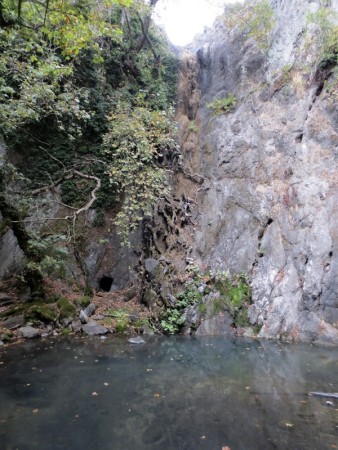 On the day we visited it, the waterfall was only a trickle of cascading drops that moistened its moss-covered path to the pool. The roots of a plane tree growing at the top of cliff followed the path of the water, weaving a web over the rockface all the way down to the pool.
Sitting on a rock at the edge of the pool I realized that the cliffs that embraced it on three sides were the remains of a crater formed twenty million (or so) years ago when a finger of molten lava pushed its way through the earth, exploding in clouds of dust and projectile rocks.
In Lesbos the volcanic activity came not from a single source–for example, from the highest mountain. Rather, like the plane trees in whose shade we rested, the volcano’s trunk with roots in the molten lava of the earth’s core, had many branches from which it erupted at different times. Huge boulders thrown out in the explosions can be seen in the meadows, while the trees in the forest curve their roots around them to reach the soil. The mountain was also shaped by the settling of volcanic dust that crumbles again into tiny fragments when exposed.
 As I was thinking of all of this my friend Cristina climbed over the roots of the plane trees that surrounded the pool, removed her clothes, and slipped into the water. Soon I followed her. We sensed that we were in a sacred place, and as we have done rituals together many times before, our ritual emerged spontaneously: it almost seemed as if our minds and bodies were moving as one.
We renewed ourselves in beauty, submerging our bodies under the water three times, while floating in the embrace of the pool, gazing up at the rock formations, admiring trees that looked like dancing women, moss that looked like pubic hair, and blue black damselflies that all together had created a most beautiful place that called to something deep within us on that day.
Later we would sing the English version of the song of the Navajo Beautyway:
I walk with beauty before me.
I walk with beauty behind me.
I walk with beauty all around me.
As I walk the beauty way.
I walk with beauty above me.
I walk with beauty below me.
I walk with beauty inside me.
As I walk the beauty way.
We are the creative process of life.
We are restored in beauty.
Blessed be!
Carol leads the life-transforming Goddess Pilgrimage to Crete (facebook and twitter). Carol’s books include She Who Changes and and Rebirth of the Goddess; with Judith Plaskow, the widely-used anthologies Womanspirit Rising and Weaving the Visions and forthcoming next year, Goddess and God in the World: Conversations in Embodied Theology. Explore Carol’s writing.




 When the wheel of the year turns towards fall, I always feel the call to retreat, to cocoon, to pull away. I also feel the urge for fall de-cluttering—my eyes cast about the house for things to unload, get rid of, to cast away. I also search my calendar for those things which can be eliminated, trimmed down, cut back on. I think it is the inexorable approach of the winter holiday season that prompts this desire to withdraw, as well as the natural rhythm of the earth which so clearly says: let things go, it is almost time to hibernate.
 Historical note: I took the name Formosus (r. 891-896) from one of the popes of the Dark Ages. After his death, his body was exhumed, dressed in papal vestments, and put on trial for political crimes. The corpse was found guilty, and the vestments were torn off it. Then it was thrown into the Tiber. A monk pulled it out, and it is said that the corpse was then burned.

 Feminism and Religion