

Sheep – soft-footed, fluffy creatures – graze and amble along with frolicking lambs by their sides. Know worldwide as docile and friendly, sheep – in particular the female ewes and their lambs – have come to symbolize innocence, gentleness and peacefulness. The symbolism of rams takes on a slightly different, more masculine tone and will be looked at separately.
Continue reading “Sheep – Gentle Wisdom by Judith Shaw”Category: Paganism
From the Archives: Answering the Call by Joyce Zonana
This was originally posted on April 30, 2020
Very early in Henri Bosco’s 1948 novel Malicroix, a young man, Martial de Mégremut, living placidly amid fruitful orchards in a tame Provençal village, receives a letter informing him he has inherited “some marshland, a few livestock, a ramshackle house” from a reclusive great-uncle, Cornélius de Malicroix. Against his family’s strenuous objections–with alarm they speak of “marshes, mosquitoes, miasmas”–Mégremut resolves to travel alone to the remote Camargue to claim his “wild” Malicroix inheritance. The house is on an island, and to reach it Mégremut must cross a rough river, at night, in a frail wooden boat piloted by a taciturn old man who meets him at dusk in the middle of a vast plain.
So begins a deeply internal quest narrative, an initiatory journey that forces Mégremut to come to terms with himself and with the elements–earth, water, wind, and fire–that are ever-present, sometimes terrifyingly so, on the island. For once he arrives, he learns that he must remain there alone for a full three months if he wishes to obtain the inheritance. Torn about whether to stay or leave, he finds that the decision to stay is made of its “own accord,” unconsciously.
Continue reading “From the Archives: Answering the Call by Joyce Zonana”The Callanais (Callanish) Stones and the Cailleach by Judith Shaw
I felt compelled to visit Scotland without truly understanding why. I said I was called by my studies of Celtic mythology and by images I had seen of the land. I told people in Scotland I was on an artist’s journey. But now I see that Mother Earth wanted my attention – and in Scotland, particularly in the Highlands, Earth energy is strongly present. From the start, a major part of that calling was the ancient Callanais Stones – pronounced like the English translation “Callanish” – located on the remote Isle of Lewis.
Getting around the Hebrides and the Highlands was difficult without a car as bus access is very limited. Though a little restricting, it kept me connected to Earth as I walked and I walked. With every step I felt the call of Earth – from even before the human family began.
It was a glorious sunny afternoon when I arrived by ferry on the Isle of Lewis/Harris. Next was a bus ride north to Stornoway, my base for exploring Callanais. Here I first learned of the Stones connection to the Cailleich, an ancient goddess whose origins are unknown. Her name literally means “the Veiled One” but has come to mean “Old Woman or Wife.” Yet she was all powerful and ageless.
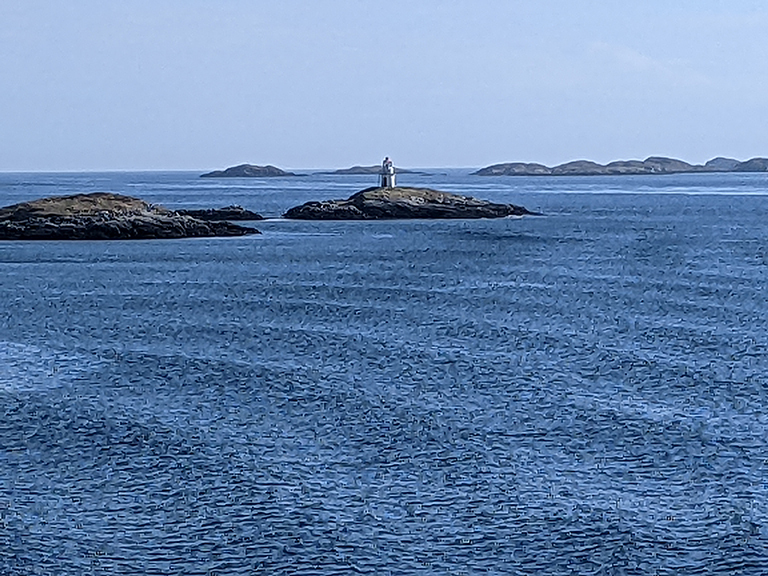
An elder man spoke about Callanias and the Stones’ connection to the nearby mountain – “Cailleach na Mointeach” – Gaelic for “The Old Woman of the Moors” or affectionately called “Sleeping Beauty” as the mountain looks like a woman lying on her back with bent knees. He said you could see this mountain through the stones. His storytelling got me searching for more info on the Cailleach’s connection to the Stones.
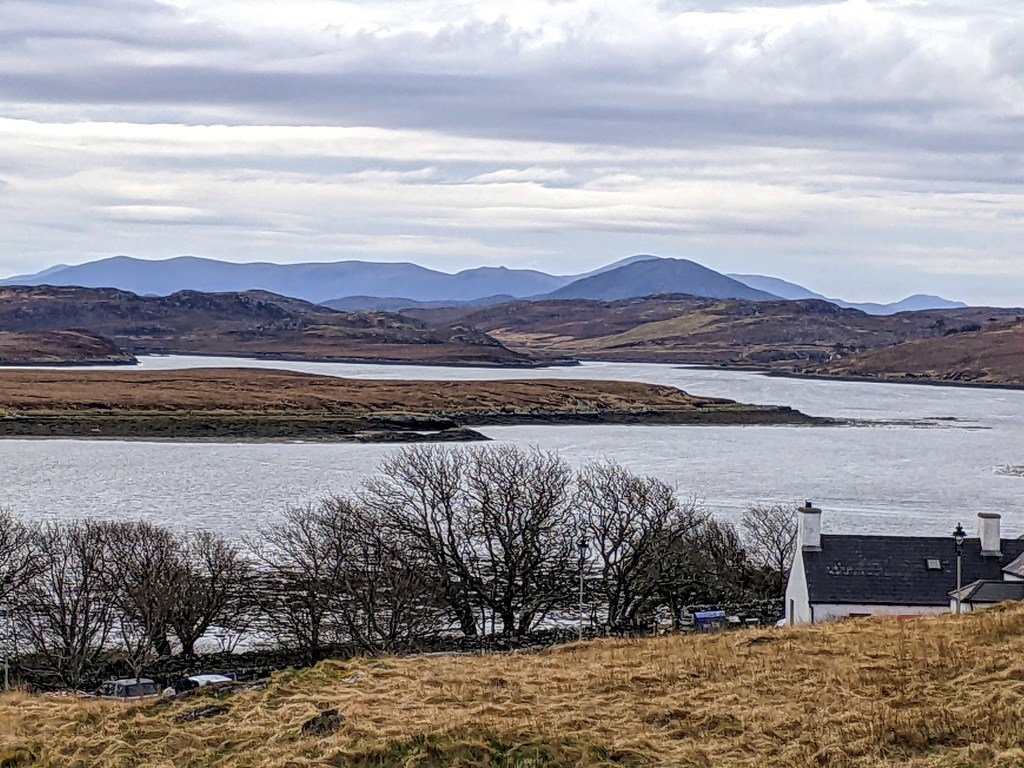
First, I learned of the extreme age of the islands and of the stones that make up the land. The Callanais Stones date back to 3500 BC but the rocks that created Scotland come from an inconceivable 3 billion years ago as the landmasses of Earth were created from out of the waters.
Around 450 million years ago, at the beginning of the Caledonian Orogeny, Scotland, Scandinavia and North America were one continent with the now, non-existent Iapetu Ocean separating them from England, which was joined with the rest of northern Europe. This was a long geological period of continental collision and mountain building, that turned Iapetu Ocean into land and fused Scotland and England together.
Quieter conditions occurred for several millennia, covering Scotland with layers of sediment forming various sedimentary rocks until 60 million years ago when Earth moved again and the continent split apart forming the North Atlantic Ocean with volcanoes erupting all along Scotland’s new western edge.
These are the creation stories the science of geology tells us. But our ancient ancestors told a different story of the creation of Scotland and the other Celtic lands. Long, long before the Celts arrived in Ireland and Scotland, the indigenous people worshipped The Cailleach, as both the goddess of creation and the goddess of destruction. She became Calleach Bheur to the Scots. “Bheur” means sharp and she was credited with creating the sharp and biting winter weather, which helped to shape Scotland.
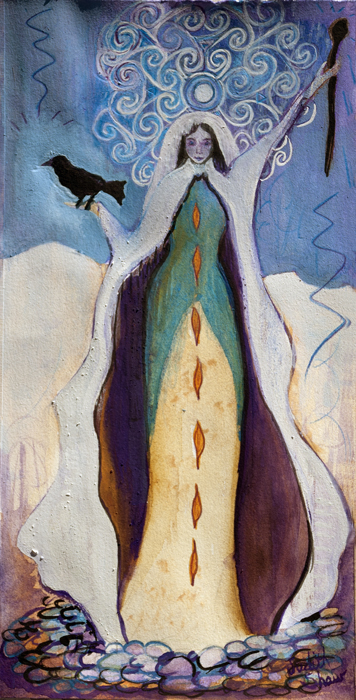
The Cailleach, a Dark Goddess of nature, is one with the land. Sometimes depicted with one eye, she sees beyond duality peering into the Oneness of all Being. She is the embodiment of winter, clothing the land with snow. Sacred Stones are her special places.
She leapt from mountaintop to mountaintop, dropping rocks to create hills, mountains and islands. She carried a slachdam – the Druidic rod, or a hammer with which she wielded power over the seasons and weather.
She is the guardian of the life force, finding and nourishing the seeds, commanding the power of life and death. The Cailleach personifies death and the transformative power of darkness, leading us through death to rebirth.
Our ancestors believed that the rocks on the Isle of Lewis used to create the Callanais Stone Circle were gifts from the Cailleach – from her acts of Earth building. These metamorphic gneiss rocks are among the oldest in Europe and are embedded with various types of crystal such as quartz, feldspar and hornblende. Perhaps these crystals in the ancient rocks create the energy field I felt so strongly on my visit – all coming from the hand of the Cailleach, a personification of the power of Mother Earth.
Archeologists theorize that the 5,000 year old Callanais Stones were a sacred site created for ritual and prayer, in particular from which to mark the 18.6 year lunar cycle – similar and yet more complicated than the yearly Sun cycle of Summer and Winter Solstices.
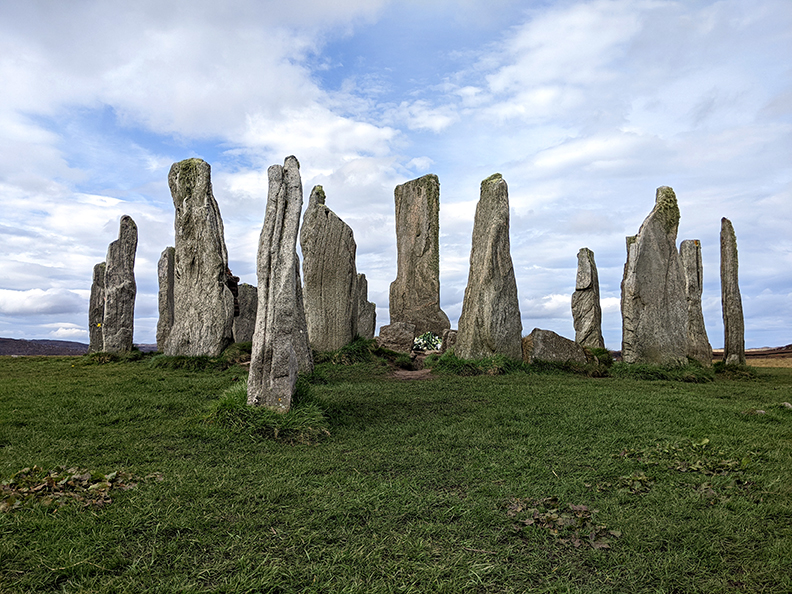
Every 18.6 years, this moon cycle reaches Major Lunar Standstill with the full moon nearest the Summer Solstice. It is viewed through the Callanais Stones rising out of Cailleach na Mointeach – our Earth Mother. Being so far north it only skims the horizon then appears to set among the stones.
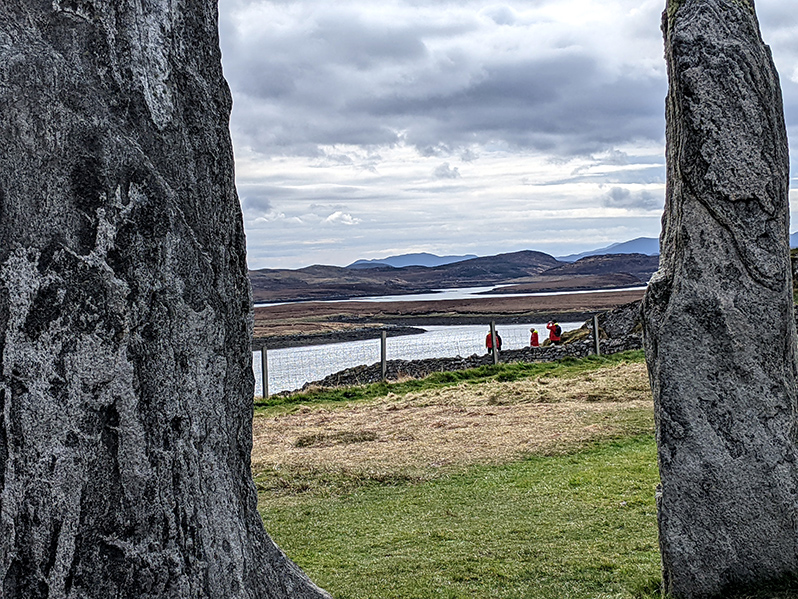
It is hard for our modern minds to understand the awe these ancient people must have felt at the beauty and terror of nature during the Megalithic Era – when the human family was first beginning to settle in one place though had not yet discovered agriculture.
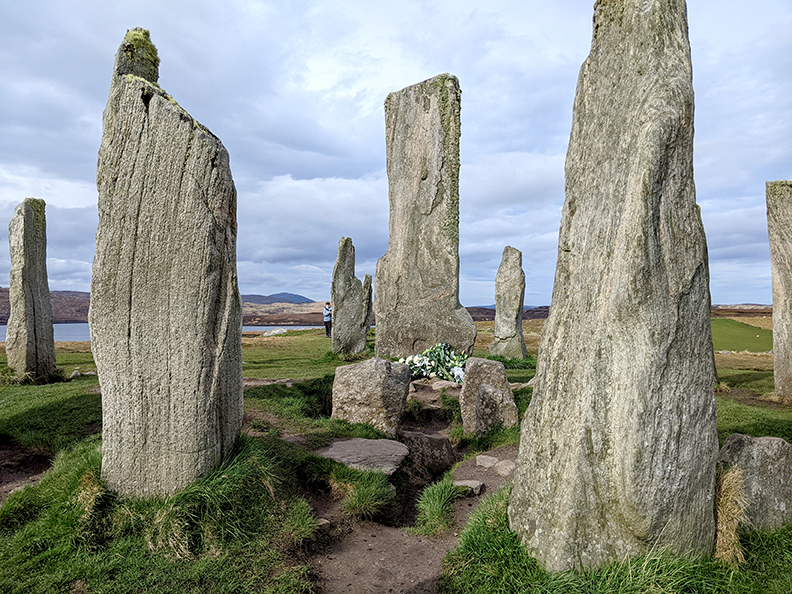
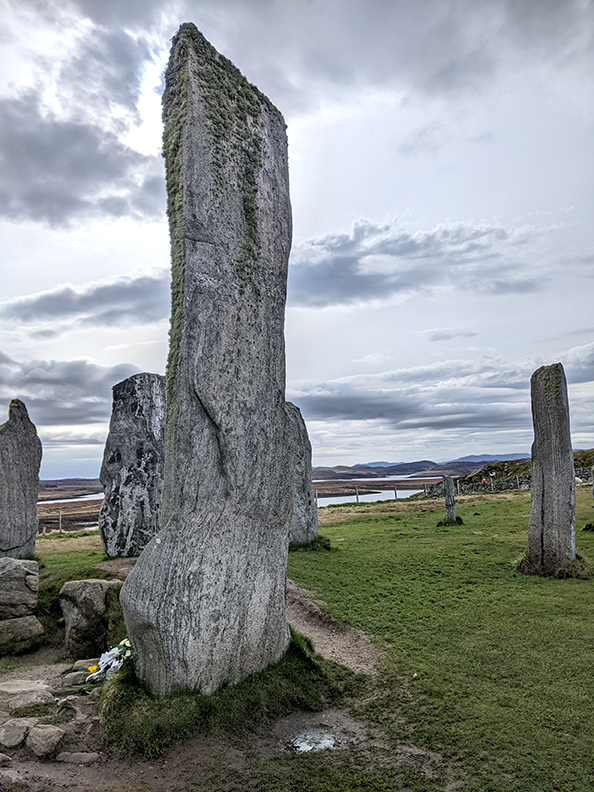
Perhaps the ceremonies held at Callanais helped hold the terror at bay. Closing my eyes I can imagine being there on this short night, near mid-summer, for the ritual marking of the passing of winter – I and my tribe had survived the season of long, dark nights. This was the special time that our tribal shaman knew how to mark. We all understood the precariousness of life and that marking the circuits of Earth and Sky provided invaluable knowledge for our survival. I can imagine feeling immense gratitude witnessing the cycles of life unfold as Earth and Sky and human minds interacted and the full moon rose out of our Earth Mother – Cailleach na Mointeach – and then set within the Sacred Stone Circle.
Further illustrating Callanais’ connection to Goddess, its original construction was comprised of 13 stones arranged in a circle – both number and shape are symbols of Moon and Goddess. At some point an even-armed cross was added around the perimeter – symbolic of the sun and of the meeting place of the divine and the mundane.
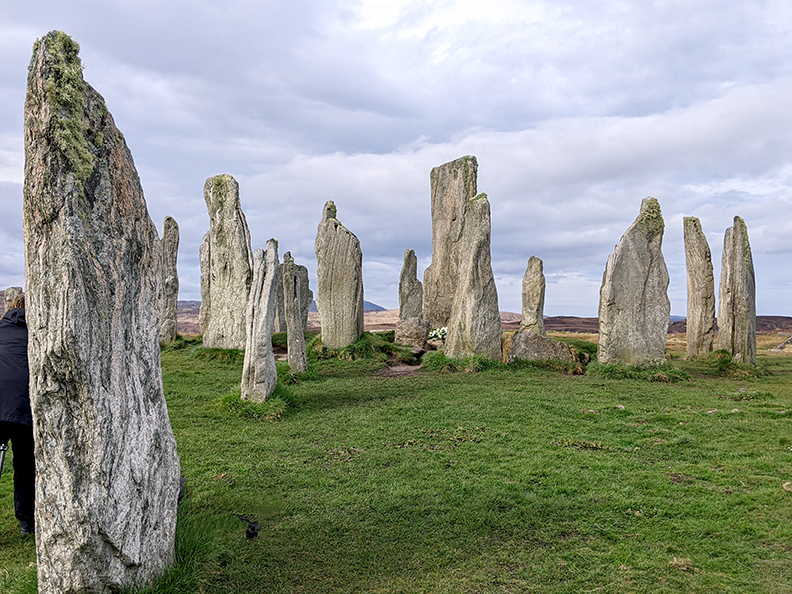
It seems unlikely that such a magnificent structure was created for use only once every 18.6 years. Of course these people left no written account of their actions, but local legend and lore suggests the Callanais Stones were seen as a fertility power spot. Given the Stones connection to Moon and Goddess that is not surprising. An old legend claims that Callanais is a promising spot to consummate a marriage or become engaged. In fact I overheard a couple of visitors while I was there claiming to have become engaged at Callanais.
But what does a site like the Callanais Stones hold for us today? Can Mother Earth still speak to us there?
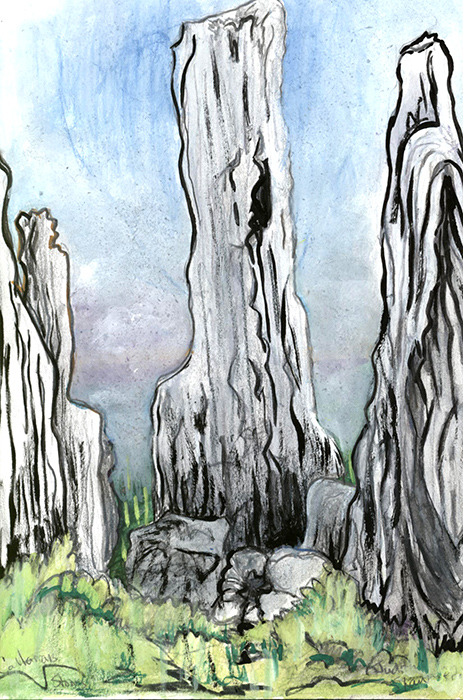
After a bit of a wander through and around the Stones, I sat and sketched. Slowly through that act of eye to hand to pencil to paper I began to feel the deep connection that always comes in when I attempt to translate 3D reality onto a 2D piece of paper.
Time passed and soon the only return bus would arrive so I stopped and just sat quietly, listening to the wind and feeling the energy. I felt strongly a sacred presence in this spot where long, long ago ceremonies for Goddess had been held. I heard the Cailleach’s calling – to an acceptance of our modern world and the difficult days of transformation the 21st century offers up. The winds carried her message – a glimmer of hope that we can find our way back to living in balance with her natural rhythms of creation, destruction and creation. I felt her reassurance that though the geography of Earth changes and the epochs of humankind and the flesh and bones of all creatures pass away, the magnificence of life continues. The Cailleach touched my heart there at her Sacred Stone circle, reminding me that, though pain and suffering has been and will always be with us, life is a gift to be cherished.
Here are a few more photos of the Callanais Stones
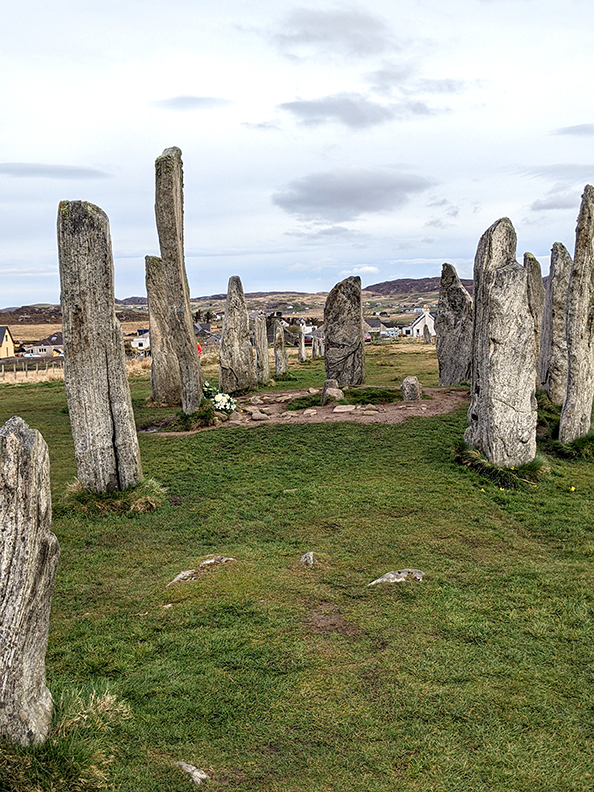
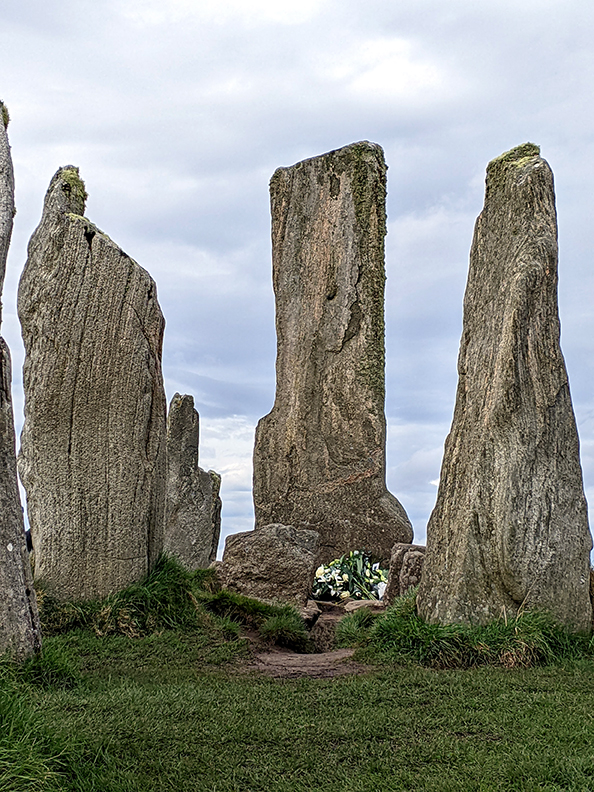
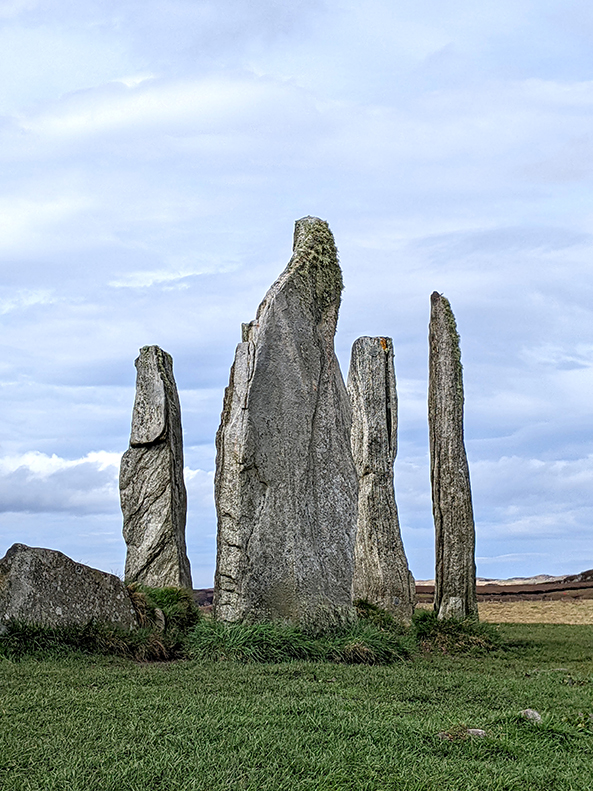
Post Script – If you are interested in learning more about the 18.6 year moon cycle be sure to read “Moon Teachings for the Masses” by Dr. Judith S. Young.
Sources: Moon Teachings for the Masses, Callanish, Isle of Lewis, Eye of the Psychic, Edinburgh Geological Society,
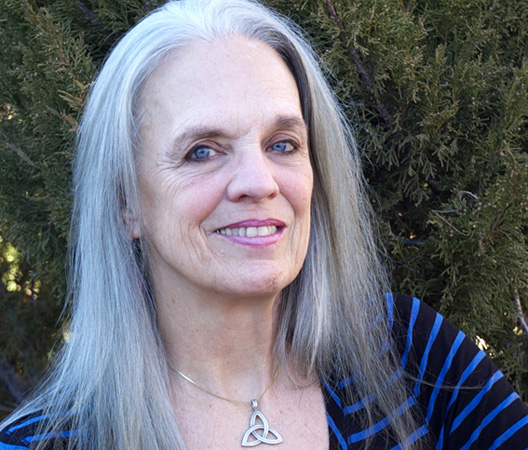
Judith Shaw, a graduate of the San Francisco Art Institute, has been interested in myth, culture and mystical studies all her life. Not long after graduating from SFAI, while living in Greece, Judith began exploring the Goddess in her art. She continues to be inspired by the Goddess in all of Her manifestations. She is now working on her next deck of oracle cards – Animal Wisdom. Originally from New Orleans, Judith makes her home in New Mexico where she paints as much as time allows and sells real estate part-time. Give yourself the gift of one of Judith’s prints or paintings.

Judith’s deck of Celtic Goddess Oracle Cards is available now. You can order your deck from Judith’s website – click here. Experience the wisdom of the Celtic Goddesses!
Don’t Feed the Christians and More Importantly Don’t Feed the Fear by Caryn MacGrandle
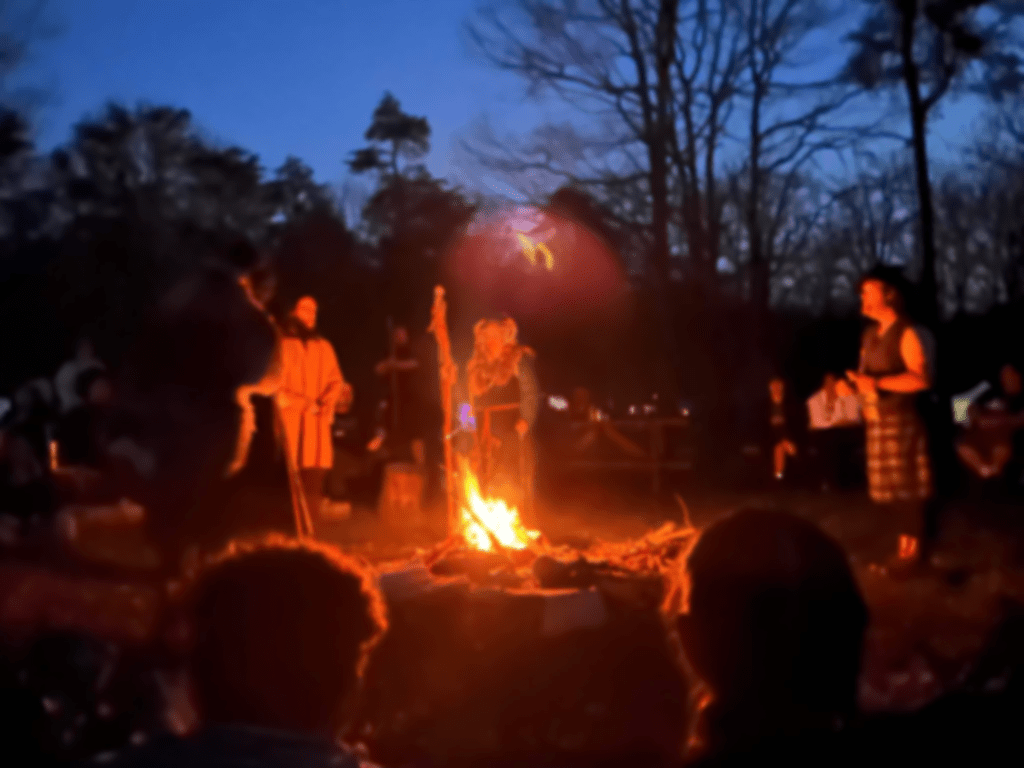
I just returned from a Pagan festival in Tennessee. This is the first overnight event that I have gone to post Covid pandemic and also the first Pagan festival that I have ever been to. Pre-pandemic all the events that I have gone to have been Women’s events and gatherings such as Gather The Women Annual Gathering, ALisa Starkweather’s Daughters of the Earth, Midwest Women’s Herbal Conference and others along those lines.
They pretty much all had a Pagan dusting to them because anything where you find the Divine in the Feminine and in the Earth, rocks, crystals, herbs, the stars, and populated by people who live closer to the Earth, avoid crowds, are empathetic, well, you’ve got Pagan leanings.
But I shied away from the word ‘Pagan’ for a long time, because I grew up Catholic and even though growing up in a very waspy suburb of Dallas, I did not give it much thought at all, I have since realized that the undercurrent of my belief system was that Pagans were evil, animal sacrificing, overly sexual, devil-worshiping and otherwise just something to be avoided.
Rites of May, by Molly Remer
It is important that we share these rituals of celebration and affirmation with our sons as well as our daughters. Men, too, should know the power of joined hands in a circle, voices lifted in song, and sweet words of connection surrounding one another on a bright spring day…
I rose early seeking Beltane dewdrops
with which to anoint my brow.
the cupped violet stems and clover
were dry
and I found no dewdrops
in the chickweed stars.
Instead, I put out oranges
for the orioles,
ran my fingers through the dandelions,
and pressed my nose into the lilacs.
I spotted green flowers
on the mulberry trees,
found the first wild pink geraniums
and tender bells of columbine
and came face to face
with the quiet black eyes
of solemn deer in the raspberry bushes.
These things
their own kind of anointing,
their own small and significant
rites of May Magic.
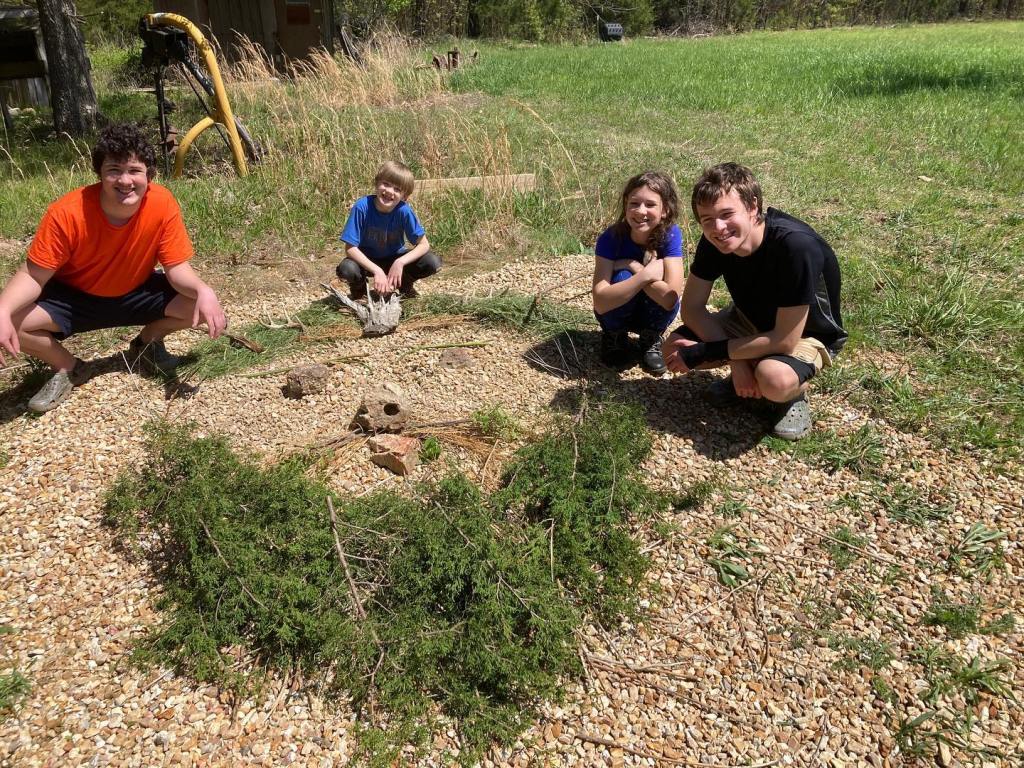
As a family, we traditionally celebrate the May by making a Green Man face in our field, using natural items that we find that day. As a goddess-focused person who walks an almost exclusively goddess-centered/nature-based path, this is one of our few family rituals that centers around more masculine sacred imagery. It is a favorite for my kids—rituals involving multi-age groups should always be as highly participatory as possible. I have written several times for FAR about how my hearth-priestessing has evolved over the years, letting go of more and more control, doing less and less planning, and being more freeform, spontaneous, flexible, and playful. My four children now range in age from 7-18. We have celebrating the turning of the Wheel of the Year for their entire lives. I love how our memories of past rituals inform the present—for example this year’s Green Man had the same rock for a nose that we used for last year’s Green Man.
This year, May Day was bright and sunny with a wild wind. We circled near the driveway, building our Man on the gravel, where his features would stand out against the brown rocks. We gave him antlers formed from cedar branch and white-tailed deer and a crown of a split stump of gray oak. My oldest son trimmed off cedar branches for his beard, my husband pruned the hydrangeas of last year’s dead growth to frame his face, my sixteen year old gathered golden stalks of dry bluestem grass for a mustache, and my 11 and 7 year olds gathered pieces of grass and cinquefoil to trim his hair and beard.
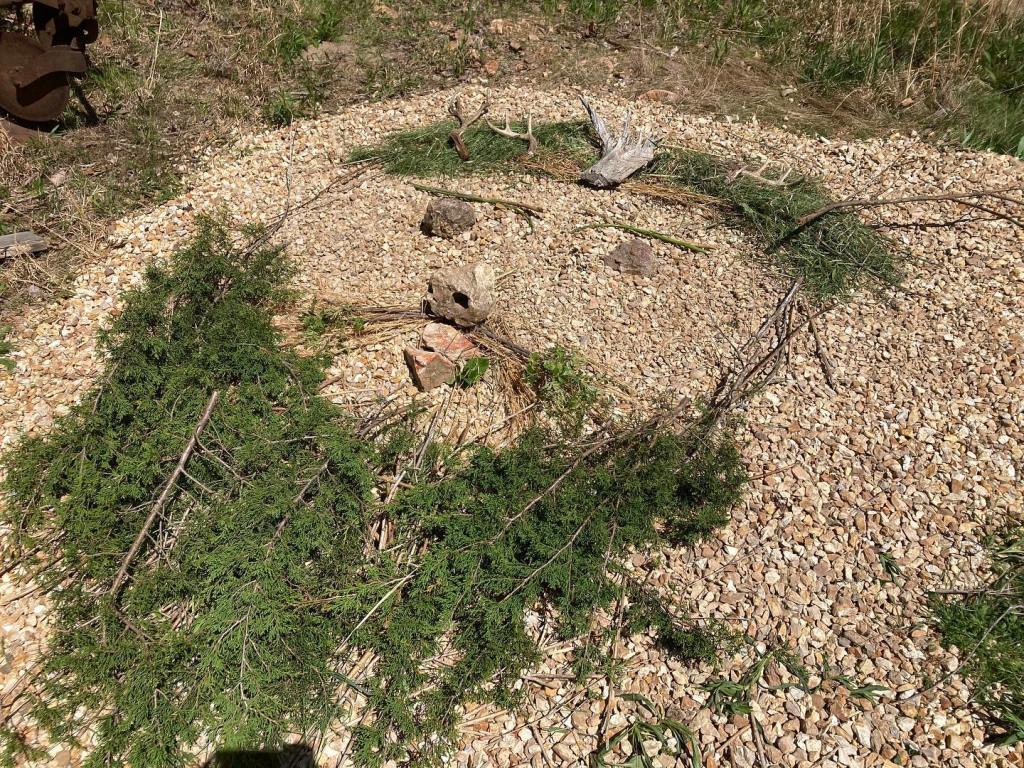
We stood around him in admiration for a few minutes and then I spoke of the bounty, growth, and renewal of this time of year. We stood hand in hand and read the following blessing together (me calling a line and then all repeating it):
A sweet blessing
of the singing sky
to us.
A slow blessing
of the shining flame
to us.
A strong blessing
of the crashing wave
to us.
A soft blessing
of the pulsing earth
to us.
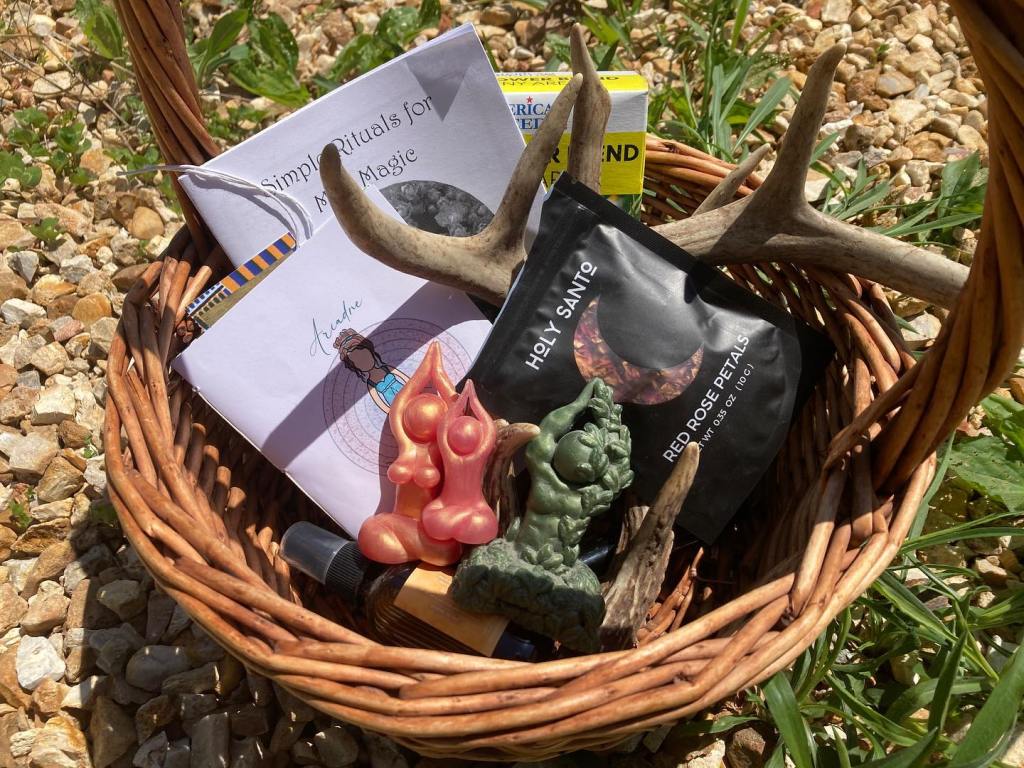
We then offered a wish to one another in turn with a spritz of “Valiant Heart” spray (from Honey and Sage Co). For example, I spritzed my daughter (11) and wished her curiosity and creativity and then she turned to her father and spritzed him wishing him health and prosperity.
I gave everyone four rose petals (whole flowers would have worked well, but I was working on the fly!) and invited everyone to kiss each petal in turn and then offer it to the Green Man (the wind whirled most of our petals away as we released them, which was pleasant as well—our wishes, accepted), based on this past poem:
Find four flowers
and bring them to your lips
one at a time.
One for wonder.
One for joy.
One for love.
One for magic.
Make your promise
invite them in,
one by one
the spell is done.
We sang a few lines together, laughing, from one of Tom Bombadil’s ditties in The Fellowship of the Ring and shouted out, “Happy May!” after finishing our raucous rendition:
Now let the song begin! Let us sing together!
Of sun, stars, moon and mist, rain and cloudy weather,
Light on the budding leaf, dew on the feather,
Wind on the open hill, bells on the heather,
Reeds by the shady pool, lilies on the water…
We then each took a handful of wildflower seeds and sang “Call Down a Blessing” over them, each of us plugging in a blessing word in our turn.
Call down a blessing
Call down a blessing
Call down a blessing
Call down
__________before you
__________behind you
__________within you
and around you.
This song is based on Cathy Parton and Dave Para’s song, but is sung collaboratively with each person choosing a blessing to sing together in the blank space. (A recording of our women’s circle singing this together during a ritual is available here.) We then scattered to plant our handfuls of seeds in whichever place we wished to do so.
This whole ceremony took less than thirty minutes and we closed our largely spontaneous ritual by joining hands and offering our family’s usual closing prayer (learned from our own dear Carol Christ): May Goddess bless and keep us, may wisdom dwell within us, may we create peace.
It is important that we share these rituals of celebration and affirmation with our sons as well as our daughters. Men, too, should know the power of joined hands in a circle, voices lifted in song, and sweet words of connection surrounding one another on a bright spring day.
My oldest son is graduating from high school this month and this week I took him to register for his first college classes. At this threshold moment in parenting, I feel the odd psychological sensation of overlapping generational “timelines,” sometimes feeling like I, myself, have become my parents, while at the same time, feeling like I am a college student myself. But, for now, at this moment, we stand here together under a Beltane sun, laughing together around a Green Man in the stones.
Molly Remer, MSW, D.Min, is a priestess, teacher, and poet facilitating sacred circles, seasonal rituals, and family ceremonies in central Missouri. Molly and her husband Mark co-create Story Goddesses at Brigid’s Grove (brigidsgrove.etsy.com). Molly is the author of nine books, including Walking with Persephone, Whole and Holy, Womanrunes, and the Goddess Devotional. She is the creator of the devotional experience #30DaysofGoddess and she loves savoring small magic and everyday enchantment.
The Magic of the Ordinary, by Molly Remer
“Nothing is so simple, or so out of the ordinary for most of us, then attending to the present.”
— Ernest Kurtz & Katherine Ketcham, The Spirituality of Imperfection
I often speak of being in the temple of the ordinary, of seeing the enchantment in the ordinary. In the book The Spirituality of Imperfection, the authors write that “beyond the ordinary, beyond material beyond possession, beyond the confines of the self, spirituality transcends the ordinary, and yet, paradoxically, it can be found only in the ordinary. Spirituality is beyond us, and yet it is in everything we do. It is extraordinary. And yet, it is extraordinarily simple.”
This spring, I presented at an event and the concept of “being versus doing” arose. I reminded participants that “being” is not a competitive sport. We cannot not be, we are being all the time. I think sometimes the pressure we put on ourselves to be better, to “do” being better, can be really hobbling. Likewise, the sensation that spirituality is somewhere “out there” or that it has to be bigger than or better than or transcendent instead of present in the ordinary. On a goddess based path, with a feminist orientation, I find that the Goddess herself pervades all of existence, pervades your whole entire life, even the rough and weary places, even the ragged and strange places. Returning to Kurtz and Ketcham, they write: “Now…beyond the ordinary is not meant to suggest something complicated, different, different or self-consciously special. Nothing is so simple, or so out of the ordinary for most of us, then attending to the present. The focus on this day, suggested by all spiritual approaches, attending to the present, to the sacredness present in the ordinary, if we can get beyond the ordinary is, of course, a theme that pervades Eastern expressions of spirituality and other expressions too.”
I know that I often find myself seeking or longing for the special moments, the magic, the flashes of transcendence, and sometimes this can cause me to miss the ordinary, to miss the present, to miss where I am because I’m longing for something else. Adages to the effect of “do what you are doing” and “be where you are” may begin to sound cliché almost and the reason they do is because it’s so simple and so out of the ordinary to simply come back to attending to the present. The present moment is, in my eyes, truly where we find the goddess, in the pulse of presence in the every day. In the book She of the Sea, author Lucy Pearce addresses the question of the transcendent ordinary as well: “I want to write of the oceanic mystery, the soul of goddess magic, the sacred that which lies beyond words, because the repeated deliberate seeking of connection to this is at the heart of what I do and who I am. It is my creative and spiritual practice. I want to speak of this so that you can close your eyes turn inwards and smile knowing, just knowing until our conversation can continue without words…I want to share what I have known and for not to sound strange, yet strangeness is its nature. The soul is not of this world. It’s not rational, the sacred is not logical, but nor is this chaotic, magnificent, contradictory, and complex world of ours. And yet, we insist on pretending that it is and being disappointed, afraid, or bemused when it shows us its reality, again and again.”
The sacred is not logical, and neither is the world itself, but we pretend that it is, and then we get disappointed when we see reality. I originally learned the phrase “don’t argue with reality” from self-help author Wayne Dyer. There can be a whole range of potential experiences that are beyond objective reality or the reality that people sometimes insist is all there is. Jeanette Winterson, in her book Lighthousekeeping writes: “I do not accept that life has an ordinary shape, or that there is anything ordinary about life at all. We make it ordinary, but it is not.”
Maybe we are trying to make things ordinary that are not. My kids are growing up and getting ready to graduate from high school. One of my sons is very into science and loves biology and genetics and he is fond of boiling things down to an “everybody’s just a mass of cells having a collective hallucination” type of rhetoric that leaves little room for the esoteric and little room for inherent meaning. However, for me, I come back to the reality of being human as its own kind of miracle, its own profound magic. The reality of having this body with all these cells, which are doing all these things day in and day out that I don’t consciously know how to do, and yet my body does them every single day. That’s magic, even if we can explain the objective “why” of it. I don’t consciously know how to beat my own heart, but wait a second, yes, I do, because here it is beating every day from birth till death. Some people may be quite attached to maintaining the assertion that life is random and pointless, but this is not the story I see. I see wonder. I see magic. I see a miracle in motion. I am awestruck at the impossible reality of being a bundle of cells typing this essay right now. Yes, I am “only” a bundle of cells and that is absolutely pure magic to me. In fact, your very presence right here, right now is proof of the sacred on this earth in my eyes. May we all love the ordinary and let it whisper of the magic right beneath the skin.
Breathe deep
and allow your gaze
to settle on something you love.
Draw up strength from the earth.
Draw down light from the sky.
Allow yourself to be refilled and restored.
There is good to be done on this day.
Let your own two hands
against your heart be the reminder
you need
that the pulse of the sacred
still beats
and the chord of the holy yet chimes.
Molly Remer, MSW, D.Min, is a priestess facilitating women’s circles, seasonal rituals, and family ceremonies in central Missouri. Molly and her husband Mark co-create Story Goddesses at Brigid’s Grove. Molly is the author of nine books, including Walking with Persephone, Whole and Holy, Womanrunes, and the Goddess Devotional. She is the creator of the devotional experience #30DaysofGoddess and she loves savoring small magic and everyday enchantment.
Carol P. Christ’s Legacy: “THE OLD RELIGION” OR A “NEW CREATIVE SYNTHESIS”?
Moderator’s Note: Carol Christ died from cancer in July, 2021. Her work continues through her non-profit foundation, the Ariadne Institute for the Study of Myth and Ritual and the Goddess Pilgrimage to Crete. This blog was originally posted June 30, 2014. You can read its original comments here.
Is Goddess feminism an old religion or a new creative synthesis? Can it be both? Goddess feminism draws on the feminist affirmation of women’s experiences, women’s bodies, and women’s connection to nature; the feminist critique of transcendent male monotheism as the symbolic expression of male domination of women and nature; and 19th and early 20th century discussions of Goddesses and matriarchy.
Most Goddess and other spiritual feminists have experienced Wiccan rituals, which are often simply called Goddess rituals. For many of us, elements of Wiccan practice strike a chord of knowing, while other aspects seem odd or strange or even just plain weird. What are the roots of Wiccan ritual?
Continue reading “Carol P. Christ’s Legacy: “THE OLD RELIGION” OR A “NEW CREATIVE SYNTHESIS”?”From the Archives: Grainne – Sun Goddess/Winter Queen by Judith Shaw
This was originally posted on June 24, 2015. You can see the original comments here.
In the ancient Celtic world the Goddess was the One who expressed Herself through the many. Grainne is such a one. She is both Winter Queen/Dark Goddess, nurturing seeds through winter, and Solar Sun Goddess, welcoming the rebirth of spring. She is Aine’s sister or another aspect of Aine. She, like Aine, was honored at the summer solstice and the first grain harvest of early August with bonfires and torchlit processions on top of her sacred hill at Leinster, Ireland. Remnants of these festivals are still found in folk ritual today.
Continue reading “From the Archives: Grainne – Sun Goddess/Winter Queen by Judith Shaw”On Ukraine, War and Goddess’s Protection by Judith Shaw
We have all been horrified by the Russian invasion of Ukraine as we witness the brutal bombardment of not only military sites but also of civilians, neighborhoods, hospitals, churches, historical sites and nuclear power plants. It has been called the first TicToc war as these images fill up our computers and cellphones, leaving peace lovers challenged to maintain their belief in peaceful resolutions to conflict
Continue reading “On Ukraine, War and Goddess’s Protection by Judith Shaw”Hawk – A Soaring Visionary by Judith Shaw
Hawk, beautiful and deadly, soars high in the air – circling and circling – its piercing eyes focused below. Spotting Hawk, one is amazed by its elegance and power while feeling a strange and ancient connection to this magnificent bird. Yet it strikes fear in the hearts of small animals.
Continue reading “Hawk – A Soaring Visionary by Judith Shaw” Feminism and Religion