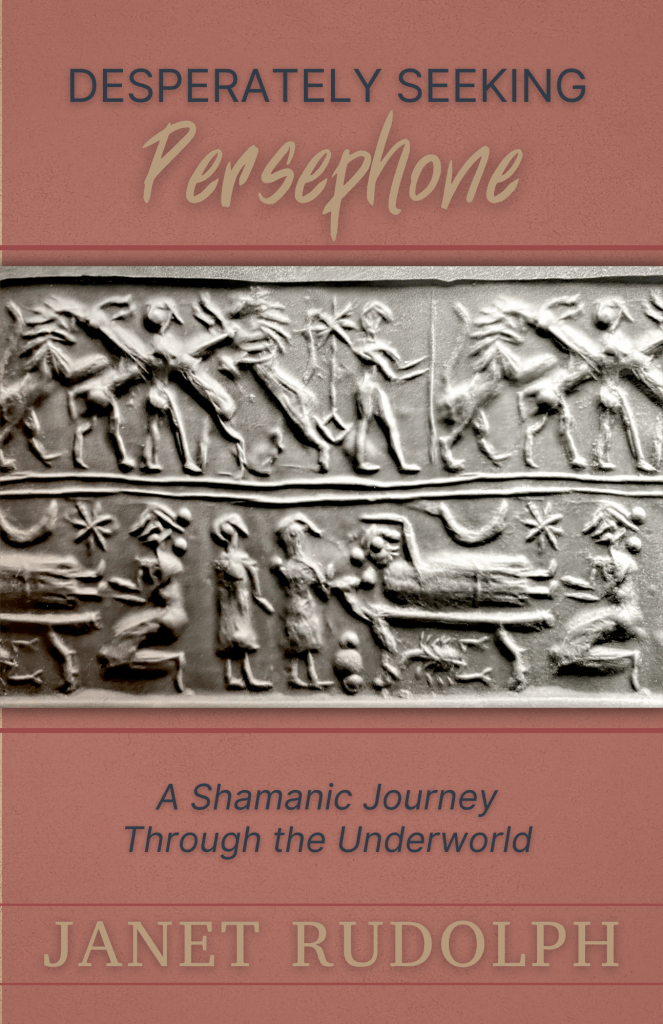
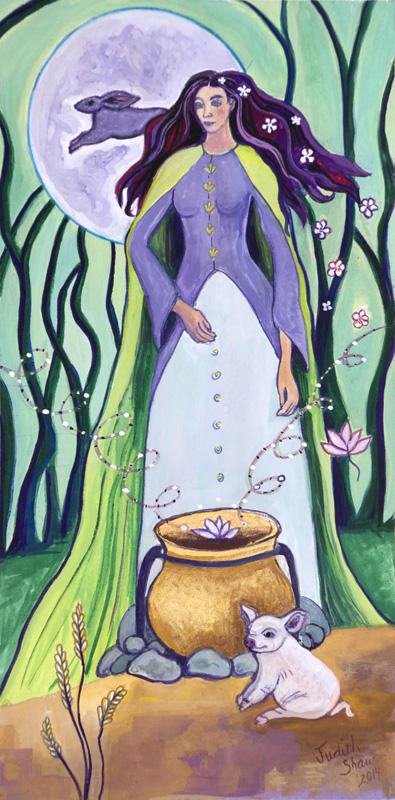
At first glance the ancient belief that bees were birthed from dead bulls seems odd. But if we delve deeply into pre-historical artifacts we discover the mythopoetic roots of this idea.
Our Paleolithic ancestors lived immersed in nature within the cyclical nature of time. For them the moon, which revealed monthly, yearly and even longer cycles of time, became the symbol of the cycle of birth, death and regeneration.
Are cruelty, violence and greed written into the human DNA? Are we destined as a species to continually and for eternity create our world in a hierarchical manner where the privileged few receive almost all of the goods and services while the masses live in slavery of one form or another?
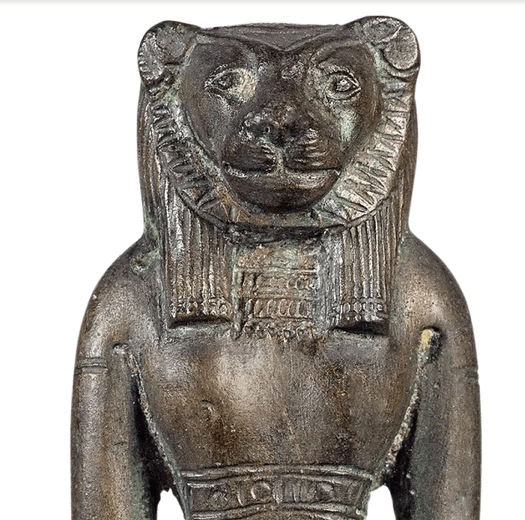
One of the over 700 granodiorite statues made of the Goddess Sekhmet almost 3500 years ago, “the Lady of the Place of the Beginning of Time.”
Molly Remer of Brigid’s Grove, a fellow contributor here at Feminism and Religion recently wrote on the Mother Well section of the divine feminine app: “I feel like Inanna & Enheduanna are all around in recent months!”
Yes. I do as well.
A year or two ago, I read a book by Lauren Sleeman entitled ‘Behold’. The premise of the book has remained with me: a telling of the Goddesses, in particular Lilith, the Great Mother and Crone of the Cosmos, and Hekate, Goddess of the Dark Moon and the Mysteries of Life, who have been silently watching and waiting these past few thousand years to return to our human consciousness.
Yesterday I wrote about the priestess/scribe Enheduanna and her warrior/king father Sargon. I posited their connection to the codification of patriarchy. They did not invent it, as war and the diminution of women had been happening in some circles. I do wonder, however, if they furthered it along to a point of no return.
Another king of the time, Urukagina from circa 2350 bce[1] codified laws under the guise of reformation. Some of his reforms were progressive in that they sought to protect the poorer classes against aristocracy and the priesthood. But they also were clear to let women “know their place.” Here are the translated words from his laws:
“If a woman to a male has spoken . . .[bad] words(?) which exceed (her rank?), onto the teeth of that woman a baked brick shall be smashed, and that brick will be hung at the main gate.”
I make a vow of self-sovereignty, a declaration of wholeness, a promise to myself that I will keep: I vow to listen to my heart, to claim my power and my voice. I vow to live my own magic, to step into the center of my own life and live from there. I vow to live a life that includes space for me, to stand up for what I need, to listen to my longings, to honor my inner call, to do my own work with trust. I vow to never abandon myself. I vow to inhabit my own wholeness in all ways.
In February, I signed up for a Vow of Faithfulness class with WomanSpirit Reclamation. Guided by Patricia Lynn Reilly (of “Imagine a Woman” and A God Who Looks Like Me fame) and Monette Chilson, the class was based on Patricia’s book, I Promise Myself: making a commitment to yourself and your dreams. Structured as a seven week online women’s circle, the class took us on a deep dive into vow-making, culminating in a vow ceremony in which we made a public (to the class that is) declaration of our own vows to ourselves. As the class unfolded, I found myself reviewing past vows as well as sensing new vows bumping up against my consciousness, whispering to be heard.
Night becomes day, winter becomes spring, children become adults who become elders who become ancestors – transformation is a theme that appears again and again in our myths, legends and natural world.
But transformation is not easy as it requires us to let go of the old, the comfortable, the familiar and make way for the new and unknown. We can look to myth and legend with their many instances of transformation for guidance through these difficult moments.
Imbolc brings an invitation into change, to step into the forge of transformation, to sink into the holy well of healing, to open ourselves up to an evolving path of growth and discovery. It is now that we remember we are our own seeds of promise and while there is time yet to stay in the waiting place biding our time and strengthening our resources so we have what we need to grow, soon we will feel the wheel urging us onward, the call to set forth becoming unmistakable and strong. Let us settle ourselves into center, nestle into trust and determination, and extend outward from here feeling the sweet wind caress us and the fiery forge beckon us as we heed the summons to roll on, the path opening up before us as we move.
One of the members of my app put a Yule event in Tuscambia, Alabama on the divine feminine app. The description is as follows:
A FREE EVENT! Saturday December 3 from 1-9pm. Come out and enjoy the Celtic and Mystical Vibes of the Holiday Season! Dress up if you would like in Celtic, Viking, gods or goddesses, wizards, witches, or any other mystic! Enjoy last minute holiday shopping, downtown local restaurants and some street food, some street performers and photo ops with a 7 foot Krampus and others in character walking around! A very entertaining event in the quaint downtown of Tuscumbia, AL. See you there!! – Hesperia Mystic Shoppe
A few leaders from local churches became upset upon learning of the event saying that they were inviting in demons with this event (the Krampus is what they were particularly opposed to). They asked to speak at the local council meeting, and you can see a news story and video here.
Find some pine trees and a wide rock in the sun. Settle down and feel gratitude curl around your shoulders. Listen to the wind sense that there is sorrow too in this place, deep and old, threaded through the lines of sun slices of shadows. It tells of what has been lost, what has been stolen, of silenced stories, and of fracturing. Make a vow, silent and sacred, to do what you can, to rebuild the web to reweave the fabric. Lie on your back in the pine needles, feel your body soften into the ground and become still. Allow yourself to feel held, heavy bones and soft skin becoming part of the land. Wonder how many of your ancestors kept other people from becoming ancestors themselves. Watch the sunlight making tiny rainbows through your eyelashes and pines. Find a pretty rock. Don’t take it. Leave it where it belongs, on the land that gave it birth. Go home. Keep your promise.
In the United States turkeys are equated with Thanksgiving. But there is so much more to Turkey – a gentle creature who forms strong attachments. Reputed to be dumb, Turkey is in fact quite intelligent and curious, with the ability to solve problems. Turkeys have an excellent understanding of the details of their location which makes them so successful at feeding themselves. They also love to play and to cluck along with music.
photo by Tony Castro
Turkeys, indigenous to North America, evolved over 20 million years ago and share a common ancestor with grouse, pheasants and other fowl. Two species of wild turkey exist today – the wild turkey of eastern and central North America of which there are 5 sub-species and the ocellated wild turkey of the Yucatan.
Yet why is turkey named turkey? Strangely enough it was a mistake. English colonial settlers thought turkeys were a type of guinea fowl which England imported from Turkey – thus the name. The Spanish word for turkey is guajolote which is derived from the Nahuatl (Aztec) name huexolotl.