

Our bounty is in
creativity
friendship
community
the myriad small adventures
of everyday.
We tell of magic
and moonrise
and listening to the pulse
of the earth beneath our feet.
Ah, October. Fall has settled into the trees and air. Last year on Samhain (Halloween), as the sun was setting and the full moon was rising, my family stood together in the dim light on our back deck, lit a fire in a hollowed out pumpkin and offered handfuls of herbs into the flames as we celebrated our blessings, our harvests, and our bounty, as a family and as individuals. As we spoke aloud our blessings and our bounty, our words got deeper, broader, and more authentic. My twelve year old son stepped forward to say how thankful he is that he gets to live with his best friend, his fifteen year old brother, and they embraced over the flaming pumpkin. My fifteen year old son offered his thanks for a family that has “cool 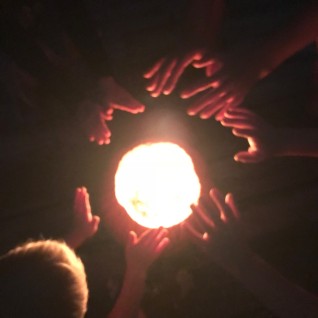 rituals like this” and my four year son offered his blessings for the “energy we feel together.” My seven year old daughter offered her gratitude for pandas and for toys.
The next week, we returned the seeds to the pumpkin and released it to the outdoors to grow next year.
Seventeen years ago, I held my first Winter Solstice ritual. I wrote my wish for a baby onto a small piece of paper and rolled it up into a “seed” of my dreams that I planted within a special wooden box. On the autumn equinox the following year, I gave birth to my first child, a son who now stands inches above me, but who joins hands with his family each month to sing “Dance in the Circle of Moonlight” together on the back deck under the full moon.
After having this first baby, it became increasingly important to me that we celebrate holidays and traditions that reflect our spiritual values and worldview rather than the packaged version of the holidays offered by society, or the religious observances of dominant faiths that do not match our own. While we have celebrated the wheel of the year together in a variety of ways in what has now been sixteen years of parenting and twenty-one years of marriage, it wasn’t really until last year that I felt I finally, truly hit my stride in planning fulfilling, nourishing family rituals. Perhaps it is because I am no longer trying to juggle nursing a baby or changing a diaper while simultaneously also guiding a ceremony. Perhaps it is because I’ve loosened up and accepted the myriad imperfections possible within a multi-age celebration. Perhaps it is because when one of the children wanders off during circle or interrupts me while I’m talking, I accept it as part of the flow, and continue our work without breaking my stride. Perhaps it is because I now laugh too when someone makes a joke during my careful ritual, and continue to roll with it, instead of feeling like it is disrespectful. Perhaps it is because I consider a 15-20 minutes family ritual perfectly sufficient instead of trying to plan for a full-fledged, retreat-style “program” of activities. Perhaps it is because we’ve joined hands in family circle in so many ways and for so many years that we all now trust that I’m not giving up on doing this together.
In the course of the year we’ve anointed one another’s foreheads with fragrant oils while standing in the freezing water of a freshwater stream. We’ve felt the raindrops kiss our faces and the rays of the sun peek in and out of the clouds as we celebrated the summer solstice by releasing wildflowers into the river. We’ve howled at the moon together, built a green man face from leaves, stones, and sticks in the field, created flower mandalas, thrown pinches of cornmeal into the woods as a symbolic sacrifice, soaked our feet in warm water laced with rose petals and then massaged one another’s feet with lotion, walked through a spiral of candlelight, and offered handfuls of herbs into a flaming pumpkin.
As we notice the changing seasons and honor the call of nature within our lives through ceremony, celebration, and song, we make visible the interconnected dance of life. We reaffirm our commitment, our relatedness, to each other and to the natural environment around us. We communicate with and are in relationship to that larger force of life and spirit that we call Goddess. And, we bring our spiritual beliefs into our bodies, hands, minds, and hearts in an ever-spinning Wheel of celebration, attention, observation, enjoyment, communion, and love.
“We can think of ritual as the container we weave in which we can be carried away by magic and ecstasy.”
—Starhawk and Valentine, The Twelve Wild Swans
For your own flaming pumpkin ritual, choose a large, round pumpkin, cut off the top 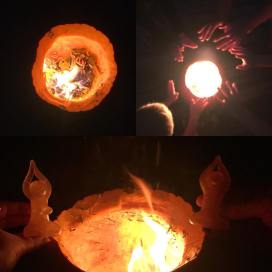 and hollow it out. Keep the seeds to plant with the remnants of your fire later. You may start the fire with paper and a lighter and then keep adding herbs to keep it burning, or you may stoke it by putting some alcohol in the bottom of the pumpkin to begin with. Alcohol burns cool and can create a longer lasting, less smoky flaming pumpkin. Offer your autumn bounty into the pumpkin with herbs sprinkles/handfuls—these can be spontaneous spoken aloud declarations of your harvest, your celebrations, your gratitude, etc. What are you thankful for?
- Optional: offer any sacrifices/releasing on slips of paper into the flames
- Optional: Sing “Hallowed Evening” chant (by my kids and me)
Hallowed evening
Hallowed night
We dance in the shadows
We offer our light.
Additional Articles:
- All We Need to Make Magic by Molly (Feminism and Religion)
- Tips for Rituals with Kids by Molly (Brigid’s Grove)
- To Light a Flaming Pumpkin cross post with full family Samhain ritual.
- Flaming pumpkin inspiration from Coloring Book of Shadows: Planner for a Magickal 2018 by Amy Cesari



 The awakening occurred at 1:27am with the pterodactyl-cry only uttered by toddlers. It continued around 2am when said pterodactyl joined weary moms in bed. Stinging tears splattered pillows with a swift headbutt to my nose, later accompanied by footied talons jabbing my ribcage as this tiny person became the human crossbar of a giant “H,” vertical moms arching precariously on either edge of the overstuffed bed. 5:30am came all too soon as both children arose, crows louder than any rooster, tired moms stretching their aching backs. Navigating this whole feminist parenting thing is complicated, y’all. As an artist, author, activist, and academic, I thought I had a handle on my identity and vocation; now I feel like motherhood is the only moniker defining my exhausted reality.
 Last year, I turned 40 and started grad school while working part time at the public library as the Children’s Services Manager, living in a cohousing community, volunteering with my Sisterhood, and raising three teenagers. I’m between semesters at the moment and I’ve had a chance to do some reading by choice instead of reading by syllabus. One of the titles I picked up during this semester break was
  Sometimes, being overwhelmed with guilt makes one unable to act. Other times, guilt manipulates and attempts to control. It might offer a sense of responsibility and concern. More often than not, guilt comes bundled in small doses of should-haves and could-haves.
 Feminism and Religion