In the TV film about American suffragists “Iron Jawed Angels” Alice Paul (played by Hilary Swank) says to a psychiatrist who came to prison to assess her mental state during her hunger strike:
You asked me to explain myself. I just wonder what needs to be explained. Let me be very clear. Look into your own heart. I swear to you, mine’s no different. You want a place in the trades and professions where you can earn your bread? So do I. You want some means of self expression? Some way of satisfying your own personal ambitions? So do I. You want a voice in the government in which you live? So do I. What is there to explain?Continue reading ““Suchness” of inequality vs. the “story” of patriarchy by Oxana Poberejnaia”
Earlier this week, social media was all abuzz about the Pope’s investigation into restoring women to the diaconate. In the complete transcript of the Pope’s comments, the traditional notion of women’s maternal role in the church is mentioned in relation to the Church. Certainly this is nothing new. Here the Pope describes important “maternal” work such as working with the marginalized, catechesis, and caring for the sick – once again, nothing new.
However, in the next sentence, a very subtle shift is seen when it comes to normative gender roles:
…. there are men who do the same [work as consecrated women], and it is good…..and this is important.
What does this mean – a change in language? a laying of groundwork? or nothing at all?
It is no secret that cultural constructs of women as maternal and how a mother is defined as or even does has radically changed in today’s society; but, the Church continues to remain steadfast in normative roles between the priesthood and the “motherhood” of the Church (and therefore “motherhood” in general).
Stalé mám žlutou knihu tak neumím slova. (I’m still in the yellow book, so I don’t know the words). Mluvíš o něčem ale nevím co říkáš. (You are talking to me about something I don’t know what you are saying). Neznám jí. (I don’t know her).
The Czech language has three verbs that express knowledge. The first umět expresses one’s ability. Literally, one doesn’t know because one lacks the skill or hasn’t been taught how to do something. The second vedět captures more the idea of stating facts or events. It almost always requires a connecting word like “that, what, which, etc.” One can’t use this verb with a direct object with one exception: to vím (I know (it)). The third verb znát signals familiarity and it can only be used with a direct object. So, if you want to ask if someone knows someone else, you use znát, if someone knows when the movie starts, vedět, and if someone knows how to play the piano, umět.
So in other words, the three sentences above are better translated as follows: I’m still in the yellow book so I haven’t learned the words; you are talking to me about something but I don’t understand what you are saying; I’m not familiar with her.
Despite all of the ways Western society has separated the spiritual pursuit from the material and deemed spirituality superior to physicality, the religious holiday of Pesach doesn’t. In fact, it is the physical liberation of the Israelites from slavery in Egypt that starts them on their path toward the covenant and an even deeper spiritual connection to the divine. The Exodus story overflows with images, tales and situations in which: bodies are not ignored; nourishment, comfort and care is addressed spiritually as well as physically and the divine’s spiritual gift, so to speak, to the Israelites is not some other-worldly paradise but a this-worldly land flowing with milk and honey.
Of course, this doesn’t mean that the story is perfect: it is replete with war, murder, militarism, forms of colonialism and other manifestations of patriarchal violence. Patriarchal influences encourage androcentric tellings of events and sexism as well. Three examples are the all-male priesthood, the tenth plague “death of the first-born” (of course the only first born that counts are boy children), and the over-the-top covenantal concern about women as menstruators, adulterers, untrustworthy and so on. These aspects are important to acknowledge and critique, but we cannot stop there. We must cherish the story for its insights as well. Continue reading “Pesach, Toilets, and Clean, Local Water: Seemingly Mundane Yet Necessary Components of an Embodied Liberation by Ivy Helman”
In “Ecofeminism and Wilderness,” Linda Vance believes that Western society defines wilderness by “… the absence of humans, we are saying, in effect, that nature is at its best when utterly separated from the human world. The idea of wilderness is thus an extreme manifestation of the general Western conceptual rift between culture and nature,” (62). Reality television shows, focusing on survival or living off the land, often reproduce this dualistic way of thinking.
At the same time they reproduce another of Vance’s concerns, “I would argue that wilderness recreation “re-creates” more than the self: it also recreates the history of the conquest of nature, the subjugation of indigenous peoples, the glorification of individualism, the triumph of human will over material reality, and the Protestant ideal of one-on-one contact with G-d. And as for the elements of physical challenge and risk, I think it goes without saying that they appeal most to those for whom day-to-day mobility is a given, and for whom danger isn’t always close at hand,” (71). However, by presenting this dichotomy, many of the shows also subvert the ideal of untouched wilderness, challenge the notions of human abilities and highlight our lack of embeddedness and embodiment when it comes to survival situations. Continue reading ““Respect: Dualism Subversion and So Much More in Survival Reality Television,” by Ivy Helman.”
At the time of climate change and crises of capitalism we need to drop our sense of entitlement to comfortable life or even to life at all. Nature will not spare us just because we are humans. When the meltdown of economic and environmental systems occurs, we are all going down: humans and non-humans, women and men, spiritual or not. We have almost run out of time.
Victor Pelevin, my favourite contemporary Russian author, has a novel called “The Sacred Book of the Werewolf“. I love it in part because, like Kill Bill, it is a rare creation by a male author, which manages to capture the female warrior spirit.
It starts with the main character, a Chinese Buddhist Were Fox who lives in present-day Moscow, consoling herself: “What else (or What the fuck) did you expect from life, A Huli?” A Huli is her name, supposedly meaning Fox A in Chinese. It is also a swear phrase in Russian, meaning “What the fuck?”
Like you, I am no longer a young woman. Like you, I am a lifelong feminist activist. But, unlike you, I am not supporting Hillary Clinton. I am supporting Bernie Sanders because of–not in spite of–my feminist principles. I came into the feminist movement through the antiwar, antipoverty, and civil rights movements. My feminism cannot be reduced to the single issue of women’s rights. I believe that feminism can and must be intersectional and inclusive of issues of class and race. For me it must also include an analysis of the relationship between patriarchy and war, which I have discussed in a series of blogs on Feminism and Religion that I hope you will read.
I believe the future of the United States (and the world) requires us to dismantle the system in which the 1% owns more of the world’s resources than the rest of us combined. As you and I both know, poor women of color are at the bottom of this system, both in the United States and worldwide. As you and I both know, there are reasons to seriously doubt if democracy can function in a political system in which the 1% can buy candidates and fund voter suppression. Continue reading “Dear Gloria: The Feminist Candidate I Can Believe In Must Be Unbossed and Unbought by Carol P. Christ”
I have never understood the logic behind sexism. Why is half (or so) of the human race better than the other half? Of course, patriarchy and patriarchal religious traditions offer various seemingly logical reasons, sometimes even divine explanations for the inequality between the sexes. Still, the –isms of patriarchy, whatever their “reasons” or perhaps better excuses, puzzle me.
Even more puzzling are the steps patriarchy-orientated men and women take to preserve these distorted systems. Violence usually goes hand-in-hand attempting to control others in order to preserve the status quo. Obviously if you need to resort to violence to keep people in their place, there is something horribly wrong with society. That being said – one could say that almost no society, nation or culture in our modern times doesn’t have some form of patriarchal violence within it. One would be correct to attribute some measure of the increase of violence to globalization, capitalism, fear, past colonialism and/or neocolonialism. Nonetheless one is hard pressed to find a culture without sexism, without patriarchy and without the need to keep the system in place through violence. Continue reading “Mazel Tov Tzidkaniyot of the Wall by Ivy Helman”
She appeared on a hill on December 9, 1531. She spoke to Juan Diego in his native tongue of Nahuatl; the language of the Aztecas. She asked for a church to be built at that very site in honor of her, the Virgin Mary. Juan Diego took the request to the local priest, but his story was not believed. On December 12, following further instructions from La Virgen, Juan Diego was able to find and pick roses not native to Mexico. He rolled them up in his tilma and returned to the priest. When he unrolled his tilma to present the roses, there on the tilma was the image of La Virgen de Guadalupe; she was as dark as the natives themselves.
Natives across Mexico and throughout the Americas endured the brutal realities of conquest, and experienced the relegation to second class citizens during the colonial period in Mexico. In particular, native women experienced oppression two-fold. This is evident in the fact that native men had privileges and opportunities within the public sphere of society which were denied to women, such as holding particular types of public service positions.
So how is it that millions of natives across the continent converted to Catholicism, the religion used by their oppressors to justify the horrors and atrocities inflicted upon them? The appearance of La Virgen to Juan Diego. She is seen as the blending of the Indigenous and European cultures. A Huffington Post article, Everything You Need to Know About La Virgen de Guadalupe, explains, “Her image has been used throughout Mexican history, not only as a religious icon but also as a sign of patriotism.” Indeed, she has appeared as a symbol even in the most pivotal of moments, such as the fight for Mexican independence and the Mexican Revolution. The authors of the study The Evolving Genre of ‘Our Lady of Guadalupe’: A Feminist Analysis, also note that she has become “. . .the ideal model for womanhood and motherhood.” Continue reading “La Virgen de Guadalupe: New Feminist Portrayals by Jose Duran”
In recent years “the Sacred Feminine” has become interchangeable with (for some) and preferable to (for others) “Goddess” and “Goddess feminism.” The terms Goddess and feminism, it is sometimes argued, raise hackles: Is Goddess to replace God? And if so why? Does feminism imply an aggressive stance? And if so, against whom or what?
In contrast, the term “sacred feminine” (with or without caps) feels warm and fuzzy, implying love, care, and concern without invoking the G word or even the M(other) word–about which some people have mixed feelings. Advocates of the sacred feminine stand against no one, for men have their “sacred feminine” sides, while women have their “sacred masculine” sides as well.
Nothing lost, and much to be gained. Right? Wrong.
Perseus with the Head of Medusa: Sacred Masculine and Sacred Feminine?
When Goddess feminism emerged onto the scene early in the feminist movement, it had a political edge. It was about women affirming, as Meg Christian crooned in “Ode to a Gym Teacher,” that “being female means you still can be strong.” Goddess feminism arose in clear opposition to patriarchy and patriarchal religions. It was born of an explicit critique of societies organized around male domination, violence, and war; and of the male God or Gods of patriarchal religions as justifying domination, violence, and war. In this context, “the sacred masculine” was not understood to be a neutral or positive concept. To the contrary, the male Gods of patriarchy were understood to be at the center of symbol systems that justify domination.
The terms “the masculine” and “the feminine” were floating around and sometimes evoked in early feminist discussions, but when examined more closely, they were rejected by most feminists as mired in sex role stereotypes. The psychologist Carl Jung, for example, associated the masculine with the ego and rationality and the feminine with the unconscious. True, he argued that modern western society had developed too far in the direction of the masculine and needed a fresh infusion of the feminine in order to achieve “wholeness.” This sounded good, but when feminists looked further, they discovered that Jung and his followers harbored a fear of the uncontrolled feminine.
Jungians consider the unconscious to be the repository of undisciplined desires, fears, and aggressive feelings that require the rational control of the ego. Though strong and intelligent women were among Jung’s most important followers, Jung and his male companions retained a fear of independent women, speaking of women who developed their rational sides fully enough to argue with men and male authorities as “animus-ridden,” a term not meant as a compliment.
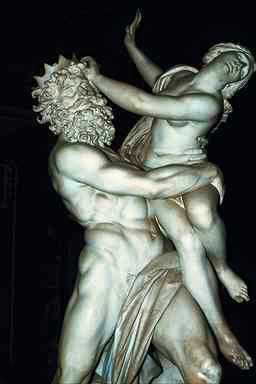
Hades Abducting Persephone: Marriage of Sacred Masculine and Sacred Feminine?
Jungians, following Erich Neumann, understand the progress of history through an evolutionary model in which humanity began in a matriarchal stage in which the unconscious reigned. This period of culture, which spawned the image of the Great and Terrible Mother, was primitive and irrational. Matriarchy was naturally superseded by patriarchy, in which the individual, the ego, and rationality emerged. In the patriarchal stage of culture, male Gods and heroes were the primary symbols, and rationality reigned supreme.
The patriarchal stage of culture had its limitations, which were revealed in the two World Wars of the twentieth century and the nuclear and environmental crises that followed. Rational man, Jungians argued, had come to the point where he needed to reconnect with his feminine side. The unconscious feminine was now understood to be a nurturing matrix that included the body, nature, and feeling, from which rational man should and could never fully separate himself.
The great archaeologist Marija Gimbutas also spoke of two cultures within Europe, an earlier matrifocal one she called Old Europe and a later patriarchal one. The Jungian Joseph Campbell endorsed Gimbutas’ work, leading some to assume that Gimbutas and Jungians hold similar theories of human history. In fact they do not: Gimbutas did not subscribe to an evolutionary theory of culture. She would never have said that the earlier matrifocal culture “had to be superseded” by the later patriarchal culture “in order for civilization to advance.” The clear conclusion to be drawn from Gimbutas’ work is that the patriarchal culture was in almost every way inferior to the one it replaced.
For Gimbutas, the agricultural societies of Neolithic Old Europe were peaceful, egalitarian, sedentary, highly artistic, matrifocal and probably matrilineal, worshiping the Goddess as the powers of birth, death, and regeneration. These societies did not evolve into a higher stage of culture, but were violently overthrown by Indo-European invaders. The culture the Indo-Europeans introduced into Europe was nomadic, patriarchal, patrilineal, warlike, horse-riding, not artistic, worshiping the shining Gods of the sun as reflected in their bronze weapons. Gimbutas did not look forward to a new “marriage” of matrifocal and patriarchal cultures. Rather she hoped for the re-emergence of the values of the earlier culture. Her theories had a critical edge: she did not approve of cultures organized around domination, violence, and war.
This critical edge is exactly what is lost when we begin to substitute the terms “sacred feminine” for “the Goddess” or “Goddess feminism” and “sacred masculine” for “patriarchy” and “patriarchal Gods.” When we allege that we all have our “masculine and feminine sides,” and that it is important “to reunite the masculine and the feminine,” it is easy to forget that in our history, the so-called sacred masculine has been associated with domination, violence, and war.
If we hope to create societies without domination, violence, and war, then we must transform the distorted images of masculinity and femininity that have been developed in patriarchy. We must insist that domination, violence, and war are no more part of masculinity or male nature than passivity and lack of consciousness are part of femininity or female nature. It may feel good to speak of reuniting the masculine and the feminine, but feeling good will not help us to transform cultures built on domination, violence, and war.


 In the TV film about American suffragists “Iron Jawed Angels” Alice Paul (played by Hilary Swank) says to a psychiatrist who came to prison to assess her mental state during her hunger strike:
 Earlier this week, social media was all abuzz about the Pope’s investigation into restoring women to the diaconate. In the



 It starts with the main character, a Chinese Buddhist Were Fox who lives in present-day Moscow, consoling herself: “What else (or What the fuck) did you expect from life, A Huli?” A Huli is her name, supposedly meaning Fox A in Chinese. It is also a swear phrase in Russian, meaning “What the fuck?”
 In the past week, founder of Ms. Magazine Gloria Steinem, whom I have always greatly admired,
  I have never understood the logic behind sexism. Why is half (or so) of the human race better than the other half? Of course, patriarchy and patriarchal religious traditions offer various seemingly logical reasons, sometimes even divine explanations for the inequality between the sexes. Still, the –isms of patriarchy, whatever their “reasons” or perhaps better excuses, puzzle me.
 She appeared on a hill on December 9, 1531. She spoke to Juan Diego in his native tongue of Nahuatl; the language of the Aztecas. She asked for a church to be built at that very site in honor of her, the Virgin Mary. Juan Diego took the request to the local priest, but his story was not believed. On December 12, following further instructions from La Virgen, Juan Diego was able to find and pick roses not native to Mexico. He rolled them up in his tilma and returned to the priest. When he unrolled his tilma to present the roses, there on the tilma was the image of La Virgen de Guadalupe; she was as dark as the natives themselves.
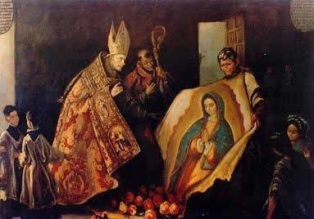 La Virgen de Guadalupe
 ears “the Sacred Feminine” has become interchangeable with (for some) and preferable to (for others) “Goddess” and “Goddess feminism.” The terms Goddess and feminism, it is sometimes argued, raise hackles: Is Goddess to replace God? And if so why? Does feminism imply an aggressive stance? And if so, against whom or what?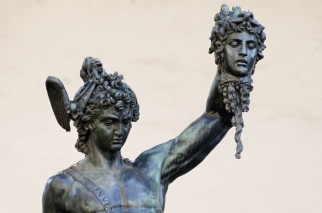
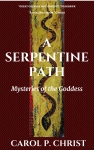 A Serpentine Path: Mysteries of the Goddess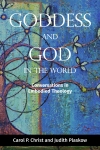
 Feminism and Religion