Last week I had a vivid and visceral dream. I woke from it feeling body sensations as if I had just had the experience I dreamt about.
In my dream I am pregnant—or I am supposed to be pregnant. But I look down at my belly and there is no movement. Nothing. And my belly isn’t very big. I think the baby must have died. Then I feel movement—the feelings of a baby turning over and moving inside me. And I can see right through my skin, like an ultrasound image.
I can see the baby positioning herself to engage the birth canal. She actually uses her hands to click her head into engagement. I realize she is face up and that this will be a painful delivery. I know that she is a girl. Then I see a reflection of myself in the mirror and see that my belly is still high and that the baby has decided to wait. She is not ready to be born.
A year or so before the November 2020 U.S. presidential election, a private Facebook group now titled “Wives of the Deplorables! Go Vote!” came together because many women were distraught about the political ideological rift between them and their husbands—a rift that became more evident as Election Day 2020 drew nigh. Women, stunned and disappointed by the Trump-like behavior (angry, petty, and argumentative) of their Trump-supporting husbands or partners, encouraged each other virtually as Biden (now President-elect) moved closer and closer to winning the White House.
From the group’s private Facebook page: “This is a group created after a CNN report about the wives of Trump Supporters. This is not a politically affiliated group….This females only group is created to support each other and help women share their thoughts.” Continue reading “They Really Do Hate Us* by Esther Nelson”
I have a close family member who is staunchly Republican and frequently posts videos from the conservative platform PragerU or “Prager University.” Video topics include: why the Democratic Party is the “real” racist party (as though either party is innocent of racism), the “war on boys” and masculinity, and how feminists don’t care about Muslim women (as though some Muslim women aren’t also feminists), among other issues. You get the picture. It is a propaganda media source founded by radio talk show hosts which creates short videos on every topic there is, presenting the conservative viewpoint as the simple “God’s honest truth” about the issue.
I’ve seen some of these videos. They are as offensive as they are misleading. But one element that is particularly egregious to me is their complete disregard for larger context. Continue reading “A Case for Context by Sara Frykenberg”
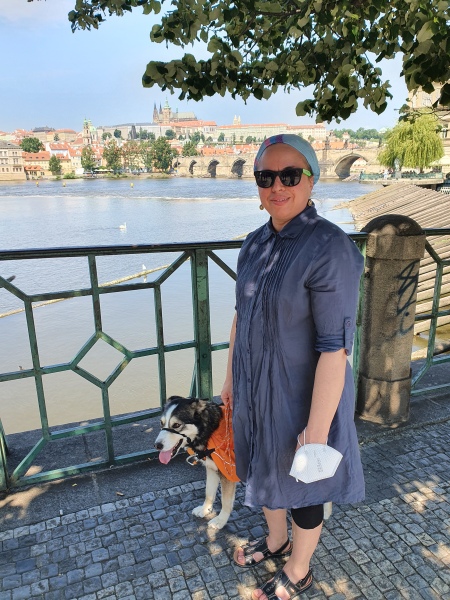
This month more than most, I feel like I have so much to say that I don’t really know where to begin. It doesn’t help that next door they are remodelling an apartment and, outside my window, there is a crew drilling up the sidewalk and another roofing the house across the street. The noise and its echoing are overwhelming on Prague’s narrow streets.
Perhaps the best place to start is with a similarly loud occurrence. On June 27th, Prague commemorated the 70th anniversary of the execution of Milada Horáková using the city-wide intercom system. Minute-long excerpts from her trial and execution were broadcast throughout the day. Horáková, the only woman to be executed during the Communist regime in Czechoslovakia, was a long-time proponent of democracy and women’s rights. In the field of women’s rights, she focused on the status of women and children, spending considerable effort on women in the workplace and reconciling their work with family responsibilities. She was also an outspoken critic of the Nazi Regime, having spent time as a political prisoner in Terezin. When the war ended, she joined parliament, but resigned right after the communist take-over. After continuing to speak out against the Communists, she was arrested in September of 1949 and charged with attempting to overthrown the government. She along with 12 others were interrogated and tried. Four of them, including Horáková were sentenced to death. She was publicly hanged on the 27th of June 1950. Eighteen long years later, she was posthumously exonerated, and in 2000, the Czech Republic unveiled a commemorative tombstone for her in the National Cemetery at Vyšehrad Castle. In 2017, a film was made about her life and legacy.Continue reading “Listening to the Noise: The Connections between Milada Horáková, Anti-Semitism, and the Black Lives Matter Movement by Ivy Helman.”
,A few years ago, I visited the family farm founded by ancestors from Germany in the Pokonos with a newly discovered cousin. The woman I met was delightful: warm and friendly and very much connected to family still living in the area. Her mother had vivid memories of the farm. In contrast, my great-grandmother left home to marry in Brooklyn. My father had fond memories of visiting the farm as a child, but lost touch with the relatives there when his family moved to California in the 1930s.
My cousin was working as a department manager at Walmart. She seemed smart as a button, so I asked her why she had not gone to college. She said that though she had the grades no one encouraged her to do so. Her response made me wonder if I would have gone to college if my part of the family had remained close to the family farm. I was stunned by the roles chance and the choices of others play in our lives. Though I had more education than my cousin, I was not sure that mine was a happier life. I envied the family ties that shaped and defined her days.
In the midst of recent events and protests, a social media campaign entitled #sharethemicnow has emerged. The campaign asked white people and people of influence to use their platforms, quiet their voices, and highlight, heighten, and listen to their Black counterparts. I have been honored and privileged to be a monthly contributor here at FAR for 5 years. This month’s post will be in participation with the #sharethemicnow campaign. This campaign seeks to keep the momentum for the realization and implementation of equality and just treatment for all peoples – regardless of race, religion, gender, or sexual orientation. I asked a dear friend of mine, whom I had the pleasure of working with at Whittier College, to write this post. Dr. Laurel Brown, whose discipline is in Social Work, shares with us some thoughts on Christianity and Social Justice in midst of our current issues.
Following the murders of Trayvon Martin and Tamir Rice, Kelly Brown Douglas released her book, Stand Your Ground: Black Bodies and the Justice of God. In this critical work, she details the embedding of structural violence within the doctrine of American Exceptionalism and the deep rooted racial injustice that our nation was founded upon.
Over the last several months, our world has changed. We’ve witnessed great tragedy and there is so much to grieve. COVID-19 intruded upon our lives abruptly forcing the realization of our misplaced priorities. However, systemic racism has always been here, tightly woven into the fabric of our society; yet privileged voices have failed to answer the call for justice.
As so many risk their health and safety to march for racial justice; to exclaim that Black Lives Matter and that George Floyd’s life was indeed sacred (as was Raychard Brooks, Breonna Taylor, Freddie Gray, Sandra Bland, Philandro Castile, Alton Sterling, Eric Garner…#SayTheirNames), we must consider our own responsibility in perpetuating oppressive structures that condone the trend of public lynchings.
Following the murders of Trayvon Martin and Tamir Rice, Kelly Brown Douglas released her book, Stand Your Ground: Black Bodies and the Justice of God. In this critical work, she details the embedding of structural violence within the doctrine of American Exceptionalism and the deep rooted racial injustice that our nation was founded upon. She explains it was not a book that she wanted to write; rather, as a mother of an African American son, it is a book she was compelled to write. In doing so, Kelly has laid bare the sin of our nation. Five years later, her witness continues to demand our attention.
I reached out to Kelly and asked if she would be willing to talk with me about her book and she graciously agreed. Thus, for this post, I am sharing the wisdom of Kelly Brown Douglas, vlog style, knowing that, in this moment, it is her words that we all need to hear.
Gina Messina, Ph.D. is an American feminist scholar, Catholic theologian, activist, and mom. She serves as Associate Professor and Department Chair of Religious Studies at Ursuline College and is co-founder of FeminismAndReligion.com. She has written for the Huffington Post and is author or editor of five books including Women Religion Revolution. Messina is a widely sought after speaker and has presented across the US at universities, organizations, conferences and on national platforms including appearances on MSNBC, Tavis Smiley, NPR and the TEDx stage. She has also spoken at the Commission on the Status of Women at the United Nations to discuss matters impacting the lives of women around the globe. Messina is active in movements to end violence against women and explores opportunities for spiritual healing. Connect with her on Twitter @GMessinaPhD, Instagram: @GinaMessinaPhD, Facebook, and her website ginamessina.com.
A lof of people have been raving about the Superbowl Halftime show, and for good reasons.
A lot of people have been raging about the Superbowl Halftime show, and for good reasons.
[Please hang in there with me as I conduct a back and forth exercise in this blog post; try to read it all the way through.]
Two famous, talented women of color performed impressive, culturally rich songs and dances, and along with children of color, they denounced the racism and cruel policies of the current administration. In many ways, it was the most progressive, ethically compelling Halftime show in history.
In a recent post I wrote about finding God in music. I confess, I cannot remember the last time I set foot in a church. As a woman, I continually grapple with the foundational messages of Jesus and Catholic Social Teaching and the disconnect with the power structures that seek to control the ways we love and find justice. I long to participate in the culture I grew up in, but cannot support the weaponization of the tradition.
Lately, I’ve come to realize that the messages I connect to I find in music. There are particular songs that offer me the guidance, philosophy, and ideas around meaning and purpose that I resonate with. One of those is “Where’s the Love?” by the Black Eyed Peas.
I’ve been listening to it on repeat lately because it is the sermon I need to hear; it speaks to me and even though it was recorded quite a while ago, it is still relevant. I think it is fair to say that in our current socio-political culture, people are “acting like they got no mamas.”And by the way, I include myself in that statement. Like anyone, I sometimes get so caught up in believing that my way is the only way, I forget to listen to what others have to say.
We are in the midst of a political civil war and are so busy yelling past each other, we’ve forgotten how critical unity is to shaping a healthy government that serves its purpose – caring for the people. Continue reading “Where’s the Love by Gina Messina”
There’s magic in hiking alone, but as women, we’ve been taught to worry about venturing far on our own. In fact, we’ve been taught to worry about a lot more than that.
Though once I merely shrugged off the warnings and the horror stories, confident that I was wrapped in some sort of “not me” protective veil, I don’t usually take my safety for granted anymore. Maybe it’s because I’ve outgrown the belief that I’m invincible. Maybe it’s because I’m a mother and have a different understanding of the fragility of life and the female body. Maybe it’s because that murderer on the Appalachian Trail went by the nickname “Sovereign,” appropriating the powerful, beautiful word that is so essential to my life’s work.
This particular day, however, my desire to be outside was more compelling than my new bend toward caution. I called my husband to tell him just where I’d be, joking that he needed to know where to look for me if I didn’t pick up the girls from camp on time.



 This month more than most, I feel like I have so much to say that I don’t really know where to begin. It doesn’t help that next door they are remodelling
 A few years ago, I visited the family farm founded by ancestors from Germany in the Pokonos with a newly discovered cousin. The woman I met was delightful: warm and friendly and very much connected to family still living in the area. Her mother had vivid memories of the farm. In contrast, my great-grandmother left home to marry in Brooklyn. My father had fond memories of visiting the farm as a child, but lost touch with the relatives there when his family moved to California in the 1930s.
 A lof of people have been raving about the Superbowl Halftime show, and for good reasons.
 In a recent post I wrote about