I was reminded that the idea of eschatological reversal can be a powerful image in the promotion of justice if we believe that we already are, or that we should be moving towards the ultimate end that remedies current injustices.
I started teaching a course in Introduction to Christian Ethics a couple weeks ago for a class of graduate students who are pursuing their M.Div. and other Masters in religion degrees. We are spending some time talking about the use of Scripture in ethics, so I reviewed Richard Hays’ 1996 text The Moral Vision of the New Testament: A Contemporary Introduction to New Testament Ethics. It got me thinking a lot about the role of eschatology in ethics. (Eschatology is the area of theology concerned with “last things,” like the end of the world, heaven, hell, death and eternal judgment.)
Sometimes I think it happened gradually. Other times it feels like sudden change. Either way I find myself in an in-between space that is my life.
With apologies to Victor Turner and his cultural anthropological appropriation of liminality as a threshold space, I have come to view my liminal living as a more permanent dwelling place these days. Turner’s category of liminality locates subjects in the betwixt and between as they move from one manifestation of identity in community to a new kind of integration or role in community. I am starting to wonder, however, if the thresholds are actually dwelling places for some of us in this world.
I don’t know if that means I am actually more marginal than I am liminal. The margins are margins because they remain on the outskirts and they help define the boundaries. Margins are permanent. Am I marginalized if I live at the edges of the communities and identities I use to occupy, perhaps never to return to the bosom of the center? I hesitate to make such a claim mostly because I still occupy privileged spaces not the least of which are those constructed from how whiteness grants access and authority in this world. Continue reading “Living Liminality: Of Thresholds and Dwelling Places by Marcia W. Mount Shoop”
Can women have it all? Possibly. Can men ever have it all? Maybe. Regardless of however we put it, the are ills to every good deed in the world and we need to get back to understanding how and why we use each other in order to fully understand that behind every good man might be a good woman but also behind every good women there might also be a good man.
Growing up, my favorite movie was The Associate staring Whoopi Goldberg as a woman at a Wall Street firm attempting to climb her way up the corporate ladder through hard work and dedication. Her character Laurel Ayres does all the work and comes up with the ideas that clients eventually invest in, her partner Frank takes all the credit and eventually surpasses her at work by getting the promotion she had been vying for. In a prodigious scene that I still vividly remember from my childhood, Laurel quits her job and starts an investment firm on her own; betting every cent and piece of property she has on the eventual success of her new business adventure.
In an attempt to break through the proverbial glass ceiling and play with the big boys of Wall Street, Laurel eventually discovers that although she can be (and is) the genius behind many of the great ideas that would save companies millions, she still needs to have her ideas expelled by a man she creates in order to win over clients, which eventually leads her to become successful. However, while Laurel is reaping in the benefits of having Mr. Cutty, her made up business partner, by her side, she eventually learns that no matter what she does she will always be secondary to her male business partner. Continue reading “Why Men (and Women) Can’t Have It All by John Erickson”
Neil Gilman in his book Sacred Fragmentswrites, “Since our faculty of reason is G-d-given, since it is the quality that distinguishes us from the rest of creation, and since all human beings share that same innate faculty, what better way to establish the veracity of a religious tradition than by demonstrating its inherent rationality?” To be fair, Gilman is not the only and definitely not the first to support this position. Many theologians, especially those influenced by various Greek philosophers like Socrates, Plato and Aristotle, have said the same thing. In the Roman Catholic tradition, Thomas Aquinas is adamant that rationality is humanity’s imago dei, how we are made in the image of God – what the beginning of Bereshit (Genesis) suggests. Descartes argues, “I think therefore I am.
I wasn’t reading it to find out about the origins of the earth in the way the big bang theory explains it. I was reading it to find out what an ancient people thought about the connection between God, the heavens and the earth, and all the creatures and creations in between.
For years, I’ve been fascinated by creation myths. Yet as a feminist, I was taught to be suspicious of the biblical creation myths in Genesis. The creation of man from dust and the subsequent creation of woman from his rib have often been interpreted to support claims about women’s inferiority to men. And obviously, the accounts of Eve and the serpent and her role in “tempting” Adam have been used to justify claims of women’s susceptibility to evil and their wanton natures which lead men astray.
So it was a bit of relief when in my first weeks of study in seminary, my Hebrew Bible professor pointed out that there are two creation myths in the opening chapters of Genesis. I was relieved because Chapter 1 and the first few verses of chapter 2 told a creation story I enjoyed reading. Continue reading “Back to Beginnings by Elise M. Edwards”
It’s incredibly liberating to have the co-mingled sensation of being elevated by aesthetic delight, affirmed by words that reflect the life experiences of you and your loved ones, and honored by another’s desire to relate to you. This type of liberation is spiritual.
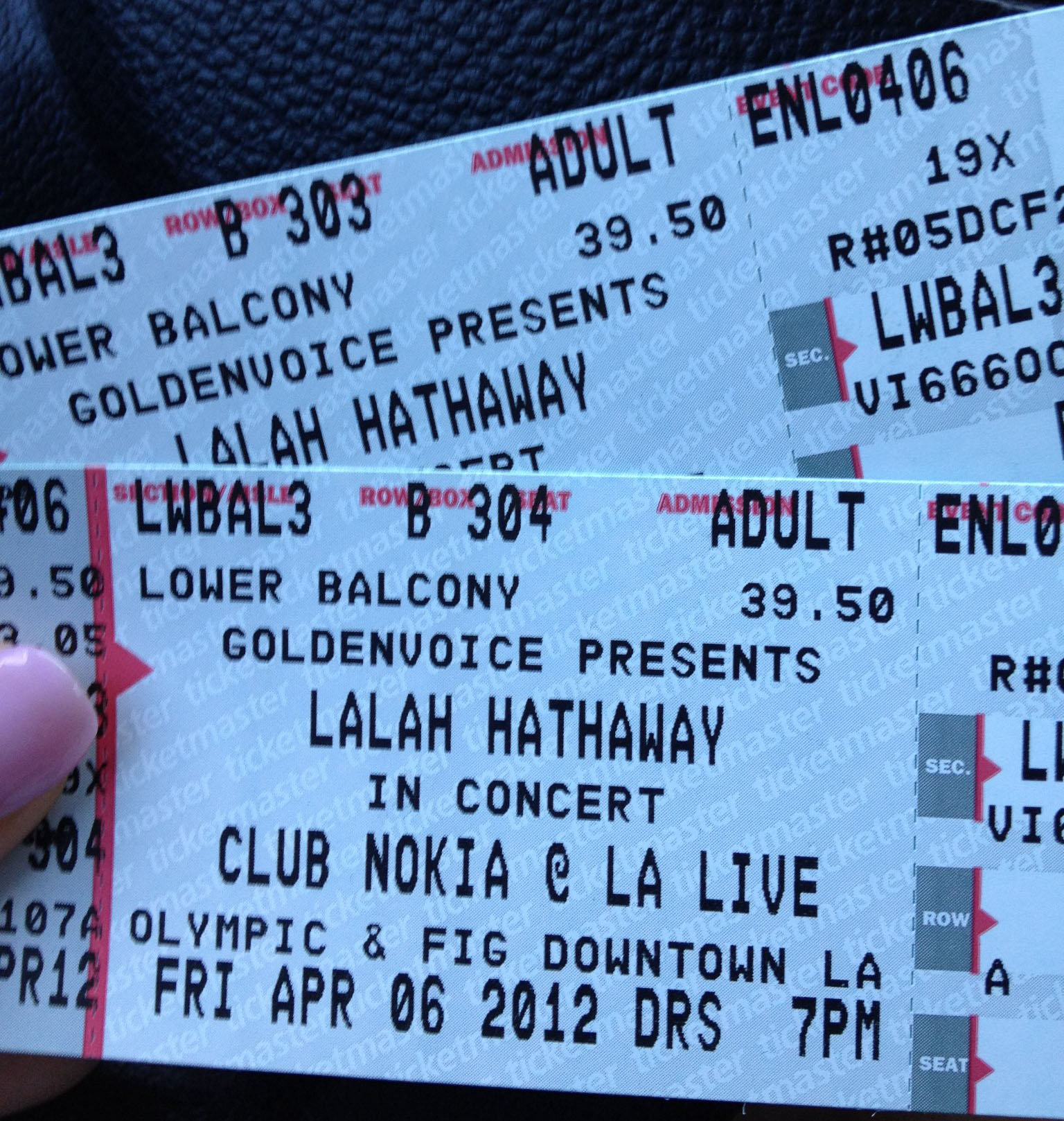
Last month, I attended a Lalah Hathaway concert, the first live concert I think I’ve attended in about a year. For those of you who don’t know, Lalah Hathaway is an R&B singer and daughter of the late Donny Hathaway. It was my first time hearing her perform and the audience’s response to her artistry sparked some thoughts in my mind about authenticity, soul, and participation in the black church.
I should probably admit that my favorite genre of music is R&B/soul because of what its name suggests – the ability of the music to connect to the innermost parts of my being, the spirit inside of me that recognizes what is true. Whether they are speaking about joy or pain, love or loss, soul singers have a way of making me feel the authenticity of their souls conveyed through their music and lyrics. Because I agree with the feminist principle that the personal is political, I believe that feminists must take the time to recognize what is personally true for them and what is most real. This is so that feminists’ energies directed toward making the world a more just place can be sustained during times of struggle, and maintained with integrity, regardless of what sphere they’re located within. Soul music helps me remember who I am. Continue reading “When Music Touches Your Soul by Elise Edwards”
It can only be that She begins in a small way at a single place in the world. It can only be that She begins within us.
Carol Christ’s post this week made me think of a favorite little passage I love from a Catholic theologian, Gerhard Lohfink, who wrote a book about whether God needs the church. I’m not going to engage that specific question here nor am I going to talk about the ins and outs of the book. I simply mention it because it holds within it the beautiful passage that deeply resonates with me and has become the primary image I hold on to when thinking about how I want to participate in the transformation of the world. The passage comes from a part of the book where Gerhard Lohfink muses about how God would start a revolution while still respecting human freedom and participation:
God, like all revolutionaries, desires the overturning, the radical alteration of the whole society – for in this the revolutionaries are right: what is at stake is the whole world, and the change must be radical, for the misery of the world cries to heaven and it begins deep within the human heart. But how can anyone change the world and society at its roots without taking away freedom? (Lohfink, 26)
The issue is that for centuries people have tried and tried again to change the world, to ‘free the masses’ and save people from suffering, misery, and oppression – but too often revolutionaries resort to violence as their means. The systems are so rigidly and stubbornly in place that the revolutionary comes to see no other way to bring about radical social change except through a widespread violent overthrow. Continue reading “How Does Goddess Change the World? by Xochitl Alvizo”
The depth of life’s interconnection is our greatest vulnerability and our greatest hope. We are beings in relation.
Today we celebrate Mother’s Day. Drenched in some strange amalgam of consumerism and genuine desire to nurture the ones who have nurtured us, we buy flowers and gift cards. We plan Sunday brunches or make that extra-long phone call to our mothers living far from us. My own mother, to whom I owe my courage and creativity, lives two thousand miles away. It was she whose breath gave rise to my own, whose gentle strength and fierce passion made way for my being in the world. It is my mother to whom I trace my beginning, and yet, if life is as Anais Nin imagines it, a “process of becoming” are we not ever-beginning? If all life itself is in process, if the powers of destruction and creation flow, creating and re-creating all that is, I wonder at the wombs that make and re-make us.
This process of becoming is an adventure through the whirlwind, a tour of the chaosmos. Our becoming, wrapped up with the becoming of Creation itself, is an unwinding of the fibers of the universe and our own souls, spiraling toward liberation. And so, on this Mother’s Day, I offer gratitude and honor toward all that gives us birth, to all who take part in our process of becoming.
Wave Womb by Galen Dara
In honor of ourselves. There is a sense that each of our beginnings emerges out of a wound, out of a dying. The day I was born was the day I received my first scar. I was a C-Section baby and the doctor nicked the edge of my forehead narrowly missing my eye. Soon enough, the wound healed and I still have a tiny scar by my right eye. Today, many years and many scars later, I marvel at our ability to heal. We give life to ourselves, after the movements of death have swept through us, after long nights of grief and the collapse of all we knew. In the quiet stillness of a soul razed, creativity moves. Continue reading “In Honor of All that Gives Life by Ashley Anderson”
I make a distinction between power and authority. Authority is a personal characteristic based on a relationship of trust between me and a text, a person, or their work. Power, on the other hand, is operative with or without trust.
This past weekend, I had the honor of participating in a workshop on Living Texts: Celebrating Feminist Perspective and Theo/alogy, Authority, and the Sacred in the Academy. The workshop was organized for the Women’s Caucus of WECSOR, a regional association of national organizations who study religion. I was delighted to connect with new friends, mentors and sisters interested in feminism and religion, including some of my co-contributors on this site –Theresa Yugar, Sara Frykenberg, and Corinna Guerrero . There were two panels that shared our reflections about authority from either student perspectives or diverse professional perspectives. I shared my experiences as a student. This workshop was a gathering where women scholars in religion could discuss the challenges and promises of our voices in the academy. Because our dialogue was so inspiring to me, I thought I’d continue the discussion here. Continue reading “My Feminist Perspective of Authority – Part 1 by Elise M. Edwards”
Many women’s dreams have not been realized. How do we come to terms with this thealogically?
Although I am as neurotic as the next person, I am also really wonderful—intelligent, emotionally available, beautiful (if I do say so myself), sweet, caring, and bold. I love to dance, swim, and think about the meaning of life. I passionately wanted to find someone with whom to share my life. I did everything I could to make that happen—including years of therapy and even giving up my job and moving half way around the world when I felt I had exhausted the possibilities at home.
For much of my adult life I have asked myself: What is wrong with me? Why can’t I find what everybody else has? Even though I knew that there were a lot of other really great women in my generation in my position and even though I knew that many of my friends were with men I wouldn’t chose to be with, I still asked: What is wrong with me? Continue reading “ON NOT GETTING WHAT WE WANT AND LEARNING TO BE GRATEFUL FOR WHAT WE HAVE BY CAROL P. CHRIST”


 I was reminded that the idea of eschatological reversal can be a powerful image in the promotion of justice if we believe that we already are, or that we should be moving towards the ultimate end that remedies current injustices.





 Feminism and Religion