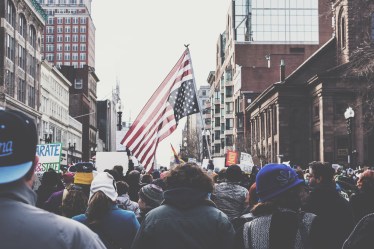
Pride by John Erickson

When we come together, we are the Divine.  I didn’t think I could experience that twice in one year; clearly, I was wrong. 

If you’re anything like me you not only hate opening up your Twitter feed each morning but also feel compelled to in order to make sure you didn’t miss whatever new atrocity to come out of 1600 Pennsylvania Ave. After the Women’s March, I felt charged. I felt that whatever this administration threw at the proverbial “us,” I knew we could and would overcome it. Although that charge kept me going for a few months, there came a time where I just couldn’t go on anymore and that I was completely drained; then walked in a man named Brian Pendleton.

After the Women’s March on January 21, I didn’t know what to expect. The event was truly so successful that many of the organizers and coordinators were on an activist high as a result of what was a truly magical and divine moment. A few months came and went and the 45th President of the United States continued (much to our surprise) to be as awful as we all knew and expected. However, while I am able to exist in a world, no matter how oppressive, as a cisgendered white male and the full on privilege and power that comes along with that territory, many of the individuals and communities being attacked did not have those same freedoms; and like with the Women’s March and how that all took shape, in walked Brian Pendleton to my life to talk to me about the #ResistMarch.
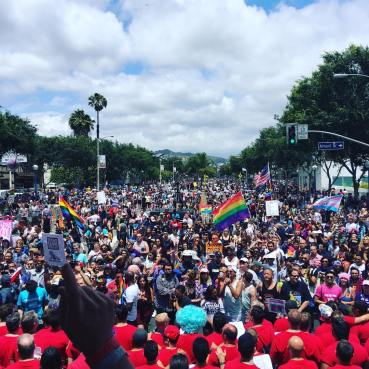
Cover PhotoAlthough my involvement during the 120 days or more that led up to the #ResistMarch happened in a flash, one thing is for certain: miracles exist not because of divine intervention but because G-d places people on this Earth to make positive impacts. The beauty of the #ResistMarch was not just the passion of the organizers but the beauty of the rainbow that came out in full force on June 11

The strength shown by our community was one that, for all intensive purposes, proves that love does conquer all. RuPaul couldn’t have expressed the common and conquering theme better than when he said: “It’s all about love; giving love and being able to receive love. That’s our secret weapon; that’s the one thing they don’t have: our love and our music. That is our activism. That is what we use and what we always use to fight the ugliness.”

That is the one experience that I took most out of the #ResistMarch: the power of love and friendship; the beauty in the unexpected conversation that leads to changing the world, again.  Thank you, Brian. Thank you, for bringing us all together to resist, recharge, and love.
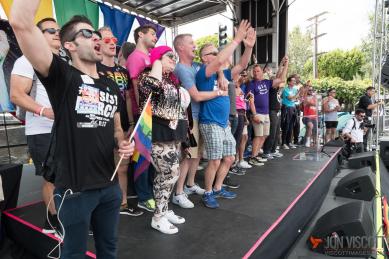
19055531_10158898620590385_6920780108892374453_o

When we come together, we are the Divine.  I didn’t think I could experience that twice in one year; clearly, I was wrong.

John Erickson is the President of the Hollywood Chapter of the National Organization for Women. John is a Ph.D. Candidate in American Religious History at Claremont Graduate University where he is finishing up his dissertation tentatively titled “Step Sons and Step Daughter”: Chosen Communities, Religion, and LGBT Liberation.” John holds a MA in Women’s Studies in Religion; an MA in Applied Women’s Studies; and a BA in English and Women’s Studies. He is the Founding and Past President of the University of Wisconsin Oshkosh’s LGBTQA+ Alumni Association and currently serves as the Chair of the Legislative Committee for the Stonewall Democratic Club, a Diversity and Inclusion Fellow at Claremont Graduate University. He is a permanent contributor to the blog Feminism and Religion, a Co-Founder of the blog The Engaged Gaze, and the Co-Chair of the Queer Studies in Religion Section of the American Academy of Religion’s Western Region, the only regional section of the American Academy of Religion that is dedicated to the exploration of queer studies in religion and other relevant fields in the nation. In April 2017, he was the first openly gay athlete to be inducted into the Wisconsin Volleyball Conference Hall of Fame. Most recently, John was one of the coordinators of the Women’s March Los Angeles, which brought together 750,000 people in downtown Los Angeles on January 21, 2017, and a Committee Member for the #ResistMarch, which brought together 100,000 people from Hollywood to West Hollywood in honor of LA Pride on June 11, 2017.



Anti-Muslim Demonstrations Demand Our Response by Katey Zeh

kamesh-vedula-208292

On June 10th anti-Muslim demonstrations were held in 28 cities across the United States, including one a few miles down the road from me at the North Carolina Capitol grounds in Raleigh. Organized by ACT for America, identified by the Southern Poverty Law Center as the largest Anti-Muslim hate group in the country, these “anti-Sharia” gatherings were advertised with propagandist messaging like “If you stand for human rights, please join us to march against Sharia” and “Sharia is incompatible with our Constitution and our American values.”

It’s no coincidence that these anti-Muslim demonstrations were organized during LGBTQ Pride month, specifically the weekend before the one year mark of the massacre at the Pulse nightclub in Orlando that left forty-nine people dead and fifty-three others wounded, nearly all of whom were young members of the Latinx community. The shooter Omar Mateen had pledged allegiance to the Islamic State before opening fire at the gay club. Scott Pressler, one of the major organizers of the anti-Muslim gatherings, claims that the Orlando massacre was a wake-up call that led him to do two things: to come out as a gay man, and to join ACT for America “to fight for my community, my country.”

ACT for America operates under the guise of human rights and women’s liberation to justify its anti-Muslim, white Supremacist agenda. The organization’s founder, Brigitte Gabriel, cited acts of violence against women including female genital mutilation and honor killings as the basis of organizing these anti-sharia demonstrations. She criticized U.S. feminists, claiming (falsely) that they have we have been silent on these issues. In an interview Scott Pressler also tried to appeal to feminists in joining his anti-Muslim crusade when he said, “ We [the LGBTQ community] are under attack simply because of our sexuality. Just like women, just for being born a female you are already under attack, and I think that’s demonstrative of how extreme radical Islam really is.”

Continue reading “Anti-Muslim Demonstrations Demand Our Response by Katey Zeh”

Gay Pride and Gay Resistance by Marie Cartier

marie-with-pussy-hat-made-by-sister-cast-member-amandaWelcome to the resistance, Feminism and Religion family. This month is Gay Pride Month in many cities, including mine—Long Beach, California—where we just celebrated our 34th gay pride parade and our annual “Dyke March.” gay pride slogan
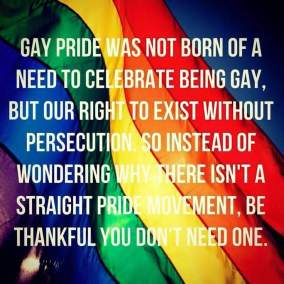
This blog is primarily a photo essay of those events and past pride events I have been in—a celebration of pride and gay family during the spring months which commemorate the first televised gay uprising against police harassment by the gay and lesbian and transgender family on June 28, 1969 at the Stonewall inn in New York City, NY.  Continue reading “Gay Pride and Gay Resistance by Marie Cartier”

Remembering Sor Juana Inés de la Cruz’s Life and Legacy: Champion of Universal, and Non-Human Rights November 12, 1648/51 – April 17, 1695 by Theresa A. Yugar

She studies, and disputes, and teaches,
and thus she serves her Faith;
for how could God, who gave her reason, want her ignorant?

—Sor Juana Inés de la Cruz, Villancico, or, “Carol”, in celebration of St. Catherine of Alexandria (1692)

05.Yugar 1The reason for this blog, and for writing it on this day, is to celebrate and remember the life and legacy of Sor Juana Inés de la Cruz.

In 1994, I was exposed, by chance, to the life and writings of 17th century Novohispana feminist Sor Juana Inés de la Cruz. I am the product of twelve years of Catholic education, eight years of which were in an all-women setting. Again, by chance, I learned about Sor Juana in a liberation theology class while studying feminist theology at Harvard Divinity School. In this class, I learned about Sor Juana’s bold advocacy of the right of women to be educated. This spurred me to learn more about this Catholic Latina theologian whom I would later discover was the last great author of El Siglo de Oro (Spain’s Golden Age), recognized in her era as an esteemed poet, mathematician, astronomer, and more. This was the beginning of my life-long passion to reclaim the legacy of Sor Juana and her-story within the Christian, non-Christian Western tradition, and in Spanish and Mexican history. Continue reading “Remembering Sor Juana Inés de la Cruz’s Life and Legacy: Champion of Universal, and Non-Human Rights November 12, 1648/51 – April 17, 1695 by Theresa A. Yugar”

The Death Penalty and Human Dignity: Where Do We Stand? by Stephanie N. Arel

stephanie-arel

On Wednesday, March 22, I had the pleasure to speak at a conference on law, economics, and religion hosted jointly by Georgetown University Law Center and the Pardes Institute of Jewish Studies. Entitled “The Moral Economy,” the conference provided rich learning from an accomplished cast of rabbis, attorneys, and judges, including Pardes faculty members and alumni.

I presented with Dr. Jenny Labendz of the Solomon Schechter Day School and Dr. Deborah Barer of Towson University in a panel entitled, “Death penalty, human dignity and ethics: Retribution and an eye for an eye?” We engaged in a fascinating discussion that covered Rabbinic and Talmudic Law alongside the Gospel of Matthew, the Beatitudes, and Catholic Social Thought. I felt privileged and honored to learn from them in an interreligious exchange.

The topic of our session though proved pressing. Amidst news reports that Arkansas is “turning its death penalty into an assembly line” – the state currently prepares to execute eight men in over 10 days in April – we queried together, “What is at stake for the prisoner and those implicated or involved in the death penalty process both on moral and economic grounds?” Continue reading “The Death Penalty and Human Dignity: Where Do We Stand? by Stephanie N. Arel”

Painting the Mother of Exiles by Angela Yarber

angelaLast month, my column focused on the importance of intersectionality within the feminist movement by highlighting the revolutionary work of Sojourner Truth, an escaped slave, abolitionist, and women’s rights activist. I’d like to continue to press the importance of intersectionality, particularly given our current political state. Of late, I’ve received a little criticism that some of my recent Holy Women Icons are too political, particularly with reference to Mothers of Black Lives Matter, Dolores Huerta, and the Midwives of Standing Rock. As a woman artist, and particularly a queer woman artist, the personal is always political. Feminists taught us this decades ago. Since the lives, loves, and bodies of LGBTQs, women, refugees, immigrants, people of color, Muslims, Jews, those who are differently abled, and the poor continue to be legislated, violated, excluded, and oppressed, I’d contend that writing about, painting about, and working for liberation for all of these intersectional identities is paramount, especially for those who profess faith in a homeless refugee liberator from the Middle East (that would be Jesus, of course). Needless to say, I believe these recent works in the Holy Women Icons Project fit in quite nicely with the over seventy revolutionaries—political and otherwise—that I’ve painted and written about in the past.

These critiques combined with the current climate of the United States, new legislation passed, proposed, and promised that attacks the lives of the aforementioned marginalized groups. So, I took to canvas and, for the first time, I did not pen the poetry scrawled across the holy woman’s heart. Instead, I relied on the words of Jewish American poet, Emma Lazarus (1849-1877). Most famous for the portion of her sonnet, “The New Colossus,” that graces the pedestal of the Statue of Liberty, I wanted Lady Liberty and Lazarus’ timely words to become my newest Holy Woman Icon. In its entirety, “The New Colossus” reads: Continue reading “Painting the Mother of Exiles by Angela Yarber”

Doctrine and Fidelity by Elise M. Edwards

elise-edwardsThis past week, I was listening to Krista Tippett’s podcast On Being as she spoke with Pádraig Ó Tuama.  He is a poet, theologian, and leader in the Corrymeela community of Northern Ireland. As he spoke about several things related to the challenges of belonging, reconciliation, and fractured communities, he said, ”The measure of Christian fidelity is more than the positions we take.”

I agree.  I interpreted his statement as a condemnation of the ways Christian doctrines and moral positions too often take priority over other matters of faith.

Continue reading “Doctrine and Fidelity by Elise M. Edwards”

A Gift Offered in Faith and Love by Elise M. Edwards

elise-edwards“The day begins with the sun and ends with the moon and stars; what you do in between is your gift to the world.” – Reyna Craig

The new year has begun, and many of us take this marking of time as an occasion to set intentions, goals, plans, or resolutions for the year ahead.  For us feminists, the year ahead holds clear challenges.  We know that the bodies, spirits, minds, hearts, and souls of women, racial and ethnic “minorities,” and all sorts of vulnerable people will be attacked.  We know that the protections secured under the law for these bodies, spirits, minds, hearts, and souls have been eroded and continue to be dismantled in the name of… well, what exactly? Justice? Life? Religion?

We’ve seen voting rights eroded in the name of democratic ideals.  We’ve seen challenges to bodily autonomy in the name of life.  We’ve seen state-sanctioned murder in the name of law and order.  We’ve seen a rise in religious intolerance in the name of religious liberty.  Our work in this age must be to continue to expand our collective understandings of these ideals.  This is the gift we offer to the world.

Continue reading “A Gift Offered in Faith and Love by Elise M. Edwards”

Moving Forward and into a New Season by Elise M. Edwards

elise-edwardsIt’s only been a month and I am still reeling from the US presidential election.  I feel like I’m just beginning to emerge from the sense of loss and futility that has cloaked me.  But I am beginning to move forward.

I don’t feel better.  I’m still confused and discouraged about why people voted for Donald Trump.  I’m very concerned about his cabinet picks and his proposed policies.  But I am actively seeking a path forward and a path of resistance.  I’m finding support in my spiritual practices and communities.

In the Christian calendar, we are in the season of Advent.  Advent carries profound symbolism, and this year it is especially poignant for me.  The word advent bears meanings of arrival, birth, and emergence.  It’s the beginning of the Christian year, which is patterned on the life of Christ, but the year does not begin Jesus’ birth.  That celebration is observed at Christmas, four weeks into the church year.  The weeks preceding Christmas are a time of preparation and reflection on the need for the Incarnation.  The Incarnation of God in the Christ Child may be a distinctly Christian doctrine, but I believe the need for it–even the idea of it–is found in other spiritual and religious teachings.

Continue reading “Moving Forward and into a New Season by Elise M. Edwards”

Divine Physics: A Poetic Reflection on Ecclesiastes 3:14 by Lori Stewart

lori-stewart

Ecclesiastes 3:14 – I know that whatever God does endures forever; nothing can be added to it, nor anything taken from it; God has done this, so that all that should stand in awe before him. 

Nothing can be added or
taken away…
… then why does it feel like everything is lost?

You haul away the bodies while
we watch
— linking arms
— standing fast
against the tide of
grief that churns until
we can find
a distraction that makes us believe
life will return to
normal

Nothing can be added or
taken away, you say…
Really?
You take away innocence at
the marketplace
— the prices vary by age
— virgins to the highest bidder
Surely, El-roi, you see
— the pain
— the suffering Continue reading “Divine Physics: A Poetic Reflection on Ecclesiastes 3:14 by Lori Stewart”