Finding Andraste in the Norfolk Landscape by Claire Bullion

Goddess Andraste is the embodied spirit of all of nature in Norfolk, England. We know She must have been a Goddess of Sovereignty to the Iceni tribe because Queen Boudica called on her to protect the people and their lands when they were invaded and brutalised by the Romans in 60AD.

Boudica may have been a Priestess of Andraste, possibly as Queen she was an earthly embodiment of the Goddess, or at least chosen as leader by Andraste. Able to perform ritual, she was probably trained as a Druid.

Continue reading “Finding Andraste in the Norfolk Landscape by Claire Bullion”

Days Like These, by Molly M. Remer

Sometimes the best rituals
are those we cannot plan,
requiring only pine needles and wind,
open eyes
and a long, slow-sinking sun
settling gently into shadows.
Sometimes the best magic
of all is made with
what is exactly right now,
bluestem grass and gray feathers,
raccoon footsteps
between the trees,
laughter and joined hands,
a faith in the cycles of retreat
and renewal.
This is what we are here for,
days like these.

One crow behind the house greeted me on a frosty solstice morning. Five more slid across the road in front of me as I reluctantly left home to go to the dentist. A red-shouldered hawk glided across the road next and I spotted a kestrel perched on a wire. I drove and sang, memories of our bright candles and solstice spiral the night before behind my eyes, sun bread left rising golden on the counter at home. The dentist has devised a pulley system to hang bird feeders by each of his second story windows and I watch house finches collect sunflower seeds as I lie in the chair. I spot a vulture circling in the distance slow and graceful above the trees. The sky is blue. When I leave the office, I hear a crow’s voice call from across the street and as I drive back home to my family and our winter holiday celebrations, another red-shouldered hawk swoops in front of me, while a red-tailed hawk sits solemnly in a tree by the field, watching the ground. I’m amazed how birds, so unbound, tether me so reliably to the magic of place, to being present with the ensouled and singing world as I move within it and I am grateful.

In the late afternoon on the solstice, my family and I carry the sun bread we have made out to the field by our studio. We join hands and sing and then toss small bits of our golden bread to the sun, calling out our wishes for the year to come and offering our thanks to the spinning world we walk on, beneath this burning sun.

The kids go inside and my husband, Mark, and I walk down the road to finish watching the sun set. It sinks low and slow behind the bare oak trees, growing larger and redder as it goes. It seems to be one of the most drawn out sunsets of this year and we sit down in the frost-crisped dittany by the side of the road, our backs against the oak trees, watching. I turn to look at Mark smiling and say: this is what I am here for, days like these.

I decided to take social media break as 2021 drew to a close, something I’ve wanted to do for a long time, something I’ve needed to do for a long time, and yet, something I’ve always talked myself out of. I need this for our business, I think. It is part of my work. How else will I reach people? I will just post a few more things. While, inside, the hunger to really listen, to de-fragment my mind and re-collect my soul continued to build to a peak of fervency and desire. The blessing and the curse of social media is that everything is in one place. Convenient, yes. Holds you hostage, also yes. Exposes you to more information than you can reasonably hold and process, also yes. The first day of my break, I was amazed how often I was tempted to cheat, how many ways I came up with to sneak around the limit and to just do one little thing anyway. I was also surprised to discover how much extra space there is in my mind and how liberating it is to step away from the clamor of so many other voices. As Cal Newport explains, we all need time each day when we are outside of the influence of other minds. And, I was surprised by how invisible I felt, how unseen and unheard. As the days passed, I felt it though, my scattered pieces coming home. I knew that social media was affecting my focus and my brain functioning, could feel it fragmenting my thoughts, and making my focus and attention jumpy and scattered. In these days of silence, something began to heal inside. I feel a bit invisible, yes, but I also feel whole. I feel like I am coming back online, to my own life.

What was intended only as a ten day break over the winter solstice, extended through the first month of new year and while I’m not saying I’m never going back, I find I am in no rush to re-engage, certainly not in the way I had before.

In the reclaimed attentional space within, I discovered the soulsong of a new book walking up to me, hands extended and eyes wide.

We walk again under long wings of twilight, last vestiges of day sinking purple and mauve into the horizon. Somehow we end up talking about cryptocurrency and NFTs.

Give me dirt and give me stars, I say, as our feet crunch across the brown gravel, our shoulders hunched slightly against the wind. Give me life, right here, where it is.

As we come back up our driveway, we spot a doe at the compost pile, she watches us silently as we turn to make one more lap down the dusky gravel road.

Molly Remer, MSW, D.Min, is a priestess facilitating women’s circles, seasonal rituals, and family ceremonies in central Missouri. Molly and her husband Mark co-create Story Goddesses at Brigid’s Grove. Molly is the author of nine books, including Walking with Persephone, Whole and HolyWomanrunes, and the Goddess Devotional. She is the creator of the devotional experience #30DaysofGoddess and she loves savoring small magic and everyday enchantment.
Note: this essay is excerpted in part from a book in progress, tentatively titled Walking with the Goddess.

Andraste, Celtic War Goddess – a Non-violent Approach, by Judith Shaw

Mythology can be a helpful lens through which to view the march of history. The goddesses and gods are archetypes, illustrating the many facets of human experience for us, while at the same time lighting the path of connection between all Earth’s creatures and Earth herself – helping us understand ourselves and our place in this beautiful, yet often difficult, world of duality.  

Continue reading “Andraste, Celtic War Goddess – a Non-violent Approach, by Judith Shaw”

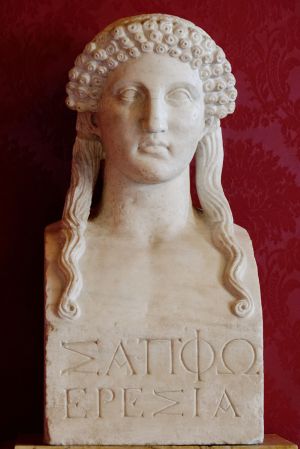
Sappho in a Locrian Mode by Carolyn Lee Boyd

Sappho

The world Sappho envisions in her poetry is one with many lessons for us in the 21st century about how to live. While ancient Greek society, especially in later eras, was deeply misogynistic and women had few rights, Sappho’s words evoke a perspective in which goddesses, especially Aphrodite, are revered and the connection of worshippers to goddesses is intimate, art created by women is celebrated, women’s relationships are central to one’s well being, and love and sensuality are enjoyed.

But words only tell part of the story. Sappho’s poetry was meant to be sung, and while we can’t hear the songs she wrote, I think it is interesting to note that Anne Carson, in her 2003 translation “If Not, Winter” says that Sappho is credited with inventing the Locrian musical mode.  A mode is a scale in which the progression of notes follows a set pattern of whole and half notes. We are all familiar with the major mode that makes music sound happy (Happy Birthday song) and the natural minor mode that we use for sad music (House of the Rising Sun). But there are many other modes, and the Locrian mode is one of them. (just a note: the Locrian mode is the same as the Greek Mixolydian mode and completely different from the modern Mixolydian mode, just to be confusing.)

Continue reading “Sappho in a Locrian Mode by Carolyn Lee Boyd”

From the Archives: Beyond Clenched Teeth: Reflections on Forgiveness by Elizabeth Cunningham

Moderator’s note: This marvelous FAR site has been running for 10 years and has had more than 3,600 posts in that time. There are so many treasures that have been posted in this decade that they tend to get lost in the archives. We are beginning this column so that we can all revisit some of these gems. Today’s blogpost was originally posted January 19, 2014. You can visit it to see the original comments here.

Elizabeth Cunningham

“I forgive you.”

These words make my teeth buzz like the sound of chalk squeaking on a blackboard. I can vividly recall my sister and myself, as children, saying these words through clenched teeth.  Not only were we Christians, we were the minister’s daughters.  We had no choice. The only other words I hated as much: “I’m sorry,” also forced through clenched teeth.

Oddly enough I cannot recall my older brother being told to ask my forgiveness when he and his friend pummeled me. That fell into the category of: “you egged them on.” My mother did used to say of my brother, mournfully and anxiously: “he doesn’t know his own strength.” Which meant: it isn’t his fault that he hurt you.  But my sister and I were supposed to be nice to each other.

Continue reading “From the Archives: Beyond Clenched Teeth: Reflections on Forgiveness by Elizabeth Cunningham”

From the Archives:“Vaginas are Everywhere!”: The Power of the Female Reproductive System by John Erickson

Moderator’s note: This marvelous FAR site has been running for 10 years and has had more than 3,600 posts in that time. There are so many treasures that have been posted in this decade that they tend to get lost in the archives. We are beginning this column so that we can all revisit some of these gems. Today’s blogpost was originally posted June 19, 2012. You can visit it to see the original comments here.

I have a beautiful picture of vagina hanging on my wall.  However, for the longest time it was in the back of my closet, with a plastic bag covering it.  I wasn’t ashamed of it but my ex-boyfriend, like most gay men, refused to have it on the wall where he could see it.  He is now long gone; the vagina is now out and proud.

I bid on the picture one fall during a showing of the Vagina Monologues at Claremont School of Theology.  One of my best friends was in the show and I had always loved its powerful message.  I walked out of the theatre, waiting for my friend, and there it was: the picture of the vagina.  I found myself caught up in its beauty.  Its gaze had mesmerized me.  The outlying layers of red, the contours of its shape, they all began to mold into a figure before my eyes.  While I have never thought of myself as a religious person, I realized that at that moment I was no longer looking the old photo but rather I was staring at the outline of the Virgin Mary.  At that moment, I realized that I had to have the picture.

Continue reading “From the Archives:“Vaginas are Everywhere!”: The Power of the Female Reproductive System by John Erickson”

Asherah, Blessed, Asherah by Janet Maika’i Rudolph

Once upon a time, the Great Goddess was the spiritual focal point of ancient culture. Her worship included honoring women, living in harmony with the earth, and cherishing the processes of the cycles of nature. Asherah was one of those Goddesses. When the Patriarchs moved in and worked to suppress the old goddess religions, Asherah and her fellow Goddesses were diminished, and in a propaganda coup we might recognize today, defined Her as evil. I imagine that some brave people fought to hold onto the Goddess in Her glory but when they saw they were losing the battle, they encoded Her and Her Sister Goddesses into their cultural mythology. Hidden in this manner, She found Her way into the bible. If we can uncover those codes, we can reclaim Her, others and their Earth-based spirituality.

Continue reading “Asherah, Blessed, Asherah by Janet Maika’i Rudolph”

Rituals for Our Sons, Part 2, by Molly Remer

Five years ago, I wrote an essay for Feminism and Religion musing about rituals for our sons. I wondered aloud how we welcome sons in manhood, how we create rituals of celebrations and rites of passages for our boys as well as our daughters. I have been steeped in women’s ceremony and ritual since I was a girl myself, watching the women wash my mother’s feet and crown her with flowers at her mother blessing ceremony as she prepared to give birth to my little brother when I was nine years old. Her circle of friends honored us too, crowning their daughters with flowers and loosely binding their wrists with ribbon to their mothers as they crossed the threshold into first menstruation.

At 24, I then helped plan the rite of passage for my youngest sister, then 13, as she and her friends gathered into a wide living room, flowers on their heads and anticipation in their eyes as we spoke to them of women’s wisdom and the strength of, and celebration of, being maiden girls on their way to adulthood. I knew then that I would have a ritual for my own daughter, yet unconceived, one day. I birthed two sons and lost another son in my second trimester. I led a circle of mothers and daughters through a series of nine classes culminating in a flower-becked coming of age ceremony while newly pregnant with the rainbow baby who would become my own daughter.

Continue reading “Rituals for Our Sons, Part 2, by Molly Remer”

Farewell to Carol Christ at the Kamilari tholos tomb, Crete by Laura Shannon

September 7, 2021

1. Tholos tomb of Kamilari

1. At the gate

On a hilltop between the horned peak of Mount Psiloritis and the wide blue expanse of the Libyan Sea, Ellen Boneparth, Tina Nevans and I prepare to enter the Kamilari tholos tomb. This round vaulted structure served as a communal and egalitarian burial site for thousands of years, from Neolithic through late Minoan times, and Carol brought more than 40 groups of Goddess Pilgrims here to honour those who have gone before. This is where Carol asked the three of us to perform a farewell ritual for her; she wanted no other ceremony. We each don a scarf and necklace which belonged to Carol and enter the sacred space. Kostantis stays behind to guard the gate, in case any other visitors arrive during our ritual.

2. Invocation

On this spot, hundreds of women have honoured thousands of ancestors. We ask for the benevolent presence and the blessing of all those who knew and loved Carol, living and dead. We ask permission of the spirits of the place to enter for this ceremony. We ask Carol’s own ancestors, and the Minoan ancestors of this place, to bless and welcome Carol as a beloved daughter and granddaughter of both lineages.

Continue reading “Farewell to Carol Christ at the Kamilari tholos tomb, Crete by Laura Shannon”

A Mystical Journey: Psalm 93 by Janet Rudolph MaiKa’i

Sometimes I’m asked where I get my inspirations for verses to explore. In this case it was from the God Squad’s Rabbi Marc Gellman who discussed Psalm 93 in a recent column. In his analysis, he used Psalm 93 to wax poetic about how powerful god is outside of nature. In fact, he declared that the worship of nature is idolatry because it only points toward God but can’t completely match God’s majesty. Ahem and Excuse me! With my ire raised, I had to go and look at the Hebrew from my own Mystic Pagan perspective. Rabbi Gelman looks at these verses and his take-away is that “God is more powerful than even the most powerful storm.” Ahem and Excuse me again!  

After delving into the Hebrew words, I see a whole other side to this powerful Psalm. I see the “power of God” [as he would say] or the “beauty of the divine [as I would say],” is that most awesome ability to midwife creation and birth. In other words, to make love manifest. I see in Psalm 93, an esoteric poem bursting with motion that begins by creating a place (Earth) for life to exist. This poem is filled with sound vibrations, thunderous surf, the movement of water and descriptions of thresholds. As the motion unfolds, one is invited to participate in the energies [powers] of the divine pouring out through these threshold gateways.

Continue reading “A Mystical Journey: Psalm 93 by Janet Rudolph MaiKa’i”