The Girl Who Lived: Reflections on Malala, the Middle East, and Feminism by Erin Seaward-Hiatt

Erin-Close-Up-BWAs I return home from a busy day signing off on proofs and churning out cutesy paper patterns, I find my husband, Neil, at the kitchen table. He wears a complicated frown as he pores over a score of tiled browser windows telling various iterations of a singular story. “Come here,” he says, flipping to a second tab, “you’ve got to see this.” It’s The Daily Show, and as I poise for Tea Party zingers and Obamacare barbs, I see instead a girl in hijab, a brilliant smile, and a whole new hope for world politics.

The story was all about a girl. Malala Yousafzai achieved international fame one day when she took a Taliban bullet to the head. Her vocal support for girls’ education had earned her a spot on the Taliban’s hit list. It’s a group with an all-too-familiar radical bent that thrives, among other things, on the cultural ideal of women’s inferiority and silence. One moment Malala was boarding a bus and the next, she faced a hopeful assassin, eager to erase her words and her work from the world. Continue reading “The Girl Who Lived: Reflections on Malala, the Middle East, and Feminism by Erin Seaward-Hiatt”

The Feminization of Poverty: The Impact on Migrant Mothers in the U.S. by Michele Stopera Freyhauf

Freyhauf, Durham, United Nations, Feminism and Religion, John Carroll, UrsulineI had the honor of speaking at the United Nations during the Commission for the Status of Women this past March about the Feminization of Poverty and the Impact on Migrant Mothers.  Below is the text of my speech delivered.  By posting my speech, it is my hope to use social media to help draw attention to this problem and use our resources to find solutions.

Over the last thirty years, rich countries have grown much richer, and poor countries have become, in absolute and relative terms, poorer. Global inequality in wages are striking and poor countries are turning to the IMF or World Bank for loans, which require “so-called” structural adjustments of devaluing currency, cuts in support for “noncompetitive industries,” and the reduction of public services such as healthcare and food subsidies, which has provided disastrous results for the poor, especially women and children.

The feminization of poverty not only means that more of the world’s poverty is born by women, thanks in large part to globalization of the world economy, but includes a denial of access to fundamental human rights, including health, education, nutritious food, property, representation, etc. Feminized poverty encompasses more than matters of individual suffering – it ensnares a vicious cycle of poverty that impacts their entire family.

Feminization of poverty has no singular cause. The United Nations Development Fund for Women identified 4 key dimensions that indicated a heightened rate of poverty for women:

First is called “the temporal dimension,” which means that women are often the primary caretakers of children and household duties. Women who live in developing nations may also have agricultural or physical responsibilities. With these demands, less time is available to devote to paid employment causing them to earn a smaller income even though they effectively do more work than their male counterparts.

Second is “the valuation dimension” which is defined as unpaid labor that women perform to take care of family members and other household chores. Work that is considered “less than” because formal education or training is not required.

Third, is “The employment segmentation dimension.” Women are natural caretakers and thus corralled into “women’s work”, such as teaching, working with textiles, or domestic servitude that includes caring for children or the elderly.

Finally, “the spatial dimension.” When employment is non-existent or difficult to find, women may have to migrate to other areas to find work temporarily. If a woman has children, she may refuse to take the job and stay to care her family. However, Some opt to leave their families behind, to secure what they consider a better life – a means of support – but this choice often comes a great cost. Continue reading “The Feminization of Poverty: The Impact on Migrant Mothers in the U.S. by Michele Stopera Freyhauf”

We Rose for the One Billion on V-Day by Jameelah X. Medina

Jameelah Medina

Every February I gear up to participate in local V-Day 1 Billion Rising events where activists rise up to end violence against women and girls. This year’s theme was the journey to justice, and there were two local events. I delivered a speech at the second event. This is so meaningful to me because it testifies to how far I have come in my journey. Just a few years ago, I would never have spoken what I considered the unspeakable. I have found that with each utterance, I gain more freedom and encourage others to do the same in their own way.

One in every three women/girls will be sexually assaulted in her lifetime, and someone is sexually assaulted every two minutes in the USA. Knowing this and being one of these women, I dedicate this month’s post to my fellow survivors in hopes that you find some healing in it. Below is what the crowd heard from me on V-Day:

Justice is one of those tricky concepts that has many faces. For some survivors, justice is restorative where they are willing to engage in a dialogue with the perpetrator, community, and other stakeholders to attempt to repair the harm that has been done to them. For others, justice is poetic. It comes in the form of retribution and punishment whether it involves incarceration, physical harm or illness, or death by homicide or suicide. Yet other survivors feel that there is no such thing as justice any way you look at it. They feel that there is nothing that can ever be said or done to erase or minimize the life-long effects of the violence perpetuated against them. Continue reading “We Rose for the One Billion on V-Day by Jameelah X. Medina”

Seriously?! Let’s Blame Feminism for the Creation of a “Wimpy” Nation by Michele Stopera Freyhauf

FreyhaufIt is so easy to blame feminism for the ills of the world – mainly because of continued misconceptions and misunderstandings about the definition or meaning of feminism. Feminism is responsible for poverty, bad leadership, wars, the polar vortex, the list goes on. Feminism is still considered a derogatory term that serves to incite prejudice against those who label themselves as one.  In fact, negative connotations surrounding feminism are exacerbated in today’s culture, especially in the media.  Fox News seems to be the poster child of “femiphobia” – a term coined by Stephen Ducat and defined as “wanting to repress every man’s feminine side and demonize the feminine and gay wherever we see them.” Elisabeth Hasselbeck and Nick Adams, in a recent interview, illustrate this femiphobic viewpoint by blaming feminism for raising a culture of “wimps” and “wussies” and thus compromising the U. S.’s national security and weakening its global presence.  In other words, feminism is to blame for the problems of the world.

According to Adams, men around the world are no longer allowed to be “manly” and that this phenomenon is a “dangerous” problem:

American men are of course very susceptible to it. It’s really important particularly in America given the leadership role that America has in the world that American men be allowed to be men.

What does in mean to be a man and how is Adams defining that stereotype? While I am aware of the discussion of gender identity and roles even gendered stereotypes, this post is not about what those roles mean.  Rather, for this point of discussion, I want to address the issue of masculinity, feminism, and what it means to be a “wimp” as portrayed by popular media.

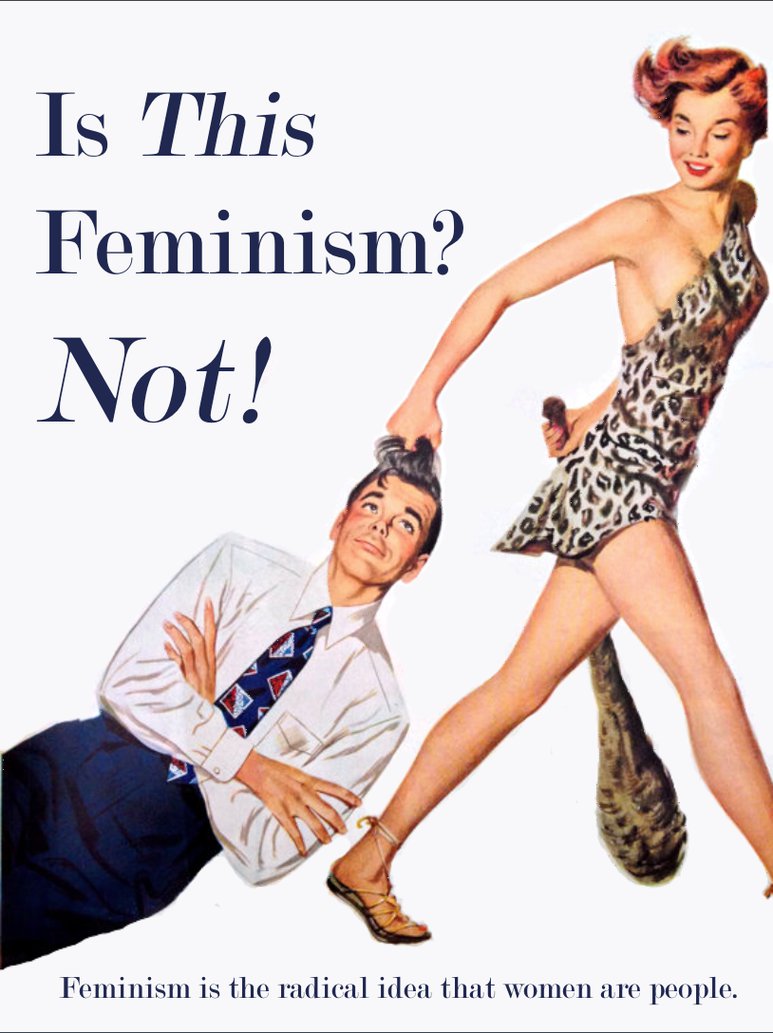
Original photo: http://poasterchild.deviantart.com/art/Feminism-Not-406854334

With that caveat in mind, I ask the following questions:

  • Is the author suggesting a move to a “hypermasculinity”?
  • Is Adams identifying masculinity with aggression and violence in a world where feminists and perhaps all women are demonized?

In a society dominated by the “alpha male” character trait,male  honor and pride are paramount. Is Fox News telling men to replace so-called passive behavior with pride, abrasiveness, authoritarianism, and arrogance–in such a world if where women are demonized, then assaultand rape will follow.  The call for “real men” or “hyper-masculinity” therefore provides a real potential to move us further towards a misogynistic rape culture of violence–in the direction of barbarianism.

Continue reading “Seriously?! Let’s Blame Feminism for the Creation of a “Wimpy” Nation by Michele Stopera Freyhauf”

What Would Malala Do? by Gina Messina-Dysert

Gina Messina-Dysert profileOctober 11th was International Day of the Girl – a movement that empowers girls around the world to see themselves as powerful change agents. This year’s theme is “Innovation for girls’ education.”  Certainly, this makes sense given that education is one of our most powerful resources – just ask Malala.  During her recent interview on The Daily Show, Malala reminded the world that it is education that can solve global problems – not war.

The youngest person in history to be nominated for a Nobel Peace Prize, Malala is clear in her message; the only way to make change is through peace, dialogue, and education.  When asked about her reaction to the threat to her life by the Taliban, Malala responded saying that she thought quite a bit about what she would say if she came face to face with a Talib.  “I would tell him how important education is and that I would even want education for your children as well. That’s what I want to tell you, now do what you want.”

Although the Taliban has continued to threatened her life, Malala says striking back is not the right approach.  “If you hit a Talib, then there would be no difference between you and the Talib. You must not treat others with cruelty. … You must fight others through peace and through dialogue and through education.”  Such words of wisdom from a child. Continue reading “What Would Malala Do? by Gina Messina-Dysert”

“The Invisible War” Goes On by Marie Fortune

Marie FortuneThe invisible war of sexual assault of female and male military personnel by their fellow soldiers, sailors, airmen and marines continues even as the U.S. Senate holds hearings and presses for substantive changes in the way cases of sexual assault are handled. The Academy Award nominated documentary tells the story of survivors of rape and of an institution long on rhetoric and short on change.

In 2012, there were 26,000 reported rapes in the military which is a 35% increase over the previous year. Since 1991, it is estimated that 500,000 women have been raped in the U.S. military. Half a million. At least 20% of women who serve have been assaulted while serving.  This gives new meaning to “friendly fire.” One commentator compares it to incest: a military unit has a family dimension. You should be able to trust the members of your unit to have your back and your commander to protect you as needed. Continue reading ““The Invisible War” Goes On by Marie Fortune”

(Femen)ism? by Kile Jones

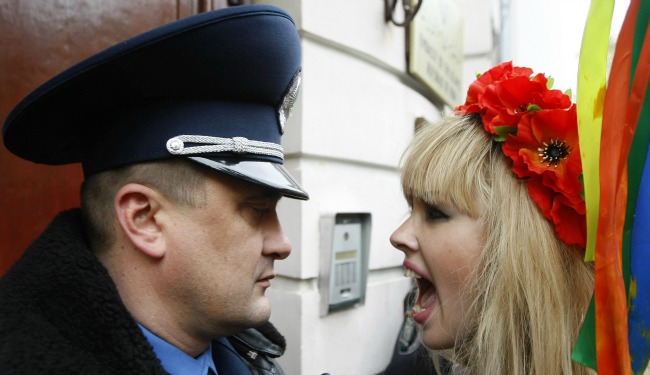
Kile Jones, atheistAs most of us are aware by now, there is a “feminist-sextremist” group from Ukraine called “Femen.”  This group has been very controversial by their public demonstrations of nudity, the words they paint on their bodies, and their explicit condemnations of political structures and organized religions.  They were started by Anna Hutsol in 2008 and have now spread throughout Europe and the Middle East.  The question I pose for this post is: Does Femen harness or hinder the power of the feminist critique?

Image from Konstantin Chernichkin/Reuters

Femen is precisely the kind of movement that pushes us in our understanding of feminism, the means by which it is best expressed, and the issues surrounding moral condemnation and religious sensitivity. Continue reading “(Femen)ism? by Kile Jones”

The Flesh Made Word: Colm Toibin’s “The Testament of Mary” on stage and in print By Joyce Zonana

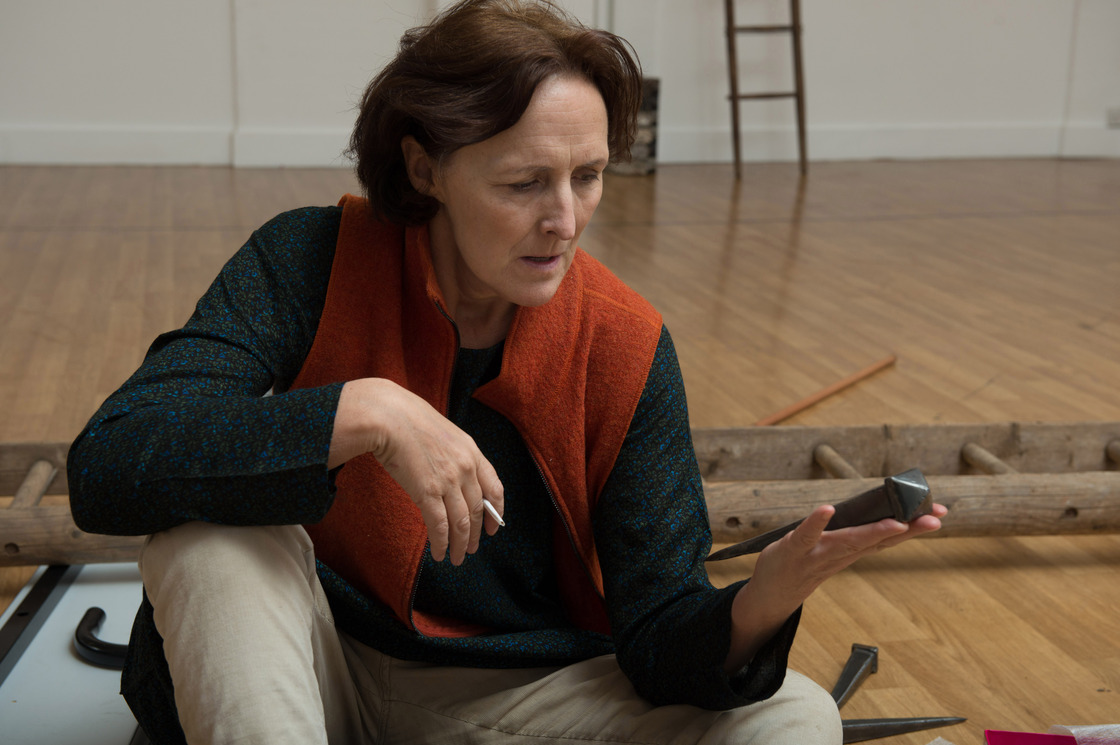
Colm Toibin Fiona Shaw Testament of Mary Ephesus Artemis House of the VirginBefore the play begins, the audience is invited on stage; we walk around, not quite knowing what to do, gazing at the props, uncertain.  A few chairs, scattered jars of honey, jugs of water beside a free-standing waist-high faucet, a tall ladder, a long table, a stripped tree trunk with a wooden wheel at the top suspended from the rafters, a menacing roll of barbed wire, and a live turkey vulture occasionally spreading wide its iridescent blue-black wings: such is the set for Deborah Warner’s searing production of Colm Toibin’s The Testament of Mary, a one-woman show currently in previews at the Walter Kerr Theater in New York.  In a large open-sided box, stage left, the actress Fiona Shaw, draped in blue from head to toe, arranges herself, then sits perfectly still, holding a lily and an apple.  We know this woman.  The Virgin Mary.  The Icon.  Incarnate.

Fiona Shaw rehearses for her role as the Virgin Mary in The Testament of Mary. Irish novelist Colm Toibin's one-woman play opens April 22 at Broadway's Walter Kerr Theater.
Shaw in rehearsal. Photo by Hugo Glendinning

But when we are all back in our seats, Mary casts off her robe to stand before us in a simple black shift, flowing easily over narrow brown pants. Her hair is cropped, her face haunted; wearing short leather boots, she fumbles as she searches for a hand-rolled cigarette to steady herself.   “I remember everything.  Memory fills my body as much as blood and bones.”  No longer an icon, hardly a virgin, this Mary addresses us with the piercing directness of the passion she has suffered: to have seen her only son crucified despite her efforts to save him. Now, interrogated by two unnamed apostles (John and Luke?) who want to fix the story of her son’s life and death and resurrection, Mary insists on reporting only what she knows:  “I was there.  I fled before it was over but if you want witnesses then I am one and I can tell you now, when you say that he redeemed the world, I will say that it was not worth it.  It was not worth it.”

Continue reading “The Flesh Made Word: Colm Toibin’s “The Testament of Mary” on stage and in print By Joyce Zonana”

Reflections on Good Friday by Kathryn House

Tomorrow is Good Friday on the western Christian calendar, the day when western Christians remember Jesus’ death on the cross. The day is often memorialized in ways that recall Jesus’ last moments, from his final steps to his final words, with great specificity. For as many traditions to observe the day, there are theologies to interpret just what, if anything, the cross “means.” In the past few years, I have found myself moving further and further away from identifying this day as one that saves. If I am honest, it has been, and continues to be, an exercise and practice in theological freedom. For me it started with the moment in my first year of theology class when my professor spoke about Anselm and Abelard, of transactions, of debt satisfaction. Something about seeing this formula within its feudal context – of seeing it for the first time as a deeply contextual rather than eternal or primordial or absolute theology – struck a chord and disrupted some sediments I considered unshakeable.

This fissure and subsequent reimagining has continued as over the years I’ve engaged the work of womanist and feminist theologians. There was sister FAR contributor Xochitl Alvizo’s post last year disrupting the spectacle of Good Friday, of re-imaging new rituals that do not dwell on death. There is the work of JoAnne Terrell, the books Proverbs of Ashes and Saving Paradise by feminists Rebecca Parker and Rita Nakashima Brock, and my professor Shelly Rambo’s work on spirit and trauma. I suppose if I am anywhere on the topic, I am just no longer sure that Jesus paid a debt he did not owe because I owe a debt I cannot pay. I am unconvinced that suffering redeems, that blood atones, that the death of a son – of anyone’s daughter or son – brings satisfaction. Certainly feminists and womanists hold diverse beliefs, but here is where I can stand, for now.

Continue reading “Reflections on Good Friday by Kathryn House”

Response to “The Islamic Solution to Stop Domestic Violence” by Samar Esapzai, Shireen Ahmed, Vanessa D. Rivera, Ayesha Asghar, and Hyshyama Hamin

0 0 This article is in response to a post by Qasim Rashid of the Muslim Writers Guild of America titled, “The Islamic Solution to Stop Domestic Violence” published in the Huffington Post‘s Religion Blog on March 5th, 2012.

Although this post came to our attention a year after it was written, as young Muslim women who have worked with and/or written about gender-based violence issues that have  personally affected some of us, we deemed it fit to respond. Also, the points we will discuss here are not only limited to the particular post written by Rashid, but rather address similar arguments that have been made by other writers as well on this issue.

0_20_3It is a concern to us that Rashid uses the Quran verse 4:34* and proposes that it contains the “Islamic solution” to domestic violence. He states that according to the perspective of an American social scientist Dr. James Q. Wilson, known for his controversial works on the criminal justice system, men are more prone to anger and aggression and less capable of self-restraint than women. This, we assume, the author took from Wilson’s essay, “The Future of Blame” in which he cites what he calls “the claim” of research by neuropsychiatrist Dr. Louann Brizendine.  Interestingly, Wilson is also a rational choice theorist on the causation of crime and violence; he argues that individuals make clear, rational decisions after evaluating all possibilities and do that which benefits them the most. Continue reading “Response to “The Islamic Solution to Stop Domestic Violence” by Samar Esapzai, Shireen Ahmed, Vanessa D. Rivera, Ayesha Asghar, and Hyshyama Hamin”