What Would Malala Do? by Gina Messina-Dysert

Gina Messina-Dysert profileOctober 11th was International Day of the Girl – a movement that empowers girls around the world to see themselves as powerful change agents. This year’s theme is “Innovation for girls’ education.”  Certainly, this makes sense given that education is one of our most powerful resources – just ask Malala.  During her recent interview on The Daily Show, Malala reminded the world that it is education that can solve global problems – not war.

The youngest person in history to be nominated for a Nobel Peace Prize, Malala is clear in her message; the only way to make change is through peace, dialogue, and education.  When asked about her reaction to the threat to her life by the Taliban, Malala responded saying that she thought quite a bit about what she would say if she came face to face with a Talib.  “I would tell him how important education is and that I would even want education for your children as well. That’s what I want to tell you, now do what you want.”

Although the Taliban has continued to threatened her life, Malala says striking back is not the right approach.  “If you hit a Talib, then there would be no difference between you and the Talib. You must not treat others with cruelty. … You must fight others through peace and through dialogue and through education.”  Such words of wisdom from a child. Continue reading “What Would Malala Do? by Gina Messina-Dysert”

“The Invisible War” Goes On by Marie Fortune

Marie FortuneThe invisible war of sexual assault of female and male military personnel by their fellow soldiers, sailors, airmen and marines continues even as the U.S. Senate holds hearings and presses for substantive changes in the way cases of sexual assault are handled. The Academy Award nominated documentary tells the story of survivors of rape and of an institution long on rhetoric and short on change.

In 2012, there were 26,000 reported rapes in the military which is a 35% increase over the previous year. Since 1991, it is estimated that 500,000 women have been raped in the U.S. military. Half a million. At least 20% of women who serve have been assaulted while serving.  This gives new meaning to “friendly fire.” One commentator compares it to incest: a military unit has a family dimension. You should be able to trust the members of your unit to have your back and your commander to protect you as needed. Continue reading ““The Invisible War” Goes On by Marie Fortune”

(Femen)ism? by Kile Jones

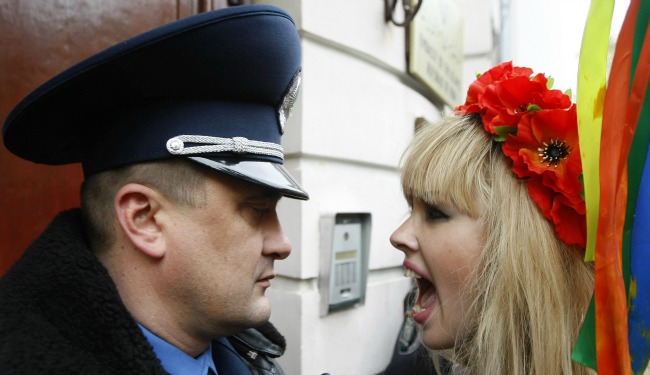
Kile Jones, atheistAs most of us are aware by now, there is a “feminist-sextremist” group from Ukraine called “Femen.”  This group has been very controversial by their public demonstrations of nudity, the words they paint on their bodies, and their explicit condemnations of political structures and organized religions.  They were started by Anna Hutsol in 2008 and have now spread throughout Europe and the Middle East.  The question I pose for this post is: Does Femen harness or hinder the power of the feminist critique?

Image from Konstantin Chernichkin/Reuters

Femen is precisely the kind of movement that pushes us in our understanding of feminism, the means by which it is best expressed, and the issues surrounding moral condemnation and religious sensitivity. Continue reading “(Femen)ism? by Kile Jones”

The Flesh Made Word: Colm Toibin’s “The Testament of Mary” on stage and in print By Joyce Zonana

Colm Toibin Fiona Shaw Testament of Mary Ephesus Artemis House of the VirginBefore the play begins, the audience is invited on stage; we walk around, not quite knowing what to do, gazing at the props, uncertain.  A few chairs, scattered jars of honey, jugs of water beside a free-standing waist-high faucet, a tall ladder, a long table, a stripped tree trunk with a wooden wheel at the top suspended from the rafters, a menacing roll of barbed wire, and a live turkey vulture occasionally spreading wide its iridescent blue-black wings: such is the set for Deborah Warner’s searing production of Colm Toibin’s The Testament of Mary, a one-woman show currently in previews at the Walter Kerr Theater in New York.  In a large open-sided box, stage left, the actress Fiona Shaw, draped in blue from head to toe, arranges herself, then sits perfectly still, holding a lily and an apple.  We know this woman.  The Virgin Mary.  The Icon.  Incarnate.

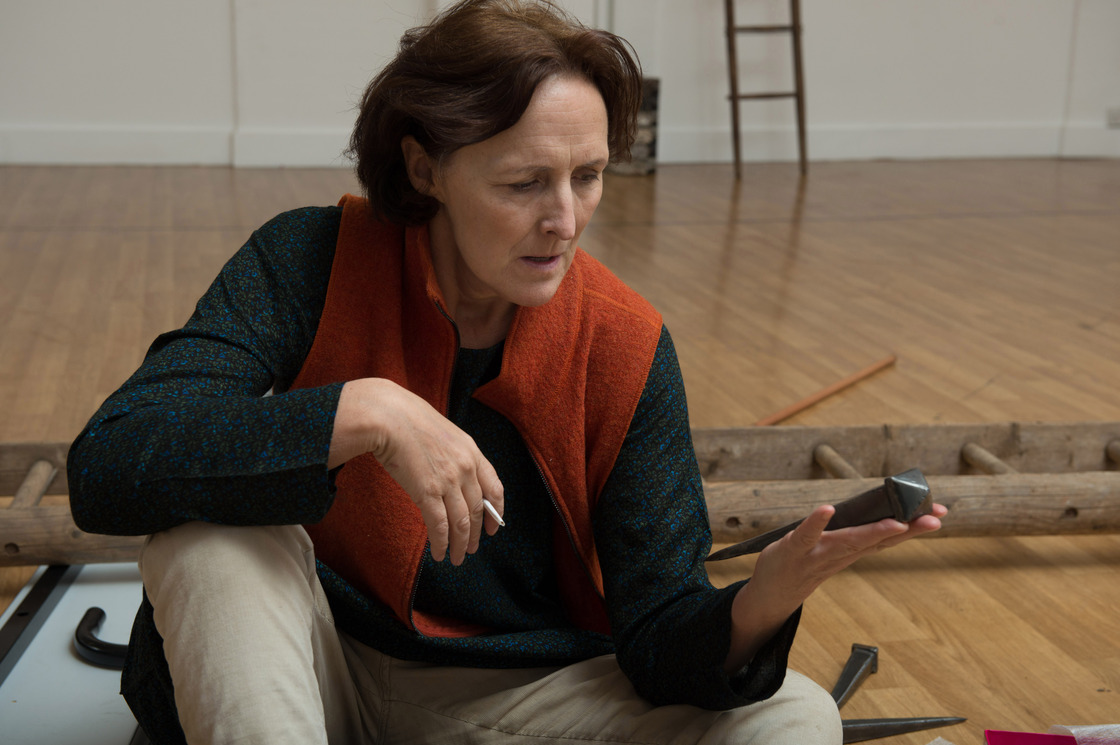
Fiona Shaw rehearses for her role as the Virgin Mary in The Testament of Mary. Irish novelist Colm Toibin's one-woman play opens April 22 at Broadway's Walter Kerr Theater.
Shaw in rehearsal. Photo by Hugo Glendinning

But when we are all back in our seats, Mary casts off her robe to stand before us in a simple black shift, flowing easily over narrow brown pants. Her hair is cropped, her face haunted; wearing short leather boots, she fumbles as she searches for a hand-rolled cigarette to steady herself.   “I remember everything.  Memory fills my body as much as blood and bones.”  No longer an icon, hardly a virgin, this Mary addresses us with the piercing directness of the passion she has suffered: to have seen her only son crucified despite her efforts to save him. Now, interrogated by two unnamed apostles (John and Luke?) who want to fix the story of her son’s life and death and resurrection, Mary insists on reporting only what she knows:  “I was there.  I fled before it was over but if you want witnesses then I am one and I can tell you now, when you say that he redeemed the world, I will say that it was not worth it.  It was not worth it.”

Continue reading “The Flesh Made Word: Colm Toibin’s “The Testament of Mary” on stage and in print By Joyce Zonana”

Reflections on Good Friday by Kathryn House

Tomorrow is Good Friday on the western Christian calendar, the day when western Christians remember Jesus’ death on the cross. The day is often memorialized in ways that recall Jesus’ last moments, from his final steps to his final words, with great specificity. For as many traditions to observe the day, there are theologies to interpret just what, if anything, the cross “means.” In the past few years, I have found myself moving further and further away from identifying this day as one that saves. If I am honest, it has been, and continues to be, an exercise and practice in theological freedom. For me it started with the moment in my first year of theology class when my professor spoke about Anselm and Abelard, of transactions, of debt satisfaction. Something about seeing this formula within its feudal context – of seeing it for the first time as a deeply contextual rather than eternal or primordial or absolute theology – struck a chord and disrupted some sediments I considered unshakeable.

This fissure and subsequent reimagining has continued as over the years I’ve engaged the work of womanist and feminist theologians. There was sister FAR contributor Xochitl Alvizo’s post last year disrupting the spectacle of Good Friday, of re-imaging new rituals that do not dwell on death. There is the work of JoAnne Terrell, the books Proverbs of Ashes and Saving Paradise by feminists Rebecca Parker and Rita Nakashima Brock, and my professor Shelly Rambo’s work on spirit and trauma. I suppose if I am anywhere on the topic, I am just no longer sure that Jesus paid a debt he did not owe because I owe a debt I cannot pay. I am unconvinced that suffering redeems, that blood atones, that the death of a son – of anyone’s daughter or son – brings satisfaction. Certainly feminists and womanists hold diverse beliefs, but here is where I can stand, for now.

Continue reading “Reflections on Good Friday by Kathryn House”

Response to “The Islamic Solution to Stop Domestic Violence” by Samar Esapzai, Shireen Ahmed, Vanessa D. Rivera, Ayesha Asghar, and Hyshyama Hamin

0 0 This article is in response to a post by Qasim Rashid of the Muslim Writers Guild of America titled, “The Islamic Solution to Stop Domestic Violence” published in the Huffington Post‘s Religion Blog on March 5th, 2012.

Although this post came to our attention a year after it was written, as young Muslim women who have worked with and/or written about gender-based violence issues that have  personally affected some of us, we deemed it fit to respond. Also, the points we will discuss here are not only limited to the particular post written by Rashid, but rather address similar arguments that have been made by other writers as well on this issue.

0_20_3It is a concern to us that Rashid uses the Quran verse 4:34* and proposes that it contains the “Islamic solution” to domestic violence. He states that according to the perspective of an American social scientist Dr. James Q. Wilson, known for his controversial works on the criminal justice system, men are more prone to anger and aggression and less capable of self-restraint than women. This, we assume, the author took from Wilson’s essay, “The Future of Blame” in which he cites what he calls “the claim” of research by neuropsychiatrist Dr. Louann Brizendine.  Interestingly, Wilson is also a rational choice theorist on the causation of crime and violence; he argues that individuals make clear, rational decisions after evaluating all possibilities and do that which benefits them the most. Continue reading “Response to “The Islamic Solution to Stop Domestic Violence” by Samar Esapzai, Shireen Ahmed, Vanessa D. Rivera, Ayesha Asghar, and Hyshyama Hamin”

What We’ve Learned from Steubenville by Gina Messina-Dysert

Gina Messina-Dysert profileThe nation has watched over these last several months as the rape case in Steubenville, Ohio has unfolded in the media.  On March 17, 2013 the verdict was announced and the two teenage boys accused of raping a 16 year old girl were found guilty on all counts.   Although the verdict was just, all other circumstances surrounding the case, including the sentence, support the existence of a rape culture.  What we have learned from Steubenville is that the humanity of women and girls continues to be of little importance in today’s society.

To begin, the assault itself was horrific.  While two teenage boys took turns raping and abusing the body of Jane Doe, the other boys present took great pleasure in watching, taking pictures, texting, tweeting, facebooking, and video recording the brutality.  It was a scene out of The Accused (the film that recounted the real life rape of a woman while a crowd watched a cheered) all over again–this time with the “benefit” of modern technology.  Not only were those in the room witnesses to this gruesome attack, the entire world became voyeurs as video, pictures, and text went viral. Continue reading “What We’ve Learned from Steubenville by Gina Messina-Dysert”

Marriage as a Commodity (Satisfaction Guaranteed) by Michele Stopera Freyhauf

Freyhauf, Feminism, Religion, Durham, Old Testament, Blogger, Bible, Gender, Violence, Ursuline, John CarrollThis Saturday I will be presenting a paper about Cyberbrides at the United Nations Commission on the Status of Women.  While my focus for that paper is the impact on mothers and families, my research also revealed how some Cyberbrides (or Mail-Order Brides) are selected from internet catalogues with “satisfaction guaranteed” and how “International Marriage Broker” may be a cloak hiding the agencies’ involvement with human trafficking.

Cyberbrides are essentially mail-order brides, but like pen pals, they can chat and exchange pictures on the Internet and interact through video or instant chat.  There are almost 2.9 million website matches that turn up when Google-ing “Mail-Order Brides” within 19 seconds of pressing the “return” button. With the low cost of social media, a new venue to market and display this “commodity” is available.  Presently,  about 30 Facebook sites exist that advertise “Mail-OrderBrides. Continue reading “Marriage as a Commodity (Satisfaction Guaranteed) by Michele Stopera Freyhauf”

Gendercide: Words and Poem by Bernedette Muthien

engender, Bernedette Muthien, gendercide, poetry, violence against women, patriarchy,

gendercide  

 it took a full week

of straitjacketing generations

of genocidal femicidal trauma

for the clay dam wall to explode

and flood me in torrents

of collective grief

a poet with no words

a lifelong activist struck dumb

i choke on love for the dead

thousands of beautiful women and children a year

i puke for my incested cancerous country

and gag grappling for compassion of

perpetrators and the morally blind

in this breathtaking country

so brutally drenched in the blood

of ordinary women and children

i discover anew

that i fail to

swim

my spiritual cadaver

is dragged under by the concrete limbs

of victims perpetrators witnesses

majority blinkered burdens

too busy scrabbling for survival

to fight for justice

as i contemplate the imminent refreshment

of my childhood starvation

my hunger for food agency adventure

leads me to stare the dragon in its ambered eyes

like a mirror of my ever-present shadows

Demon! Patriarchy…

how can I love you to death…?

— Bernedette Muthien (15 feb 2013)

for the billion women martyrs around the world… Continue reading “Gendercide: Words and Poem by Bernedette Muthien”

Second Class Rape Victims: Rape Hierarchy and Gender Conflict

Deconstructing masculinity isn’t the key to solving social, sexual, and domestic violence across the world but it is a step worth taking when attempting to engage men in affecting change to stop these violent actions since men, statistically are the perpetrators of such crimes that both cause such outcry as well as perpetual silence.

johnThe most disturbing part of the 2006 documentary Deliver Us from Evil isn’t the fact that Father Oliver O’Grady is rewarded by the Catholic Church with a new congregation in Ireland after his short stint in prison for the rape of dozens of children in the 1970s, but rather the hierarchy of gendered victimization which is often created throughout the various rape cases that are both reported and unreported throughout history.

I am often troubled by the ways in which rape cases are discussed and deconstructed via mediums such as blogs, online communities, social media networks, the news, and popular culture.  No series of events troubled me more than the Jerry Sandusky trial, but more importantly, the ways in which the young boys and adult men who were subjected to Sandusky’s abuse quickly overshadowed the other rape cases that are reported on a daily basis, specifically those involving young girls and women. Continue reading “Second Class Rape Victims: Rape Hierarchy and Gender Conflict”