What’s Wrong with this Picture? by Elise M. Edwards

Elise EdwardsOn Monday, the picture was on my Facebook feed again: The picture of a girl lying face down in the grass under a police officer pressing his knee in her back. It was from the video of an African-American teenager being pinned to the ground by Eric Casebolt, the police officer in McKinney, Texas who was responding to calls about a pool party. When I saw the picture this time, it was in a screenshot with these words below it:

“Funny how a 14 year old bikini-clad black girl being publicly assaulted by an adult male does not accrue mainstream feminist outrage.” – Yohanna

The screenshot was taken of a post to Yohanna’s Twitter account (@maarnayeri). I don’t know her, but she troubled me.

If you haven’t seen the images we’re talking about, you can view the video here with a description of what is concurring or below from YouTube. I was reluctant to watch the video. It seems voyeuristic to view this young woman’s suffering and screaming. And, if I am honest with myself, it also seems useless. Viewing this from my computer screen, I’m in no position to help her. I hear her cries and it make me cry too. But I can’t push him off of her. When other teens tried to come to her defense, Casebolt pulled a gun on them and chased them. I don’t even have the power to get him fired from his position of authority immediately. No, we must have the investigations and inquiries and due process that seems so indiscriminately afforded to the privileged. Casebolt was put on administrative leave on Friday, and on Tuesday June 9, he resigned.

So how should I respond?

I had a conversation with one of my closest friends a couple days ago that provoked me to reflect on what to do when I’m conflicted about how to respond. Her background is in acting and theatre, and now she is a pastor and artistic director of a Christian church and arts initiative who believes in supporting arts, imagination and creativity. In our conversation about discerning the next steps in our lives, she was reminded of a book by Samuel Wells that proposes “theatrical improvisation as a model for Christian ethics.” That reminded me of books I’ve read that talk about musical improvisation or call-and-response as model for living, and some pieces I’ve written about that. Inspired by ethicists and theologians including Emilie M. Townes and H. Richard Niebuhr, I believe that to answer the question of how I should respond, I must first answer ‘What’s going on?” An improvised response or a fitting response is the response to what is already occurring. We must look at the situation critically to respond appropriately.

What’s going on in this video and the controversy surrounding it? I am certainly not an impartial or all-knowing observer, but here’s what I see:

  • A white man forcibly throws an unarmed, African-American teenager to the ground yelling “On your face!” We can see that she is unarmed because she is wearing a bikini.
  • The man is a police officer. He is upset that his authority is being challenged. Other officers are present and seem to be asking questions, but the violent one seems out of control and frantic, running around and yelling. He escalates the situation when he throws the girl to the sidewalk, which causes an outcry in the crowd.
  • As the video went viral, there were many protests and online statements against this violent event, but also statements of support for the officer. And sadly, I agree with Yohanna’s assessment. I may have missed it (and I hope I did), but I didn’t see a broad, mainstream feminist response against this violence.

I’m a feminist. I’m a black feminist. I’m a Christian feminist. I may not be a mainstream feminist (depending on your definition), but I’ll express my outrage anyway. It is sickening to watch his treatment of this teenage girl. This man’s mistreatment of a young black girl’s body is chilling. It is wrong and he should be held accountable for it.

I don’t think outrage is enough. But outrage does express that our moral sensibilities have been awakened and that we recognize that something profoundly wrong has occurred. In the face of comments that say she deserved this treatment, we as feminists must insist on the officer’s wrongdoing. “She had it coming.” “She incited him.” As feminists, we know that these kinds of statements are used in cases of rape and intimate partner violence to explain away violent actions and to shift the guilt from perpetrator to victim. The backlash against feminists and others who oppose these explanations argues that we ignore the victim’s responsibility or agency.

Bloggers and social media users know all too well the horrific statements that often appear in the comments section of online posts, videos, and articles. One comment I saw about the McKinney video says that the girl was “sassing back” at the police and that “if she wants to talk like adult then she’s going to be treated like an adult.” This kind of justification makes my blood boil! Sassing back is speaking up and saying something to an authority figure when you are expected to be silent.  While the term sassing back doesn’t exclusively apply to women and girls, it is nonetheless a phrase with gendered connotations. How many boys are called “sassy”? Is it that no one had the right to say anything to this officer running around yelling at black teen boys to sit on the ground, or is it that this black female should have kept quiet? Regardless, throwing an unarmed person to the sidewalk for supposedly saying something disrespectful is not justifiable behavior to adults or children.

I wish I knew more about what’s going on and how to respond to the violence I see in the world. I know these perennial questions subvert easy answers. I only have a partial response. I am responding with outrage and questioning and take this to my feminist community and into my spiritual practice. “What’s going on?” and “How should I respond?” are questions I ask God. I pray for justice. I pray for God’s presence in the outrage and in the investigations, and in the lives of those children who were violated.

Elise M. Edwards, PhD is a Lecturer in Christian Ethics at Baylor University and a graduate of Claremont Graduate University. She is also a registered architect in the State of Florida. Her interdisciplinary work examines issues of civic engagement and how beliefs and commitments are expressed publicly. As a black feminist, she primarily focuses on cultural expressions by, for, and about women and marginalized communities. Follow her on twitter, google+ or academia.edu.

The Religiosity of Silence by John Erickson

In a repetitive culture of abuse and silence, is it really shocking to find out that an individual who preached such hate and discontent for others actually perpetuated other forms of heinous abuse against others?

John Erickson, sports, coming out.In 2013, I wrote an article about the then latest reality TV scandal featuring A&E’s Duck Dynasty’s Phil Robertson and his rampant foot-in-mouth disease that caused him to express, in the pages of GQ, his true distaste for the LGBT community and specifically for the sexual proclivities of gay men.

Now, two years later in another reality TV show, TLC’s ’19 Kids and Counting’, it isn’t star Josh Duggar’s anti-LGBT statements getting him into trouble but rather his sexual assault and molestation of 5 girls, including two of his sisters. However, while the Internet explodes with attacks against Josh Duggar and his Quiverfull background, it is vital to remember that the silence that he and his family inflicted upon his victims since 2006 has not only been ongoing since then but is also being reemphasized today with each keystroke focusing on the assailant rather than the victims. Continue reading “The Religiosity of Silence by John Erickson”

Abuse Does Not Have “Fifty Shades of Grey” by Michele Stopera Freyhauf

WARNING: This article or pages it links to contain information about domestic abuse and sexual violence which may be triggering to survivors.


Freyhauf, Durham, Hahn Loeser, John CarrollNo matter what you call it abuse is abuse. This is highlighted in the popular book and now movie Fifty Shades of Grey. Because of the stir this book caused, I delved into the first book and my initial reaction was that of repulsion and wonderment. How could a woman let a man control her like that? Why would she let him do things like that to her and continue to come back to him? Why is this book so popular?

Are women sexually repressed in a way that their own sexual experiences are routine and boring (the book is full of BDSM) or they have never orgasmed (every time they have intercourse, Anastasia is guaranteed to orgasm)? Why do we find it okay to label body parts as “love boxes” or “considerable length” or the multitude of references to a man’s penis or woman’s vagina that is meant to sound sexy or romantic? Why does he announce “I am going to f*** you now” every single time they have intercourse? Can’t the reader figure out what is going on without making this announcement?

However, after I got beyond my initial reaction (or shock), I took a step back and became upset and outraged.  In essence, the overall issue with the book can be summed up in one word: control. Some women argue that the awkward doe-eyed virgin journalist exercises control over the sexually deviantPicture from fanpop.com

Picture from fanpop.com

billionaire that keeps him coming back to her – I disagree. I see control exercised by the sexually deviant man over a woman enamored by him in such a way that is sexually, physically, and psychologically exploitative and abusive. Yes – I understand this is fiction, but this type of writing causes immense problems.

In a culture that embraces “Blurred Lines,” money and power, and “the bad boy persona,” this storyline fuels the fodders of the fire with a sensationalism that plays on sexual fantasies and/or those wishing prince charming will sweep them away. One needs to look no further than “The Bachelor” or Bret Michaels’ “Rock of Love” television shows that promote the exploitation of women’s desires to be with the rich handsome man at any cost to self and dignity. In fact, an article posted about the movie stated that if Christian Grey was not a billionaire and behaved in the same way, he would be arrested and labeled a sex offender. So again, is the message we want to send to our daughters, nieces, and friends is that the rich can do whatever they want and you should let him? I think not.

Continue reading “Abuse Does Not Have “Fifty Shades of Grey” by Michele Stopera Freyhauf”

Get your fatwa off our backs! by amina wadud

amina 2014 - croppedIt’s not so easy any more to control the parameters of Islam and the way it is practiced by those who wish to stuff their opinion down the throats of other Muslim citizens, be they minorities or majorities across the globe.
This past week the Selangor Islamic Religious Counsel in Malaysia, issued a fatwa against Sisters in Islam (SIS), accusing them of being “deviant” because they subscribe to religious liberalism and pluralism.  They called for a ban on all their publications and to silence their social media. They sought to shun their activities and personhood “in the name of Islam.’

The next day SIS held a press conference and went on full counter attack.  This is what it has come down to for many who stand for justice, equality, and human dignity for all, within an Islamic perspective.

Let me step back and explain about a fatwa.  Continue reading “Get your fatwa off our backs! by amina wadud”

The Nuns Jumped Over the Wall by Dawn Morais Webster

Dawn Morais Webster, the Pope off to his summer palace, Castel Gandolfo. He tells the world he will now become just a “humble pilgrim.”

One of the most prized dishes in Chinese cuisine is called “The Monk Jumped Over the Wall.” The name comes from the folk belief that the monk was unable to resist the aroma of this delicious dish and jumped the wall in search of it.

Reading Jo Piazza’s If Nuns Ruled The World: Ten Sisters on a Mission, it is clear that these nuns, and others like them, have been drawn by people’s needs, to jump the walls of patriarchy and prejudice.

And there’s no putting them back behind those walls.

Just ask media maven, Sr. Maureen Fiedler: “After all, Jesus was a feminist, and we claim to follow him.”

One nun, though, has accepted being put behind bars for literally breaking through the fences around the nuclear facility in Oak Ridge,Tennessee. Sr. Megan Rice is unfazed by clerical disapproval.

“I don’t believe in excommunication,” she says, “because I don’t see the institutional Church as the real Church.” Continue reading “The Nuns Jumped Over the Wall by Dawn Morais Webster”

In Memory of Margot Adler (1946-2014) Priestess, Journalist, Skeptic, Mystic by Elizabeth Cunningham

Elizabeth Cunningham headshot jpeg“Ritual has the power to end our alienation from the earth and from each other. It allows us to enter a world where we are at home with the trees and the stars and other beings, and even with the carefully hidden and protected parts of ourselves that we sometime contact in dreams or in art.” –Margot Adler
Margot Adler died of cancer on July 28, 2014. A Pagan priestess, she asked for memorial events to be held in the season of Samhain, also known as Halloween.  At this time of year, the rituals of many religious traditions remind us that we are all connected, the living, the dead, and those to come, one continuous communion.  In this spirit, I offer a tribute to the late Margot Adler.

Though I must have heard her distinctive voice on National Public Radio where she served as an innovative and eclectic journalist for thirty years, I encountered Margot Adler’s work more intimately by accident—or synchronicity—as countless others have.  I had recently found myself face to face with the goddess.  As if in answer to my question: “Who are you and what do you want from my life?” a hefty book literally fell off a shelf in a small-town bookstore: Margot Adler’s ovarian work Drawing Down the Moon: Witches, Druids, Goddess-Worshippers, and other Pagans. Writing as both observer and participant, Margot brought into fruitful union the spiritual seeker and the fact-finding reporter, the social activist and the ecstatic celebrant.  I had found a trustworthy guide for my own explorations. Continue reading “In Memory of Margot Adler (1946-2014) Priestess, Journalist, Skeptic, Mystic by Elizabeth Cunningham”

5 Examples of Religion as the Next Feminist Frontier by Meagen Farrell

meagenfarrellIn February 2014, headlines incorrectly stated that Gloria Steinem said religion is the biggest problem facing women today. Wrong.

In her interview by Jennifer Aniston at the first Makers Conference, Steinem said that not talking about religion is one of the biggest problems facing feminism today. That’s a big difference. At first she said the biggest problems are “anti-feminism” and “pay inequality,” but those issues are already on the table. She believes the feminist establishment isn’t talking about religion enough.

I agree and have agreed for a long time. Like many in this community, I have spent many years talking about feminism and religion, and it’s about time the Big Names noticed it is an important conversation. I hope they realize quickly that it’s already been going on for over a century!

Continue reading “5 Examples of Religion as the Next Feminist Frontier by Meagen Farrell”

Women at the Secular Student Alliance Conference by Kile Jones

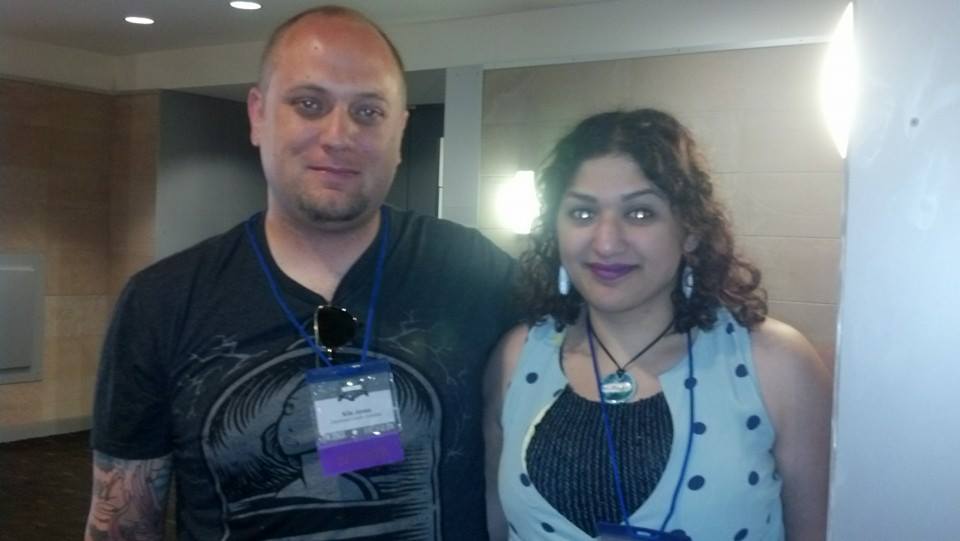
KileA few days ago I had the pleasure of giving a talk at the Secular Student Alliance Conference on how non-believing persons can work with Churches.  Amidst the chaos of conferences–managing your time, deciding which talks to attend, and making sure you have enough water (it was a Burning Ring of Fire outside in Tempe, AZ)–I got to meet some pretty incredible secular women.

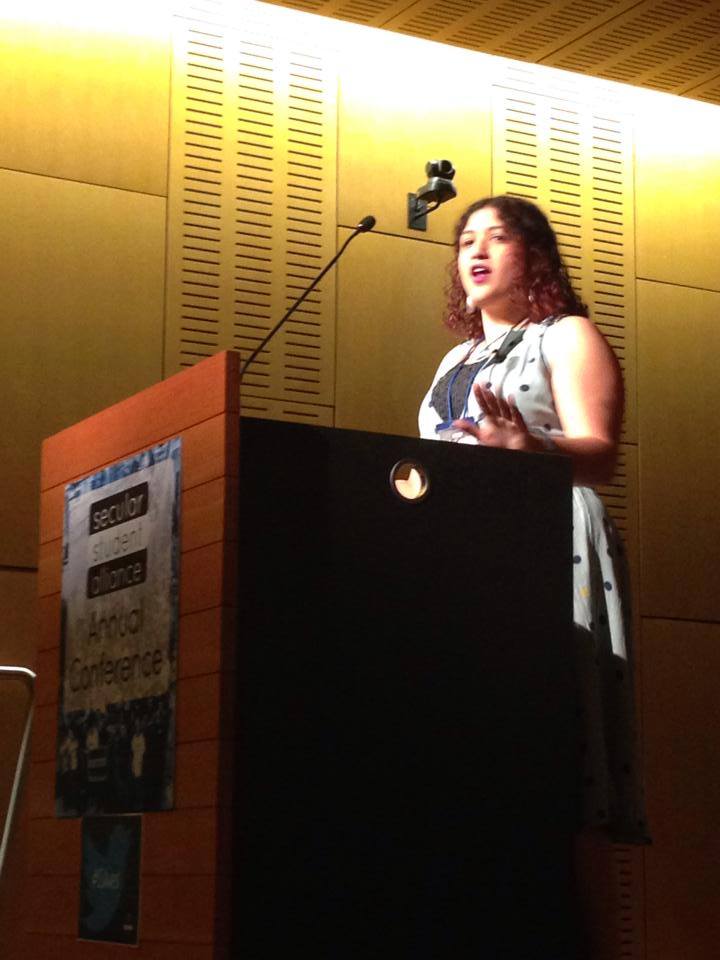
One of them was Heina Dadabhoy.

Heina speaking at SSA
Heina speaking at SSA.

Former Muslim, blogger at Freethought Blogs, and overall bad-ass, Heina spoke about ways in which secular groups can create a more welcoming environment for ex-Muslims and Muslims beginning to doubt.  Her talk, “Of Murtids and Muslims,” (a “murtid” is a public apostate) was not only about her experiences coming out as a secular humanist, but considered some of the absurd questions people ask her (and other ex-Muslims) about leaving Islam.  “So did your parents try to honor kill you?”  “Have you gone through FGM?”  It was disturbingly humorous.

What I considered to be Heina’s main point, was that we should respect each others’ individual differences and not generalize and caricature all Muslims with the depictions of some.  “Just because you read Ayaan Hirsi Ali’s book,” Heina notes, “does not make you an expert on Islam.”  Heina made sure to emphasize the radical diversity that exists in Islam.  She also spoke of the some of the issues that people go through when they leave Islam: How do I create a new identity when my old one was intricately tied up in my Muslim community, family, and culture?  How do I navigate popular culture when I have missed a bunch of it?  How do I find myself in this new secular world?  Heina’s answers were refreshingly honest and insightful.

P.S. Aisha (one of Muhammed’s wives) should not simply be reduced to the young person Muhammed married; she was also a war leader, influential Muslim thinker, and someone who contributed greatly to early Islam.  This is, of course, Heina’s insight.

Me and Heina at SSA
Me and Heina at SSA

Another awesome secular woman I met, was Sarah Morehead.

Sarah. Photo from Apostacon.

Sarah is a former evangelical Southern Baptist, Executive Director of the “Recovering From Religion” project, and another overall bad-ass.  She spoke on how to start up a Recovering From Religion group on your campus.  Here is a blurb about Recovering From Religion,

“If you are one of the many people who have determined that religion no longer has a place in their life, but are still dealing with the after-effects in some way or another, Recovering From Religion (RR) may be just the right spot for you. Many people come to a point that they no longer accept the supernatural explanations for the world around them, or they realize just how much conflict religious belief creates. It can be difficult to leave religion because family and culture put so much pressure on us to stay and pretend to believe the unbelievable. If this is you, we want to help you find your way out. Don’t let people convince you that you just didn’t have ‘enough’ faith, or that you just haven’t found the “right” religion.”

Sarah and I chatted (and often laughed) about our old experiences as conservative Christians.  We discussed some of the funny language (Christian-eze) we used to use, the various levels of guilt and shame that were cast upon us, and how science helps explain some of the interesting displays of piety often seen at Pentecostal services.  Sarah’s jovial and welcoming demeanor was calming, and as an Executive Director for a project aimed at helping people “recover” from religion, I cannot think of a better person for the job.

Lyz.  Photo by SSA.
Lyz. Photo by SSA.

The last woman I have in mind is Lyz Liddell.

Lyz is the Director of Campus Organizing for the Secular Student Alliance.  I have an interview I did with her a while back, on this very blog!  Besides running around with her headset on, standing on chairs for announcements, and generally keeping the world of SSA from not crumbling into oblivion, Lyz is a great motivation and example.  If you are ever interested in starting a SSA group on your campus, talk to her.

To all those who attended this years SSA West, or who are involved with helping secular students: Unite!

Kile Jones holds a Bachelors of Theology (B.Th.) from Faith Seminary, a Masters of Theological Studies (M.T.S.) and a Masters of Sacred Theology (S.T.M.) from Boston University, and is a current Ph.D. in Religion student at Claremont Lincoln University.  He also holds a Certificate in Science and Religion from the Boston Theological Institute.  Mr. Jones has been published in Zygon: Journal of Religion and Science, Philosophy Now, Free Inquiry, World Futures, Human Affairs, and the Secular Web.  He is the Founder/Editor-in-Chief of Claremont Journal of Religion (www.claremontjournal.com), and is the Founder/Director of Interview an Atheist at Church Day (interviewatheists.wordpress.com).

#YesAllWomen, the Darwin Debate, and the God Complex by John Erickson

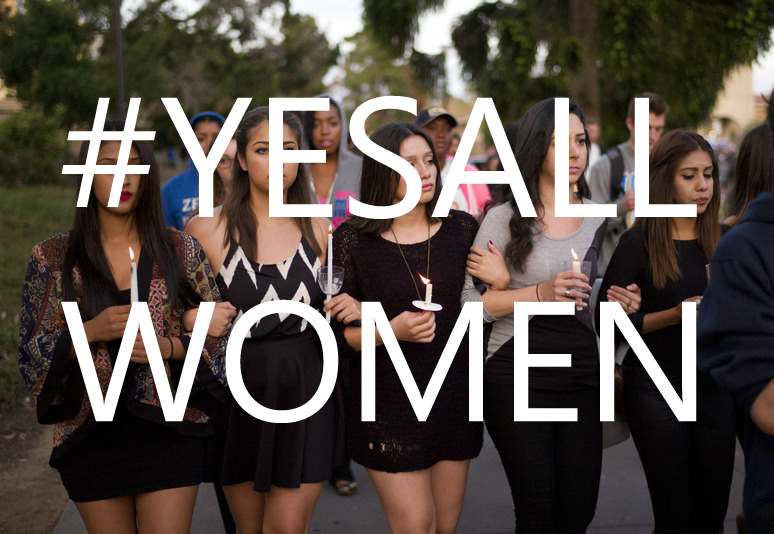
#YesAllWomen proved that although not all men commit horrible crimes against women, the men that often get the headlines and create the most controversy are the ones that need to be watched out for.

John EricksonThe one thing I typically will choose to do on the rare occasion that I’m able to sit down and relax is to watch a documentary.  While some people may go to the gym, read a book, or hang with friends, I typically choose to stay in, nestle up on my couch, and learn.  While on my last bout of relaxation, I chose to watch the HBO documentary Questioning Darwin. Although it offers very little new insight into the evolution vs. creationism debate, it does offer an interesting new way to look at the recent social media hashtag war feminists, allies, and supporters found themselves in over the #YesAllWomen movement that took the world by storm.

yesallwomen

Now, before I discuss #YesAllWomen, I have to admit that I did not enter into the safe space women created for themselves to tell tales of the horrible things they have and have had to face on a daily basis.  I firmly believe that men should not have entered into the digital space Continue reading “#YesAllWomen, the Darwin Debate, and the God Complex by John Erickson”

The Real Reasons America Hates “Octomom” by Tricia Pethic

Tricia PethicMany of us participate in dehumanizing Nadya Suleman, depriving her even of her own name by virtue of using the term ‘Octomom.’ Suleman has few people on her side of the ring, partly because she embodies what both conservatives and liberals hate most. Suleman recently made news again on charges of welfare fraud; she may spend up to eight years in prison. If Suleman does go to prison, I hope she ends up where I work so I could tell her what I really think: that America’s hatred of her has more to do with them than it does with her. And I’d remind her of God’s mercy and compassion: something I think has been absent from this discussion.

We recognize the name Nadya Suleman, yet how many people recognize the name Michael Kamrava? Kamrava was the doctor who injected Ms. Suleman with twelve embryos which earned him a suspension of his medical practice. Why is Ms. Suleman not known primarily as a victim of medical malpractice? Continue reading “The Real Reasons America Hates “Octomom” by Tricia Pethic”