

 On the eve of the Jewish Sabbath and the start of Rosh Hashanah, Supreme Court Justice Ruth Bader Ginsburg breathed her last breath. She was 87. She fought so hard for so long. She is an American patriot, hero, champion for women’s rights, and for many she was the stalwart bastion of justice and ‘liberal’ rulings. She was a Supreme Court Justice for 27 years. Her life has been put into books, a movie, and the most notorious memes around. She became known for elaborate collars over her Justice robes. We mourn the lost of her, we celebrate her memory, and we must pull up our boots and continue the fight.
Category: Women’s Power
Re-Visioning Medusa: Part II by Sara Wright
 Read Part I of Re-Visioning Medusa here.
Recently, I was given a wonderful gift, a small shiny black pot with Avanyu’s image carved into its micacious clay surface. I have become enamored by the images and the mythology around this powerful serpent. Every day I look at my pot and wonder what specific message Avanyu might be trying to convey to me.
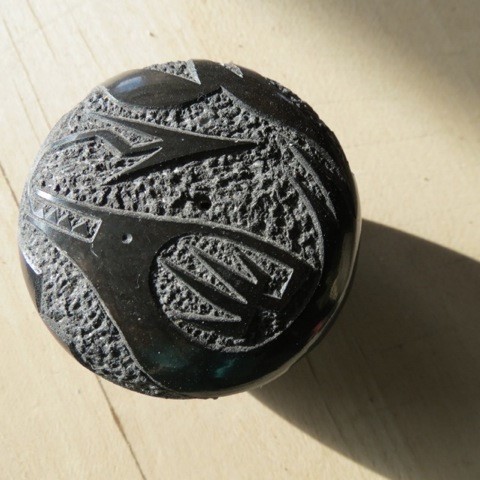
As I began this essay I also wondered how Avanyu’s serpentine aspect might relate to my writing about Medusa? Was he guiding me? I certainly believe he is highlighting the importance of needing to live through the truth of my body. Continue reading “Re-Visioning Medusa: Part II by Sara Wright”
Kamala Harris, the Democratic Vice President for 2020 by Anjeanette LeBoeuf

August 11th saw Democratic Presidential Candidate Joe Biden announce his pick for Vice President. This pick broke open the history books; California US Senator Kamala Harris. Kamala has been steadily rising as a political force for over ten years. Her nomination is groundbreaking on so many levels. So, let us talk about Senator Harris.
Continue reading “Kamala Harris, the Democratic Vice President for 2020 by Anjeanette LeBoeuf”
No, I Don’t Fucking Need Anxiety Meds: The Covid Misogyny Epidemic by Trelawney Grenfell-Muir
 “I think you should take medication for anxiety.”
This was my doctor’s response when I calmly listed my Covid symptoms, which had been going on for a month and had landed me in Urgent Care twice and the ER twice, once via ambulance when the hotline nurse thought I was having a stroke because my face suddenly went numb, and my blood pressure, usually below normal, had shot up to 199/113.
I had just described my previous month – two weeks of crippling fatigue, occasional sore throat, then stomach upset arrived day 17 along with fever and cough that sometimes worsened into scary difficulty breathing, then came the pricking and shooting nerve pains, numbness, and feeling that all my blood was cold and trembly and horribly uncomfortable, the metallic taste in my mouth, the painful glands, vicious headaches, a week of horrible adrenaline spikes and insomnia, bladder discomfort, two days of insatiable, continual, desperate thirst, conjunctivitis… hell, I’m sure I’m forgetting a few. Continue reading “No, I Don’t Fucking Need Anxiety Meds: The Covid Misogyny Epidemic by Trelawney Grenfell-Muir”
Spiritual vs. Material: The Middle Way? by Elisabeth Schilling
 For much of my life, I’ve wanted experience. I think it stems from my childhood/teenage years. When I would travel (for school events, mostly), everyone my age or a bit older always seemed SO much older than me, so much more mature, and I always felt like a little kid, and that embarrassed me. I didn’t care about money or being materially successful. It seemed more admirable to take a road or overseas trip and meet a lot of different people and encounter cultures and read books that would help me grow emotionally and mentally. Recently, my friend who is younger and on his way to being a millionaire by the time he is 40 has tried to encourage me to read books about financial investments and business. I do not have the best habits with money, mainly meaning I don’t usually save or invest and just live paycheck-to-paycheck rather carelessly.
But in the Dhammapada and Upanishads, they say that neither those who only follow the material path nor those who only follow the spiritual path will reach nirvana. . . it is only those who find a balance between the material and spiritual, the mind and the body that will be able to reach nirvana, be one with Brahman and notice the true self. Continue reading “Spiritual vs. Material: The Middle Way? by Elisabeth Schilling”
A Ladder to the Stars by Sara Wright
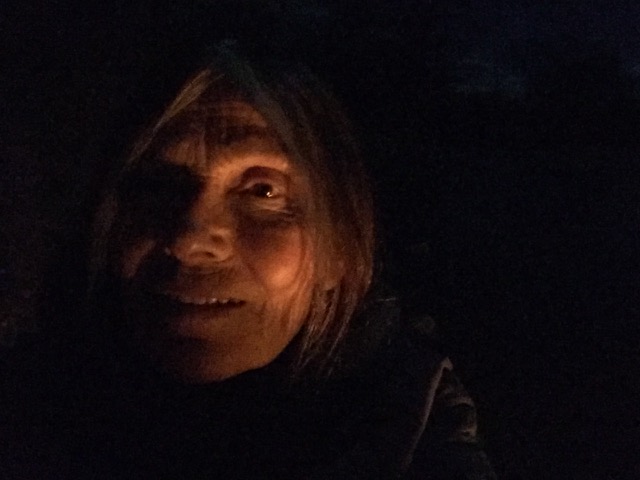
A Ladder to the Stars
Every evening at twilight
she climbs a ladder
to the stars…
Venus is her guide …
As the Evening star
(who also rises at dawn)
this Goddess of Love
is her Muse.
As a woman who
respects herself,
she stands up for others.
She has learned how to Love.
Giving is as natural
to her as breathing;
every gesture is grounded
in caring for people and the Earth…
“What If We Touched Ourselves Lovingly Every Day?” by Trelawney Grenfell-Muir
I watched her hand stroke along my arm, so gently, so lovingly. Her voice whispered, “I love you, Trelawney. I love you, Trelawney.” The soft, tender caress felt poignant, healing, magical. I wept with gratitude.
It was my own hand stroking me. My own voice. Continue reading ““What If We Touched Ourselves Lovingly Every Day?” by Trelawney Grenfell-Muir”
Feeling Squeezed by Esther Nelson
 Tyler Foggatt, associate editor of The New Yorker magazine’s, “The Talk of the Town series,” recently contributed (March 23) an essay titled “Cooped Up.” She notes that China, the first country to shut down due to COVID-19, is now in the process of opening up. More than ten million people in Xi’an, the capital of Shaanxi Province, were under lockdown. She writes, “When restrictions were eased, earlier this month, the city’s [Xi’an] divorce rate spiked.” Marital conflicts, often existing underneath the radar, bubble to the surface and sometimes explode during periods of quarantine (forced togetherness).
According to Foggatt, American psychologist Lawrence Birnbach predicts that the divorce rate in the U.S. will rise as the current pandemic unfolds. Two of his patients, married to each other and self-quarantined together, reported they have argued more than ever, mostly having to do with how thoroughly (or not) one person washes their hands and wipes down surfaces.
I think many of us can relate to this. Long before the current health crisis developed, my spouse and I went about our lives quite differently. At times we clashed. Keeping our distance from each other—even before social distancing became the “right” thing to do—was effective inasmuch as that strategy kept things from boiling over, at least most of the time. Continue reading “Feeling Squeezed by Esther Nelson”
When Life Hands You Lemons… by John Erickson
“When life hands you lemons, sometimes you have to make applesauce.”
 I’ve been thinking a lot about something my grandmother would always tell me: “When life hands you lemons, sometimes you have to make applesauce.” I know, it sounds crazy, but life right now appears to be more on the crazy than the sane side.
We’re all in a state of uncertainty right now. The news is scary. Twitter is scary. Heck, even TikTok is losing parts of its humor. Everywhere we seem to turn, it’s more information about COVID-19, new cases, new lockdowns, and new things that we shouldn’t do for the foreseeable future. Continue reading “When Life Hands You Lemons… by John Erickson”
Beth March and the Courage of the Gentle Giver by Cathleen F
As someone who spent my prepubescent years watching director Gillian Armstrong’s “Little Women”, I was eager to see Greta Gerwig’s newly released version. Previously unexplored contours of each character, and of my changed perceptions, were made visible through this iteration. The most difficult and touching part of the film that lingers with me is the story of Beth, pianist and caretaker. Beth’s untimely death brings grief into the center of the March family narrative, and Gerwig’s portrayal brought up grief in me about my experiences with invisibility as a paced introvert in a culture that celebrates speed and extroversion.
I grew up wanting to be like Jo March, the outspoken, reactive protagonist. Jo was the rebel, the obvious feminist, and, mostly importantly to me, the brave one. Beth seemed to me to be boring, relegated to a life at home, bound by illness and a preoccupation with the needs of neighbors. Her steadiness looked to me like obedience; she could not fight away the disease that eventually killed her, and I wished to be everything besides her, the introvert who observed and cared and loved music and then died. As I grew into my own introverted, observant, caregiving tendencies, I began to wonder if I had been tricked by my culture, by my upbringing, to think I was Beth when I was really Jo! While social pressures certainly influenced my personality, as they do for us all, I didn’t want to believe that perhaps I was growing into my natural temperament, endowed by the Universe, expressed in my mind and body. As a woman in the 21st century, as a feminist, I was supposed to be like Jo, not the way I was (am). To have a deliberate or tender nature was, in my subconscious perception, to betray the spontaneous, assertive natures of those more worthwhile feminists who got things done. Continue reading “Beth March and the Courage of the Gentle Giver by Cathleen F”
 Feminism and Religion