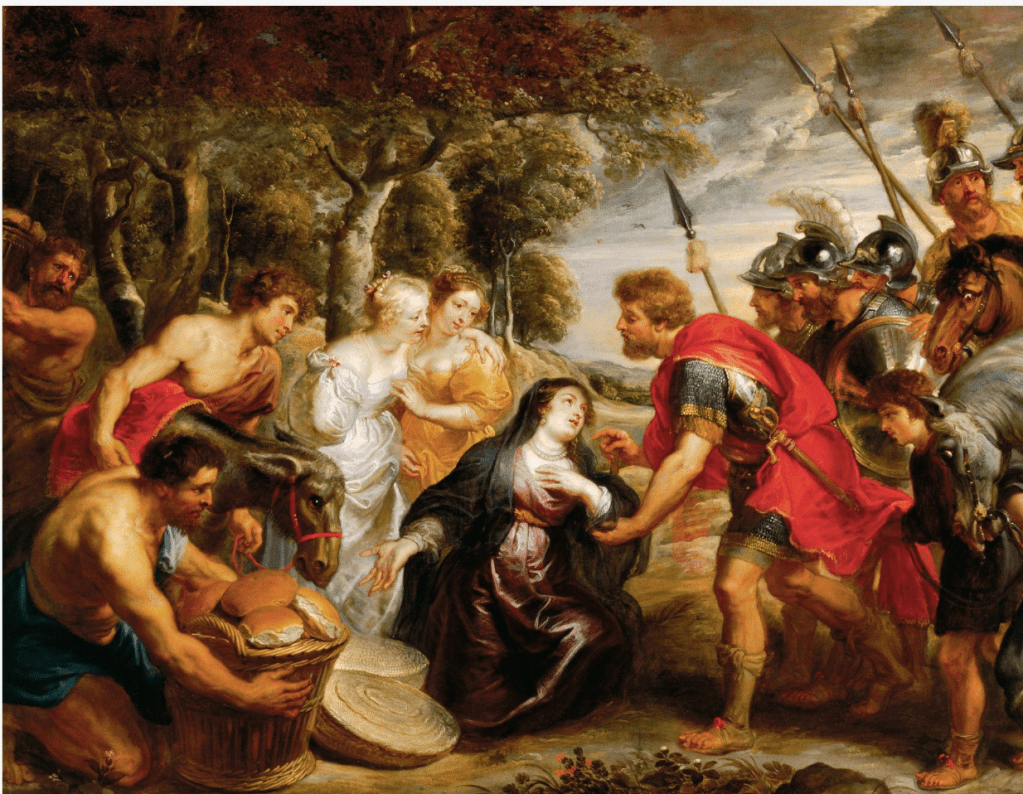
The meeting of David and Abigail by Peter Paul Rubens circa 1630
In these days when so many are afraid and aching for the people of Ukraine, and concerned about the lasting impacts of this war around the world, I cannot help thinking of the wise women of ancient Israel. These wise women, unafraid of confronting dangerous men, used their intelligence and storytelling skill to defuse violent situations between powerful adversaries and restore peace. May their wisdom be felt in the world now.
The institution of “wise woman” appears several times in the Bible. In the Book of Samuel, a wise woman (chachamah in Hebrew, from chochmah, wisdom) steps in when there is a war, or political conflict, to promote peace. In II Samuel 14, after King David’s son Amnon rapes David’s daughter, Tamar, the king does nothing. Tamar’s full brother Absalom takes matters into his own hands and kills Amnon, then flees to another country. David grieves for Absalom but won’t send for him. The wise woman of Tekoa appears before King David, pretending to be a woman whose sons fought, and one killed the other. The story she tells helps to reconcile King David with his son Absalom, at least temporarily.
Moderator’s note: This marvelous FAR site has been running for 10 years and has had more than 3,600 posts in that time. There are so many treasures that have been posted in this decade that they tend to get lost in the archives. We have created this column so that we can all revisit some of these gems. Today’s blogpost was originally posted October 18, 2020. You can visit the original post here to see the comments.
I have a vivid childhood memory of being sick with the stomach flu and standing in the doorway of my parents’ bedroom looking for my mother. Her care for sick children was tender and thorough. She would bring us ginger ale and toast with jelly. When she had time, she read us stories. I can remember her steering me, heavy with fever, back to a bed that she had magically smoothed and cooled. But that day my mother lay in her own bed in an old nightgown, not stirring. She had the flu, too, and could not get up to care for the rest of us. It was a shocking and sobering moment.
As I grew older, I transferred my need for comfort, reliability, and continuity from my mother to the earth, the sure turning of the seasons, beloved trees, waters, and rocks. As a young mother, I looked forward to sharing my own childhood joys with my children, among them jumping into autumn leaf piles. The first time my children leaped into a leaf pile, they came up covered with the ticks that have now made my region the epicenter of Lyme and other tick-borne diseases. Nor was I able to share with my children the joy of drinking water straight from a stream.
Moderator’s note: This marvelous FAR site has been running for 10 years and has had more than 3,600 posts in that time. There are so many treasures that have been posted in this decade that they tend to get lost in the archives. We have created this column so that we can all revisit some of these gems. Today’s blogpost was originally posted July 1, 2018. You can visit the original post here to see the comments.
I bet almost no one knows this secret: the United States is being watched over by two goddesses! One of them stands on top of the Capitol dome in Washington, D.C. The other stands on an island in New York harbor.
The goddess standing above our congressional building is named Libertas, or Freedom. She’s a Roman civic goddess whose sisters are Concordia and Pax. Although the Romans hardly ever experienced freedom, civic harmony, or peace, they always kept their eyes on the possibilities. Libertas was sometimes merged with Jupiter, sometimes with Feronia, who was originally an Etruscan or Sabine goddess of agriculture or fire. In Rome, Feronia became the goddess of freed slaves. Libertas is shown on Roman coins as a matron in flowing dress and wearing either a wreath of laurel leaves or a tall pilleus, which is called a “liberty cap” and looks like a witch hat without the brim. And there’s also a bird—is it a raven?? She holds either a liberty pole (vindicta) or a spear, and in some paintings of her (she was a popular subject in the 19th century) there is a cat at her feet.
Because the late 18th century is sometimes referred to as the Augustan Age (for classicism in architecture, literature, and art and named after the first Roman emperor, Caesar Augustus), the Roman Libertas became Lady Liberty during the American Revolution. To celebrate the repeal of the Stamp Act in 1766, Paul Revere created an obelisk with an image of Lady Liberty on it, and a short time later, Tom Paine addressed her in his poem, “The Liberty Tree.” An enormous bronze statue of Lady Liberty was commissioned in 1855 for the top of the Capitol building, and she was hoisted up there in 1863, where she stands, hardly visible, to this day.
Here’s my idea. This FAR community has lots of power. We—and at least two thirds of the U.S. population—are very unhappy with the antics of the Lyin’ King and his court…excuse me, the executive and legislative branches of our national government. So let’s visualize Libertas coming to life. Watch her stomp her heavy bronze feet so hard she breaks a hole in the top of the dome. Watch her fly down into the main lobby of the Capitol. Now she turns in one direction and stalks into the Senate. “Gentlemen and Ladies,” she begins, “you were sent here to do a job. You’re not doing your jobs. Work together! Learn to compromise. Stop talking so much. Get to work!” And then she marches into the House. “Why are you here?” she asks. “And why are you here only three or four days a week, and why aren’t you working for the benefit of all the citizens of the United States?” I suspect that Libertas, who is 19 feet 6 inches tall and weighs approximately 15,000 pounds, could indeed put a scare into Congress, not to mention all the lobbyists. Remember, she also carries that spear. And she no doubt knows how to use it.
Our second national goddess? “Liberty Enlightening the World,” whom we call the Statue of Liberty, was a gift from France to the U.S. circa 1886 on the occasion of our centennial. Designed by Frederic-Auguste Bartoldi and Alexandre Eiffel (who also built a famous tower in Paris), Lady Liberty holds a tabula ansata (a tablet evoking the law) in one arm and with her other hand raises a torch, a common symbol of truth and purification through illumination. She wears a crown of solar rays similar to the crown worn by the Colossus of Rhodes, one of the seven wonders of the ancient world.
For almost a century and a half, Liberty has welcomed immigrants to our Atlantic shore. Those immigrants were the grandparents and great grandparents of nearly all of us. Now let’s visualize Liberty taking action. Goddesses can perform magic; let’s visualize Liberty multiplying herself into 10,000 Liberties, and then let them travel to Texas, New Mexico, Arizona, and California and—you guessed it—let them stand facing south. Let these 10,000 goddesses with torches of purification replace the Xenophobe-in-Chief’s wall/fence/border army. Let’s ask Liberty to welcome people into the U.S. Because she’s smart (and the flames of that torch can reveal a lot) and there are indeed drug smugglers traveling in addition to men, women, and children who are coming for sanctuary or safety or work, let her use her torch to reveal the small proportion of criminals trying to sneak in. And let her welcome and protect everyone else and keep families together. (Maybe she could send all the ICE agents off hunting coyotes, who are no doubt smarter and more humane than they are.)
Here is the full text of “The New Colossus” the poem by Emma Lazarus that Lady Liberty proclaims to the world. Maybe our senators and representatives should read it—for the first time, I bet. They should pay attention to what it says and obey the words and principles of this goddess.
Not like the brazen giant of Greek fame, With conquering limbs astride from land to land; Here at our sea-washed, sunset gates shall stand A mighty woman with a torch, whose flame Is the imprisoned lightning, and her name Mother of Exiles. From her beacon-hand Glows world-wide welcome; her mild eyes command The air-bridged harbor that twin cities frame. “Keep, ancient lands, your storied pomp!” cries she With silent lips. “Give me your tired, your poor, Your huddled masses yearning to breathe free, The wretched refuse of your teeming shore. Send these, the homeless, tempest-tost to me, I lift my lamp beside the golden door!”
Let us visualize both of these American goddesses doing their work and protecting the hard-won rights of everyone who lives in the United States.
BIO:BIO:Barbara Ardinger, Ph.D. (barbaraardinger.com), is the author of Secret Lives, a novel about crones and other magical folks, Pagan Every Day, a unique daybook of daily meditations, and other books. She really enjoys writing her monthly blogs for FAR. Her work has also been published in devotionals to Isis, Athena, and Brigid. Barbara’s day job is freelance editing for people who have good ideas but don’t want to embarrass themselves in print. To date, she has edited more than 400 books, both fiction and nonfiction, on a wide range of topics. She lives in Long Beach, California, with her rescued calico cat, Schroedinger.
Hello FAR family! Here are photos from the October 2nd Women’s March in Long Beach, CA. The Women’s March began after the 2016 “election” and continued through the Trump years, and was not immediately active after Biden won. But after Texas passed it horrific ban on abortions with no exceptions, the Women’s March re-ignited across the nation… especially in response to the recent Supreme Court approval of the unconstitutional ruling on abortion in Texas which limits abortion access to 6 weeks of pregnancy – a time span that denies abortion completely as almost all women do not even know they are pregnant within this time, never mind having time to decide if an abortion is their choice.
The Women’s March came together in October in a very short amount of time. For example the Long Beach rally came together in just 10 days. I attended and was one of 500+ (though reports said 200, I was there and we were more!
Click then scroll to see full image…
May the revolution continue! As Hillary Clinton said, “Women’s Rights are human rights.” And my favorite chant throughout the March was, “Who sent us? Ruth sent us!!”
Bio
Marie Cartier has a Ph.D. in Religion with an emphasis on Women and Religion from Claremont Graduate University. She is the author of the critically acclaimed book Baby, You Are My Religion: Women, Gay Bars, and Theology Before Stonewall (Routledge 2013). She is a senior lecturer in Gender and Women’s Studies and Queer Studies at California State University Northridge, and in Film Studies at Univ. of CA Irvine.
I have been so angry about the Texas law that functionally bans abortion, I have not even been able to find the words to write about it. But alas . . . being angry without taking action is too often what we women do. So, I am forcing myself to focus and write this blogpost. I think the worst part of this law (although there are so many it is truly hard to choose), is how it isolates a vulnerable, pregnant woman. Can you imagine having an unwanted pregnancy and not being able to talk to anyone about it? This law puts a whole women’s support system into legal and financial jeopardy; a mother, sister, friend, doctor, staff at the doctor’s office, therapist, random neighbor and on and on. A woman’s only “legal” option is to talk to a crisis pregnancy center which comes with a hefty dose of political agenda. This is manipulation at this most virulent, cruel, and controlling.
A few years ago I encountered a Norwegian folktale titled “Prince Lindworm.” This tale was completely new to me and aspects of it have lingered as I contemplate the future of my country.
In “Prince Lindworm,” a childless Queen wants an heir and follows the advice of the Wise Woman she meets in her garden. The Wise Woman tells the Queen where to find two magical roses, instructs her to eat only one, and warns that she “will be sorry” if she eats both. The Queen, of course, eats both and gives birth to twin boys. The elder child emerges as a serpent or lindworm and immediately disappears into the forest. Only the Queen witnesses this birth and, as this is not the child she wants to parent, she remains silent. The second boy is beautiful and healthy and grows into a fine young man. When he is of age to seek a wife, his path is blocked by his unknown exiled brother, Prince Lindworm, who has grown into a massive, repulsive serpent and claims his right to have a bride first. The Queen admits her failure to follow the Wise Woman’s advice and the kingdom must cope with the knowledge that the heir to the throne is an exile.
Dear FAR readers – please find photos from a celebration of the 101 anniversary of women’s suffrage, the 19th Amendment, that I attended August 26, 2021. That day marks the end of the 100th year of women having the right to vote.
One of the 18 characteristics of Africana Womanism is being a self-definer. This piece is a sliver of my process to do and be exactly that.
I am striving to be a whole Black woman. I have an awareness that I am a whole person and transcend the role that Amerikkkan* society has given black women. Wholeness is justice and justice/liberation is wholeness. We are unaware of the full extent that racism has impacted Black women psychologically and emotionally. I’m saying racism constricts us in exhausting ways- the results have been wearing on our mental and sexual health, senses, nerves, physical health for years. And it still is.
When I was invited to create this post, a number of topics came to mind. But I decided to start our conversation with my response to the question: why do I write?
I am a Colombian woman designer who promotes venture projects in a region in which it is difficult to grow a business. In my daily work life, I ask entrepreneurs why they do what they do; why do they take the risk of possible failure? Usually, once we know the why, finding the how is much easier.
Note: If you’ve been reading Athena’s story for the past two days (link to Part 2 here), you know what’s happened to her before her third birth. You’ve read her version as I heard it in my mind and wrote it down. Part 3, here, is mostly speculative, based on hints in books I’ve read during the past twenty-plus years. If you’ve read The Greek Myths by Robert Graves (who is said to be The Authority), you’ve met Medea in the context of the yarn about the Golden Fleece, but I’m leaving Jason out of this story. I’m also leaving Theseus (also associated with Medea) out. These boys have no role in Athena’s story of her meeting and her shamanic rebirth at the hands of the great Medea, who is sometimes called a sorceress. Read on.
Athena
And so with the help of the great Hera, who remembered how I had once loved her (and she still loved me), I left Zeus’ stony kingdom. Hera helped me depart, though I soon forgot her help. I suppose she is still there. After all, her own lands had been taken long before, her own throne stolen long ago, her temples and altars supplanted. I suppose she has nowhere to go now. For all I know, great Hera remains at the declining god-king’s side, where poets still deprecate her and laugh at her and call her a nagging wife. A god-king as impotent as he is now needs such a strong wife, does he not? I regret that I no longer know her.
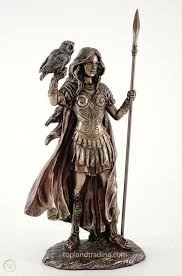
But I could find no other kingdom that would give me charity or honor, found no other king or god who would wed me or let me speak for him, and so I become disillusioned with kings and gods and epic tales. I put down my spear and shield and abandoned my armor and helmet, though I always kept my owl (who often flew above me) and my ragged plume.
And so, twice homeless, twice born and twice dead, friendless and scorned by the men I had so harshly judged, I wandered through the world, and all anyone saw was a woman, a gray, anonymous woman carrying a stick and a drooping feather. I walked up and down in the world and had no home. I had neither friends nor sisters nor protégées to honor me, neither priestesses nor queens to love me. I had no one at all. I had nothing at all. I wandered alone through all the lands around the wine-dark sea, alone in the lands around the central sea, alone in the lands along the ocean sea and the northern sea. For uncounted years I wandered alone, stopping here and there, but never staying anywhere, searching for what I never found and no longer remembered. I went in a plain gray cloak with my stick in my hand, my sad plume in a pouch at my belt. Sometimes I ate, but more often I went hungry. Up and down upon the earth I walked, and so my pride and anger began to be worn away.