When I asked Debra about this circle she said “the circle around the eye is symbolic of the moon, a nightly ritual of seeing the moon.” Curiously, women as ‘seers’ have an intimate relationship with the moon. Both eyes seem to be able to stare directly through the mask. The woman’s lips are parted; she is breathing but there is no sense that she is about to speak.
The length of the woman’s neck is accentuated by its distinct slate blue tones. This neck seems especially vulnerable – stretched perhaps to endurance. Suddenly it occurs to me that it is also a neck, like a chicken’s neck, that is ready for the chopping block. Has this woman lost her voice? Her ability to breathe? Is there a threat of being separated from her body? The suggestion of a body ends at the woman’s shoulders so we are left wondering…
Since our feelings and emotions reside in our bodies the suggestion here is that this woman may be without access to her body on an instinctual level. If so she is unable to protect herself. Blue is a color that is sometimes associated with death. In some Native traditions, like that of the Zuni and the Lakota Sioux blue is the color of the Underworld. Particularly touching is the pale four petaled flower to the lower right of the left half of the relief, a flower without a stem or root, or is this a wheel of some kind, one that is in motion – whirling – chaos? To my mind a number of aspects of this portrayal speak to the presence of death. Continue reading “The Mask and the Mirror – Part 2 by Sara Wright”
In her recent essay on this “Feminism and Religion” site, Ivy Helman wrote: “Over the past few months, I’ve been struggling to write posts. This month is no different. I am currently sitting with four different half-drafts on three semi-related topics, none of which I seem to be able to complete…I write. I erase. I rewrite. I copy bits of one into another to save for some other time. I’m left with one sentence….”
I think all writers have this experience—writing, erasing, and then rewriting over and over again. Writing during the current pandemic seems more difficult than ever. Perhaps it’s because our dealings with the outside world have been drastically curtailed. Writers need a variety of social interactions and experiences to sort out, reflect upon, and then create into a work of art that appeals and connects with an audience. At least I find this to be so. Continue reading “Embroidery in the Time of Covid by Esther Nelson”
I have a vivid childhood memory of being sick with the stomach flu and standing in the doorway of my parents’ bedroom looking for my mother. Her care for sick children was tender and thorough. She would bring us ginger ale and toast with jelly. When she had time, she read us stories. I can remember her steering me, heavy with fever, back to a bed that she had magically smoothed and cooled. But that day my mother lay in her own bed in an old nightgown, not stirring. She had the flu, too, and could not get up to care for the rest of us. It was a shocking and sobering moment.
As I grew older, I transferred my need for comfort, reliability, and continuity from my mother to the earth, the sure turning of the seasons, beloved trees, waters, and rocks. As a young mother, I looked forward to sharing my own childhood joys with my children, among them jumping into autumn leaf piles. The first time my children leaped into a leaf pile, they came up covered with the ticks that have now made my region the epicenter of Lyme and other tick-borne diseases. Nor was I able to share with my children the joy of drinking water straight from a stream. Continue reading “Child of the Earth by Elizabeth Cunningham”
The quality of mercy is not strained;
It droppeth as the gentle rain from heaven
Upon the place beneath. It is twice blest;
It blesseth him that gives and him that takes…
This speech (Act IV, scene 1) from The Merchant of Venice, given by Portia in disguise as a boy lawyer (and Bassanio doesn’t even recognize her!), may be one of Shakespeare’s most famous. In the play, as we know, Shylock, a Jewish moneylender, and Antonio, a merchant waiting for his ships to come in, make a bargain, one part of which is that if Antonio doesn’t pay on time, Shylock gets to collect one pound of his flesh. Antonio’s ships don’t come in, the case is taken before the Duke of Venice, and Portia appears in disguise to solve the legal issues. She goes immediately to Shylock and speaks this speech to him.
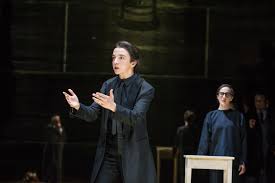
Portia, The Merchant of Venice Act IV, sc. 1, Royal Shakespeare Company production
This is more of an announcement than an article. My novel, WHITE MONKEY CHRONICLES, which has been reviewed by Elizabeth Cunningham on the FAR site, will be offered for FREE for five days, Oct 1st through Oct 5th. I would love for the women of FAR to be able to take advantage of this limited offer.
The story centers on a rogue order of nuns who are raising an undocumented, bicultural baby god on the downlow. He’s blue. A little bit Hindu, a little bit Jew, the baby is an inconvenient truth about an affair between two Gods from opposing religions, one married, one the famous bachelor God of the bible. The Cardinals of the Great Church get wind of this illegitimate baby God and so begins the hunt. Expect an appearance by the Godma to sort out this metaphysical mess. Continue reading “White Monkey Chronicles by Isabella Ides”
When we meet
our deep
brown eyes
mirror a
mutual need
for light
to penetrate
human darkness.
Your eyes are
wary and fearful;
Mine hunger
for your touch.
I cry out softly
“Don’t be afraid…
I love you”.
We share
a haunted skin –
hunted down
by Difference.
You are slaughtered
by men with guns.
I am knifed by wounding
man words,
– boy threats,
a ‘gift’ of a still warm
grouse – her neck twisted
and broken – dropped
at my door.
There are so many ways
to kill an animal.
You have shiny black fur
and my skin is light
but our senses scream
as one
in torment –
our bodies feel
the earth moving
under our feet.
We have no place
left to go –
no hope of peace.
What’s left?
Courage
to endure.
Working notes:
Some nights I walk down to the field, the one I call “field of dreams” to gaze up at the constellation of the Great Bear who circumnavigates the sky. In the Northern Hemisphere the Great Bear was probably the first image and manifestation of the Goddess. As a bear She denned in the fall, gave birth in dead winter, was reborn in the spring, feasted during the summer, and re –entered the cave of night in the fall, participating in an endless round of becoming. This year I feel the loss of Her Presence keenly. It has been a year of endurance; one in which hope has been absent. A year permeated by fear, drought, heat, stagnancy, unbearable waiting for house repairs to begin. It is almost October; un – dealt with house repairs loom as parched leaves drift to the ground and rains never come… I am losing perspective and I know it.
Wild bears have been for the most part absent from my life. For the first time ever. The absence of day bears mirrors the apparent loss of the Great Mother in me. I am drowning in doubt, depression, and uncertainty.
Of course, hunting pressure has reduced the number of bears to almost zero and those that still haunt what’s left of these broken forests have little food or protection. Even though I offer sanctuary, treats and friendship bears have been too wary, visiting only under the cover of night. I almost never see them.
The exception was Coal, a timid 300lb adult female that barely allowed me to get a few glimpses of her during the month of June…Although Coal knows me she is no longer interested in friendship. That she has survived long enough to reach adulthood and is of breeding age (she bred last year but lost her cubs to god knows what horror) guarantees that she has had too many threatening encounters with men to trust any human, including me – a woman who loves her.
Because we are in the midst of the three month black bear slaughter I think about Coal every day hoping that somehow she has managed to escape the hunters raging gun, wild dogs that ‘hound’ her, the ugly steel traps illegal in every state but this one…I look at her picture wondering if there is some way to reach her, to protect her – to help her survive. But I suspect that I am as powerless to help her, as I am to help myself.
Sara is a naturalist, ethologist ( a person who studies animals in their natural habitats) (former) Jungian Pattern Analyst, and a writer. She publishes her work regularly in a number of different venues and is presently living in Maine.
As the American Embassy was bombed in 1999, I was hunkered in a Russian Orthodox Church, gazing at the brooding, whitewashed faces of icons, hands raised in endlessly frightening benediction. Hundreds of men met my eye, as I found myself asking, “Where are all the women?” In 2005, the sun peaked over the horizon on Mount Sanai as I entered the chapel at Saint Catherine’s Monastery, which houses the oldest collection of Christian orthodox icons in the world. As a sensory overload accosted my eyes, ears, and nose, I scanned the scene to find only two women crammed among all the icons; one was a nameless daughter sacrificed by her own father. Where were all the women? A few years later, I knelt at the Temple of 1,000 Buddhas in Thailand. Not a woman could be found. Where are all the women?
For over a decade, I’ve painted folk-feminist icons of revolutionary women from history and mythology, a subversively artistic attempt to answer my own question by painting the women who have been ignored, excluded, or strategically erased. From Pauli Murray to Sarasvati, Gloria Anzaldua to Papahanoumoku, this work continues to be a gift, joy, and a tremendous part of the mission of my non-profit, the Tehom Center, which empowers marginalized women by teaching about revolutionary women through art, writing, retreats, and academic courses. Continue reading “Subversive Sister Saints by Angela Yarber”
On the eve of the Jewish Sabbath and the start of Rosh Hashanah, Supreme Court Justice Ruth Bader Ginsburg breathed her last breath. She was 87. She fought so hard for so long. She is an American patriot, hero, champion for women’s rights, and for many she was the stalwart bastion of justice and ‘liberal’ rulings. She was a Supreme Court Justice for 27 years. Her life has been put into books, a movie, and the most notorious memes around. She became known for elaborate collars over her Justice robes. We mourn the lost of her, we celebrate her memory, and we must pull up our boots and continue the fight.
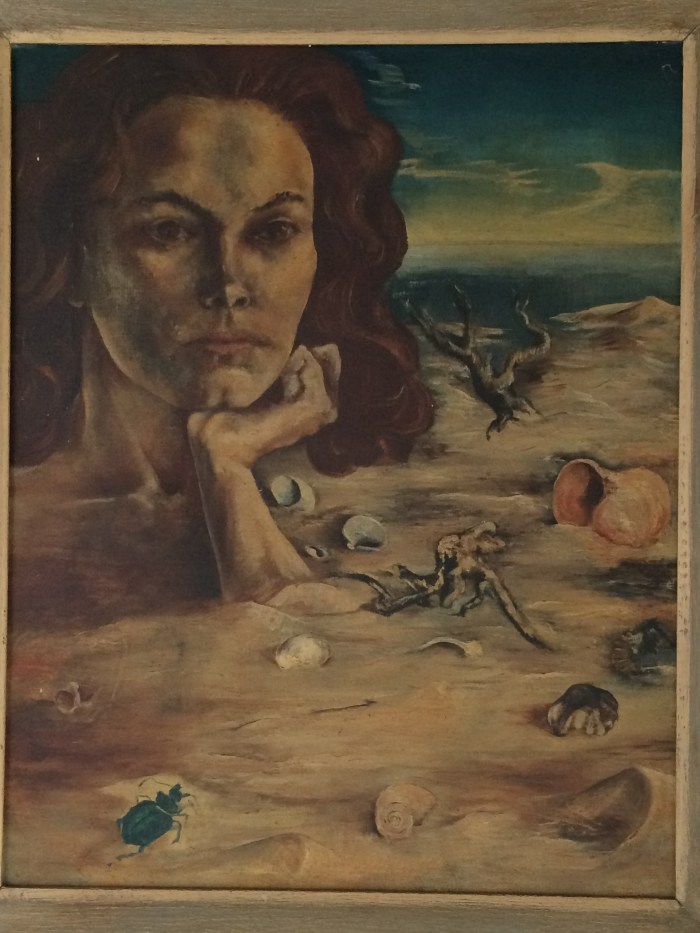
All through my childhood a self-portrait, painted by my mother hung above my parents’ bed. I was fascinated by this image of the stern face of my very beautiful mother with her long wavy chestnut hair. In the painting my mother’s body was buried in the sand up to her neck. Behind her, churning waves cascaded onto the shore. A blue sky was visible. A few seashells were scattered around and a large shiny green beetle was crawling over the sand. On the surface this image of my mother with her long curly hair seemed quite serene but as a child the painting disturbed me. It was as if this painting held a key – but to what? My father loved the painting and often commented on it…
I can remember playing at the seashore. My father would dig holes and bury both his children up to their necks in the warm sand that also held us fast…
My sense of direction is, at best, poor. In spite of that, I love a road trip. With the advent of affordable GPS (Global Positioning System) devices, driving long distances has become easier. Unfortunately, that tool (GPS) is not always reliable. Sometimes I get lost. I have a hard time figuring out how to get back on track. Like Blanche DuBois in “A Streetcar Named Desire,” I’m forced at times to depend on the “kindness of strangers.” Getting lost, though, becomes part of my road trip adventure.
I recently drove (for the third time) from Richmond, Virginia, to Las Cruces, New Mexico. I’ve chosen a different route each time. On this trip, I kept the mileage under 400 miles/day. That gave me time to look around the places I stopped for the night. This trip wasn’t nearly as taxing as those where I pushed to cover as much ground as possible in a day. I also made it a point to stay out of Texas due to the state’s high COVID-19 numbers and that added a couple of hundred miles to the drive. Continue reading “Where Am I Going? by Esther Nelson”



 In her recent essay on this “Feminism and Religion” site, Ivy Helman wrote: “Over the past few months, I’ve been struggling to write posts. This month is no different. I am currently sitting with four different half-drafts on three semi-related topics, none of which I seem to be able to complete…I write. I erase. I rewrite. I copy bits of one into another to save for some other time. I’m left with one sentence….”
 I have a vivid childhood memory of being sick with the stomach flu and standing in the doorway of my parents’ bedroom looking for my mother. Her care for sick children was tender and thorough. She would bring us ginger ale and toast with jelly. When she had time, she read us stories. I can remember her steering me, heavy with fever, back to a bed that she had magically smoothed and cooled. But that day my mother lay in her own bed in an old nightgown, not stirring. She had the flu, too, and could not get up to care for the rest of us. It was a shocking and sobering moment.

 On the eve of the Jewish Sabbath and the start of Rosh Hashanah, Supreme Court Justice Ruth Bader Ginsburg breathed her last breath. She was 87. She fought so hard for so long. She is an American patriot, hero, champion for women’s rights, and for many she was the stalwart bastion of justice and ‘liberal’ rulings. She was a Supreme Court Justice for 27 years. Her life has been put into books, a movie, and the most notorious memes around. She became known for elaborate collars over her Justice robes. We mourn the lost of her, we celebrate her memory, and we must pull up our boots and continue the fight.
 My sense of direction is, at best, poor. In spite of that, I love a road trip. With the advent of affordable GPS (Global Positioning System) devices, driving long distances has become easier. Unfortunately, that tool (GPS) is not always reliable. Sometimes I get lost. I have a hard time figuring out how to get back on track. Like Blanche DuBois in “A Streetcar Named Desire,” I’m forced at times to depend on the “kindness of strangers.” Getting lost, though, becomes part of my road trip adventure.
 Feminism and Religion