Moderator’s Note: We here at FAR have been so fortunate to work along side Carol Christ for many years. She died from cancer in July, 2021. Her work continues through her non-profit foundation, the Ariadne Institute for the Study of Myth and Ritual and the Goddess Pilgrimage to Crete. To honor her legacy, as well as allow as many people as possible to read her thought-provoking and important blogs, we are pleased to offer this new column to highlight her work. We will be picking out special blogs for reposting.This blog was originally posted February 18, 2013. You can read it long with its original commentshere. It was the first in an important 3 part series. We will be posting the next 2 parts in subsequent weeks (or you can read it earlier by going to the original post).
Recently feminist scholar Vicki Noble commented that this is the best definition of patriarchy she has read–but she hadn’t read it earlier. I am reposting it now in the hopes that all of you will share it with your social media so that it will be more widely known.
Patriarchy is often defined as a system of male dominance. This definition does not illuminate, but rather obscures, the complex set of factors that function together in the patriarchal system. We need more complex definition if we are to understand and challenge the the patriarchal system in all of its aspects.
Patriarchy is a system of male dominance, rooted in the ethos of war which legitimates violence, sanctified by religious symbols, in which men dominate women through the control of female sexuality, with the intent of passing property to male heirs, and in which men who are heroes of war are told to kill men, and are permitted to rape women, to seize land and treasures, to exploit resources, and to own or otherwise dominate conquered people.*
Moderator’s note: This marvelous FAR site has been running for 10 years and has had more than 3,600 posts in that time. There are so many treasures that have been posted in this decade that they tend to get lost in the archives. We are beginning this column so that we can all revisit some of these gems. Today’s blogpost was originally posted August 11, 2015. You can visit it here to see the original comments.
I recently came back from a weeklong camping retreat for Christian faculty and their families in beautiful Catalina (an island an hour’s boat ride away from the Southern Californian mainland). This year’s conference theme was “Power Revealed: Gifts, Dangers, and Possibilities.” Not surprisingly, the topics of race, race relations, and institutional racism came-up repeatedly in sessions and informal conversations.
In a world where the words of black women writers, even our very names are often soon forgotten, it is essential and necessary that we live through writing and teaching the words of our great and good writers, whose voices must no longer be silenced, even by death.[i]
– bell hooks
On December 15, 2021, the world lost the great feminist theorist, teacher, activist, and writer bell hooks. As a white feminist theorist, I valued immensely the ways her work widened my partial perspective, challenged my blind sports, and gave me important viewpoints on everything from sexism, racism, classism, pedagogy, militarism, work, and parenting. Her piece on feminist solidarity is the best I know — examining not just the ways we are divided by classism and racism, but also by sexism, addressing the very real and destructive ways that women undermine, abuse, and disregard each other, and how important it is to unlearn this with each other. She used the term “feminist movement,” rather than the feminist movement, knowing it not to be one thing, but rather a verb, a process of moving, changing, and transforming. Championing the power of coming to voice, she spoke truth to power, engaging in honest exploration of often difficult and divisive topics. It was this honest, liberatory voice that spoke throughout her work and made her voice so compelling, and so valuable.
Moderator’s note: Today’s post has been paired deliberately with yesterday’s archivalpost by Mary Sharratt. Both pay homage to Margaret Fell in very different yet complementary ways.
In the conservative evangelical church world—a world I was deeply invested in for most of my twenties—people often spoke of Christian feminism as if it appeared for the first time in our generation, or maybe one generation prior. I’m not totally sure why I accepted this as true—but I did, for a long time. It wasn’t until seminary that I learned otherwise.
It turns out that the dream of full, real, felt equality for women within Christianity is a very, very old dream. The history of women in church is a great deal more complex than I had assumed, or been led to believe. Over the course of two thousand years of Christian history, women have fought for, and sometimes experienced, freedom to lead and minister and be fully human.
Moderator’s note: This marvelous FAR site has been running for 10 years and has had more than 3,600 posts in that time. There are so many treasures that have been posted in this decade that they tend to get lost in the archives. We have created this column so that we can all revisit some of these gems. Today’s blogpost was originally posted March 6, 2019. It is paired with a new guest post abut Margaret Fell which will be posted tomorrow. You can visit the original post here to see the comments.
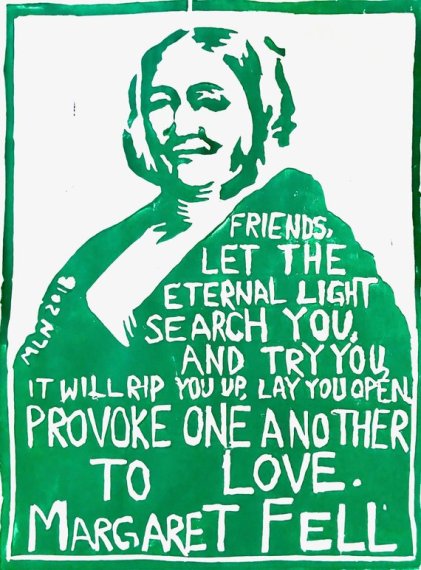
This linoprint of Margaret Fell can be orderedhere.
Pendle Hill will forever be associated to the Pendle Witches of 1612 who live on in the undying soul of the landscape and its folklore and who inspired my 2010 novel, Daughters of the Witching Hill. Pendle Hill also gave birth to the Quaker movement.
In 1652, George Fox, a simple weaver’s son and cobbler’s apprentice turned dissenting preacher, wandered across England on a spiritual quest. When he climbed Pendle Hill, his revelation came to him—an event that would change both Fox and the world forever. He envisioned a “great multitude waiting to be gathered.”
Reading Elizabeth Ann Bartlett’s beautiful post inspired me to share the following poem. I wrote it many years ago for my friend Lynette Eldridge to honor her love of the darker shorter days of winter.
As a devotee of the Divine Feminine, I have received many gifts that have enhanced and enriched heart, mind and soul. The greatest of these is the friendship of women. I became friends with Nettie during the hours-long drives we made together once a month for nine months from Nevada City, CA to Santa Cruz, CA to prepare for a Vision Quest in the Mojave Desert. Our journeys began in January, in the early morning dark of the short days following winter solstice.
My deeply devout French- Italian Catholic Grandmother held my hand as we walked into the village at dusk. We were going to see the crèche. I recall feeling very excited. I loved the story that she had just told me about Mary birthing Jesus in a manger surrounded by animals and doves while Joseph looked on.
I was eight years old. Until this Christmas I had never spent any time with my paternal grandmother. This year things were different. My parents were in Europe for a year and I had also been separated from my little brother who was staying with my maternal grandparents while I attended school in the east. My grandparents had sent me back to stay with my great aunts because they didn’t want me to go to Catholic school in California. I missed my little brother so much it hurt. My grandmother’s sisters were kind to me, but I was in a state of perpetual longing… How I ended up staying with this unknown grandmother remains a mystery to this day.
Moderator’s Note: We here at FAR have been so fortunate to work along side Carol Christ for many years. She died from cancer in July, 2021. Her work continues through her non-profit foundation, the Ariadne Institute for the Study of Myth and Ritual and the Goddess Pilgrimage to Crete. To honor her legacy, as well as allow as many people as possible to read her thought-provoking and important blogs, we are pleased to offer this new column to highlight her work. We will be picking out special blogs for reposting. This blog was originally posted July 9, 2012. You can read it long with its original commentshere.
My relationship to God changed when I accused “Him” of everything I thought “He” had done or let be done to women—from allowing us to be beaten and raped and sold into slavery, to not sending us female prophets and saviors, to allowing “Himself” to be portrayed as a “man of war.”
In the silence that followed my outpouring of anger, I heard a still small voice within me say: In God is a woman like yourself. She too has been silenced and had her history stolen from her. Until that moment God had been an “Other” to me. “He” sometimes appeared as a dominating and judgmental Other, and at other times as a loving and supportive Other, but “He” was always an “Other.” I as a woman in my female mind-body definitely was not in “His” image.
This month’s blog post marks my 10-year anniversary writing for feminismandreligion.com (FAR) and my 122nd post. I would just like to take a moment to acknowledge this milestone and thank the community for both its dialogue with me and support over these years. I look forward to writing for FAR for years to come.
Speaking of dialogue and support, this post is structured in the form of an answer to Barbara Ardinger’s question on my last post. She asked in what language I read Torah. I found that intriguing. To me, what I do is obvious. Yet, for the reader, I have never explicitly walked through the steps of how I create these Torah commentaries. In this walk-through, the reader is getting a rather unedited look into my process.