Season two of Star Trek: Discovery incorporates religion differently than season one. While there are religious overarching themes running throughout, like how actions to shape the future and faith not as convictions but as empowerment, a more fitting and interesting way of addressing religion throughout this season is to look at the individual characters and what their stories have to stay about religion.
Captain Pike knows and understands religion. He also often believes. Michael is the persistent skeptic. The Red Angel plays many roles: an illogical mystery, a revelation, a savior or a intentional sign. Saru is the convert, physically transformed with a newfound confidence and power, while Hugh is the reincarnated, whose bodily existence begets loneliness and struggle. Spock is the logic wrestler, who as Pike says asks “amazing questions.” Finally, not a character per se, episode two, entitled “New Eden,” represents a typical Western understanding of organized religion, replete with sacred writings and a church.
Like season one, religion is present in the opening scene of the season, this time in the form of mythology, as Michael tells a tale of an African girl who threw embers from a fire into the air creating the Milky Way. Michael says that she left a message in the stars if one was willing and open to receiving it.
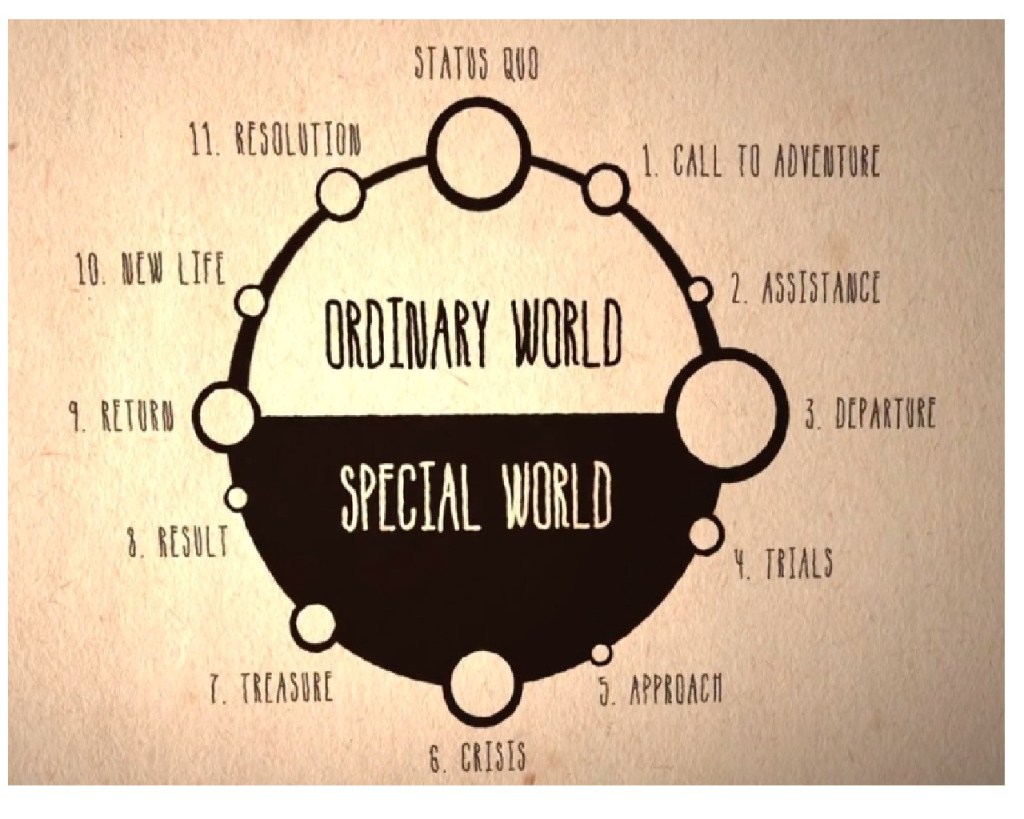
Joseph Campbell’s monomyth, the Hero’s Journey, is outlined in his 1949 book, The Hero with a Thousand Faces. Drawn from his studies of comparative mythology and Jungian psychology, the Hero’s Journey has become a foundation myth of modern culture. The hero, generally young and vigorous, sets off into the unknown to battle antagonistic forces and returns transformed, a hero and guide to his people.
As Campbell writes in The Hero with a Thousand Faces:
A hero ventures forth from the world of common day into a region of supernatural wonder: fabulous forces are there encountered and a decisive victory is won: the hero comes back from this mysterious adventure with the power to bestow boons on his fellow man.
The Hero’s Journey has served as the go-to template for Hollywood screenwriters and bestselling novelists. We see this mythic pattern of the conquering male hero played over and over again in popular culture. Think Luke Skywalker in the original 1977 Star Wars—or any protagonist in a George Lucas or Steven Spielberg movie. Creative writing teachers encourage their students to pattern their story arcs on the Hero’s Journey to give a sense of archetypal depth and resonance. But this technique has been overused to the point of becoming a cliché. A deeply sexist cliché. Continue reading “The Via Feminina: Revisioning the Heroine’s Journey by Mary Sharratt”
Valentine’s Day was never about romantic love in my family. Mom always gave us Snoopy Valentines. Dad would write hilarious rhymes. My stepmom created gorgeous tea parties with chocolates and flowers, and we even gave red treats to our dogs. It was a chance to tell each other how much we love each other, and it was… well, really fun! So it’s no surprise that we’ve continued these traditions, with our own kids and dogs, and we all look forward to St. Valentine’s Day.
Most people know Valentino was from Italy. That’s another thing I love. I really love being Italian. Whenever I go back to New York, I feel my family’s Italian history and heritage surging through my soul. My olive-skinned mother would get so excited for the Italian street festivals – you know, where the center of the pavement is the red, white, and green of the Italian flag, instead of double yellow? And we had to eat the street food, like sausages with peppers and onions, and pizzelle. We’d wander around listening to folk music, proudly wearing our ‘Kiss Me, I’m Italian’ buttons, and giving each other lots of kisses.
Many Americans described the recent (January 6, 2021) attack on the Capitol in Washington DC as shocking. I believe the event reflected one of the many times we’ve reaped the fruit of what we’ve sown throughout the course of American history. Thomas Edsall, in a New York Times article (1/28/21), wrote an excellent piece titled, “The Capitol Insurrection is as Christian Nationalist as it Gets.” He quotes a variety of experts on religion and other disciplines while contextualizing the incident within a religious narrative—something that is sorely lacking from our news outlets.
I think many people think of religion as something inherently good or at least as a neutral phenomenon belonging for the most part to an unearthly, apolitical realm. Charles Kimball writes in his book When Religion Becomes Evil: “History clearly shows that religion has often been linked directly to the worst examples of human behavior… more wars have been waged, more people killed…in the name of religion than by any other institutional force in human history.” Continue reading “Is Authoritarianism a Christian Value? by Esther Nelson”
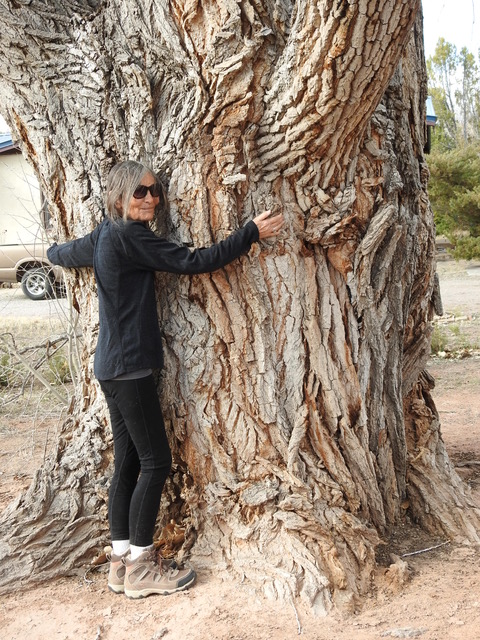
This morning, I walked around the field and discovered three soft white breast feathers of an unknown bird, two earthstar mushrooms, sinking quietly back into the soil, one tiny snail shell, curled in spiral perfection, and the fire of my own spirit burning in my belly, rekindled by elemental magic of the everyday kind, the small and precious gifts of an ordinary day.
Every January, we rent a house on Dauphin Island and spend the month at the beach with our kids. Usually, we pack our business along with us and work from the rental house, though this year my sister kept it running from our home studio in Missouri instead. My husband describes this month away as the “weekend of the year,” and this is, in fact, how it feels, except for unlike most normal weekends, we walk five miles by 8:30 a.m. each morning. We joke that this is one of the best ways to know we’re on “vacation.” During one month of walking, we will log more than 300,000 steps together, this time away from home allowing us to pare back the layers of to-dos that build up each year, to re-prioritize our goals, to re-sync ourselves with what we most value, and to breathe deeply back into ourselves again—our hearts, our hopes, our dreams—after the hectic holiday season. Since we are self-employed, we never wake to an alarm clock at home, but while on our sojourn away, always motivated by the prospect of finding good shells, we set the alarm for 5:00 a.m., rising to the voice of Kellianna singing “I Walk with the Goddess” as we set off in the darkness to the uninhabited beach down the road. This year, due to hurricane damage and the resultant road work and beach restoration work in progress, the only way to reach our favorite walking spot is to rise before the road crews do and get out and back before the access road is closed to traffic for the work day.
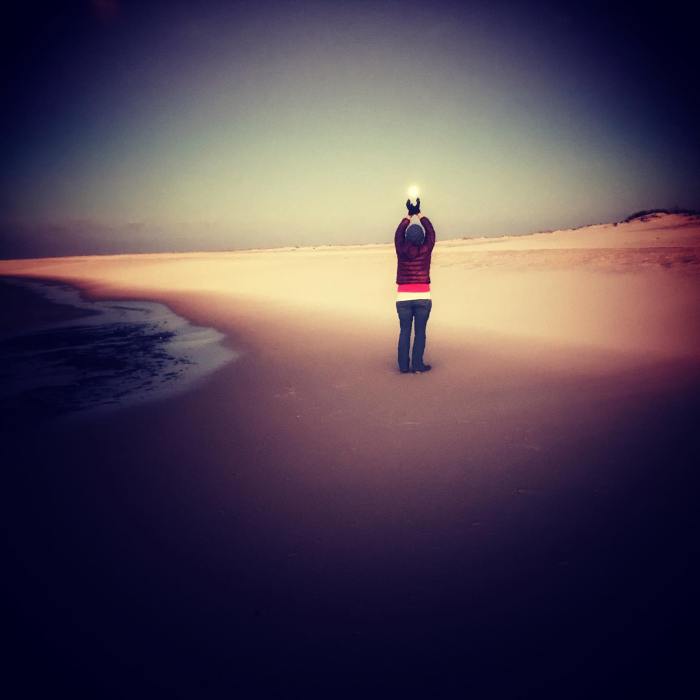
We walk before dawn, our faces glimmering palely beneath a full moon. Our shell finding has been slender on this trip, the beach often swept clean by waves, but on this day, lit only by full moonlight, I finally catch sight of a big brown moon snail shell, half-buried in the sand. My favorite type of shell and, discovered on a full moon, no less! My husband’s foot comes down upon it as I grab his arm to stop him, but then I seize it with glee, undamaged and smooth in my hand. Though I have previously written that I expect no reward for devotion, sometimes it is, in fact, delightful to receive a reward anyway, especially on a dark beach with only moonlight as my guide. We spot two glowing eyes a few feet away and a fox keeps pace with us, pausing to sit and watch as we make our steady way along the shore. The sky lightens to rainbow stripes as the first flares of dawn begin to glow with eastern fire. I stand with my arms extended, the fingertips of one hand reaching for the moon while the other hand reaches for the sun, the waves lapping at the shore, the wind at my back. I feel held, suspended in eternity, small and rapturous, balanced at a centerpoint of time, inhabiting the liminal, poised within a living strip of space between land and sea, earth and sky, wind and sand, dawn and dusk, motion and stillness. Behind me, the fox moves swiftly away across the sand under a rainbow sky.
I reflect as I continue to walk, murmuring the Charge of the Goddess below the moon, that these are my favorite kinds of rituals, the most powerful kinds of ceremonies, the truest expression of magic in my life and days.
On the winter solstice this past year, I carried a blanket out to the field in front of our house. I brought along my Womanrunes cards so I could do an annual oracle card layout for the year. I carried my journals and my planner and some of our small goddess figurines. Rather than sit on the blanket and dream about the year to come, busily scribbling notes and ideas in my planners as I had envisioned, instead I lie flat on my back on gazing at the sky. I became aware as I was lying there, breath slow in my belly, that I could see the moon on my right hand side and I could see the sun getting closer to setting on my left hand side. Then, I became aware that the birds were at my feet at our bird feeder by the studio building. Next, I became I aware of the cedar trees above my head, at the far side of the field. Lying there, feeling the earth beneath me, the sensation struck: I’m surrounded by the elements. I’m surrounded by all these aspects of magic, right now, no elaborate solstice ritual required. Though I made sun bread with my children and we held our traditional candle lit winter solstice ceremony and spiral walk, these moments lying on my back in the field were my ritual, my ceremony, the fullest expression of a living spirituality for me. Magic need not need to be fancier or more elaborate or more planned out than this, I think. It can mean lying on your back in a field and feeling the presence of the living elements around you, carrying you, holding you, supporting, nourishing, restoring, revitalizing, and, in a way, rebirthing you into awareness.
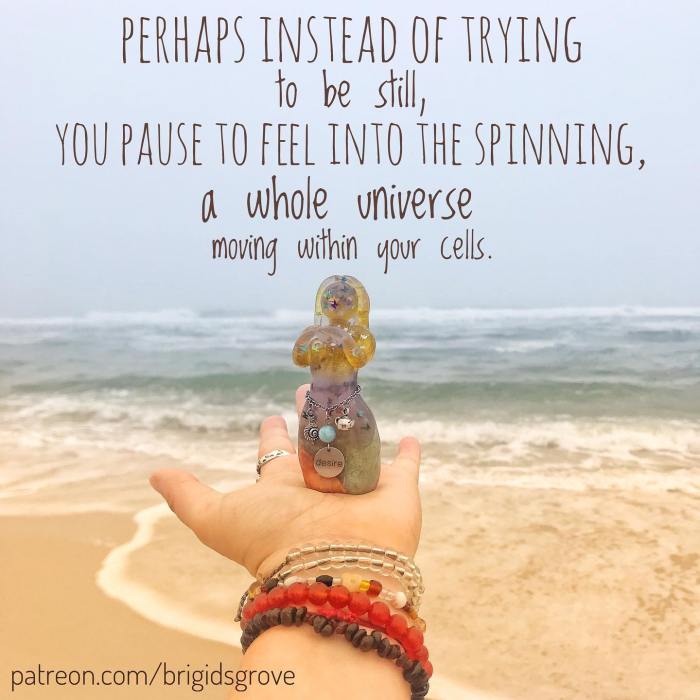
When I rose from my blanket to work on my plans, I noticed the way the rapidly setting sun was peeking through the trees and I decided to take a picture of one of my goddesses there with the last rays of the solstice sun shining behind her. As I squatted down to take the picture, I saw that one of the sunrays was extending through the trees in such a way that it was literally pointing exactly at my blanket, right at my little pile of books and my little plans, an affirmation of sorts: this is where you need to be, this is what you need to be doing. Since it was the Winter Solstice, of course this ray of light reminded me of light coming through Stonehenge and striking the exact right point, and it thrilled me to know that if I hadn’t decided to be outside exactly at this exact moment with the sun at this position, I never would have seen the ray of light illuminating my blanket. I’m not suggesting that the sun did that for me, it was rather that I allowed myself to witness what was already there, as if the ceremony was in place, it was unfolding, it was taking place, whether I was going to step into it or not, whether I was going to notice it or not, whether I was even aware of it or not. While this may not sound like a ceremony or a ritual in the way that many people describe ceremony and ritual, for me, it was one of the most powerful rituals I experienced that year.
Ceremonies of earth and being are unfolding around us all the time and we can either be present for them or not.
I could not have planned or designed that solstice or the full moon, fox-accompanied beach walk. I could not have planned or designed these rituals of living. I stepped out into the world instead and saw what ceremony was already underway, and then took part in it. Perhaps this sounds too simple or too small. There are many books with plans and outlines, ceremonies and correspondences, the right colors of candle and the right invocations to choose. And, those things are all wonderful too. I love setting up a fulfilling ritual space and creating a ritual atmosphere for people. I love candles and singing and choosing just the right words. I write today to remind us that there are many rituals of the everyday, there are many ceremonies of everyday magic, natural magic, that are already unfolding around you. I invite you to consider stepping into them and receiving them as a gift rather than trying to harness the elements or shape the setting to your own will. I encourage you to savor and see the unplanned, small magics of living unfold as they will. These elements of the holy, these sacred sites, can be alive, within you, beneath your feet, and around you every day, waiting (or not waiting) for you to notice that they’re here, carrying you along.
May you celebrate, savor, and sink into the magic of your life right where you are.
Sometimes, the world creates ceremonies for us and we just have to show up for them.
Dedication: I dedicate this writing to all animals, women, children who have been violated, brutalized or murdered by men.
I will never forget
the look in her eyes
when he kicked her
the ugly brown shoe
smashing the domed
brown skull –
the daze – vacant
uncomprehending
falling to the floor
her eyes glazed
still find mine
“What did I do?”
Here’s a simple spiritual practice that I’ve been doing for longer than I can remember. During the regime of the Orange T. Rex, I started doing it at bedtime to calm my mind so I could go to sleep. We’re hopefully living in a more optimistic and peaceable time now, but that’s no reason not to add a new spiritual practice to our lives. I hope you’ll like this one and will try it for yourself.
We’re accustomed to seeing people praying with rosaries or reciting mantras and counting repetitions with strings of beads. We can do that, too. But how about using a simpler “tool” to keep track of our mantras and affirmations—our own hands?
How to use your hand? Make a fist and extend each finger as you say its affirmation. If you’re seated, lay your hand on the arm of the chair or in your lap and tap one finger at a time. Or just find your own way to keep track.
In the next paragraphs, I interpret what the affirmations in the illustration mean to me.
Thumb: All seems well. Yes, this is ambiguous, but consider what we’ve been living through since 2016, especially in 2020 with the pandemic and the election. Perhaps things have improved now. Perhaps some things do seem well. This ambiguity is the baseline upon which the rest of the handy practice is built.
Pointer finger: All things shall be well. This and the next finger are my paraphrases of the writing of Dame Julian of Norwich (ca. 1314-1416), a medieval English anchorite. Dame Julian lived through the Black Death and the Peasants Revolt and was the author of Revelations of Divine Love,https://en.wikipedia.org/wiki/Revelations_of_Divine_Love which is the first surviving book in the English language written by a woman. An interesting note about the conjugation of English verbs: the declarative (everyday) mood is I/we shall, you will, he/she/it/they will. Note that when the “shall” and the “will” are reversed—I/we will, you shall, he/she/it/they shall—we get the imperative mood. It’s emphatic. “All things shall be well” means that’s how it’s gonna be. When you say this affirmation (aloud or silently), say it emphatically.
Long finger: All manner of things shall be well. Again, my paraphrase. (What she really wrote is what she heard Jesus say in a vision: “All shall be well, and all shall be well, and all manner of thing shall be well.”) Let’s look more closely at my version. “All manner of things”: not just a few things, but many things. What do you see as “all manner of things”? Your own welfare? The welfare of your family and friends? What’s happening in your neighborhood, city, state, nation? Think as personally or as generally as you want to when you say this. (You can of course change what things shall be well every time you repeat this affirmation.) Emphasize “all manner” as you think about what you want to be well. Then also emphasize “shall be well.” We’re not giving orders to the universe, of course, but we can shout if we want to.
Ring finger: All can only be well. A typical metaphysical affirmation. As you repeat it, see it as a universal goal. Try saying it five times, stressing each word in turn. ALL can only…. All CAN only…. All can ONLY…. Et cetera.
Pinkie finger: Om tare tuttare ture soha. Because I took refuge with Green Tara during a weekend workshop taught by Dagmola Jamyang Sakya many years ago, I use the Tara mantra. Translation: “I prostrate to the Liberator, Mother of all the Victorious Ones.” (Well, I don’t do the proper Tibetan prostrations. It takes me forever to get up off the floor.) Another goddess mantra is Vishwa Shakti Avaham. Translation: “Universal energy of the Divine Mother [Shakti], be present in my life.”
You can of course make other choices for your pinkie finger affirmation. Here are half a dozen ideas. Use them and/or make up new ones. Let your littlest finger be strong enough to hold a big intention.
Deena Metzger’s Goddess Chant: “Isis Astarte Diana Hecate Demeter Kali Inanna.” You’re invoking seven powerful goddesses into your life.
“We are the flow, we are the ebb. We are the weavers, we are the web.” (Probably composed by Shekinah Mountainwater.) We are active parts of the benevolent universe.
A Beatitude. Here’s one I like: “Blessed are the merciful, for they shall obtain mercy.” I have long believed that if Christians paid more attention to the Sermon on the Mount there would be less conflict in religious discussions.
The opening line of a Psalm. Here’s Psalm 19 (AV): “The heavens declare the glory of God; and the firmament sheweth his handywork.” Open your own Bible and select the Psalm that speaks to your heart.
These lines spoken by the exiled Duke in the Forest of Arden in Shakespeare’s As You Like It: “And this our life…/ Finds tongues in trees, books in the running brooks,/ Sermons in stones, and good in everything./ I would not change it” (II, 1, 562-65). As we’ve seen in many posts by the FAR community, we can find much good in and learn much from Mother Nature.
The first line of this Jerry Herman song from La Cage aux Folles: “The best of times is now.” Here’s the whole song from the 2010 Tony awards broadcast https://www.youtube.com/watch?v=PBZLCnF4KC0 as sung by Douglas Hodge (who won the Tony that year) and the whole cast. It’s enormous fun to watch. (Those are the Cagelles dancing in the aisles.) For a cheery and inspiring conclusion to your handy spiritual practice, learn and sing the whole song.
[Note: Many thanks to Jennifer Ardinger for turning my sketch of the hand into real art. Many thanks to Meloney Hudson for teaching me the Shakti mantra.]
Barbara Ardinger, Ph.D. (www.barbaraardinger.com), is a published author and freelance editor. Her newest book is Secret Lives, a novel about grandmothers who do magic. Her earlier nonfiction books include the daybook Pagan Every Day, Finding New Goddesses (a pun-filled parody of goddess encyclopedias), and Goddess Meditations. When she can get away from the computer, she goes to the theater as often as possible—she loves musical theater and movies in which people sing and dance. She is also an active CERT (Community Emergency Rescue Team) volunteer and a member (and occasional secretary pro-tem) of a neighborhood organization that focuses on code enforcement and safety for citizens. She has been an AIDS emotional support volunteer and a literacy volunteer. She is an active member of the Neopagan community and is well known for the rituals she creates and leads.
All week we have been warming our spirits at the sacred fire of Candlemas / Imbolc, the Celtic holiday in honour of Brighde, Irish saint and Goddess of poetry, smithcraft and healing. Imbolc falls approximately 6 weeks between the winter solstice and the spring equinox, one of the 8 festivals of the Celtic year.
In the Greek Orthodox Church, February 2 is celebrated as Ypopantis, the presentation of Jesus at the Temple, 40 days after his birth, in accordance with Mosaic law. This day also marks Mary’s ritual return to the world after forty days of postpartum seclusion. This practice was known in the Western Church as ‘churching’ or blessing a new mother after 40 days; Hindu tradition also recommends women spend up to 40 days in rest and isolation after childbirth.
Mosaic of the Nativity
In the west, the customs of confinement and churching have dwindled since the 1960s, but in Greek Orthodox tradition until very recently, these forty days of isolation for mother and child were routine. A special word, lechóna (λεχώνα), from the ancient Greek for ‘bed’ or ‘couch’, denotes a woman in this special time. Continue reading “Forty Days After Childbirth, Mary Returns to the World by Laura Shannon”
Dear President Biden, Vice President Harris, and Members of the 117th Congress,
At a crucial moment of leadership transition in the history of ancient Israel, the Israelites were about to cross the Jordan River without Moses at their head. As Moses passed on the mantle of authority to Joshua, he enjoined his successor and the assembled community, “Be strong and resolute” (Deuteronomy 31:8). The challenges before the people were multiple and daunting, but Moses urged them not to be afraid or dismayed. His powerful words, which are repeated three times in Deuteronomy 31 (vv. 6, 7, 23), contain a bracing message for the new administration and new Congress as you confront multiple crises facing our divided nation. Continue reading “Be Strong and Resolute by Judith Plaskow”
The archetype of the Weaver is being widely activated. Thousands of women and men come forth to incarnate it by creating webs of spiritual awakening, by honoring ancestral ways of being, and by promoting practical and sustainable ways of living and thriving.
However, many of these efforts collapse due to a lack of genuine communication inside the group. How can we direct our intentions into grounding a vision that is broader than ourselves? How can we weave together in such a way that each feels heard and, at the same time, willing to deeply listen and feel into, not only the group as a set of individuals, but also to what is making its way into birth out of the group as a unit?
Although it seems easy, group synchronization is not a light task and, in order for this to happen at a substantial level, one has to start from oneself. It is necessary for a kind of initiation to take place, an initiation called “soul individuation.” Soul individuation is a deep dive into one´s own underworld in order to unearth and liberate experiences that have caused one´s soul to fragment. Until this is achieved, one can communicate only from that broken place, not from a place of wholeness and authenticity. Journeying to the underworld is not a pleasant process but, it is a necessary step towards balance and integrity. Continue reading “The Sacred Face of Death by Eirini Delaki”





 Dedication: I dedicate this writing to all animals, women, children who have been violated, brutalized or murdered by men.
 Barbara Ardinger, Ph.D. (
 All week we have been warming our spirits at the sacred fire of Candlemas / Imbolc, the Celtic holiday in honour of Brighde, Irish saint and Goddess of poetry, smithcraft and healing. Imbolc falls approximately 6 weeks between the winter solstice and the spring equinox, one of the 8 festivals of the Celtic year.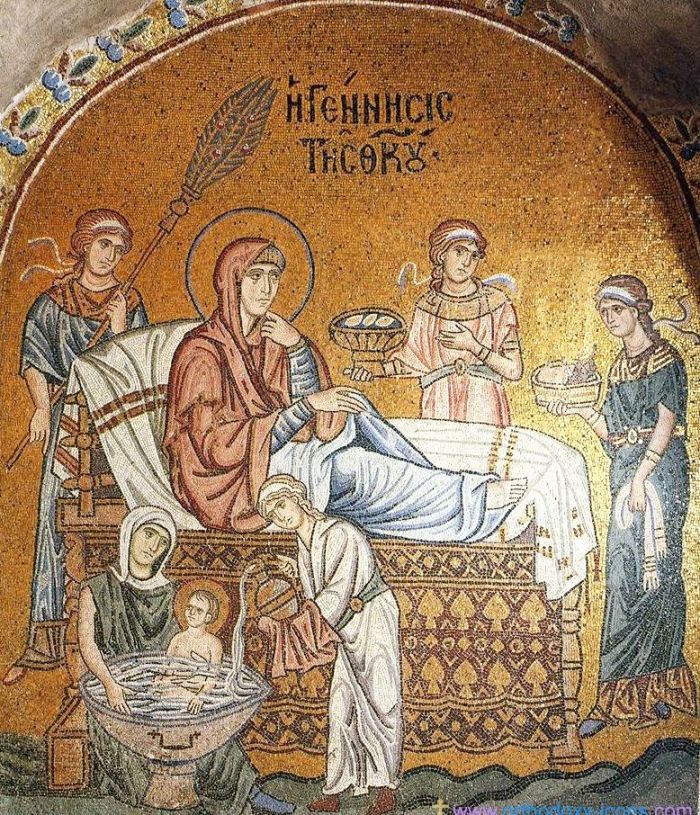
 January 29, 2021