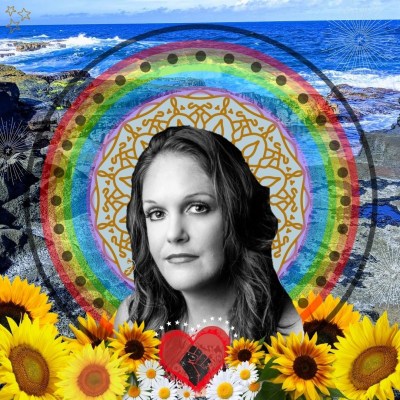
Recently feminist scholar Vicki Noble said this is the best definition of patriarchy she has read–but she hadn’t known of it earlier! I am am republishing it now in hopes that all of you will share it on your social media so that it becomes more widely known. Thanks!
Patriarchy is often defined as a system of male dominance. This definition does not illuminate, but rather obscures, the complex set of factors that function together in the patriarchal system. We need more complex definition if we are to understand and challenge the the patriarchal system in all of its aspects.
The quality of mercy is not strained;
It droppeth as the gentle rain from heaven
Upon the place beneath. It is twice blest;
It blesseth him that gives and him that takes…
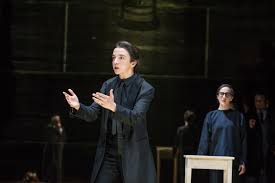
This speech (Act IV, scene 1) from The Merchant of Venice, given by Portia in disguise as a boy lawyer (and Bassanio doesn’t even recognize her!), may be one of Shakespeare’s most famous. In the play, as we know, Shylock, a Jewish moneylender, and Antonio, a merchant waiting for his ships to come in, make a bargain, one part of which is that if Antonio doesn’t pay on time, Shylock gets to collect one pound of his flesh. Antonio’s ships don’t come in, the case is taken before the Duke of Venice, and Portia appears in disguise to solve the legal issues. She goes immediately to Shylock and speaks this speech to him.
Portia, The Merchant of Venice Act IV, sc. 1, Royal Shakespeare Company production
This is more of an announcement than an article. My novel, WHITE MONKEY CHRONICLES, which has been reviewed by Elizabeth Cunningham on the FAR site, will be offered for FREE for five days, Oct 1st through Oct 5th. I would love for the women of FAR to be able to take advantage of this limited offer.
The story centers on a rogue order of nuns who are raising an undocumented, bicultural baby god on the downlow. He’s blue. A little bit Hindu, a little bit Jew, the baby is an inconvenient truth about an affair between two Gods from opposing religions, one married, one the famous bachelor God of the bible. The Cardinals of the Great Church get wind of this illegitimate baby God and so begins the hunt. Expect an appearance by the Godma to sort out this metaphysical mess. Continue reading “White Monkey Chronicles by Isabella Ides”
The first thing I do in parenting courses is ask students their most basic beliefs about children. Students are startled by this opening slide, “what are children?” The obvious, knee-jerk response to the question, “Are children human?” is “Of course!” It seems like an unnecessary, bizarre question to ask.
However, many parents and societies treat children as though they are not fully human. Children are valuable, but they are not given the respect, trust, and basic human rights that we generally say humans should receive. Actually, most people treat children with coercion, humiliation, and distrust – as though children are willfully bad and thoughtless. Every time parents give a “consequence” (imposed punishment) for “bad behavior,” they are telling the child that she is a bad person, who needs to be “kept in line” by punitive measures. Every time parents tell children to eat this before they can eat that, or that they must put on a coat if they are to go outside, parents are sending the message that children do not deserve bodily autonomy, do not have the right to make basic decisions about their own bodies, are incompetent. That is anti-feminist parenting. Continue reading “Feminist Parenting, Part 2 — What are Children? Are Children Human? by Trelawney Grenfell-Muir”
When we meet
our deep
brown eyes
mirror a
mutual need
for light
to penetrate
human darkness.
Your eyes are
wary and fearful;
Mine hunger
for your touch.
I cry out softly
“Don’t be afraid…
I love you”.
We share
a haunted skin –
hunted down
by Difference.
You are slaughtered
by men with guns.
I am knifed by wounding
man words,
– boy threats,
a ‘gift’ of a still warm
grouse – her neck twisted
and broken – dropped
at my door.
There are so many ways
to kill an animal.
You have shiny black fur
and my skin is light
but our senses scream
as one
in torment –
our bodies feel
the earth moving
under our feet.
We have no place
left to go –
no hope of peace.
What’s left?
Courage
to endure.
Working notes:
Some nights I walk down to the field, the one I call “field of dreams” to gaze up at the constellation of the Great Bear who circumnavigates the sky. In the Northern Hemisphere the Great Bear was probably the first image and manifestation of the Goddess. As a bear She denned in the fall, gave birth in dead winter, was reborn in the spring, feasted during the summer, and re –entered the cave of night in the fall, participating in an endless round of becoming. This year I feel the loss of Her Presence keenly. It has been a year of endurance; one in which hope has been absent. A year permeated by fear, drought, heat, stagnancy, unbearable waiting for house repairs to begin. It is almost October; un – dealt with house repairs loom as parched leaves drift to the ground and rains never come… I am losing perspective and I know it.
Wild bears have been for the most part absent from my life. For the first time ever. The absence of day bears mirrors the apparent loss of the Great Mother in me. I am drowning in doubt, depression, and uncertainty.
Of course, hunting pressure has reduced the number of bears to almost zero and those that still haunt what’s left of these broken forests have little food or protection. Even though I offer sanctuary, treats and friendship bears have been too wary, visiting only under the cover of night. I almost never see them.
The exception was Coal, a timid 300lb adult female that barely allowed me to get a few glimpses of her during the month of June…Although Coal knows me she is no longer interested in friendship. That she has survived long enough to reach adulthood and is of breeding age (she bred last year but lost her cubs to god knows what horror) guarantees that she has had too many threatening encounters with men to trust any human, including me – a woman who loves her.
Because we are in the midst of the three month black bear slaughter I think about Coal every day hoping that somehow she has managed to escape the hunters raging gun, wild dogs that ‘hound’ her, the ugly steel traps illegal in every state but this one…I look at her picture wondering if there is some way to reach her, to protect her – to help her survive. But I suspect that I am as powerless to help her, as I am to help myself.
Sara is a naturalist, ethologist ( a person who studies animals in their natural habitats) (former) Jungian Pattern Analyst, and a writer. She publishes her work regularly in a number of different venues and is presently living in Maine.
Today a couple of friends and I were discussing egalitarian matriarchal values. I stated that in these societies there is no great difference in male and female personalities because both males and females are expected to be as kind and loving and generous as their own mothers. “Oh no I would not want that,” the other woman responded. “I want my man to be masculine–not wishy washy or namby pamby.” This woman soon acknowledged that she did not want her man to be dominant or aggressive. Yet her first reaction was to reject the idea that men might do well to emulate the values of their mothers.
This conversation illustrates the difficulty we have in conceiving alternatives to the way we assign gender roles. Masculine: assertive and aggressive. Feminine: weak and passive.
In fact. being as kind, loving, and generous as mothers in egalitarian matriarchies has nothing to do with these familiar gender binaries. Mothers in egalitarian matriarchies are assertive, but not aggressive, and there is nothing weak or passive about them. Love, kindness, and generosity are not about standing back and letting others walk over you. Instead they are active values that require intelligence, reflection, and strength. Continue reading “Masculine: Aggressive/Feminine: Passive: Can We Imagine Alternatives? by Carol P. Christ”
The Torah reading for the first day of Rosh haShanah, the Jewish new year, is not, as one might expect, the creation of the world (Rosh haShanah was Friday night, Saturday and Sunday, 9/18-9/20). Instead, the set reading is Genesis 21, the story of how Sarah, wife of Abraham, gives birth to Isaac—a joyous occasion indeed, given that she is ninety years old. But then Sarah becomes anxious that her husband’s other wife, Hagar, also has a son, Ishmael, who could inherit from Abraham, and demands that Hagar and Ishmael be expelled from the household. This year, reading this tale, I am seeing a story that shows how when we think about success, abundance, and consequences, we include some people in our consideration but not others. In this tale, the Divine includes the perspectives of the unwitnessed even when we do not.
In Genesis 16, it is Sarah (originally called Sarai) who first arranges a sexual relationship between Hagar, an Egyptian woman enslaved to her, and her husband Avraham, who has been called by God to create a new nation. God has promised her husband Avraham a great posterity, but they do not have even one child. Sarah gives Hagar to Avraham in order to produce an heir (no consent on Hagar’s part is recorded). When Hagar becomes pregnant, the text suggests that Sarah has become “light” or “diminished” in Hagar’s eyes. In other words, Hagar no longer treats Sarah as her owner. Sarah complains to Avraham, and Abraham gives Sarah permission to do whatever she wants with Hagar. Sarah abuses Hagar, and Hagar runs away. An angel arrives while Hagar is sitting by a well, and directs Hagar to return, for she is to give birth to a child who will give rise to uncountable numbers of offspring. During this encounter, Hagar gives God a name: El Ro’I, the God who sees me. Continue reading “Hagar, the Divine Witness, and the New Year by Jill Hammer”
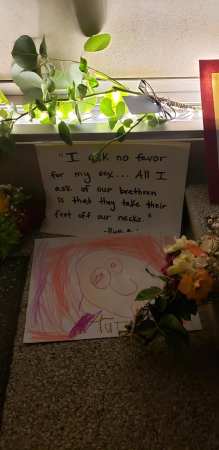
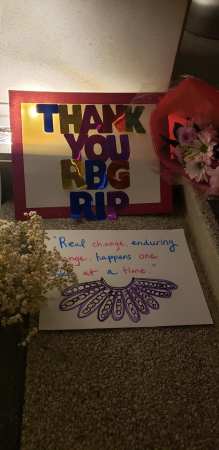
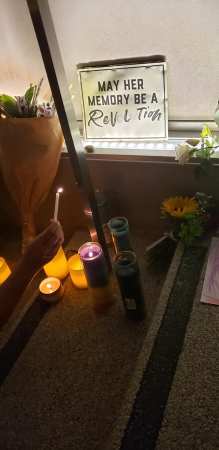
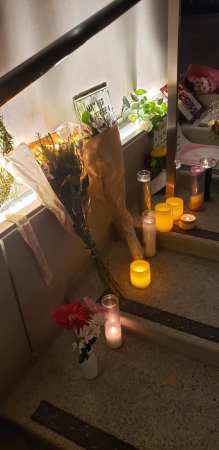
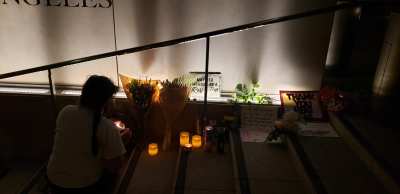
We may all remember 2020 as the year when we could no longer look away from death. Our western culture has hidden death away in hospitals and funeral homes for generations. However, in these past months we have all been inundated with daily images of COVID-19 patients dying alone in ICUs, terrified people and wildlife consumed by flames or flood, televised funerals of victims of racial violence, children starving due to droughts, the loss of icons of courage and compassion like Ruth Bader Ginsburg, Elijah Cummings, and John Lewis, and so much more. Even as we seem to be surrounded by death, we risk being inured to its tragedy by the sheer numbers of dead from these and other causes.
How we survive this time as individuals and a society may depend in part on how we are able to answer the question “Were we able to mourn each life lost – human or non-human — as a sacred being, unique and irreplaceable? Did we ignore the suffering of others or did we find deeper compassion?”
As the American Embassy was bombed in 1999, I was hunkered in a Russian Orthodox Church, gazing at the brooding, whitewashed faces of icons, hands raised in endlessly frightening benediction. Hundreds of men met my eye, as I found myself asking, “Where are all the women?” In 2005, the sun peaked over the horizon on Mount Sanai as I entered the chapel at Saint Catherine’s Monastery, which houses the oldest collection of Christian orthodox icons in the world. As a sensory overload accosted my eyes, ears, and nose, I scanned the scene to find only two women crammed among all the icons; one was a nameless daughter sacrificed by her own father. Where were all the women? A few years later, I knelt at the Temple of 1,000 Buddhas in Thailand. Not a woman could be found. Where are all the women?
For over a decade, I’ve painted folk-feminist icons of revolutionary women from history and mythology, a subversively artistic attempt to answer my own question by painting the women who have been ignored, excluded, or strategically erased. From Pauli Murray to Sarasvati, Gloria Anzaldua to Papahanoumoku, this work continues to be a gift, joy, and a tremendous part of the mission of my non-profit, the Tehom Center, which empowers marginalized women by teaching about revolutionary women through art, writing, retreats, and academic courses. Continue reading “Subversive Sister Saints by Angela Yarber”





 The first thing I do in parenting courses is ask students their most basic beliefs about children. Students are startled by this opening slide, “what are children?” The obvious, knee-jerk response to the question, “Are children human?” is “Of course!” It seems like an unnecessary, bizarre question to ask.

 The Torah reading for the first day of Rosh haShanah, the Jewish new year, is not, as one might expect, the creation of the world (Rosh haShanah was Friday night, Saturday and Sunday, 9/18-9/20). Instead, the set reading is Genesis 21, the story of how Sarah, wife of Abraham, gives birth to Isaac—a joyous occasion indeed, given that she is ninety years old. But then Sarah becomes anxious that her husband’s other wife, Hagar, also has a son, Ishmael, who could inherit from Abraham, and demands that Hagar and Ishmael be expelled from the household. This year, reading this tale, I am seeing a story that shows how when we think about success, abundance, and consequences, we include some people in our consideration but not others. In this tale, the Divine includes the perspectives of the unwitnessed even when we do not.