The candle represents the light of love, compassion and connection kindled in our hearts as we dance.
In these challenging times, one of the hardest things to do is to keep our hearts open. Grief and despair tend to shut them down. And even among close friends, colleagues, family members, and people with whom we share worship, when we clash over differing political opinions, trust can swiftly erode. These kinds of losses and sorrows can make us just want to close the doors to our hearts.
Yet hardened hearts and minds are not going to help us overcome conflicts and affirm connections. Only if we can open our hearts to one another, holding the fullness of our (and others’) feelings in a compassionate way, can we weather the storms which threaten to divide us further. And only if we are united can we find our way together through those storms.
One of the best ways I know to connect with others and to open my heart is through the joyful experience of traditional circle dance, particularly Armenian dances. I have written previously on this blog (The Dance of Memory, The Wishing Tree) about Armenian dances and their ancient roots, their links to the pre-Christian Goddess, and how they affirm survival throughout the traumas of history. I have also written about my friend and colleague Shakeh Major Tchilingirian and her inspiring Circle of Life project, which brings Armenians, Turks, Kurds, Assyrians, and other survivors of atrocities and genocide to dance together for reconciliation.
Why are so few women mentioned in the great feast days like Pentecost, the Last Supper, the Baptism of Christ, etc.? God made no commandment that they not be included.
Inquisitive women like myself have always been around Christ listening to His message. There they were, cooking and cleaning at the Last Supper, at the wedding at Canon and when He fed the five thousand. When Christ invited the children to come to him, you can be sure the mothers were there, too.
Beginning as early as the fourth century the dominant Christian leaders, all men, twisted and distorted Holy Scriptures to thwart the ascendant positions for women within the religious hierarchy and in christian societies in general. Yet, the underlying teachings of Jesus Christ, the Apostle Paul, Moses and the prophets, – all call for the proper and equitable treatment of God’s children. Without a doubt, God and Christ love all of humankind with no gender bias. When women listen to scripture we naturally fill in the gap, or adjust the gap knowing in our hearts and souls, we are not inferior to men.
The past few weeks, I’ve been sitting with the many layers held by the concept, and the manifest reality, of mother, mothering, and motherhood. Mother is seen in the divine feminine, in the cosmos, and in the sea and the glow of the moon. She is held in our genes and our histories and the eyes of our children. She is found in archetypes of healing, nurturing, and comfort, as well as in stories of criticism, coldness, and abuse. She is the soft one who tends grief and holds hands and braids hair, and she is the unbreakable one whose labor and caregiving is taken for granted in most areas of her life. We carry our mothers with us in our DNA, in our stories, and in the way we navigate the impacts of intergenerational trauma.
She doesn’t always appear in our stories in simple or easy ways. Some of us mother children we did not or could not grow in our bodies; some of us birth babies who are now mothered by others. Some of us are not mothers at all. Some of us had mothers who could not love us unconditionally, or did not have mothers in our lives, or had mothers who brought us more pain and humiliation than comfort, from whose effects we are still recovering, are still healing. Others have mother wounds, mother blessings, that escape delineation in a single blog post restrained both by its word count and the sometimes-limited imagination of its author.
Mother is a tough concept for me. My own relationship with my biological mother was a source of confusion and heartache for years; the resolution of that internal conflict left me feeling cut off from my maternal grandparents, whose influence on my early life was wholly positive, loving, and stabilizing. Connecting with my ancestors is a part of my spiritual practice, so this loss was present with me, in my heart and waking meditations as well as in my rich dream life, which included frequent visits to my grandparents’ home. Each morning I’d awaken from a dream spent in that space to the stifling realization that their home – my childhood home for my earliest memories – had been torn down years ago. Continue reading “Carrying Our Mothers by Chris Ash”
Have you heard about, applied or received the Feminist-O-Meter lately?
The Feminist-O-Meter is a tool that often appears in feminisms and women rights activisms, fostering power struggles, cliques, jealousies and -if that is not enough – encouraging the reproduction of mainstream socialization that fosters competition and alienation among women.
It can be summed in the expression:
“Not my way to see Feminism? Then, that’s NOT Feminism”
I see feminisms as revolutions of subjectivities based on the radical idea that women are people … and it turns out that people are diverse, we are the result of our experience and the way we interpret them.
So, I do not understand why there is so much drama, judgment, outrage and social punishment in feminist spaces when those involved are undertaking the process of discovery, of claiming back our personhood by legitimizing our different ways of thinking, our understandings of liberation, and our acknowledgment of what makes us happy and makes us feel feminist.
The Shakespearean quote, “something is rotten in the state of Denmark,” comes from a palace guard. After watching Prince Hamlet walk away with the ghost of Hamlet’s murdered father, the former King, the guard has a sinking feeling about how screwed up things are in his country.
And if you remember the play at all, things were pretty rotten. By the end of the story just about everybody dies. Revenge, misunderstandings, accidents, and lust for power are just a few of the causes of death. The guard was right. Something was rotting away at his country—something that was vacating people’s integrity and trust, something that was not afraid to use violence and lies to get its way, something that was blind with a hunger for more and more power no matter the cost.
When I was in graduate school, I learned to doubt myself. Despite having won Danforth and Woodrow Wilson graduate fellowships that paid for my tuition and living expenses, I was continually told by professors and male students alike that I would not finish my degree and that if I did I would get married, have children, and never use the degree I had earned. I tried hard to maintain my confidence in myself, but it was difficult when I was the only woman in the program. There was one other woman my first year, but she was older than I was, a nun, and I never saw her in class or at social events. My self-esteem was gradually eroded. If I had not had a fellowship, I would probably have dropped out.
Fast forward a few years. There were several more women in the program, but only one in theology, my friend Judith Plaskow, and she too struggled. I was working on my comprehensive exams and wondering if I had what it takes to pass them and then write a Ph.D. thesis. After the initial shock of being treated as if I was not the equal of the male students in the program, I began to look around me. A few of the male students seemed really bright, many of them were average, and some of them were plodders. I hate to admit it, but I looked at the least competent among them and said to myself, “If he can do it, then surely I can.” And I did. I passed my exams. A few years later my Ph.D. thesis was approved.
If contributions to the field are any indication, Judith Plaskow and I were not only as good as the most mediocre men in our graduate program, we smarter than the average ones, and at least as smart as the smartest ones. But we didn’t know that then. Men have been getting degrees and being promoted and moved up that ladder because other men like them, identify with them, feel sorry for them, and for lots of other reasons having nothing to do with excellence, and sometimes not even do do with competence.
Last week I heard Cecile Richards say something to Lawrence O’Donnell that reminded me of this. Speaking of the huge numbers of women who—inspired by the women’s marches–will be voting, registering voters, campaigning, and running for office in 2018 and beyond, she said women “totally understand that they can do better than who’s in office now.”
photo by Marie Cartier
For far too many years women have been held back by lack of self-confidence and self-esteem. We didn’t think we could and we didn’t. We don’t think we can and we don’t. We thought men were smarter than us or had more time or more drive. The founder of the Society of Women Engineers at San Jose State told my classes that women who got even one B+ in an engineering class were likely to drop out of the program, while men graduated who graduated with C averages went on to get great jobs. Now we see truly mediocre white men holding public office all across the country and in its highest offices. The harm they are doing to women, to children, to the elderly, to people of color, to the environment has been a wake-up call for all of us. There are so many mediocre white men in office that women–of all colors and ethnicities–are realizing that we can do better than that! Once we begin to see what we can do when there are large numbers of us holding office all across the country, there will be no stopping us!
On Sunday, January 7th, a highly visible and poignant protest and stance was made. The 75th Golden Globes was the frontline to which the privileged Hollywood A-Listers took a stance. They collectively drew a line, a call for change. A straightforward act of wearing the color black, spoke volumes. Gone were the entertainment commentators stating which color was bold or trendy. The focus was on the collective statement that was being made on the red carpet. Countless actors voiced their own stories of #WhyWeWearBlack, they called out executives who are complicit in maintaining pay inequality, in hiding sexual abuse and intimidation, in the unequal job opportunities, and even in the lack of recognition.
We, Goddess types, are getting ready to celebrate Imbolc, beginning on the evening on February 1st through the following day, until dusk. Many ask, “well, just what is Imbolc?”
To give you a quick etymology …. From Old Irish it means “in the belly” referring to the pregnancy of ewes. It might also mean “to wash or cleanse oneself” and finally, perhaps, “budding.”
The easiest way for me to understand it is in remembering when I carried each of my children “in the belly.” There was this magical moment when I felt them move for the very first time. This is an event called “quickening,” a stirring of the unborn child in the womb. Every woman who has given birth, remembers this moment with her child. Continue reading “A Time to Make New by Deanne Quarrie”
If you don’t know how to flirt, you shouldn’t be having sex with anyone.
I admit it… I used to love flirting. It can be incredibly fun. I flirted outrageously with guys I had no intention of dating, and guys flirted with me who weren’t interested in dating me. It wasn’t about sex, either. It was just awesomely fun. The only time I minded was if it turned out they were married/in a committed relationship.
Flirting is like dancing. Both people have to agree to participate. It involves a lot of asking the other person what s/he is comfortable with. Sometimes it is kind of sexual, sometimes it is beautifully spiritual or exciting intellectually. Sometimes it’s tequila body shots, sometimes it’s holding a gaze just a little longer than normal, sometimes it’s making witty but not cruel jokes at the other person’s expense. But it has to be fun, it has to be happy. Like sexual intimacy. If at any point, one party becomes uncomfortable, the other party has to back up and figure out why, and what is needed now.


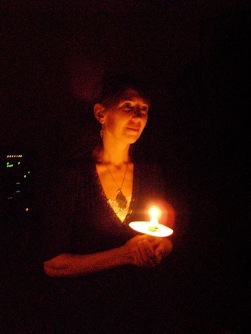

 The past few weeks, I’ve been sitting with the many layers held by the concept, and the manifest reality, of mother, mothering, and motherhood. Mother is seen in the divine feminine, in the cosmos, and in the sea and the glow of the moon. She is held in our genes and our histories and the eyes of our children. She is found in archetypes of healing, nurturing, and comfort, as well as in stories of criticism, coldness, and abuse. She is the soft one who tends grief and holds hands and braids hair, and she is the unbreakable one whose labor and caregiving is taken for granted in most areas of her life. We carry our mothers with us in our DNA, in our stories, and in the way we navigate the impacts of intergenerational trauma.

 When I was in graduate school, I learned to doubt myself. Despite having won Danforth and Woodrow Wilson graduate fellowships that paid for my tuition and living expenses, I was continually told by professors and male students alike that I would not finish my degree and that if I did I would get married, have children, and never use the degree I had earned. I tried hard to maintain my confidence in myself, but it was difficult when I was the only woman in the program. There was one other woman my first year, but she was older than I was, a nun, and I never saw her in class or at social events. My self-esteem was gradually eroded. If I had not had a fellowship, I would probably have dropped out.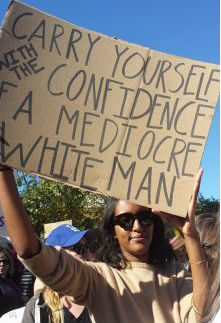
 On Sunday, January 7th, a highly visible and poignant protest and stance was made. The 75th Golden Globes was the frontline to which the privileged Hollywood A-Listers took a stance. They collectively drew a line, a call for change. A straightforward act of wearing the color black, spoke volumes. Gone were the entertainment commentators stating which color was bold or trendy. The focus was on the collective statement that was being made on the red carpet. Countless actors voiced their own stories of #WhyWeWearBlack, they called out executives who are complicit in maintaining pay inequality, in hiding sexual abuse and intimidation, in the unequal job opportunities, and even in the lack of recognition.
 We, Goddess types, are getting ready to celebrate Imbolc, beginning on the evening on February 1st through the following day, until dusk. Many ask, “well, just what is Imbolc?”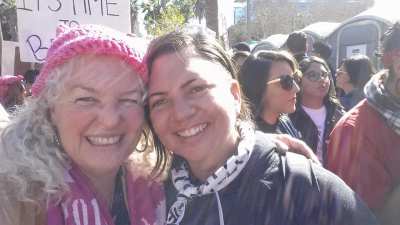

 Feminism and Religion