I spent the winter holidays in Rio de Janeiro with my sister. It was wonderful to experience the warmth of both the Brazilian people and summer in the Southern Hemisphere but a little odd to miss the quiet, dark time of winter back home. One huge bonus to the trip was to be in a place where the worship of Yemayá is alive and active. I was blessed to witness a ceremony to her on New Year’s Eve held by Afro-Brazilian practitioners of the Candomblé religion on the beach of Copacabana.
When I was in my late teens, I discovered midrash: the Jewish exegetical process by which commentators weave creative and additive interpretations into the sacred text. Midrash comes from the word “to ask,” “to seek,” or “to divine.” For example, the tale in which a well follows the prophetess Miriam through the wilderness is an ancient midrash. The story in which God stops the angels from singing as the Egyptians drown in the Sea of Reeds is a midrash. Each of these stories derives from a particular close reading of text, whether a Torah text or a verse elsewhere in the Bible. Each of them allows a new generation to add its own perspectives to the tradition.
Contemporary feminists, and many other contemporary artists, writers, and exegetes, have used a modern form of midrash to add liberatory perspectives to Jewish tradition and to biblical lore. From Miriam to Vashti, female biblical characters shine in the creative interpretations of feminist midrashists. Judith Plaskow’s “The Coming of Lilith” made a huge impact on the reading of the story of Eve and the legend of Lilith. Anita Diamant’s The Red Tent changed the conversation on Dinah forever. Alicia Ostriker, Norma Rosen, Veronica Golos, and many others have joined in this creative play which highlights marginalized voices within the text. Wilda Gafney has made contributions to a Christian and womanist form of midrash. Voices like Andrew Ramer and Joy Ladin have invited us to see queer and trans themes in the text. And of course many others, from poet Yehuda Amichai to bibliodramatist Peter Pitzele, have added to this rich tapestry.
When I learned about the Navajo Beauty Way, I understood it to be a path in which human beings respect all beings in the web of life and live in harmony with them. But I didn’t understand why this path was called the “Beauty Way.” As a young woman, I knew that my worth was defined by many in terms of my ability to conform to ideals of female beauty promulgated in movies, tv, and advertising. I didn’t believe the Navajos were talking about beauty in that sense, but because of my conditioning, I was not yet able to fully grasp what they might mean by beauty. I would have called the way they were describing a “Way of Harmony” or a “Way of Respect for Life.”
Still, I wondered: why the Beauty Way?
Marija Gimbutas described the societies of Old Europe as peaceful, settled, agricultural, highly artistic, matrifocal and probably matrilineal, and worshipping the Goddess as the power of birth, death, and regeneration in all of life. Though I am impressed with the beauty of the many small works of art Gimbutas reproduced and interpreted in The Language of the Goddess, I sometimes inadvertently omit the words “highly artistic” when repeating in her definition of the culture of Old Europe. I have tended to view the fact that Old Europe was peaceful and matrifocal as more important than the fact that it was highly artistic.Yet this judgment is wrong. In calling the cultures of Old Europe “highly artistic,” Gimbutas was trying to convey her understanding that appreciation of the beauty of life was fundamental within them.
We have been taught that “high” or “great” art is most often monumental in size. The Pyramid of Giza is over 230 meters (756 feet) tall. The Great Sphinx of Giza is 20 meters (66 feet) high. The Parthenon rose to 14 meters (45 feet) and the statue of Athena inside it was 9 to 11 meters (35-40 feet). It is telling that we use the words “high” and “great” (originally measures of size) to describe the value of artistic creations.
Statue of Athena in Parthenon reproduction in Nashville, Tennessee
The purpose of monumental works of art is to diminish the viewer, to make the her feel small, to induce her to bow down, to worship, and to obey a power or powers greater and higher than herself.
In contrast, the small scale of the art of Old Europe does not diminish anyone or anything. Its purpose is not to make anyone one want to bow down. Instead small works of art make the viewer feel comfortable, welcomed, and part of the beauty of life that is depicted.
Goddesses of Old Europe c. 5000 BCE
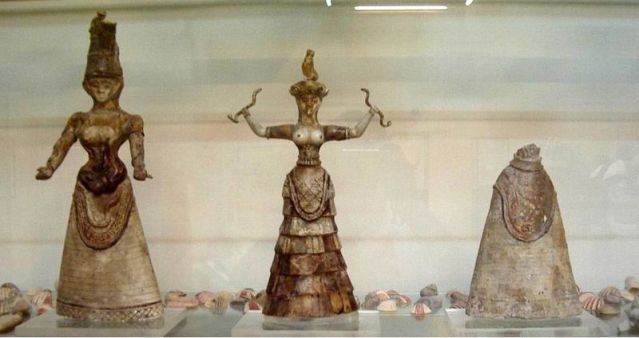
Marija Gimbutas viewed ancient Crete in the Bronze age as the final flowering of the culture of Old Europe. In Crete too, everything is on a small scale. Though the so-called Palaces or Sacred Centers are large, the rooms within them are small. There is not a single room where crowds could have bowed down to a King or Queen. Nor are there images of deities larger than life. The famous Minoan Snake Goddesses are less than 15 inches tall and the well-known pitcher Goddesses are even smaller. Such objects would have been held in hands during rituals or set on low benches in small rooms lit by oil lamps.
Snake Goddesses of Bronze Age Crete c. 1500 BCE
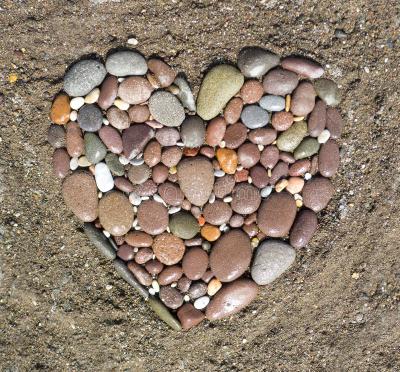
When my friend’s daughter Klia was seven years old, she spent her afternoons collecting stones by the sea. One day I asked her if the stones spoke to her. “Of course,” she replied. “What do they say?” “They say, ‘we are very beautiful.’”
Heart of stones in Lesbos
Klia intuited the meaning of the Beauty Way. It has nothing to do with artificial beauty standards. It has nothing to do with size. It is recognizing beauty everywhere and in everything. When we do so, we walk in beauty, in the grace and joy of life. And yes, the Beauty Way has ethical implications, for no one who truly recognizes beauty could want to harm it. This was understood by the Navajos, the Old Europeans, and the ancient Cretans, and many others. Only we seem to have forgotten. We can remember.
Like many in the FAR community, I participated in the world-wide 2017 Women’s March. So did Madge, the bodacious cartoon character who took me by surprise in 1990 and went on to become the narrative character of The Maeve Chronicles. Her life in print, as the first century Celtic Magdalen, satisfied her until….November 8th, 2016 when Madge returned, mouthy as ever, to rejoin us in our own times.
On the first anniversary of the historic march, I’d like to share a little of Madge’s millennia-spanning story and a few images from her two books of cartoons, now published in one volume.
Madge first appeared to me in 1990 as a line drawing of an ample woman sitting naked at a kitchen table drinking coffee. I had recently finished writing a novel, The Return of the Goddess, A Divine Comedy, and felt I had nothing more to say. I decided to play with magic markers for a while. Madge, as the naked woman introduced herself, was far from done with words. Fleshed out with peach magic marker, Madge told me she wanted “fiery neon orange” for her hair color. She also required speech balloons for her theological queries. (For example: If we are all members of the body of Christ, who is the twelve-year molar, the kneecap, the colon?) Enchanted with her sass, I invited her to be in my next novel. I pitched ideas to her. She rejected them all as too dull and said, “I want my own book of cartoons first.” Continue reading “Happy Anniversary, Women’s March, with love from Madge by Elizabeth Cunningham”
Really – everywhere we look – there are dead white guys. National holiday? Most likely in honor of a dead white guy. Statue on a green? Founder of a major Christian denomination? Dead white guy. Classic literature, painting, play, music ‘everyone’ is supposed to know about? Yup, probably by a dead white guy.
It’s a little exhausting.
It’s easy to develop a pretty negative attitude about all these dead white guys. I mean, some of them were pretty questionable if not downright oppressive people. Enough, already! Am I right?
Yes! Yes. Well… sort of. The thing is, some of them really did say and do wonderful, important things. I suppose we should not dismiss an entire portion of our history just on race and gender alone. And, truth is, I have a confession to make. I kind of really love the insights of some of these folks. I guess it’s easy to complain about all these dead white guys… until you fall in love with one of them.
In my dream, two large cats are walking towards me on a sidewalk. They are large cats, not house cats, rather, lions or tigers and they are walking on two legs, standing up, like humans. Wait, their bodies are human, only their heads are feline. As they come closer, they appear to have top hats on their heads. They look like twins. I step aside and they stroll past me.
Clearly Sekhmet and Bast have come to me in my dream. These goddesses are not part of my faith tradition. Yet depth psychology is my tool for understanding and dreams are the realm of life: animating the forces bubbling beneath the surface. I must turn my face to these feline goddesses, bow and listen, to hear what they may want to share.
Sekhmet and Bast derive from Net or Neith, the oldest Egyptian female deity. Both were considered daughters and consorts of Ra (or Re), the sun god. Bast was designated the mild eye of Ra, while Sekhmet was the sun’s scorching eye. As such, the two goddesses are both opposites and complements of each other. Continue reading “Strolling with Sekhmet and Bast into the New Year by Jan Peppler”
This post is written jointly by sisters, Trelawney and Tallessyn, who have been thinking and discussing together about this.
Contains Spoilers from the movie Star Wars VIII: The Last Jedi (TLJ).
I was born in 1974. Star Wars IV: A New Hope was perhaps the first movie I saw in a movie theater. Back then, I was too young to understand much more than that there were good guys, bad guys, and, yay – the good guys won. Except, for once, there was also a good gal. There was Leia. In a world of Spidermans, Supermans, Batmans, Lukes, Hans, Obi-Wans, and a deluge of male heroes of every kind…. There was Leia.
It’s hard to overstate how much my sisters and I loved Leia. She was so much cooler than Luke or Han. Luke was whiny and immature. Han was irresponsible and selfish. But Leia – Leia had been fighting for justice long before either Luke or Han entered the picture, and Leia had the smarts, the skills, and the grit to get shit done.Continue reading “Leia Should Get Her Movie by Trelawney Grenfell-Muir and Tallessyn Grenfell-Lee”
Why do you stay? It is a question I am often asked – but not because I am in an abusive relationship; rather because I am Catholic…and a feminist. Now please let me say up front, this is an inappropriate and unfair question to ask in any circumstance. For me, the question is particularly frustrating because it denies that my work as a feminist within my religious tradition has value. And, it implies that my faith is “less than.”
Maintaining this dual identity is a challenge. There is an incredible lack of support from both communities and I often find myself struggling to balance my faith and feminism. However, both are critical pieces of who I am. And while many argue it is only a feminist act to leave a patriarchal religious tradition, I believe it is also a feminist act to stay. Continue reading “Why I Stay by Gina Messina”
Finding joy has never been a priority for me in terms of how I structure my life. A long-term goal? Certainly, yes. My path to getting there, however, has been misguided. I’ve held the common belief that if I can achieve and succeed enough, joy–or at the very least, contentment–will find its way to me.
Sometimes I wonder if I was drawn initially to the field of faith-based advocacy because the nature of the work is to resist complacency. The successes are few and far between, and they are never sufficient for achieving the ultimate goal of justice for all. My proclivity to be dissatisfied with progress and to keep on pushing aligns well with the vision of many social justice movements.
My permanent state of dissatisfaction, which was for some time a motivational force, seeped into how I felt about nearly everything. Whenever feelings of joy or happiness would arise, particularly around work, I often attributed them to a false sense of pride that had caused me to lose focus on the long game. In short, I didn’t believe I deserved to feel joy. Continue reading “Happiness Habits by Katey Zeh”
Stories about refugees in the island of Lesbos (where I live) are no longer front page news. Yet according the United Nations Refugee Agency, 12, 742 refugees arrived here in 2017. This number is equivalent to 15% of the year-around population of the island. Though this number is huge, it does not compare to the estimated 91,506 arrivals in Lesbos in 2016. In January 2018, 7572 refugees are estimated to be stranded in the island waiting for their applications for asylum to be processed. The government-controlled reception center has a capacity of 2000, but up to three times that number are being housed there at any one time, in conditions that must be described as inhumane. It is suspected that “someone” in Greece or the European Union is slowing the asylum process in order to discourage refugees from attempting to enter the EU via Lesbos.
Recently I have begun to work with the Starfish Foundation, a local non-profit helping refugees on the island, using my skills as a writer to help with outreach. Today I share with the FAR community a blog I wrote to contextualize the desperation of the situation the refugees find themselves in.
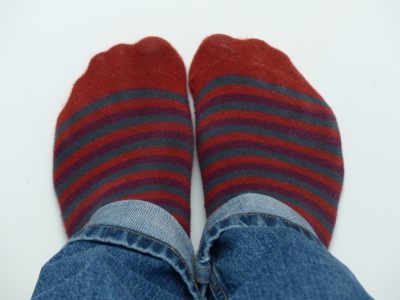
Think about it. Before you go out walking in town or countryside, you put on a pair of clean socks and then a pair of athletic shoes or boots. Your socks, which you take for granted—except when they get wet—protect your feet from blisters, callouses, and foot infections. Now imagine yourself as a refugee or migrant who has come across the wine dark sea, fleeing war. Your socks and shoes are soaking wet when you arrive. If you are lucky you will be given new shoes and socks, but then what happens?
You are taken to a refugee camp to wait for your asylum papers to be processed. While you are waiting, and it could be months or even a year, what happens to your socks? For sure they will get dirty, for you often have to walk on muddy and even sewerage infected paths in the camp. The toilets are filthy and when you have to use them, you try not to step in the muck, but sometimes you do.
You keep on wearing your socks, because you do not have a second pair. One day you decide to wash them and on that day blisters appear on your feet and become infected. You have always been a clean person, washing socks and underwear and all sorts of clothing for yourself and your family every day. But now you are facing the unknown, without even a clean pair of socks to put on your feet. You bind up your wounds and pray that your one pair of socks will not be stolen from the wire fence where you hung them out to dry.
There is an urgent need for socks in the refugee camps of Lesvos where thousands of refugees wait to learn if they will be granted asylum. It is hard for us who take our socks for granted to understand the difference a pair of clean dry socks could make in the life of a refugee. A pair of clean dry socks could make all the difference in the world.
A plea for 300 pairs of socks for men and women from Euro Relief was one of the first postings on Starfish Foundation’s web page Needs Hub, established to connect organizations helping refugees on the island of Lesvos with donors. The request for 300 pairs of socks may soon be answered, but the need for socks in the refugee camps is on-going and immense. And socks are only one of the many things—from baby strollers and wheelchairs to shampoo and toothpaste–that the refugees need. Your gift, whether large or small, really could make all the difference in the world to a vulnerable person who needs your help.
Starfish Foundation is a Greek non-profit organization. Founded at the height of the refugee migration to the Aegean islands, which was called the greatest humanitarian crisis since the Second World War, Starfish Foundation works in co-operation with other organizations dedicated to helping refugees and migrants in the island of Lesbos. Please visit Stafish’s web page Needs Hub to learn what you can do. Donate to Starfish Foundation here.


 I spent the winter holidays in Rio de Janeiro with my sister. It was wonderful to experience the warmth of both the Brazilian people and summer in the Southern Hemisphere but a little odd to miss the quiet, dark time of winter back home. One huge bonus to the trip was to be in a place where the worship of Yemayá is alive and active. I was blessed to witness a ceremony to her on New Year’s Eve held by Afro-Brazilian practitioners of the Candomblé religion on the beach of Copacabana.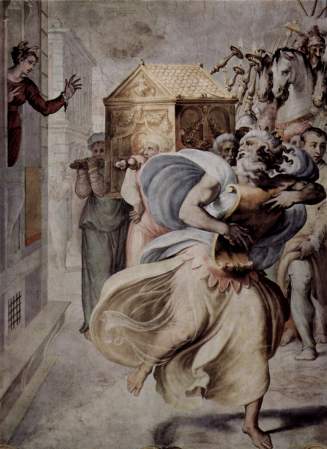
 When I learned about the Navajo Beauty Way, I understood it to be a path in which human beings respect all beings in the web of life and live in harmony with them. But I didn’t understand why this path was called the “Beauty Way.” As a young woman, I knew that my worth was defined by many in terms of my ability to conform to ideals of female beauty promulgated in movies, tv, and advertising. I didn’t believe the Navajos were talking about beauty in that sense, but because of my conditioning, I was not yet able to fully grasp what they might mean by beauty. I would have called the way they were describing a “Way of Harmony” or a “Way of Respect for Life.”

 Like many in the FAR community, I participated in the world-wide

 In my dream, two large cats are walking towards me on a sidewalk. They are large cats, not house cats, rather, lions or tigers and they are walking on two legs, standing up, like humans. Wait, their bodies are human, only their heads are feline. As they come closer, they appear to have top hats on their heads. They look like twins. I step aside and they stroll past me.
 Why do you stay? It is a question I am often asked – but not because I am in an abusive relationship; rather because I am Catholic…and a feminist. Now please let me say up front, this is an inappropriate and unfair question to ask in any circumstance. For me, the question is particularly frustrating because it denies that my work as a feminist within my religious tradition has value. And, it implies that my faith is “less than.”
 Finding joy has never been a priority for me in terms of how I structure my life. A long-term goal? Certainly, yes. My path to getting there, however, has been misguided. I’ve held the common belief that if I can achieve and succeed enough, joy–or at the very least, contentment–will find its way to me.
  Stories about refugees in the island of Lesbos (where I live) are no longer front page news. Yet according
 Feminism and Religion