The Story of Juneteenth by Kelly Brown Douglas

Tomorrow is a special day for me. It is Juneteenth.  On June 19, 1865, news finally reached Galveston, Texas that slavery had been abolished. This was of course two and a half years after Lincoln issued the Emancipation Proclamation. While the actual impact of the emancipation for the enslaved remains a source of historical discussion if not debate, the fact of the matter  is that the proclamation of emancipation and the reality of freedom for black women and men did not necessarily coincide. To be sure, for a variety of reasons, the Emancipation Proclamation did not have an immediate impact on the daily lives of enslaved women, men and children.  While the “official” historical records marks   January 1, 1863 as a day of emancipation, the historical record for the descendants of enslaved men and women marks June 19, 1865 as the day of freedom. For, it was on this day that the last slaves were free.

While the celebrations of Juneteenth have waxed and waned over the years, it remains a day in which African Americans reflect upon the “mighty long way” we have come as well as the “mighty long way” we have left to go on the pathway toward freedom.  As I celebrate Juneteenth, in the words of a black gospel song, “My soul looks back and wonders how they got over.”  And so it is that my theological imagination is stirred, for it is clear that it was by faith that they (the enslaved) got over. And so I ask, what kind of faith was it that allowed them to get over, that is, to survive a life of bondage? This question is even more pressing to me each time that I am reminded that there were those who were born into slavery and died in slavery, and thus, as Toni Morrison once exclaimed, “never drew a free breath.” So, what kind of faith was it that carried these people through life? Continue reading “The Story of Juneteenth by Kelly Brown Douglas”

RAPE CULTURE IN THE MILITARY AND “TURNING BOYS INTO MEN” by Carol P. Christ

carol p. christ 2002 colorRape is not something that “just happens” in the military. It is an inevitable product of military training. Unless and until we understand this and change the way soldiers are trained, we will never be able to stop rape in the US military or any other military system.

The right to rape women of the enemy has been considered one of the “prerogatives” of warriors since the beginning of warfare.  Propaganda-Poster-MasculinityCould “military training” which “turns boys into men” by calling them “girls” or “women” or “gay” in order to break down their self-esteem and remold their “character” as soldiers be one of the reasons rape is such a pervasive problem in the military? Are “boys” being taught that the only way to “prove” their “manhood” is to replace “identification” with women—their mothers, sisters, girlfriends, wives—with a new “identity” as a “dominant male” who “dominates” women and weaker men?  I fear that if we fail to address the “core issue” of “military training,” we will never get to the root of the rape culture that pervades the military.

Unfortunately the model of training boys to be men by humiliating them with taunts that they are “girls” or “gay” is not limited to the military but is also a regular part of sports training.  In both the military and sports, terms like “sissy,” “wuss,” “pussy,” “faggot”–and worse–are regularly used by male authority figures in order to “spur” boys “on” to feats of “physical achievement” that require “punishing” their own bodies and the bodies of others.  The use of these epithets in the context of humiliation makes it clear that “a man” is not “a woman” or “a gay”:  “a man” is someone who has eradicated all of his “feminine” qualities while learning to dominate and humiliate women and effeminate men.

Is it any surprise that rape of women and effeminate or gay men is pervasive in the military and in sports culture? Continue reading “RAPE CULTURE IN THE MILITARY AND “TURNING BOYS INTO MEN” by Carol P. Christ”

Sulis, Celtic Sun Goddess of Healing and Prophecy by Judith Shaw

judith Shaw photoAs we approach the summer solstice, the longest day of the the year, I find myself reflecting on my love of the long, hot days of summer.  The bliss of lying on a beach caressed by the kisses of sun and breeze, with the promise of the cool inviting embrace of the sea by my side, is one of my most favorite forms of relaxation.  Though the ozone layer has thinned and I can only indulge this desire in small doses now, I still love the feeling of the sun on my skin as She paints colored visions in my mind’s eye.

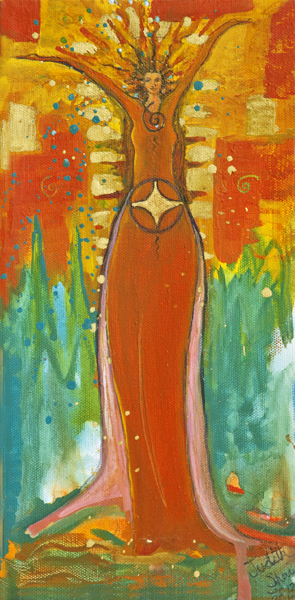
Sulis painting by Judith ShawShe –  how can I personify the sun as She when from across the world we hear only of Sun Gods and Moon Goddesses?  Yet hidden deep in mythology one discovers that long, long ago the sun was worshipped as a goddess. From Aditi – Hindu Solar Goddess from India to Uelanuhi – Cherokee Goddess of the Sun, the sun Goddesses symbolize, with female imagery, the power and life force of the sun. Aditi was seen as the  keeper of the light that illuminates all life and ensures consciousness. She was the source of all, giving birth to the universe and the heavenly bodies. Uelanuhi was responsible for dividing time into units. She was aided by Grandmother Spiderwoman’s web to capture the sun’s warmth for humankind. Continue reading “Sulis, Celtic Sun Goddess of Healing and Prophecy by Judith Shaw”

Menstruation for Buddhist Women by Oxana Poberejnaia

oxanaNot all, but many women menstruate. The menstrual cycle is a contentious areas for feminists. Even men who aspire to be a feminist tend to find it difficult to deal with it. Inappropriate jokes ensue, and completely ignoring the issue is also a popular option.

My journey along a feminist path and toward the Sacred Feminine necessarily included working with my menstrual cycle. In this, Women’s Wisdom and the Menstrual Cycles articles  and Womb Blessings by Miranda Gray have been most helpful.

Continue reading “Menstruation for Buddhist Women by Oxana Poberejnaia”

Public Depression and Feminist Spirituality by Linn Marie Tonstad

Linn Marie TonstadIn her recent book Depression: A Public Feeling, Ann Cvetkovich examines the experience of depression through the genre of memoir as well as by the construction of an archive of depression. Her archive includes sources ranging from John Cassian’s discussion of the way monks experience acedia to analyses of depression as the result of racism and colonialism, to suggestions for spiritual practices of transcendence – daily habituated actions of repetition and physical wellbeing – that might contribute to rendering depression manageable if not curable. The book, part of the Public Feelings project, is fascinating for the scholar of religion on multiple levels.

First, in terms of teaching and mentoring, Cvetkovich’s analysis of depression as reflective of real states of affairs in the world, rather than as a (mere) biological fact, speaks to an experience that I, and no doubt many others, have every year. At some point, an activist student (usually but not always female) will either email me or ask for an appointment to talk about struggles she’s been having. These students are usually heavily engaged in struggles for queer causes, in learning about intersectionality, reading critical race theory or Karl Marx for the first time, or discovering feminist theology, and trying to live into such modes of analysis in their personal relationships as well as in their ‘public’ lives as activists, members of churches, future clergy members, or the like. And unsurprisingly – and very familiarly – such students get to a point where they ask questions about how to remain engaged in such struggles when the opposition – personal and structural – feels so overwhelming. What do I do when I’m at a party and one of my friends says something heterosexist? How do I remain committed to the cause to which I’ve devoted my energies when I see so many other causes needing support? I’m worried that I’m alienating my family by the ways in which I’m changing. How ought I to relate to parishioners who think that opening a soup kitchen constitutes the pinnacle of meaningful service to God and neighbor? Continue reading “Public Depression and Feminist Spirituality by Linn Marie Tonstad”

A Divine Gift by Elise M. Edwards

Elise Edwards

I recently graduated with a PhD, and I have been fortunate enough to have many occasions to celebrate this milestone within the past month.  At the beginning of this month, I visited my parents in my hometown, and they threw a graduation party for me.  In addition to a great number of family members and friends who came to the party, several members of the Baptist church I attended in my 20s and early 30s came to celebrate as well.  I received many wonderful graduation gifts.  Surprisingly, some of the gifts led me to reflect on my faith convictions, namely some of the tensions I wrestle with.

A woman whom I had served on many committees with and worked closely with on plays and other artistic activities gave me an especially thoughtful gift.  It is a beautiful wooden plaque with the word “STRENGTH” at the top in capital letters and my name at the bottom in capital letters.  In between the two are decorative flourishes and these words from the New King James Bible: I can do all things through Christ who strengthens me. (Philippians 4:13) Continue reading “A Divine Gift by Elise M. Edwards”

Birth as a Shamanic Experience by Molly

editMollyNov 083Childbirth is a rite of passage so intense physically, psychologically, emotionally, spiritually, that most other events in a woman’s life pale next to it. In our modern lives, there are few remaining rituals of initiation, few events that challenge a person’s mettle down to the very core. Childbirth remains a primary initiatory rite for a woman.” –Maren Hansen (MotherMysteries)

When I was pregnant with my first baby, I read an article with the theme of “Birth as a Shamanic Experience.” I can no longer find the exact article (online or printed), but I distinctly remember my feeling upon reading it: I was entering into a mystery. Giving birth was big. Bigger than anything I’d ever done before and it went beyond the realm of a purely biological process and into something else. Like shamanic experiences, giving birth is often described as involving a sense of connection to the larger forces of the world as well as being in an altered state of consciousness or even a trance state. While shamanic experiences may involve “journeying” to other realms of reality, giving birth requires the most thoroughly embodied rootedness of being that I’ve ever experienced. It, too, is a journey, but it is a journey into one’s own deepest resources and strongest places. The sensation of being in a totally focused, state of trance and on a soul work mission is intense, defining, and pivotal.

Shamanic journeys may be embarked upon for the purpose of soul retrieval and I can’t help but think that this is the purpose of giving birth as well—the birthing woman travels into herself to bring forth the soul of her child.  Continue reading “Birth as a Shamanic Experience by Molly”

God Doesn’t Live Here Anymore: Gay Bars and the Growing Divide Between Sexuality and Spirituality by John Erickson

oes God exist within the LGBTQ community anymore or has the community itself abandoned God for all-night raves, dance clubs, alcohol, and hypersexualized and over commoditized fetishized forms of femininity and masculinity? Oftentimes, I find myself answering yes to the above questions. After surviving hate crime after hate crime and endless batches of newly elected conservative politicians hell bent on ignoring medical and social epidemic plaguing the very country they were elected to serve and protect, why would a community, oftentimes linked to sin itself, believe in a holy entity?

John Erickson, sports, coming out.My good friend and fellow Feminism and Religion Contributor Marie Cartier’s forthcoming book, Baby You Are My Religion: Women, Gay Bars, and Theology Before Stonewall argues that American butch-femme bar culture of the mid-20th Century should be interpreted as a sacred space.  Specifically, gay bars served as both communal and spiritual gathering spaces where butch-femme women were able to discover and explore not only their sexuality but also their spirituality.  An opus of an academic accomplishment based off of the amount of in-depth interviews she conducted, Professor Cartier explores lived religion in an area that has become all too common within the LGBTQ community: the bar

The Palms, the last local and only lesbian bar to be found in city of West Hollywood, CA is closing its doors and I can’t help but wonder where its patrons or parishioners will now go? Continue reading “God Doesn’t Live Here Anymore: Gay Bars and the Growing Divide Between Sexuality and Spirituality by John Erickson”

Shekhinah by Rabbi Jill Hammer

Shekhinah  		Rabbi Jill Hammer, PhDI invite you to encounter Her as I encountered Her— with mystery, and with surprise.

The Sabbath night is the joy of the Queen with the King, and their uniting… Scholars who know this secret are intimate with their wives only on the Sabbath night.

This is a text from the Zohar, an important kabbalistic work.  We all know who the King is—the disembodied yet fatherly entity who creates the world by word— not by sex with a goddess— and who gives the Torah.  But who is the Queen?  Don’t Jews reject the idea of a divine queen?  Didn’t the prophet Jeremiah scold Israelite women for worshipping the Queen of Heaven?

There is a Jewish custom to recite the poem Lecha Dodi “Come, My Beloved”— on Friday night, as they turn to the door of the synagogue to greet the Sabbath.  What most Jews don’t know is that Jewish mystics regard the Sabbath as an embodiment of the immanent, feminine face of God.  The Sabbath’s entry into the synagogue, and the sexual coupling of lovers on Friday night, are embodiments of the divine union of the masculine face of God and the feminine face— dare we say— of Goddess. Continue reading “Shekhinah by Rabbi Jill Hammer”

Tikvah v’hashamayim (Hope and the Heavens): A Jewish Perspective on Redemption by Ivy Helman.

headshotThe Torah is bursting with hopes over-fulfilled.  Abraham and Sarah hoped for a child and gave birth to a nation.  The Israelites hoped for freedom from slavery and eventually received an entire Promised Land.  We understand hope and, in so many ways, we live on it, as hope has sustained us for thousands of years.  Today, our hopes inspire our actions and motivate us to work for peace, justice and equality.   In Jewish terms, we call this goal or vision of a better world in the here-and-now: redemption.

Yet, redemption does not just appear out of thin air or because we wish it.  Redemption and the hope of it requires work and cooperation with the Source of All Life.  As Deuteronomy 30:19 says, “I have put before you life and death… [therefore] choose life…”  This cooperation could be a simple commitment to tikkun olam, repairing the world (some times translated as social justice).  For others, choosing life could mean more observant religious practice.  It could also be a combination of the two.  In the end, though, I think both hope and redemption require choosing life in some form or another.

Just as how we choose life depends on who we are, how we achieve this redeemed world depends on how we understand G-d’s redemptive power.  Some of us think redemption will come through the moshiach (a savior), Continue reading “Tikvah v’hashamayim (Hope and the Heavens): A Jewish Perspective on Redemption by Ivy Helman.”