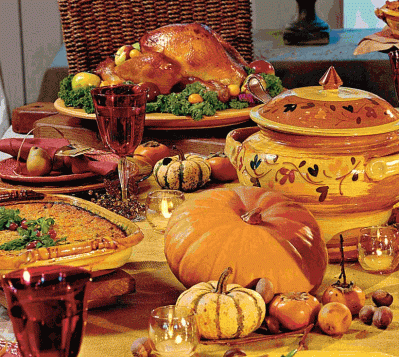
Thanksgiving evokes deep memory and raises questions about what we are celebrating, now that we know the stories we were told about the Pilgrims and the Indians are not the whole truth about America’s early history. I thought about all of this as I prepared for Thanksgiving this year and cleaned up for days afterwards.
Although I do not live in America, I have celebrated Thanksgiving with a group of friends in my home in Greece many times during the past twenty years.
Joseph Campbell spoke of ‘mentors’ appearing to help the sojourner, and what Maureen Murdock called the gathering of allies. In my hybrid of these two archetypal journeys, there may be several mentors – human, power animals, divine guides or a combination. She could be a wise elder who helps the heroine prepare for the journey or gives her a gift for later use. In my case the wise elder was my 93 year old mom who became one of my mentors. When I expressed my excitement and fears, she said what she always says when I – one of her seven children – am facing a challenge: “Go get’em Tiger!” She also offered financial support so I could take time away from my psychotherapy practice.
Two other mentors showed up in what Carl Jung called my ‘active imagination’: Carol Christ and Marija Gimbutas. Both have transitioned so my active imagination conjured their support as divine intervention. I reread Carol’s reflections and teachings on the pilgrimage, and watched the videos she made as inspiration. I felt her invitation. I was ready to change.
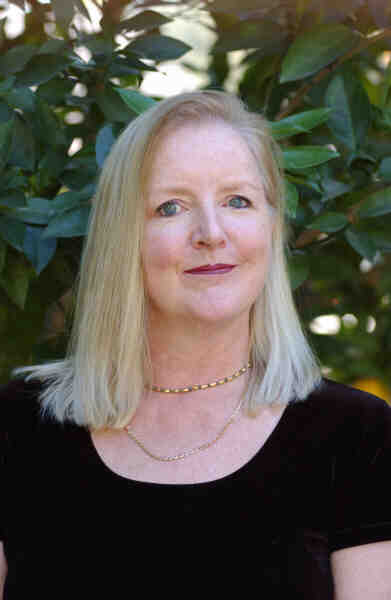
Carol Christ’s Legacy honored by Laura Shannon, and the Ariadne Institute
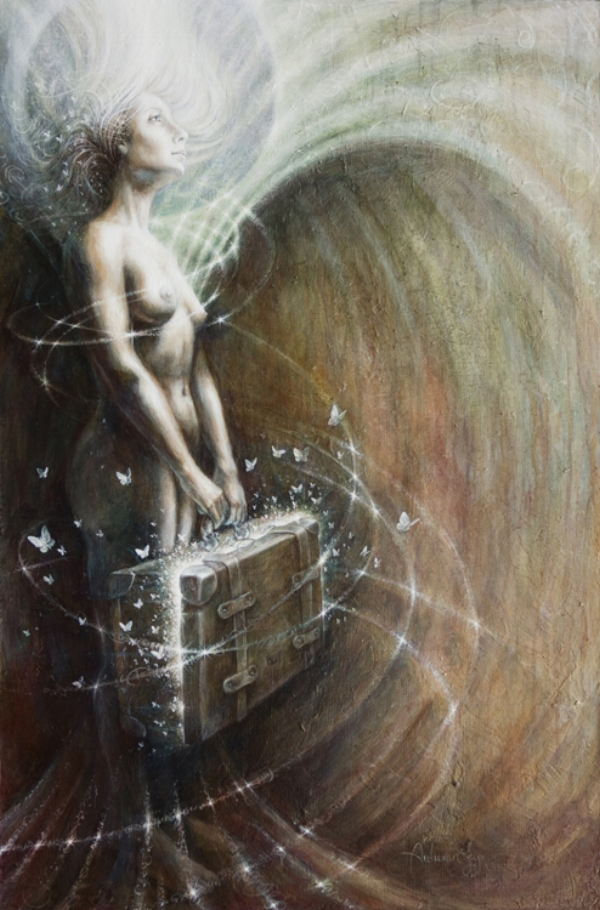
Adventure by Autumn Skye with permission of artist
When I teach the Heroine’s Journey in my Sophia Women’s Wisdom Group, I draw on Joseph Campbell’s idea of the mono-myth, an archetypal story that resonates with every human across time: The Hero’s Journey. I combine Campbell’s ideas with pieces of feminist Maureen Murdock’s heroine’s journey to recognize the unique pathway of the feminine. I call this my hybrid heroic journey. If you are not familiar with Maureen Murdock’s work, I invite you to see how she brought her feminist eye to Campbell’s iconic Hero’s Journey in her book The Heroine’s Journey: Woman’s Quest for Wholeness. After her conversation with Joseph Campbell six years prior to his transition, Murdock felt he missed “that the focus of female spiritual development was to heal the internal split between woman and her feminine nature” (p. 2). In my hybrid heroic journey, that split in the early stages is internalized negative masculinity. The rejection of our feminine nature may appear differently in each woman’s life but it is often characterized by treating ourselves how we imagine men perceive us.
My recent Pilgrimage to Crete was astonishing; my epiphany, gradual. As I share my adventure, imagine stages of your own heroine’s journey wherever you are in that cycle. I hope that by sharing this series, you will experience a real life example of Dion Fortune’s definition of magic: ‘The art of changing consciousness at will’. Starhawk, Truth or Dare, 1988.
In the middle of the night in waking sleep, I asked my great-great grandmother Annie Corliss to tell me the story of how she met and married James Inglis. This story came through me in a place I have come to call the Dreamtime. The Aboriginal term feels right. As I understand it, this is not a place where the dead speak to the living but rather a space where boundaries blur as the ancestors speak in us.
Part 1 was posted yesterday. You can read it here.
Patriarchy is a system of male dominance, rooted in the ethos of war which legitimates violence, sanctified by religious symbols, in which men dominate women through the control of female sexuality, with the intent of passing property to male heirs, and in which men who are heroes of war are told to kill men, and are permitted to rape women, to seize land and treasures, to exploit resources, and to own or otherwise dominate conquered people.[i] – Carol Christ
In Part I, I urged against the distancing that intellectual analysis can bring to situations that require us to respond from the depths of our being, and yet, how can one be a reader of this blog and not examine the intertwining strands of patriarchy, religion, women, and war in this current conflict.
During my ancestor research, I have seen the word “tenement”—with the implication of poverty, filth, and disease–handwritten onto more than one death certificate. Last month, I visited the Lower East Side where my Irish 2x great-grandmother Annie Corliss lived in the tenements near the docks with her husband the Scottish seaman James Inglis and their nine children.
Though the tenements where they lived in the vicinity of Cherry Street a block from the East River have been torn down to build public housing, my newly discovered third cousin Hattie Murphy still lives in the area. She arranged for me to visit the “Irish Outsiders” house in the Tenement Museum on nearby Orchard Street in order to gain an understanding the conditions of life in the tenements in the middle of the nineteenth century.
Part One of this article spoke of our collective yearning for peace, and the difficulty of imagining a peaceful world when we are taught to believe that “patriarchy and with it war and domination are universal and inevitable.” (Carol Christ, 2015)
But this is a myth. The peaceful civilisation of Bronze Age Crete lasted two thousand years with no sign of violence, slavery, or war. Most likely matriarchal, matrifocal, and matrilineal, ancient Crete embodied the final flowering of Old Europe. Art and archaeology reveal a life-loving people who honoured the earth, the Goddess, and nature, particularly mountains, caves, and trees. Key values and symbols of this culture of peace survive today in Cretan women’s dances and folk arts including pottery, textiles, baskets, and bread.
These are difficult days. We awaken daily to the ongoing horror of senseless killing. My heart is filled with a yearning for peace. Now is the time to dream of peace, to choose peace, to practice peace – within our selves, with those we love, in our communities and in our world.
But what might a peaceful world look like? It can be hard to even imagine – not only because we live in a world filled with war, but because we have been taught to believe, as Carol Christ explains, that “patriarchy and with it war and domination are universal and inevitable.” However, she goes on, “this is a myth perpetrated by those who do not want to give up the power and privilege the patriarchal system has accorded to them.” War is not inevitable. Peace is possible.
Blessing the Source of Life harks back to the time when shrines were built near springs, the very literal sources of life for plants, animals, and humans.
The prayer “As we bless the Source of Life, so we are blessed,” based on a Hebrew metaphor which refers to a water source and set to music in a Jewish feminist context by Faith Rogow, has become one of the bedrocks of my Goddess practice.
In Minoan Crete, seeds were blessed on the altars of the Goddess and the first fruits of every crop were returned to Her. The ancient Minoans piled their altars high with barley, fruits, nuts, and beans, and poured libations of milk and honey, water and wine, over the offerings they placed on altars. Evidence of these actions is found in the large number of pouring vessels stored near altars.
The charge of “essentialism” has become equivalent to the “kiss of death” in recent feminist discussions. In this context it is taboo to speak of Mother Earth. Yet, I would argue there are good reasons for speaking of Mother Earth that do not add up to essentialism. What if the values associated with motherhood are viewed as the highest values? What if the image of Mother Earth encourages all of us to recognize the gift of life and to share the gifts we have been given with others?
For those not familiar with the “essentialism” debate in feminist theory, it might be useful to define “essentialism.” In philosophy, essentialism is the idea that every “thing” has an “essence” which defines it. In its pure form, essentialism is a by-product of Platonic “idealism” which states, for example, that the “idea” of table is prior to every actual table and that every actual table is an embodiment of the idea of table.