
Call me the devil, if you’d like.
I have just completed the three-hour retreat at the church to prepare my son for his first communion. It was a long morning, to be sure, but during that time I decide I want to try to bring the family all together. I host such occasions often, at significant cost and personal effort, but I think it builds up love and community so I do it anyhow. I go home and begin sending out invitations for the gathering.
At precisely the moment of my welcoming, I learn that I have, once again, been directly charged by so-and-so, because I have worked in a professional capacity and (I am not kidding, dear readers) because I have not had my children in T-ball and Rec Center sports. I am accused of self-aggrandizement because I go to professional conferences (to which I also take my children almost without exception). I am charged with doing things for my own glory because I teach overloads and offer paid lecture series.
There is no acknowledgement that I work to eat and to earn income to support my children or that I have never had the option not to work outside the home. I am furious, of course, because I have heard this in varying degrees over the length of my professional life and time as a parent, including once on Mother’s Day. I’m tired of the insult, but when I respond after years of such claims in outrage, I am accused of being too angry.
But, life goes on, and so does the gathering. It’s a nice time, but after the gathering, I wake up to the boldly voiced disgruntlement of a friend who has been inadvertently insulted by a conversation that occurred at the table. The insult is derived from the charge that I did not say the right words when I should have. There is a very strong critique and withering suggestion about my core values at stake, since the issue is racial. I listen and apologize but am left wondering, “don’t you know me by now?” Have you not dined with me, celebrated with me, felt my love and friendship, outreach and appreciation? I am stymied. Am I here to be judged?
Continue reading “Call Me the Devil, If You’d Like by Natalie Weaver”



 Sitting in front of the computer, I slowly and intentionally insert earbuds, click to start my favorite writing playlist, and open up Microsoft Word. I feel the tips of my fingers resting lightly on the keys, and notice the slight give of each printed square, glossy in the middle from months of 80 words per minute. I lightly tap my fingers on the keys, not pressing enough to type a letter, body motionless except my fingers, watching the absolute stillness of the screen, exploring the edge between pressure and performance with slow, shallow breaths, finally noticing the moment when the edge is breached, the key catches, and a letter appears on my screen, taking it in with satisfaction.
 Shortly after writing “
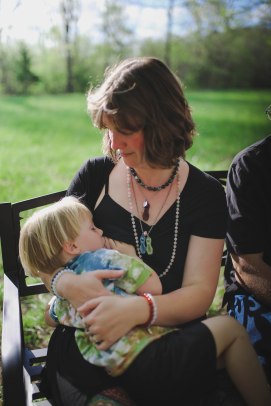 last night’s raindrops continuing to drip from the overfull gutters on the roof. The insistent stab of a single-note bird song in the air. His head nestles in the crook of my arm the way it has done every morning for three years. Blond hair against my nose, breathing in the slightly baby smell of him. “This is the last time,” I whisper softly. “We are all done after this. This is the last time we will have nonnies.”
 It is quite common, I think, for Jewish feminists to gravitate to the first creation story of Genesis/Bereshit as an example of human equality but struggle to claim this same passage as an example of the goodness of embodiment. Genesis/Bereshit 1:27 reads, “So G-d created humankind in the divine image, in the image of G-d, the Holy One created them; male and female G-d created them.” In this passage, we have not only equality between men and women, in direct contrast to the second creation story, but also a description of human nature.
 A topic that continually perplexes me, both personally and professionally, concerns the connection, or harmonization if you will, between our cognitive capacities and our physical expression and comfort, between thinking and feeling. Yoga, dance, working out, meditating, and other modalities which explicitly bring body and mind together often achieve their goal at the point of practice, and while these disciplines have residual effects, how do they have staying power?

