To Have and to Hold: Gay Marriage and the Religion Question

If a conservative religious traditions can’t give their mothers or sisters full equality, how can we expect them to give a GLBT individual the time of day?

John Erickson, sports, coming out.Outrage.  Anger.  Fear.  Hatred.  These are just a few of the words that flashed across my Twitter feed as I woke up on that fateful Wednesday, June 26 morning when the Supreme Court of the United States ruled that the Defense of Marriage Act (or DOMA) was unconstitutional and that supporters of Proposition 8, the hotly contested voter initiative in California that banned same-sex marriage, had no standing.   People were mad.  However, it wasn’t just the typical kind of mad that is associated with hatred, it was a type gay_marriage_81102178_620x350of mad that was met with impossible anguish because what I was reading and feeling was a result of one thing: there was nothing more they could do.

What does all this mean?  Questions from friends and family were filling up my inbox and although I wanted to take a moment to just hit “Reply All,” and input the words: Equality, I had to hold back and start to examine the notion that although equality may now be firmly on the proverbial table, there is still a lot of work to be done, specifically for gay marriage and those wanting to marrying inside the traditional church spaces they grew up in and not just the ones that have come out as open and affirming in recent years towards LGBT individuals. Continue reading “To Have and to Hold: Gay Marriage and the Religion Question”

Gratitude and Sharing: Two Fundamental Principles of Goddess Spirituality by Carol P. Christ

carol p. christThe more I practice the spirituality of the Goddess, the more I understand that earth-based spiritualities are rooted in two fundamental principles:  gratitude and sharing.  We give thanks to the earth for the gift of life. As we recognize our interdependence and interconnection in the web of life, we are moved to share what has been given to us with others. *

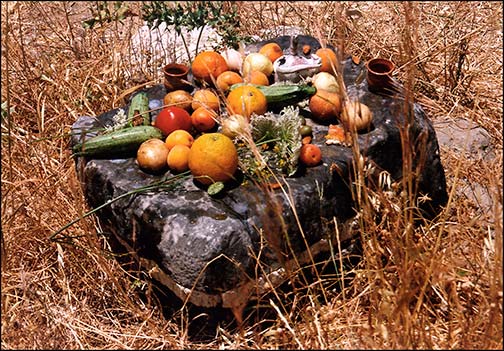
When I first began to lead Goddess Pilgrimages in Crete, I was inspired by a line in Homer to begin a pilgrimage tradition of pouring libations of milk, honey, water, and wine on ancient stones. At first I knew the form, but not its deeper meaning.  It gradually dawned on me as I thought about the large number of pouring vessels in the museums, the altar stones, and the Procession Fresco from Knossos, that an important part of Minoan rituals involved processions in which people offered first fruits back to the Mother whose body had produced them, and poured libations on altars.

kernos stone kay keys

Over twenty years of performing the ritual of pouring libations has convinced me that this was not “a” but “the” central Minoan ritual.  Its purpose is to thank Mother Earth for the bounty She has bestowed on us. Continue reading “Gratitude and Sharing: Two Fundamental Principles of Goddess Spirituality by Carol P. Christ”

Monthly Highlight: Mary E. Hunt

As a Catholic feminist theologian, activist, teacher, and writer Mary Hunt has made a massive impact in the field of feminism and religion.  Following the completion of her graduate education (MA, Harvard Divinity School, M.Div., Jesuit School of Theology, Ph.D., Graduate Theological Union), Mary recognized a strong need for theological, liturgical, and ethical development by and for women and responded by co-founding WATER (The Women’s Alliance for Theology, Ethics, and Water) in 1983.  Over the last 3+ decades, she has been instrumental in addressing social injustice and creating change in religion and community. Continue reading “Monthly Highlight: Mary E. Hunt”

Appealing to Values and Interests in Consumer Choices by Grace Yia-Hei Kao

“What the report also makes clear is that sweatshop labor is highly gendered. Between 71-85%…are women, the majority of whom are also under the age of 35.”

I was recently drawn into a facebook discussion about the ethics and efficacy of refusing to eat at Chick-Fil-A on account of its president’s public “we are inviting God’s judgment on our nation” opposition to same-sex marriage as well as the chain’s financial support of socially conservative groups.

I noted that consumers who boycott businesses generally do so because they believe that (1) continuing to patronize a place would be at odds with their core values, or that (2) their actions will “make a difference” by exerting financial pressure on the company to amend their ways. These two reasons could be related, though they often are not. People can act in accordance with their conscience without believing that they have accordingly instigated social change (n.b., just think of the earlier 2004 decision by the Presbyterian Church U.S.A. to selectively divest from certain companies in Israel), just as companies can be compelled to alter their policies by other means than by their clientele taking their business elsewhere.

Continue reading “Appealing to Values and Interests in Consumer Choices by Grace Yia-Hei Kao”

(Non-Human) Animals on the Agenda by Grace Yia-Hei Kao

“[E]thical interest in nonhuman animals is flourishing.”

To my delight, the New York Times recently chronicled the growing scholarly interest in human/non-human animal interactions in a story entitled “Animal Studies Cross Campus to Lecture Hall.” There are now more than 100 courses in colleges and universities in the burgeoning field of animal studies. At least 40 U.S. law schools now routinely offer courses in animal law. A growing number of formal academic programs, book series, journals, conferences, institutes, and fellowships are also dedicated to (re)examining human-animal relations from a variety of disciplinary perspectives—“art, literature, sociology, anthropology, film, theater, philosophy, [and] religion,” to name a few.

Continue reading “(Non-Human) Animals on the Agenda by Grace Yia-Hei Kao”