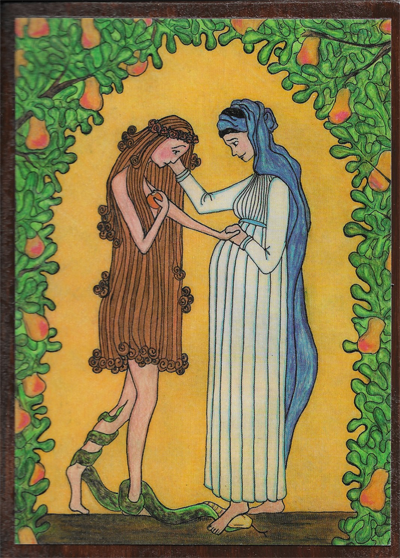
Female Wisdom in Eden: A Guide for Faith-Formed Feminists By Susie Austin

If you were taught that “men lead” is God’s design, this is your permission slip to ask a harder question: what if that teaching was never Eden’s plan — but a wound the world mistook for a rule?

Many of us grew up inside churches that loved us, baptized us, and gave us language for hope—while also wrapping womanhood in shrinking instructions: be agreeable, be modest, be quiet, be helpful. We learned to make ourselves small so that men could feel large. We learned to translate our leadership as “support,” our wisdom as “intuition,” and our authority as “being difficult.” We learned to carry the room’s temperature without ever touching the thermostat.

Feminism — and the women who lived it before it had a name — has always asked religion to remember itself. Not to abandon Scripture or tradition, but to recover what was true before fear called itself theology. Before we rewrite our lives, let’s reread the beginning.

A forgotten reading of the oldest story

Look again at Genesis: the woman sees that the fruit is “desirable to make one wise” (Gen. 3:6). In Scripture’s own poetry, Wisdom is feminine—personified as Lady Wisdom (Hebrew: Chokma) calling us to life (Prov. 8:1-4, 22-31). And Genesis 3:6 ends with four words we usually skip: “who was with her.” Translation: she leads; he lingers.

Continue reading “Female Wisdom in Eden: A Guide for Faith-Formed Feminists By Susie Austin”
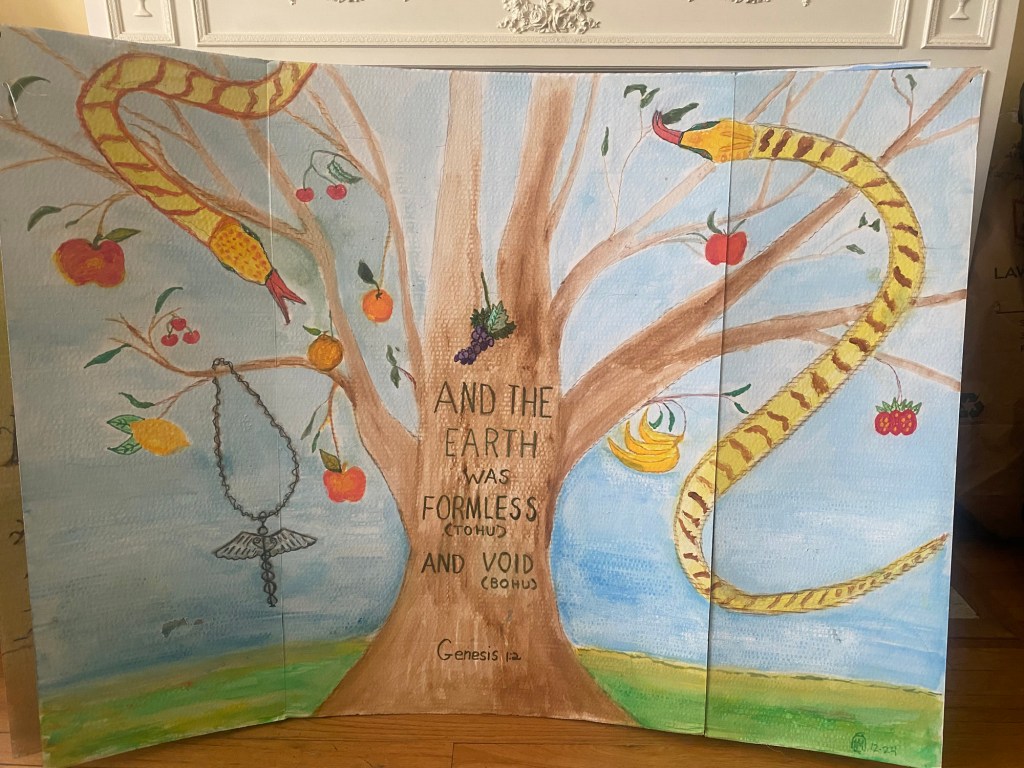
SheSpeaks! Eve by Janet Maika’i Rudolph

Author’s Note: I have begun a project called She Speaks! Women of the Bible Have Their Say. As part of this project, I have done five films with some very dedicated actors (friends of mine) who have dubbed themselves the SheSpeaks!Ensemble. I showed 4 of the films at the recent Yerusha Symposium. Based on the comments and reception, the project is now expanding. I am looking to create longer films that include story arcs. The first one will be of Eve. Below is the script for Eve along with the link to the video.

EVE speaks:

Why hello I don’t get visitors very often! Welcome. Come, come sit under my tree, let’s share some tea. I have the most wonderful and flavorful herbs here in my garden.

Look around at my most marvelous paradise. It is all filled with magical treasure. I’ll tell you a secret, the treasure I care for spans both the heavens and the earth. You see, we are at the place where spirit, breath and matter intersect. Where the living beings of earth and the animating forces of the divine join in harmony.

It is so hard to look at your holy book. I can’t imagine why I keep getting blamed for . . .well . . . just about everything.  It’s strange that your world wants to connect me with curses as I am the giver of life. In fact, did you know that my name Eve means life. I don’t understand what has become of you, my children. It is said that I brought a curse to humanity. Do you see life as a curse?  Let me tell you a bit about myself. Perhaps then you will see me differently.

Continue reading “SheSpeaks! Eve by Janet Maika’i Rudolph”

The Furious Sun in Her Mane: Nine Poems to Goddesses by Annie Finch

Poet’s Note: I composed this sequence of poems for performance, for chanting, and for devotion. I wanted people who would hear, read, memorize, and speak each poem to channel the original energetic patterns that the poets who best knew that Goddess used to connect with Her. So for each poem, I researched the meter and prosody of the original language in which that Goddess was first worshipped.  Then I carried the exact rhythmical pulse of Her language into my poem to Her in English.

The sequence was set to music by composer Laura Manning and choreographed by Georgia Bonatis, and I directed and performed a devotional dance collaboration version of it in 1994. That archival video of this performance has just been recovered for the first time in 31 years. It is now posted on my Youtube channel.

Continue reading “The Furious Sun in Her Mane: Nine Poems to Goddesses by Annie Finch”

Witches and Queens in C. S. Lewis’s Chronicles of Narnia by Elanur Williams

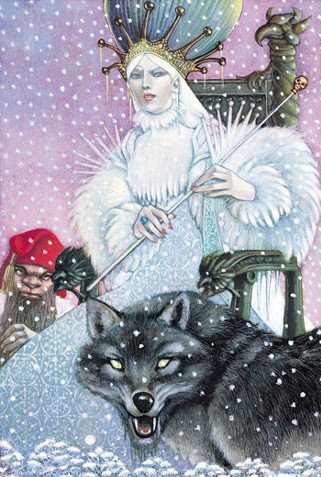
Jadis, The White Witch, by Leo and Diane Dillon. Front Cover for The Lion, The Witch, and the Wardrobe.

When I first encountered the Narnia novels as a child, the Christian symbolism was lost on me. I grew up in Istanbul, and what captivated me most was the magical world of Narnia, where one of my favorite characters, Aslan, had a Turkish name—a rarity in the British children’s books I read at the time. I also loved the mention of Turkish delight, which I did not consider to be “exotic;” rather, it was an ordinary reference to the rose, lemon, and pistachio flavored confections I often enjoyed at home. However, the character who truly fascinated me was Queen Jadis, also known as the White Witch. Her cold, regal majesty—draped in furs and gliding across a snowy landscape in her sleigh—was enchanting. I preferred witches to princesses and was drawn to stories where characters defied the roles they were expected to play, so it’s no surprise that I found the Witch’s character far more compelling than Lucy’s or Susan’s. I even had a picture of Jadis pinned to my bedroom wall. Yet within myself, I suppressed the Witch’s more admirable qualities—her anger, conviction, and sense of personal power. It took me years to reclaim, heal, and integrate these aspects.

Much has been written about C. S. Lewis’s restrictive and problematic portrayal of female characters. He perpetuates misogyny in Christian thought by depicting women who are idealized, distracted by ‘nylons and lipstick,’ in need of protection, or portrayed as liars—like Lucy, whose discovery of Narnia is initially dismissed as a childish fabrication, even though she is a truth-teller. Traces of paternalism run throughout his works, particularly through his reinforcement of a rigid gender binary. He perpetuates the view that women must suppress their own desires and dreams, in favor of being useful and serving others. Although the Narnia novels may appear to position women like Lucy and Susan as capable and responsible leaders (especially when they are crowned co-rulers of Narnia), this vision of female leadership is complicated by the presence of villainous witches and Queens.

Continue reading “Witches and Queens in C. S. Lewis’s Chronicles of Narnia by Elanur Williams”

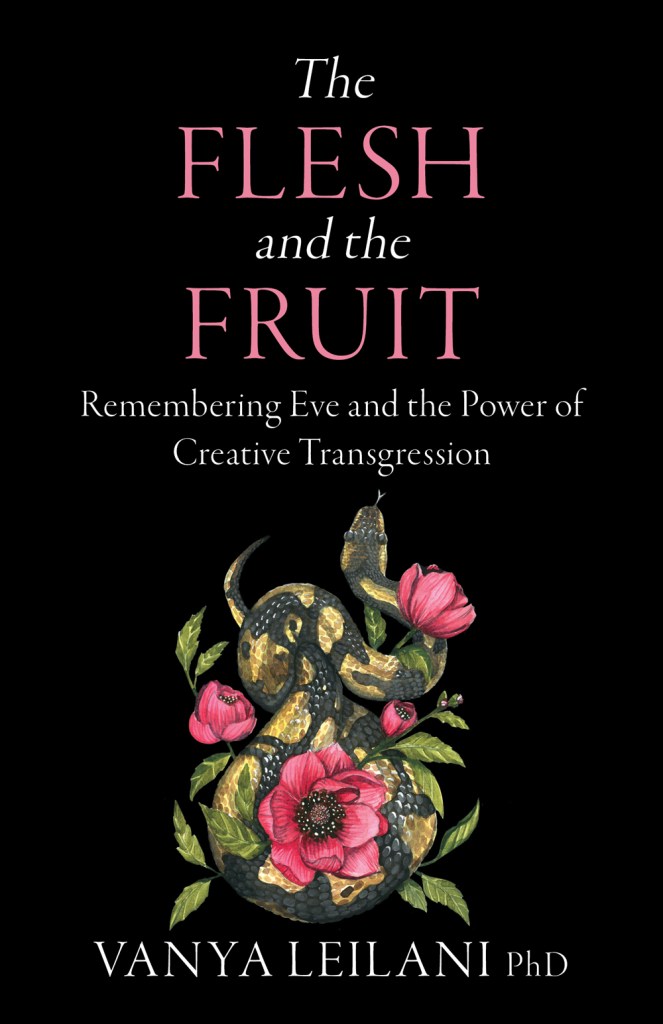
The Flesh and the Fruit by Vanya Leilani, PhD: Book Review by Janet Maika’i Rudolph

Subtitle: Remembering Eve and the Power of Creative Transgression

I have learned that every good story of spirit has many layers of meaning and pathways of understanding. Dr Leilani has found particularly relevant and even beautiful aspects of the biblical story of Eve. She uses Eve’s actions as a template of her own spiritual journey. Her pathway begins in obedience (listening to the voice of authority), travels through transgressive acts (eating of the fruit), and finally results in a self-knowing that had not been possible at the beginning of her journey.  In this book we follow along on her quest to learn about herself with Eve as her inspiration.

This is a luscious book. Vanya Leilani’s insights are not only profound but are written with a poetic sensibility. I found myself speaking some of her passages out loud because the vibration of her words are powerful and feel so sensuous on the tongue. I wanted to take them into my body, as well as read them on the page.

Continue reading “The Flesh and the Fruit by Vanya Leilani, PhD: Book Review by Janet Maika’i Rudolph”

The Place of All Possibility: Cultivating Creativity Through Ancient Jewish Wisdom by Rabbi Adina Allen

In her book Pentimento, author and playwright Lillian Hellman describes a phenomenon that often occurs when we return to a piece of art we once worked on after much time has passed: “Old paint on a canvas, as it ages, sometimes becomes transparent. When that happens it is possible, in some pictures, to see the original lines: a tree will show through a woman’s dress, a child makes way for a dog, a large boat is no longer on an open sea.” Hellman speaks of the way the aging paint allows for older layers to show through, offering an opportunity to see, in her words, “what was there for me once, what is there for me now.”

Like the painting Hellman describes, Torah, too, is a work in process. Layers and layers of interpretation have been added to it over time, according to the needs, desires, fears, and longings of those who devoted their lives to making meaning out of these sacred words. Some layers add to the beauty and power of the overall piece, strokes and shapes that bring the picture more clearly and compellingly into focus. And some accrue like varnish, making the painting hard and impenetrable. Each one of us is invited into this process of excavation, of peeling back layers of what we have been taught or what we think we know, and seeing, as Hellman writes, what is there for us now. And each of us is called to our creativity — to bring our brush back to the canvas anew, reencountering and reworking the stories, ideas, and images that lie at the very foundation of who we are and who we could be.

Continue reading “The Place of All Possibility: Cultivating Creativity Through Ancient Jewish Wisdom by Rabbi Adina Allen”

Can Feminist Christians Hasten the Advent of Reproductive Liberation? by Elizabeth M. Freese, PhD

Wikimedia Commons, Servite Church in Hungary

The collision of the 2023 Christian liturgical season of Advent with American reproductive politics has been jarring. Feminist religious critique and transformative activism are imperative.

With the Texas Supreme Court decision on a dire abortion case, alongside increasing criminalization of women having miscarriages, we are witnessing the principle of patriarchal dominance of female reproductive capacity and the denigration of women’s full, equal personhood pushed to the extreme. In part, this barbarity is perpetuated by Christianity. Even though this tradition often challenges social systems of injustice, and it does not actually support their hollow theology of “life at conception,” misogynist oppressors have plenty of Christian religiosity to stand on.

Continue reading “Can Feminist Christians Hasten the Advent of Reproductive Liberation? by Elizabeth M. Freese, PhD”

From the Archives: Where Did the Gods Come From? by Barbara Ardinger

This was originally posted on June 10, 2012

A man in the group leaned forward and asked, “But how did the Goddess get overcome?” So I told him. Young “warrior heroes” came galloping out of the Russian steppes and the Caucasus Mountains, including Afghanistan, which no one (not even Alexander the so-called Great) has ever conquered. The boys were carrying their thunder-solar-sky gods with them.

Continue reading “From the Archives: Where Did the Gods Come From? by Barbara Ardinger”

Biblical Poetry – Trees by Janet Maika’i Rudolph

Image from an Egyptian tomb ca. 1314-1200 BCE. Isis is giving nourishment in the form of fruit and drink,

In many cultures of the world, including our own, trees are considered the ancestors of humanity – own our ancestors.

Trees are connected with great goddesses throughout antiquity. We see this in the bible where, as I’ve noted before, the Tree of Life is Eve’s tree for the word Eve means life. It is, in essence, the Tree of Eve. Goddesses in trees feeding humans were common themes in ancient Middle Eastern art. The tree was Hers to give freely of as she wished.  

Anthropologist and religious scholar, Mircea Eliade writes extensively about the associations of trees ancestral connection to humans. He calls them both mystical and mythical.[1] His examples include the Miao groups of Southern China and Southeast Asia who “worship the bamboo as their ancestor.” He also notes Australian tribes who view the mimosa as their progenitor. And there is a tribe from Madagascar, called Antaivandrika which means “people of the tree,” who considered themselves descended from the banana tree.

Continue reading “Biblical Poetry – Trees by Janet Maika’i Rudolph”

What is Wrong with This Picture? Rewriting Eve by Caryn MacGrandle

One of my oldest friends who I met when I was eight years old reached out to me the other day saying that if there was ever anything she could do, please let her know. She lives in another state far away but is a subscriber to one of my blogs so she has been aware of the various things going on in my life (second divorce, so many changes and transitions in my life yet again, etc.)

Her note said if there was ever anything she could do to help, just let her know.

And I thought to myself: hmmmmmm.

You see I just put a new feature on my app where it emails local events to local users, and one of the first steps in getting this to work is having those local events on the app. So I asked her if she would mind helping me put local events on the app.

We had not actually talked in a long time, and when we had a zoom call to discuss this, I broke down crying.

I felt the pity from her. I also saw just how far I had departed from ‘normal.’ 

But I don’t want to be ‘normal’. 

Continue reading “What is Wrong with This Picture? Rewriting Eve by Caryn MacGrandle”