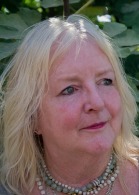
And We Are Singing, Singing for Our Lives! by Carol P. Christ

Last week I wrote about the grief I feel for the state of my nation (the United States) and of the world. A few days later one of my favorite writers, Katha Pollitt, asked why we are not all in the streets all the time, keeping alive the enormous energy that came together in the first of the women’s marches against Trump and that continued for several months thereafter in protests women’s rights, for immigrants, for the planet.

After reading Pollitt’s essay, I thought: we should be weeping and wailing in the streets. Instead of pink hats we should be wearing black, the color of mourning. But then I pulled myself up short. In the symbolism of our Old Europe, black is the color of rebirth and regeneration: the dark place where seeds must be placed if they are to germinate, the color of rich and fertile earth. If we are going to protest the racism of the Donald and his followers, we must be careful not to repeat the Indo-European binary in which light is associated with truth and goodness, while the devil and all that is evil is dark.

Nonetheless, I like the idea of acknowledging our grief for all that is being lost publicly and with others. Continue reading “And We Are Singing, Singing for Our Lives! by Carol P. Christ”

Grief, Have I Denied You? by Carol P. Christ

I have never had so much trouble trying to find a topic for blog and to begin writing it as I have this time. It is 6:58 am in Greece, three hours and two minutes before my blog is due to be posted, and I still do not have a topic. It is not that topics have not occurred to me. There is the rape allegation against Donald Trump by E. Jean Carroll. There is the fact that it was ignored by the press—as if it somehow does not matter that the President of the US is or might be a rapist. There is the declaration by Kamala Harris that if elected President she would move to immediately process hundreds of thousands of unprocessed rape kits. There are the new reports of the horrendous conditions in which children, women, and men are being kept in detention at the US border. And this morning there is the President’s racist rant against progressive congresswomen Alexandria Ocasio-Cortez of New York, Ilhan Omar of Minnesota, Rashida Tlaib of Michigan and Ayanna S. Pressley of Massachusetts. Continue reading “Grief, Have I Denied You? by Carol P. Christ”

Declaration of INTER-Dependence by Mary Sharratt


On July 4 countless people in the United States celebrated Independence Day and many enjoyed a long leisurely Independence Day weekend. While there’s nothing wrong with celebrating freedom and all that is good in your country, I’ve become increasingly nervous about any form of unchecked, uncritical nationalism. Lately in global politics there’s been a resurgence of nationalism, populism, and isolationism of the ugliest kind. The kind that says, “Our own people first,” and “We need to build a wall,” and “Let’s drive out the immigrants,” and “Let’s start a trade war with China.” In Europe this sort of nationalism manifests itself in political movements like Brexit and in right wing populist parties like Front National in France.

To counter these divisive trends, I believe we need a new global holiday and a global Declaration of INTER-dependence. Our stark reality is that we inhabit an increasingly densely populated and fragile planet with finite resources. All human and non-human life on the planet is facing the specter of climate change and other environmental factors that threaten the fabric of our very existence. We live in an increasingly interdependent global economy. If China crashes, we will all feel the repercussions. Russian interference tipped the 2016 US election. A war in Syria and wars and grinding poverty in Africa have flooded Europe with refugees, which, in part, gave rise to this right wing, populist, anti-immigration push back. But if people in the developing world continue to suffer the worst ravages of climate change and the resulting famine, war, and poverty, our global refugee crisis is only going to escalate. Continue reading “Declaration of INTER-Dependence by Mary Sharratt”

It’s Called Practice For a Reason by Kay Bee

My daily practice isn’t what I’d like it to be these days what with working two jobs, raising three teenagers, and going to grad school. I am clocking about 60 hours of work and school every week, which doesn’t leave very many spare hours for formal ritual, prayer, or meditation.

During previous phases of my life, I’ve had a daily devotional practice that’s taken on many different forms as my spiritual studies  deepen. I’ve learned to use new tools, and gone from singing other people’s chants to writing my own and creating my own prayers. As my path unfolded, my practice evolved. But last autumn, life shifted when I went back to school and shifted again a couple of months ago when I added a second job to the mix. My spiritual practice over the last month has been sporadic, random moments stolen from other obligations to say a rushed prayer, a chant sung on the drive to work, or an energy center balancing done in the shower before bed.

Meanwhile, in the back of my mind was the fact that I had committed to attending a 4-day training intensive within the Avalonian Tradition, followed immediately by a 4-day leadership retreat for the Sisterhood of Avalon. A couple of weeks ago, with my daily practice in what felt like utter shambles, I suffered an bout of extreme self-doubt. What was I thinking committing to this training intensive and leadership work when I couldn’t even manage to find 15 minutes every day to engage the practice of my faith? How on earth could I think I was ready for this? Should I even still go? Continue reading “It’s Called Practice For a Reason by Kay Bee”

Trial by Fire, Healing by Water by Carol P. Christ

It wasn’t really fire. I came home to Lesbos from a soulful Goddess Pilgrimage to Crete and a discouraging emergency meeting of the Green Party Greece totally exhausted and wanting nothing more than to rest. It was the hottest June on record and my house with its many windows felt like a furnace. Due to a dispute with the installer, it took eleven days to get the air-conditioning fixed. My little dog who could see when I left for Crete, was blind when I returned. I wondered if I would have to put her down and could not bear the thought. I was so tired and so hot that I could not think straight. It was beyond my capacity to even consider moving to a hotel. I didn’t have the energy to unpack. And I didn’t have a car as the old one had been sold and the new one was still at the dealership in Crete. So I couldn’t escape. Instead I tried to hold back tears.

After the air-conditioning was finally fixed, I was able to unpack, wash my clothes, and repack for my return to Crete. The night before I was to leave, I jumped the St. John’s day (midsummer) fires. The locals say they jump the fires for fertility (jumping fires does warm the nether parts) and health. In the photo I am sitting at a table directly behind the first fire, but I soon got up and jumped all three of them, affirming the powers of birth, death, and regeneration.

Continue reading “Trial by Fire, Healing by Water by Carol P. Christ”

Patriotism Reconsidered by Carol P. Christ

Originally published on July 8, 2013 on FAR under the title “What Is Patriotism?,” this blog asks questions that seem even more important today, when tanks have been paraded in front of the Lincoln Memorial and children are held in appalling conditions at our borders because their parents dared to seek asylum in the United States.

July 4, American Independence Day, has come and gone. Perhaps now is as good a time as any to reflect on patriotism. What is it? What does it mean from a feminist perspective?  What is the relationship between patriotism and militarism?  Can one be a patriot and oppose war?  Can one be a patriot and deny that “America is the greatest country in the world,” the foundation of  the doctrine of American exceptionalism?

In a recent blog, Caroline Kline called attention to the use of patriarchal God language in the patriotic hymns her child was asked to sing in the 1st grade.  She wondered if this God language could be changed to female positive or gender neutral.  Her post prompted me to ask if changing pronouns would be enough and to revisit the question of patriotism and nationalism. Continue reading “Patriotism Reconsidered by Carol P. Christ”

FAR Project Intern – Join Us!

It’s about every three years when we at Feminism and Religions put out a solicitation for a new intern to join our team. Back in 2013 we had the great privilege of having Kate Brunner join us. She came on as an intern and stayed to become one of our permanent co-weavers who help run the day-to-day behind-the-scenes of this collaborative project. She reorganized the structure and rhythm of how we run things and made it easier for us to bring in the next person. Enter Katie M. Deaver at the end of 2016. She is the superhero who so smoothly swooped in as Kate stepped back to attend grad school. Katie shared all the values and ethos of FAR – it was the most organic match we could have hoped for. Truly FAR couldn’t have survived without each of them.

FAR is an all-volunteer effort and now, again three years later, we are looking to bring on a next team member. From the very start, we have been of the mindset that the more voices and perspectives we can bring into constructive, community-building dialogue, the better. So…might you be up and ready to contribute to this collaborative feminist task? Continue reading “FAR Project Intern – Join Us!”

Start, Stop, Continue: 2019 Mid-year Check-in by Xochitl Alvizo

It is the first of July—half way through 2019. I remember that I and many of my friends were very glad for the end of 2018; it was a hard year of many heavy events and we looked forward to a fresh start, a new year. It’s hard to accept that half of that “new year” is over. What is different? What is new?

In the United States, we are still suffering the same president. Women’s rights over their bodies and reproductive autonomy are still under attack. Immigrants and refugees are subjected to purposefully cruel treatment under the current administration—humanitarianism not a U.S. priority. We are entering another high-stakes election season that is sure to raise all our blood pressure. Not to mention larger global concerns regarding the destruction of our environment and survival of our planet, about which Karen Hernandez recently wrote.

All of this while we also deal with our own personal work, relationships, communities, and day to day responsibilities. We attend to our practical micro concerns always in the midst of overwhelming macro realities. How are you holding up? Continue reading “Start, Stop, Continue: 2019 Mid-year Check-in by Xochitl Alvizo”

My Body, My Self by Carol P. Christ

The other night I was invited out by a new friend to meet a group of his friends. It was a lovely gathering, and I felt welcomed. As we hugged good night outside the restaurant, one of the women commented, “Wow you really are tall.” Without missing a beat, I responded, “Yes it has been the bane of my life.” As the words tumbled out of my mouth I was aware that I spoke them dispassionately, not as is usual with a catch in my throat.

Don’t get me wrong about this. I don’t go around hating myself or my body. I know I am striking. I know I stand out in a crowd. I believe I am beautiful even as I age. Still, it is difficult to be singled out as different—especially when you are just going about your business. Moreover, comments about a woman’s height are never neutral: women who are taller than men challenge gender norms by our sheer physical being. Part of what is being said is almost always: you shouldn’t be so tall.

One of these things is not like the others, one of these things just isn’t the same. Continue reading “My Body, My Self by Carol P. Christ”

Kassiani’s Song: Woman at the Center of the Easter Drama by Carol P. Christ

Today I am reposting the song and story of Kassiani, the Byzantine composer, poet, and hymnographer, who is not well-known to western feminists or in western history in general. In Christian Orthodox tradition, Kassiani’s most famous song will be sung this week on Easter Tuesday night or very early Easter Wednesday morning, placing a woman’s love for Jesus at the heart of the Easter drama.

For many this song is the high point of Easter week.

Kassiani, also known as St. Kassia, was a Greek woman born into a wealthy family in Constantinople (now Istanbul) about 805 to 810 AD. According to three historians of the time, she was intelligent and beautiful and selected as a potential bride for the Emperor Theophilos. The chroniclers state that the Theophilos approached her and said: “Through woman, the worst,” referring to the sin of Eve. Clever Kassiani responded, “Through woman, the best,” referring to the birth of the Savior through Mary.

Apparently unable to accept being put in his place by a woman, Theophilos chose another bride. Perhaps relieved, Kassiani founded a monastery in Constantinople becoming its first abbess. She was an outspoken theological advocate of icons during the iconoclastic crisis (for which she was flogged). One of only two women to publish under her own name during the Byzantine Middle Ages, Kassiani wrote both poetry and hymns. Up to 50 of her hymns are known today, with 23 of them being part of the Greek Orthodox liturgy. Continue reading “Kassiani’s Song: Woman at the Center of the Easter Drama by Carol P. Christ”