Embodied Theology: Goddess and God in the World by Carol P. Christ and Judith Plaskow

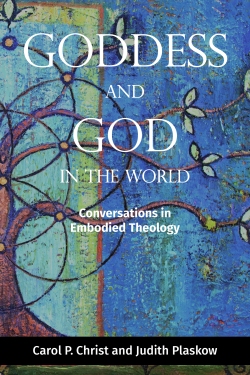
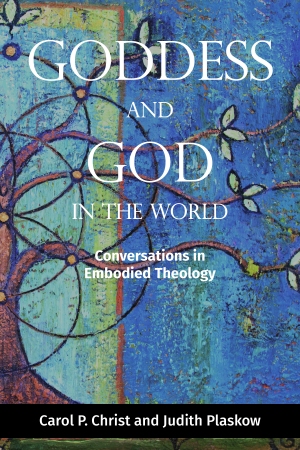
Goddess and God in the World final cover designToday is the official release date for Goddess and God in the World: Conversations in Embodied Theology. It just so happens that August 1 is also a day for celebrating the harvest. An excerpt from the Introduction introduces the embodied theological method” we hope will turn the field of theology upside down.

People who reject the popular image of God as an old white man who rules the world from outside it often find themselves at a loss for words when they try to articulate new meanings and images of divinity. Speaking about God or Goddess is no as longer simple as it once was. Given the variety of spiritual paths and practices people follow today, theological discussions do not always begin with shared assumptions about the nature of ultimate reality. In the United States, the intrusion of religion into politics has led many people to avoid the subject of religion altogether. In families and among friends, discussions of religion often culminate in judgment, anger, or tears. Sometimes the conversation is halted before it even begins when someone voices the opinion that anyone who is interested in religion or spirituality is naïve, unthinking, or backward—or, alternatively, that religious views are a matter of personal preference and not worth discussing at all.

Talking about divinity is also surprisingly intimate. Continue reading “Embodied Theology: Goddess and God in the World by Carol P. Christ and Judith Plaskow”

The Emergence of Feminist Theology: Remembering our Roots by Judith Plaskow and Carol P. Christ

Goddess and God in the World final cover designThis blog is an excerpt from our new book Goddess and God in the World which will be published by Fortress Press in just one week — on August 1. As we look forward to its release, we remember the critical works that started us on a journey of discovery that continues to unfold. In a jointly written chapter, we describe the beginnings of feminist theology.

Feminism was welling up from under during [the late 1960s]. We became feminists early in graduate school but did not discover feminist theology until we were preparing for our comprehensive exams. As Judith was later to write, feminism placed a question mark over absolutely everything for us: the maleness of God, the male authorship of the Bible, and the male perspectives from which virtually all theologies had been written. Three key essays set the stage for future work in the field, including our own. We have already mentioned these essays, but it is important to address the challenges they posed to traditional theology, and our own responses to them, in more detail here. Continue reading “The Emergence of Feminist Theology: Remembering our Roots by Judith Plaskow and Carol P. Christ”

What My Mothers and Mentors Taught Me about Self-Care by Elise M. Edwards

Elise EdwardsDuring another week of killings, war, protests, and debates about whether Black Lives Matter or Blue Lives Matter, I’m concerned about the toll it takes on those who are witnessing the violence and fighting for justice.

I’m not on the front lines of these battles, but I can feel my energy draining, nonetheless. Over the past few days, while I’ve stayed informed about the latest tragedies and conflicts, I’ve intentionally limited my exposure to most news and social media outlets. I’ve begun preparing for a contemplative retreat with other women who also care about justice.  For me to continue to participate in any effort of transforming society, culture, or the church, I must nurture my mind, spirit, and body.

Audre Lorde put it like this:

“Caring for myself Is not self-indulgence.  It is self-preservation, and that is an act of political warfare.”

Self-care is a radical practice of self-love. It is absolutely necessary when engaged in conflict against those who do not show love to you, or worse, those who seek to destroy you.  Your survival and your flourishing are defiantly brave.  Self-care honors the God who created you, the One who loves you, and the Spirit who sustains you. Continue reading “What My Mothers and Mentors Taught Me about Self-Care by Elise M. Edwards”

Dealing with Despair by Carol P. Christ

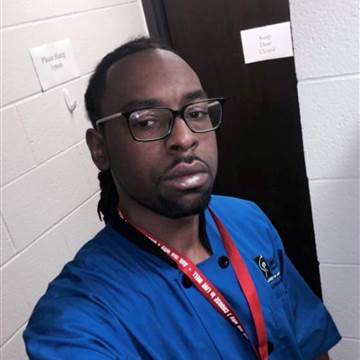
Philando Castile, school cafeteria worker, killed driving while black

In a state of shock after the police shootings of Alton Sterling and Philando Castile, I turned to my Facebook feed, looking for community in my grief and hoping to make sense of what had happened. The statement, “He would not have been shot if he had been white,” referring to Philando Castile, appeared several times. The first time I saw it, I responded, “He would not even have been stopped if he had been white.” Think about it if you are white: how many times have you been pulled over by the police?

I can answer that question: in the United States, only once, and that was because I made a second illegal U-turn at the same stop-lighted intersection as a teenager.  The policeman issued me two tickets, stating that he had been willing to let the first offence go. This is what white privilege means. Continue reading “Dealing with Despair by Carol P. Christ”

Islamophobia and Two Tales about Muslim Women by Vanessa Rivera de la Fuente

Woman in religion is a story. This means that all that is said about women in all religions, as well as from social and natural sciences, institutions and the media is a  story, a story that is the product of the interaction of mechanisms of power, authority, and performative actions. If gender is a discourse with cultural signifiers, then the “feminine” and “women” in the religious field are too. Speech about women has functioned in patriarchal structures historically, and still now, as a mechanism of control, discipline. and punishment.

In my experience, the situation of women in Islam is generally addressed from two opposing and dominant discourses that I call: The “Idealization of Inequality” and “Demonization.” The “Idealization of Inequality” view argues that the Quran elevated the position of women from a terrible condition of objectification in the pre-Islamic Arab society, also called the age of ignorance or Jahiliyya, a time in which many girls were killed at birth, to a state of full equality and recognition of rights. According to this approach, feminism has no place in Islam. Nothing should be changed. No new hermeneutics must be allowed, since the only differences between men and women stem from biology: women can conceive, men have more physical force. But this does not mean that one is below the other, because, under the “cosmological equality” established by the revelation, the lives of women and men are equal before Allah.

The “Idealization of Inequality” view represents a hegemonic discourse that lacks a strong and coherent response to the prevalence of discriminatory practices against Muslim women based on differences beyond their biological nature: such as the prohibiting women from entering or speaking in some mosques, not allowing women to hold positions of spiritual and administrative leadership, and requiring women to worship in segregated spaces with separate entrances. None of these are related to the “equality” they attribute to the Quran. Nor does the “Idealization of Inequality” standpoint provide real and concrete answers to the other issues affecting Muslim women: institutional violence, racism, stereotypes, and the sexist burden of common narratives.

The “Demonization” view, on the other hand, argues that, with respect to religion, it is not possible to speak of the liberation of women. So all kind of activism or feminist initiatives coming from or seeking background in religion are oxymorons. Accordingly, there would not be Catholic, Muslim, or Mormon feminism or the possibility to develop feminist hermeneutics that can be taken seriously. An important feature of the “Demonization” argument is the assumed axiom of a fundamental difference between East and West, pitting the rationality of “we” against the irrationality of “them,” and the analysis of “our” development versus “their” underdevelopment:  reaffirming the western identity as superior. And here lies its most egregious shortcoming: “Demonization” acts as judge and jury in regard to the description of the oppression of all women perceived as “other.” First, it places them in the category of otherness, and then it defines the causes of discrimination suffered by them in their societies. Finally, it gives “us” the messianic ability to save “those” women. Continue reading “Islamophobia and Two Tales about Muslim Women by Vanessa Rivera de la Fuente”

Our Ladies of Sea, Earth, and Sky by Joyce Zonana

Sara and the Marys
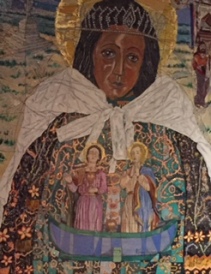
Sainte Sara encompassing Sainte Marie-Salome and Sainte Marie-Jacobe

O Sainte Marie-Jacobe, priez pour nous.

O Sainte Marie-Salome, priez pour nous.

O gardeures de la Provence, priez pour nous.

The priest intoned the words in deep, liquid accents, his voice echoing from the ancient stone church in the remote village of Les Saintes-Maries-de-la-Mer, in the Camargue region of Southern France, where the waters of the Rhone River meet the Mediterranean Sea in a wild, wide, flat expanse populated by black bulls, pink flamingos, and white horses.

“O, Saint Mary-Jacobe, pray for us.”
“O, Saint Mary-Salome, pray for us.”
“O, guardians of the gates of Provence, pray for us.”

I could feel the words resonating through me, bringing sudden, hot tears. The people gathered in the small village square repeated the priest’s chant, their voices rising above the low, white-washed houses into the sunlit sky, out towards the shimmering sea where legend tells us the two Marys had drifted two thousand years ago in a boat without rudder or sail.

Continue reading “Our Ladies of Sea, Earth, and Sky by Joyce Zonana”

Toxic Masculinity: “Masculinity Must Be Killed” by Carol P. Christ

Carol Molivos by Andrea Sarris 2A few days ago I watched the movie An Unfinished Life starring Morgan Freeman, Robert Redford, and Jennifer Lopez. Though it was recommended as a sensitive psychological drama, and though on the surface level it criticizes (male) violence against women and animals, on a deeper level, it confirms the association of masculinity with violence, suggesting that violence is the way men resolve their problems with each other.

At the beginning of the film, Robert Redford, who lives on a ranch in Montana, picks up his rifle with the intention of shooting a bear who mauled his friend Morgan Freeman. This act of violence is stopped by local authorities who arrive to capture the bear. However, the bear is not removed to a more remote area, but rather is given to a local make-shift zoo where it is kept in a small cage. At the end of the movie, Redford frees the bear after Freeman realizes that it should not be punished for injuring him. The bear is last seen crossing a mountain ridge in the distance.

Redford is grieving the death of his only son who died in an automobile accident while his son’s wife (played by Jennifer Lopez) was driving. After being beaten by her current boyfriend, Jennifer Lopez escapes with her daughter and ends up on Redford’s doorstep, announcing that her daughter is Redford’s granddaughter.  Redford, who believes Lopez is responsible for his son’s death, grudgingly allows them to stay.

When Lopez’s boyfriend tracks her down in Montana, Redford drives him out of town, threatening to kill him with his rifle. When the boyfriend comes back, Redford shoots out the tires of his car, smashes the car’s windows with his rifle, and beats the boyfriend bloody before putting him on a bus out of town.

The movie asks us to condemn the boyfriend’s violence against Lopez and Redford’s desire to kill the bear, but it also asks us to condone and even to celebrate Redford’s violent acts against the boyfriend. After all, in this case, justice is done. Right?  Continue reading “Toxic Masculinity: “Masculinity Must Be Killed” by Carol P. Christ”

Khutba “A Call to Radical and Angry Women of Faith” by Vanessa Rivera de la Fuente

Sacred+Circle+home+page+image+oneI am grateful to the Interfaith Group of Feminist Theologians and Women of Faith for remembering my spiritual affiliation and giving me the opportunity to lead this service in this fully of blessings month of Ramadan and share with you a reflection in the form of a sermon or khutba. Perhaps you know that in orthodox Islam, tradition, without any theological basis, still forbids women to speak or lead rituals. So, this is a joyful occasion for me and I want to start with my usual invocation:

I thank God for this day. I praise Allah for the paths I had to walk that led me to its light and the present day. I ask the protection of the Divine that lives in the essence of everything. and I invite my female ancestors to walk with me in this journey.

A Call to Radical and Angry Women of Faith

My dear sisters, I want to invite you this evening to reflect on what it means to be a radical woman of faith, in a context of extreme upsurge of violence against women and minoritized groups we live in. What does mean being a radical woman? As we know, radical women are feared even by their activist and feminists peers. For the mainstream of society, a radical woman is a little crazy, a little witch, a little ugly, and especially, a very angry woman.

Well, they are right about anger. To be radical is to be as outraged enough to, fearlessly and tirelessly, claim and work for the total end of all kinds of oppression. You heard it right, the total end of all kinds of oppression. For women of faith, like us, who believe in social justice as the prior duty and principle of living in the creation, the current status of abuse, violence and exploitation to which a part of humankind is subjected must provoke us to rage, anger and outrage.

Aren`t you upset? Because I am. Religious patriarchy has historically exercised and endorsed, until today, violence against women and those group defined as “minority.” This religious patriarchy, composed for priests, imams, lamas and rabbis legitimize multiple forms of exclusion of women, sexism, control of our bodies, misogyny and rape culture.

This week we mourn the death of about 50 of our Latino siblings in Orlando. We have to add to this list the hate crimes against queer people in Veracruz, México, as well the slaughtering of women in thousands of gendercides that have become the standard cover of newspapers every day, and the violence against lesbians and trans women, crimes that fail to capture the visibility and solidarity of a homophobic and androcentric society.

Without denying the misogyny and homophobia existing in my community, I want to say that the specific religion of those criminals doesn´t matter, you know why? The pernicious influence of religious patriarchy extends beyond the limits of our assemblies. People blame misogyny and LGTBQphobia on religions as if this is something external to their lives. But each day, at the school, workplace and media our society reproduces all that hetero-sexist, colonial, racist, elitist violence. Heterosexuality as a political regime, validated by hegemonic religious narratives, present in all belief systems, is a source of violence and a form of terrorism itself. Continue reading “Khutba “A Call to Radical and Angry Women of Faith” by Vanessa Rivera de la Fuente”

Goddess Politics and the Cauldron of Memory by Kavita Maya

KavitaMaya‘Someone needs to gather the stories, to keep the cauldron,’ said the late Goddess feminist artist Lydia Ruyle during one of the last times we spoke, at the 2014 Glastonbury Goddess Conference. I had hinted at my concerns around conducting doctoral research in the presence of ongoing conflict within the Glastonbury Goddess community (especially when my broadly-stated site of interest is ‘politics’), and in reply she had stressed the need to ‘hold space’ for the different voices and perspectives in the UK Goddess movement, and that conflict would be inevitable. ‘There needs to be a weaver,’ she said.

The following day I recorded an interview with Lydia and some of her friends at Café Galatea on the High Street, which she had been keen to ensure since the previous summer—with poignant foresight, given her death in March 2016. I’m not sure if she was expecting that I should fully take on the role of this ‘weaver’—there are more stories than one PhD thesis can claim to encompass—but the theme is present in my writing. Her words lead me to reflect on the weaving together of politics with memory and storytelling, and on the need to honour the plural histories of the British Goddess movement. Continue reading “Goddess Politics and the Cauldron of Memory by Kavita Maya”

What Traci West Taught Me about Dominant and Excluded Voices by Elise M. Edwards

Elise EdwardsIn my previous post, I mentioned a book I am writing about how theological and ethical considerations in architectural design can define good architecture.  In that post and in ones to follow, I am acknowledging the feminists and womanists and mujeristas who have influenced me while also opening up the dialogue to the feminists in this community who continue to inspire and guide me to do my best work.

But today, instead of talking about creativity or architecture, I want to discuss how I arrived at the conviction that community decisions about how we ought to live—whether those are decisions about laws, institutional policies, religious practices or architectural buildings—need to include the voices of the diverse people they directly and indirectly influence. Continue reading “What Traci West Taught Me about Dominant and Excluded Voices by Elise M. Edwards”