When we seek immortality or spiritual “rebirth,” are we not saying that there is something wrong with the “birth” that was given to us through the body of our mothers? In She Who Changes and in “Reading Plato’s Allegory of the Cave as Matricide and Theacide,” I asserted that our culture is “matricidal” because it is based on the assumption that life in the body in this world “just isn’t good enough.”
What is so wrong with the life that our mothers gave us that we must reject it in the name of a “higher” spiritual life? The answer of course death.
This continues the story I began last week. Catherina is my 2x great-grandmother; Agnes is my 2x great-aunt; Johanetta is my first cousin, 3x removed, and my step-2x great-grandmother; Henry is my 2x great-grandfather. It is true that Henry had eighteen children with two wives. It is also true that Henry and Johanetta married and had a child soon after Catherina’s death. Some of the other details came in waking trance as I allowed the ancestors to tell their stories through me.
Agnes Lattauer Sweitzer: I thought the day Catherina left for America would be the worst day of my life. I did not know I would see Catherina again. I did not know I would outlive my two little sisters and both of my brothers. I did not know what my daughter would do. I read Catherina’s letters from America through my tears. How I wanted to be with her on her wedding day. How I wished she had been with us when we buried our sister Johanetta. My heart nearly burst when Catherina wrote that she longed to take my hand when she gave birth to her first child. My mind contorted itself trying to envision her living in a big city, in a big building, climbing up and down stairs, her feet never touching the earth, her hands never working the soil. What kind of life was that?
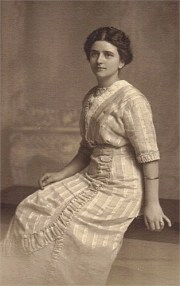
Catherina Lattauer Iloff
Catherina Lattauer Iloff: I left home a girl. Because I was not yet engaged, Mother and Agnes never told me about married life. What to expect. What to do. I loved Heinrich, or Henry, as he wanted to be called after he became a citizen of the United States. I was not prepared. Henry was so insistent. I was soon pregnant. First Henry, named for Henry’s father Heinrich, then Elisabeth, named for Mother. I had to care for them on my own. Henry was busy with his work during the days. In the evenings he went to the German beer garden to meet his friends. Growing up with my mother and sisters, I had never been alone. There were other women around, but they were busy with their own lives. Some of them were kind, some of them were not, but nobody cared about me the way Mother and Agnes did. One night Henry came home and told me he had been talking with his friends. There was land available in a place called Cherry Ridge, Pennsylvania, a day’s journey from New York City. He said it was his dream come true. We would build our own house. There was plenty of land to farm—not like back home where there were never enough fields to go around. I held my tongue. I did not tell him that I suspected I was pregnant again.
The Iloff farm house
Agnes Lattauer Sweitzer: Catherina and Henry have been to Cherry Ridge. Catherina says there is land for us there too. I don’t know what my Heinrich will say. Life is difficult for us here, but we have two young daughters, Elisabeth and Johanetta, and the baby, Peter. There is Mother to consider. Well, you could have blown me over with a feather. Heinrich said we should grab the opportunity before it is too late. Mother said she would come with us, because she wants to see Catherina and Rudolph again before she dies. She is an old lady. I wonder how she will manage the journey. But I couldn’t say no. The two of us cannot contain our joy. We will see our beloved Catherina again.
Catherina Lattauer Iloff: My life is complete. Mother and Agnes and the dear little children arrived. Mother immediately took Henry and Elisabeth in her arms. Agnes comforted me about the loss of Baby John. I could finally allow myself to cry, knowing that Mother and Agnes would be there to wipe away my tears.
Agnes Lattauer Sweitzer: Our first years in Cherry Ridge were difficult. There were houses to be built, fields to be plowed, cows to be bought and milked. I had two more children, Henry, who died as a boy, and John. My little sister outdid me. She had nine children in all: Henry, Elisabeth, John who died, John who lived, George, Catherine, Mary, Frank, and Barbara. Giving birth to so many children took its toll on her. After the last one, she was never well. I think she may have been pregnant again several times, but she never spoke about it, not even to me. Finally, she took to her bed.
Catherina Lattauer Iloff: I had nine children. I never told anyone about the babies I lost before I began to show. Mother and Agnes worried that I was having too many children. But what could I do? I loved Henry, and I loved every one of my children. Mother died a few years after she came to Cherry Ridge. She always said she was so happy she had undertaken such a great adventure. She was pleased to know that Agnes and I were settled and happy. I miss her every day. Agnes is always by my side. I was forty-two when Barbara, my last baby was born. I bled a lot. After that, I never carried another child to term. I was never myself again. Agnes is my rock. Johanetta helps with the little ones. Henry is still strong as an ox, busy in the fields or with the cattle. I see that Johanetta hangs on his every word. I dismiss such thoughts from my mind. I do not know how much longer I have.
Agnes Lattauer Sweitzer: Catherina died yesterday. She was only forty-six (I am now fifty-six), and she had not been well for several years. I told her to stay away from Henry, but she was powerless to do so. Sometimes I blame him for her death. I worry about Johanetta now. Wild horses will not keep her away from Henry. I see the way she looks at him, and I see the old goat looking right back at her. She is twenty-six, a full grown woman.
Johanetta displaying her engagement ring
Johanetta Sweitzer: I can’t believe it! Henry asked me to marry him. Mother is furious. Father says he should have whipped me a long time ago. But they can’t say no. I told them I am pregnant with Henry’s child. The older children are shocked that their cousin is marrying their father. The younger ones are thrilled. They have always viewed me as a second mother as well as an aunt. I have been looking after all of them these last years what with Aunt Catherina being so ill. I love those children.
Agnes Lattauer Sweitzer: I had to forgive Johanetta, but I will never forgive Henry. I smile when I see him to keep the peace, but my heart is cold. Peter was her first-born. After that she had Agnes and Emma, who died of some of those diseases children get. I could not help wondering if that was God’s punishment.
Johanetta Sweitzer Iloff: Henry and I were married for twenty years. Except for losing Agnes and Emma, those were the happiest years of my life. In all, we had nine children: first Peter, Agnes, and Emma, and then, Anna, Lawrence, Charles, Robert, Otto, and Phillip. Henry was a good man. He worked hard all of his life to support his family. We lost the second John a few years ago, but there were fourteen living children to mourn Henry’s death. The little ones are still with me, some of the others are scattered to the winds, and quite a few are settled around here, raising families of their own. While he was still strong and able, Henry was elected Commissioner of Wayne County. He served his fellow countrymen proudly for years. I wish Mother had been alive to see that. Maybe then she would have understood what a wonderful man he was.
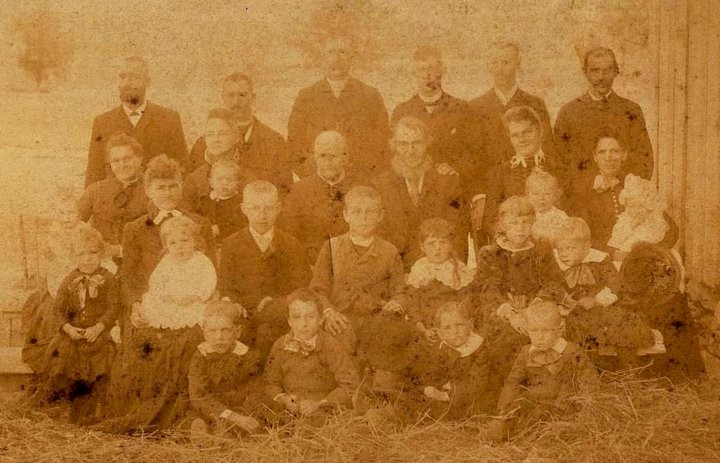
Henry and Johanetta, second row, center right with some of Henry’s children and grandchildren
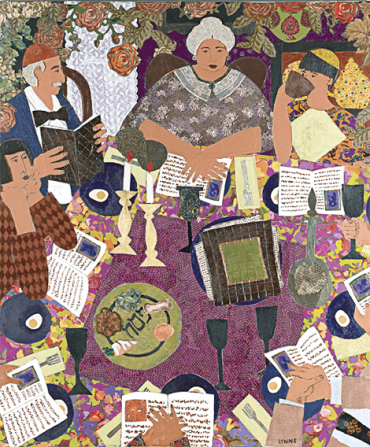
As the Jewish High Holiday of Passover draws to a close, I have been reflecting on this seasonal ritual so central to collective Jewish identity and so significant to me personally.
The Haggadah, the script for the Seder gathering, enjoins all Jews to experience the Exodus—the liberation of the ancient Hebrews from slavery in Egypt —as if it were happening to each of us in our own time. Because I was born in Cairo to an Arab Jewish family that left Egypt when I was two, I always felt Passover to be mine. No need for “as if”: our Exodus was all too real. Yet, from my parents’ accounts, life in Egypt had been delightful. I could not reconcile the Haggadah’s dreadful representation of ancient Egypt with my family’s treasured memories of contemporary Cairo: I could not understand why we celebrated deliverance from an Egypt we loved.
When I first returned from my ancestor quest in Germany, I fell ill with a bad cold and cough and had little physical energy. For two weeks I lived in the dreamtime, communicating with the ancestors and trying to make sense of the information about their lives I had discovered. After I got better, I had difficulty returning to daily life. The ancestors wanted to speak through me. Their stories, based on facts, come to me in waking trance.
Feeding the ducks
Agnes Lattauer Sweitzer : I was born in Ober-Floerscheim (Hessen Darmstadt) on July 9, 1812. I was the first in a family of five children. Four years after me came Jakob, named after Father, and three years later, Rudolph. It was nice to have brothers, but my dream of a sister came true when Catherina was born a month and a day after my tenth birthday. My mother was busy with Jakob and Rudolph, so I became a second mother to Catherina. I could not nurse her, but I could sing to her and rock her to sleep. I changed her diapers and gave her a bath. It was so wonderful to have a baby to take care of. Three years later little Johanetta was born two days after my thirteenth birthday. Another baby for me and Mother bring up together. I was in heaven. I was both mother and sister to the little girls. When they got older, I took my little sisters to play by the stream, where they giggled and cooed as we fed the ducks and the geese. In the summer, Mother and I brought them with us to the fields where we hoed and planted, weeded and harvested. They tried to pull weeds with their little fingers. It was my job to keep them from pulling up the plants too. Continue reading “A Tale of Two Sisters by Carol P. Christ”
“Is self-promotion sinful?” Author Marlena Graves asked this question on Christianity Today’s Her.Meneutics blog back in 2010. Reflecting on her experience of having a manuscript rejected by publishers for being a “no name” and not having a big enough platform, she wrestles with questions like “how much of what we do as Christians and churches is about promoting ourselves?” and “are we using the church as a vehicle to make a name for ourselves?”
Graves never directly answers the question but she imples that most of the time self-promotion is sinful. She concludes that when we are presented with platform-building opportunities, most of the time the most righteous path is to for us to take a step back in order to revaluate and humble ourselves. But, other than turning down opportunities to grow our professional presence, what does humbling ourselves mean? Continue reading “From Competition to Collaboration: Reflections on Humility, Self-Promotion, and Gender”
For several weeks now, I’ve been going through and disposing of stuff that has accumulated in my house over the past three or four decades. One of the more interesting finds was the following letter, written by my husband, when we lived in Saudi Arabia from 2000 – 2004:
May 1, 2001
Travel Letter
To Whom It May Concern:
My wife, Esther Ruth Nelson, has my permission to travel to Bahrain, Iran and other countries on May 1 – 30, 2001.
In my previous post, I wrote about my participation in planning a memorial event for the lynching of a man named Jesse Washington in Waco, Texas one hundred years ago. It prompted me to reflect on the challenge of faithfully remembering a conflicted past. It’s important that we don’t just remember past events, but that we remember them appropriately.
I’m convinced that when we remember the past, we must avoid oversimplifying the stories of what occurred to suit our present day agendas and sensibilities. We have to acknowledge the complexity, tension and conflict in what occurred, and perhaps even our own guilt and complicity in what is still occurring. As a black feminist Christian ethicist, I face this challenge when one aspect of my identity seeks to address a particular issue through a narrative that implicates or denigrates another aspect of my identity. Uncomfortable as it is, I recognize Christianity’s complicity in its defenses of chattel slavery. I recognize women’s support of patriarchy.
I went to a lecture a few weeks ago by Walter Brueggemann, a well-respected Old Testament theologian, titled “The Risks of Nostalgia.” Brueggemann warned us of the dangers of mis-remembering the past. Pointing to texts from the prophets and Psalms, he demonstrated how the people of Israel remembered a past before exile without remembering the difficulties, the exploitative conditions, and the tensions of that time. Excluding these harsher realities allowed them to gloss over the differences among them to unite in hatred and distrust in a common enemy—the one responsible of their present situation. By misremembering, they lamented a version of past that didn’t belong to all of them because it didn’t include their diverse histories. But the singular narrative served a purpose—it furthered their cause, their yearning and motivation to return to the way things were before. Did this cause really serve all those who were yearning for it? It’s a question that comes to mind when I hear women yearn for a pre-feminist era or Christians yearn for an era of Christendom.
Like the Old Testament people of exile, we are in moral danger when we remember the past with a nostalgia that sweeps over the real stories of what happened in the past. We risk buying into a narrative that harms us in its oversimplifcation. A simple solution will suffice if we believe we have a simple problem.
Lynching was not a simplistic problem and the Waco Horror is not a simplistic story. A black man was lynched for raping and murdering a white woman named Lucy Fryer. I’ll admit it. The realities of the story make me uneasy. Jesse Washington confessed to a crime and was found guilty in the court proceedings that preceded his murder. It makes sense to question whether the criminal proceedings were biased and whether his confession was coerced or illegitimate in some other manner. But even if we question his confession or conviction, we shouldn’t gloss over them as if they never occurred. To present him as a purely innocent victim would be to distort the past to serve a cause – and even a cause as noble as community unity or racial justice should not be attained through lies. People of integrity must guard against distorting the past for “the good” because the distortions themselves cause pain and harm.
Fryer’s family is still experiencing pain over her murder which precipitated the lynching. Sadly, their pain is made worse by the remembrances of Jesse Washington. Their pain does not mean we should not remember, but it does mean we cannot, as people of good conscience, romanticize violence or idealize its victims. Some people might make Washington out to be a hero or a martyr, but the organizers of the memorial service didn’t remember him that way. We didn’t cast him as a blameless victim. But we remembered him as a victim, nonetheless.
We didn’t romanticize the lynching crowds and their pursuit of justice, either. Washington was brutally tortured and killed before a crowd of thousands. If Christians are a people who embrace the love and mercy of a God who forgives the worst of sinners, they have to condemn even those crimes committed in the name of justice; crimes committed against criminals.
Noble causes, if they are just, must stand in the truth – the messy, complicated truth that resists casting all our heroes as saints, all our villains as irredeemable sinners. Real humans aren’t characters who wear the white hats and black hats of the old Westerns (or even the white hats of Olivia Pope & Associates on ABC’s Scandal).
When we resist remembering simplistic, nostalgic stories, we can begin to grapple with the reality of how difficult it really is to achieve justice. We can see humankind for who we really are. And maybe then we can ask for help.
We can ask victims to help us heal the wounds that persist. We need their help to understand their pain and the underlying causes we seek to solve.
We can ask for the help of those who study the various aspects of our world and culture—the economists, the sociologists, the historians, the artists, the theologians and ethicists, the criminologists, and the scientists. We can be humble enough to learn what we don’t know about what’s really going on.
And I hope we also ask for divine assistance. Despite their own complicated histories, wrongs, and imperfections, our faith traditions can enable us to do more than merely rightly remember, consider, and observe the problems in the world. They can embolden us with the courage of Harriet Tubman, Sojourner Truth, and Ida B. Wells-Barnett to speak a complicated truth and yet still dare to fight to make this a better world.
Elise M. Edwards, PhD is a Lecturer in Christian Ethics at Baylor University and a graduate of Claremont Graduate University. She is also a registered architect in the State of Florida. Her interdisciplinary work examines issues of civic engagement and how beliefs and commitments are expressed publicly. As a black feminist, she primarily focuses on cultural expressions by, for, and about women and marginalized communities. Follow her on twitter, google+ or academia.edu.
I am Carol Patrice Christ, born in Pasadena, California, daughter of Janet Claire Bergman, born in El Paso, Texas in 1919, daughter of Lena Marie Searing, born in Lyons, Michigan in 1891, daughter of Dora Sophia Bahlke, born in Lyons, Michigan in 1858, daughter of Maria Sophia Catherina Hundt, born in Parum, Mecklenburg in 1827, daughter of Catherina Sophia Elisabeth Schoppenhauer, born in Pogress, Mecklenburg in 1798, daughter of Anna Sophia Seehasse, born in Zulow, Mecklenburg in 1756 in the clan of Tara. I come from a long line of women, known and unknown, stretching back to Africa.
In our ritual on the Goddess Pilgrimage to Crete this May, I will have two new names to add to my mother line. The name Sophia was passed down through the maternal line for at least four generations. I am sorry it was not handed down to my grandmother, my mother, and me.
When I left for Germany a little over a month ago, I knew that Dora Sophia Bahlke was the mother of my grandmother Lena Marie Searing and that Dora Sophia’s parents were Anton Bahlke and Maria Hundt, immigrants from the small towns of Parum and Dummerhutte, in Mecklenburg, Germany. I did not have their parents’ correct names, and I had very little information about their lives in Germany. I have now put some flesh on the bones. Continue reading “An Illegitimate Child in Mecklenburg, 1850 by Carol P. Christ”
One hundred years ago, Jesse Washington was lynched downtown in Waco, Texas. Next week, on March 20th, some of my colleagues and I are organizing a memorial service to remember this horrific event and pray for a better future for our city.
We invited submissions of original prayers, poems, spoken-word pieces, music, drama, and other pieces of liturgy for this ecumenical memorial event. We received a number of thoughtful, heartfelt submissions, but we also a question:
“Why in the world do we need a memorial for one person who was lynched?!?! In the reality of things, Jesse Washington was one of thousands of Blacks that were lynched in America during the time period.”
I thought the answer was so obvious that I initially brushed off the question. But as our group proceeded with the plans, I thought about the question and wondered whether our university community would understand why we are doing this. And honestly, in moments of exhaustion when I put off responding to emails, I wondered, too. Why am I doing this?
To remember. We memorialize one person who was lynched to remind us that every single one of the thousands who were lynched was a human being who was killed unjustly.
In the speech “Lynch Law in America,” from 1900, Ida B. Wells-Barnett describes the injustice: “Our country’s national crime is lynching. It is not the creature of an hour, the sudden outburst of uncontrolled fury, or the unspeakable brutality of an insane mob. It represents the cool, calculating deliberation of intelligent people who openly avow that there is an “unwritten law” that justifies them in putting human beings to death without complaint under oath, without trial by jury, without opportunity to make defense, and without right of appeal.”
Wells-Barnett was an African-American journalist and activist for civil rights and women’s suffrage. Her writings and activism advanced anti-lynching campaigns adopted by Black women’s clubs and the NAACP. Unsurprisingly, her work was controversial, even among women’s groups. Wells-Barnett argued that lynching began after the emancipation of slaves to repress “race riots.” When a constitutional amendment permitted black men to vote, lynching was used to violently prevent their participation in state and national elections. When fraud, intimidation, and local policy succeeded in suppressing the black vote, the brutality continued in the name of avenging or preventing rape and assault of white women.[1] For this argument, lawmakers, ministers, and women’s groups accused Wells-Barnett of defending rapists and subverting “justice” for their alleged victims.
She did not defend rapists. (Neither do I.) She condemned a system that used allegations of rape of white women to legitimate hanging, burning alive, shooting, drowning, dismembering, dragging, and displaying black men’s bodies. Some allegations may have been true. Many were false. Despite the veracity of the allegations, the vigilantes tortured and killed men, women, and children in brutal, public ways, and we must not mistake that for any form of justice. Lynching apologists explicitly valued white lives over others. Lynching was, and remains a crime against humanity.
In our own age of campaigns against the impartiality of law and law enforcement, we should remember the lynching victims and the tensions within earlier waves of feminism and the temperance movement over anti-lynching campaigns. We do not have to condone criminal behavior to call for humane law enforcement or prison reform. We can affirm the humanity of accused and convicted criminals in the pursuit of justice. So we remember Jesse Washington and the other lynching victims to engage more consciously in the activism of our time. We remember so that we don’t lose sight of the complexities of our work. We work in remembrance of the many victims of injustice.
We also gather to pray. For some people, prayer is about making requests to the divine. But in a more expansive sense, prayer is communication with the divine. In prayer, we set time aside to connect to something greater than ourselves. It’s our hope that gathering as a community to pray for the future of our city prompts us to see beyond individual concerns. In a liberation ethics framework, as explained by Miguel De La Torre[2], prayer is not limited to individual, private conversations with God in hopes of gaining wisdom and guidance. De La Torre presents prayer as a communal activity that brings together different members of the spiritual body. It involves the critical application of the biblical text to the situation at hand. This involves critical analysis of the social context that gave rise to the text or its common interpretation. So we pray to give us time to come together, to read scripture, to seek God and hear God through other members of our community.
So why are we gathering? Why do we memorialize one person when there are so many others who have been harmed, not just in my local community but all of our communities?
To remember past wrongs.
To commemorate.
To honor.
To inspire.
To call attention to persisting injustices.
To make us mindful in our work.
To provoke us to pray.
[1] This argument about the reasons for lynching is found in several of Wells-Barnett’s essays, but is quite developed in The Red Record: Tabulated Statistics and Alleged Causes of Lynching in the United States (1895).
[2] See Miguel A. De La Torre’s Doing Christian Ethics from the Margins (2nd Edition, 2014).
Elise M. Edwards, PhD is a Lecturer in Christian Ethics at Baylor University and a graduate of Claremont Graduate University. She is also a registered architect in the State of Florida. Her interdisciplinary work examines issues of civic engagement and how beliefs and commitments are expressed publicly. As a black feminist, she primarily focuses on cultural expressions by, for, and about women and marginalized communities. Follow her on twitter, google+ or academia.edu.
Winter’s bone-chilling, relentless cold makes it the most treacherous season in the north when you don’t have a warm place to sleep or enough to eat. Poverty may look different in the city and the country, in various countries and continents, but it can be devastating to body, mind, and soul anywhere.
When I lived in New York City, no day went by that I wasn’t aware that people near me were hungry and homeless. When I moved to a more rural community, I found that, while small groups of volunteers ran food pantries and emergency assistance programs, many in my generally well-off town did not know that they had neighbors who were in need. While contributing to organizations that assist people around the globe is essential, clearly we must also consider what we, as human beings and especially as feminists with a focus on religion and spirituality, must do to support those who live within a few miles of us. Continue reading “A Place for Everyone at the Table by Carolyn Lee Boyd”


 When we seek immortality or spiritual “rebirth,” are we not saying that there is something wrong with the “birth” that was given to us through the body of our mothers? In She Who Changes and in “Reading Plato’s Allegory of the Cave as Matricide and Theacide,” I asserted that our culture is “matricidal” because it is based on the assumption that life in the body in this world “just isn’t good enough.”

 Carol P. Christ is author or editor of
  A Serpentine Path: Mysteries of the Goddess


 For several weeks now, I’ve been going through and disposing of stuff that has accumulated in my house over the past three or four decades. One of the more interesting finds was the following letter, written by my husband, when we lived in Saudi Arabia from 2000 – 2004:
 I am Carol Patrice Christ, born in Pasadena, California, daughter of Janet Claire Bergman, born in El Paso, Texas in 1919, daughter of Lena Marie Searing, born in Lyons, Michigan in 1891, daughter of Dora Sophia Bahlke, born in Lyons, Michigan in 1858, daughter of Maria Sophia Catherina Hundt, born in Parum, Mecklenburg in 1827, daughter of Catherina Sophia Elisabeth Schoppenhauer, born in Pogress, Mecklenburg in 1798, daughter of Anna Sophia Seehasse, born in Zulow, Mecklenburg in 1756
  Winter’s bone-chilling, relentless cold makes it the most treacherous season in the north when you don’t have a warm place to sleep or enough to eat. Poverty may look different in the city and the country, in various countries and continents, but it can be devastating to body, mind, and soul anywhere.
 Feminism and Religion