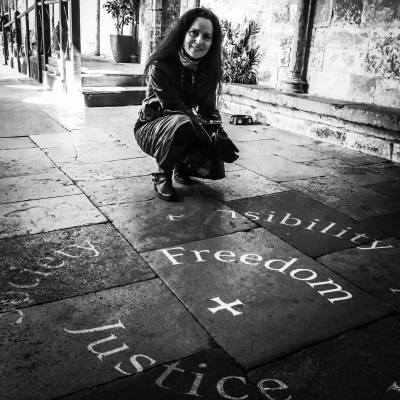
The Gift of Enduring Friendship by Sara Wright

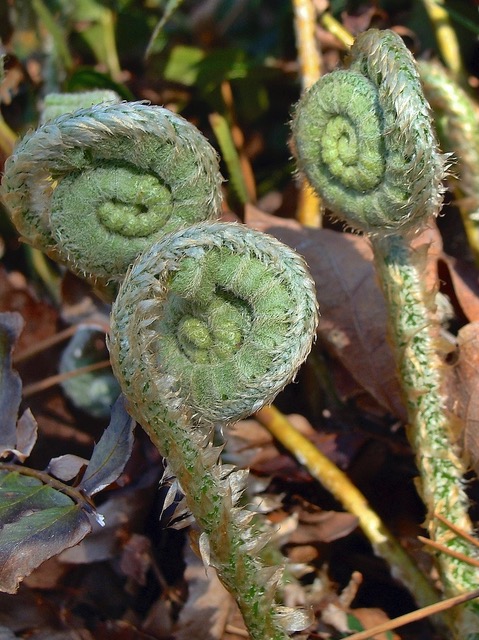
Mathias Klang from Göteborg, Sweden, Wikimedia Commons

After I experienced a sudden shattering break in a friendship with a woman writer/editor that I loved (that I believed would endure any personal difficulty) I was unable to process the event. I wrote a short poem to express my disbelief in which I likened this betrayal to the cutting down of this woman’s tree and left it at that. Silence is a killer of soul. There is no place to go.

The profound rupture of this woman thread felt catastrophic (I have never had a woman friend like her), and in retrospect I still see and experience our friendship in this light. At the time my life was in crisis. I had other consuming worries. Because I had learned at my mother’s knee that silence is literally the end of the road the bottomless chasm that separated us did not lessen in intensity, but I lived on.

Six years later that rupture has been healed. How did this happen? My friend, who happens to be something of a genius, intellectual, professional editor writer/poet wrote a book that she offered to anyone who wanted to read it for free. This act of great generosity was so typical of this woman’s behavior that it galvanized me into action. I took the risk and contacted her directly asking for a copy. I don’t recall just what I said except that I wished we could be friends again, never believing the impossible would happen but it did.

Continue reading “The Gift of Enduring Friendship by Sara Wright”

Celtic Goddess Branwen: A Path to Empathy by Judith Shaw

From the mists of Welsh mythology Celtic Goddess Branwen provides important wisdom for our modern world. Themes of the destructiveness caused by viewing those different from us with distrust and fear are found in her story. Vengeance is revealed as a downward spiral of pain and suffering. She illustrates the healing role empathy, compassion and forgiveness can play in a world gone mad with war. Her story reveals the importance of restorative justice and the many factors at play preventing its application. 

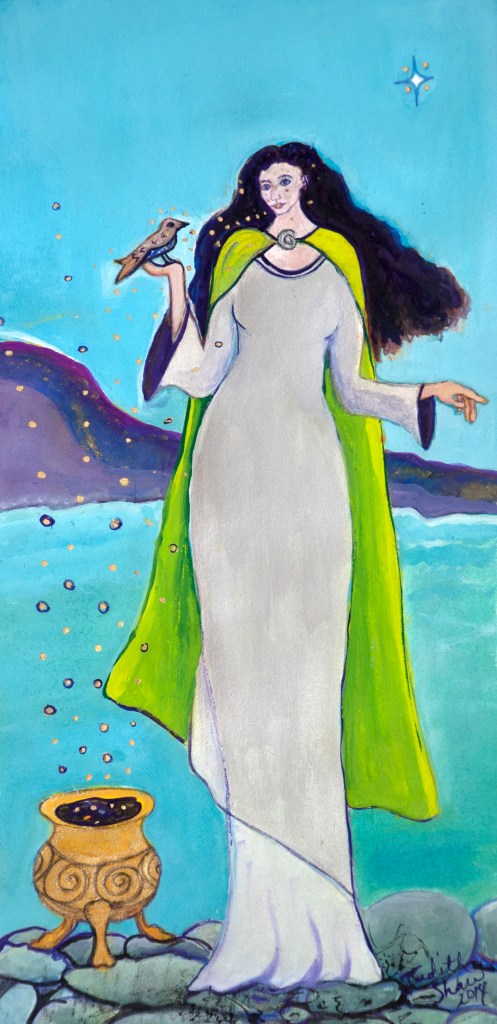
Branwen, Celtic Goddess painting my Judith Shaw

Branwen was the sister of the giant, King Bran of the Isle of the Mighty. She was loved by her people for her gentleness, compassion and beauty. In the tradition of the Old Tribes of the British Isle — most likely a hold-over from the days before kings, when Goddess was supreme — her son would become king upon the death of King Bran.

Continue reading “Celtic Goddess Branwen: A Path to Empathy by Judith Shaw”

A Story About Forgiveness by Sara Wright

Every morning I write a little meditation with attached images that in some way reflects what’s going on in my life. I do this for three reasons. To experience gratitude for something I have learned, to share my thoughts with others and to consciously align myself with LIFE while participating, albeit unwillingly, in a death destroying culture.

As a naturalist my focus is usually on some gift received resulting from my reciprocal relationship with nature. But I wrote this meditation to articulate one of the most important aspects of relating to other humans – perhaps the most important. Forgiveness. And I wrote it after experiencing the freedom and gratitude that followed a powerful act of forgiveness associated with a long-term friendship.

Continue reading “A Story About Forgiveness by Sara Wright”

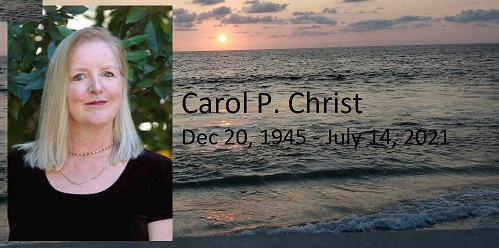
Legacy of Carol P. Christ: FORGIVENESS or TRUTH: WHICH IS THE BEST REMEDY?

This was originally posted on March 5, 2012

What happened to you really was bad. This should not happen to any child. It should not have happened to you.

In our culture there is often a rush to forgiveness that precedes acknowledging the harm that has been done. When I was a child and my father yelled at me or withheld love, I was told by mother, “He really does love you. He just does not know how to show it.” She sometimes added, “Even though he will never say he is sorry, you should forgive your father, because he did not really mean what he said.”

Continue reading “Legacy of Carol P. Christ: FORGIVENESS or TRUTH: WHICH IS THE BEST REMEDY?”

From the Archives: Beyond Clenched Teeth: Reflections on Forgiveness by Elizabeth Cunningham

Moderator’s note: This marvelous FAR site has been running for 10 years and has had more than 3,600 posts in that time. There are so many treasures that have been posted in this decade that they tend to get lost in the archives. We are beginning this column so that we can all revisit some of these gems. Today’s blogpost was originally posted January 19, 2014. You can visit it to see the original comments here.

Elizabeth Cunningham

“I forgive you.”

These words make my teeth buzz like the sound of chalk squeaking on a blackboard. I can vividly recall my sister and myself, as children, saying these words through clenched teeth.  Not only were we Christians, we were the minister’s daughters.  We had no choice. The only other words I hated as much: “I’m sorry,” also forced through clenched teeth.

Oddly enough I cannot recall my older brother being told to ask my forgiveness when he and his friend pummeled me. That fell into the category of: “you egged them on.” My mother did used to say of my brother, mournfully and anxiously: “he doesn’t know his own strength.” Which meant: it isn’t his fault that he hurt you.  But my sister and I were supposed to be nice to each other.

Continue reading “From the Archives: Beyond Clenched Teeth: Reflections on Forgiveness by Elizabeth Cunningham”

Forgiveness is a choice-Part 2 by Vibha Shetiya

It’s been over five years since I wrote the first part of this topic. A lot has happened since then; I have changed for the better or so I would like to believe, but I guess the real question is – have I changed my mind, my perspective on forgiveness? The answer is simple: No.

Why then did I even bother to write this post, you may ask. I guess I have gotten a better, deeper insight into why I continue to feel the way I did five years ago. Of course, even now I hear what philosophers have to say, and can understand, often even agree with, their arguments in favour of forgiveness: that forgiveness is not about setting someone else free; it is about setting yourself free.

But I’m still not ready.

Continue reading “Forgiveness is a choice-Part 2 by Vibha Shetiya”

I’m Getting Triggered by the Impeachment Trial and I Bet I’m Not Alone by Janet Maika’i Rudolph

This process is rattling my bones and aching my heart. How often have we seen angry men (and sometimes women) abusing women, abusing the earth, abusing the vulnerable, abusing immigrants, abusing power? And yet the pattern never seems to end. In many cases, they not only get away with it, it is actually celebrated.  

Some have been called to account – think Bill Cosby. But look how hard it is, how many years, how many accusers it takes for justice to be done. We even have two supreme court justices credibly accused of abuse. 

And look at the National Archives’ recent blunder in their exhibit titled “Rightfully Hers.” It was truly no accident that they put up an image of the 2017 Women’s March and blurred out the protest signs. Oh, the irony to blur out women’s voices in an exhibit named Rightfully Hers. Yes, they apologized. But they had to get caught first. 

We are now watching this grand human play with no promise of denouement or a finale to result in healing. 

We all know what happens when untethered abusers are allowed free reign. Although no future is set in stone, I can no longer listen to people talking about how our abuser-in-chief will inevitably be acquitted in the Senate. 

How do we carry on when human justice is denied as it so often is? 

The man who raped me was never caught. My father, who abused me, died before I really understood what abuse was. I never confronted him, nor did he pay any earthly justice price. My mother, who stood silently by, would never speak to me about it. She went to her grave never giving me details of things I knew had happened before I was of an age to remember. I know at least some of the tale from family stories and the scars left on and in my body. “This big secret” was the elephant in our room when it came to our relationship. We were never close. 

I must learn to live without human justice on this earth. My father was very much like Trump except he never had such a big platform. His response to anyone and anything he didn’t like was to sue. He was loud mouthed and judgmental. He would wake people up in the middle of the night to cater to some whim of his. But wow, if he liked you, he lavished you with his riches. And he was rich at one time. But he had made too many enemies and eventually his lawsuits started turning against him. He died from the effects of alcoholism. He was in debt. Near the end of his life he asked me for a loan. I knew I would never get it back. I figured out the price of my guilt (you know for not loving my father enough) and that’s how much I gave him. It wasn’t much. I was right, I never got it back.  

As I’ve written in this blog space before, it reinforces my belief that we each need to find our own healing path, our own pathway through human suffering. And when we come to moments of calm, we need to share our lessons. We need to spread love anyway we can, and we need to fight like hell for those still who can still get justice here on Earth. Everyone has their story of heartbreak whether it be abuse, illness, unimaginable loss, war, extreme poverty, institutional racism, miscarriages of justice, exploitation or any other number of offenses against a person. How can we face it all? How can we experience it all?

As I write this, it is Martin Luther King Day here in the United States. He was a font of wisdom and an exemplar of social action. One of his quotes resonates particularly deeply with me this year. He said, “I have decided to stick with love. Hate is too great a burden to bear.” Yes it is!

I have learned that letting go of pain and replacing it with love is the nature of forgiveness. It is not to forget but to change our own energy around the suffering. And in return for my forgiveness I don’t have to carry the too enormous burden of my history and my family shame. It is the words of MLK Jr that I want to permit to vibrate my bones and heal my heart, not the ugliness of the politics of the moment. And I think that this has global benefits as well. We are more effective when we fight social battles from a place of personal love and health than when we are vibrating the same suffering. 

Now that we have our abuser-in-chief here in the US at least brought up to face public charges, I would gladly substitute to him what I could never get from my father – for him to face true justice. By all accounts it won’t happen. The loudest shouter seems to win, and he is the loudest of all. 

Rumi wrote a poem called “Joy at Sudden Disappointment”

Someone once asked a great sheikh
what sufism was.

“The feeling of joy
when sudden disappointment comes.”

The eagle carries off Muhammed’s boot
and saves him from snakebite.

Don’t grieve for what doesn’t come.
Some things that don’t happen
keep disasters from happening.

If I may be so presumptuous, I wish he had stopped at his second line. What if that sudden disappointment doesn’t prevent disaster but is at the root of it? Can we still find a place of joy? That is the space where we need to truly heal ourselves and our world. I know I will need to find my own ending to this ugly drama in order to survive it. 

In the meantime, I really do hope that both my mother and father are resting in peace.


Janet Rudolph has written three books on the subject of ancient Biblical Teachings.  One Gods: The Mystic Pagan’s Guide to the Bible, When Eve Was a Goddess: A Shamanic Look at the Bible, and the just recently released book, When Moses Was a Shaman. For more information visit her website at /www.mysticpagan.com/

Sawbonna: Godde and Another Route to Forgiveness by Margot Van Sluytman

From the day my Father, Theodore, was brutally and callously murdered in Toronto, on Easter Monday, March 27, 1978, I wanted to meet his killer. I wanted to know how it was possible to do such a horrific thing. I wanted to know how he felt about destroying the lives of so many; my family’s, and his own.

We did meet. The meeting occurred in July of 2007. Because of reading about an award I received for my Therapeutic Writing Workshops and the publication of my books about healing, voice, and agency, he emailed me. Our meeting, our reconciliation, even those many years after that dark, dark day, was a rich blessing in my life, and proved helpful for him too.

The word forgiveness, is one that can lead to great suffering for victims and offenders alike. Victims are told that if they do not forgive, they cannot heal. Offenders are told that if they are not forgiven, they cannot move on from the crime they have committed. Forgiveness is a loaded word, with as many understandings, expectations, and definitions as there are experiences of savage loss, savage grief, savage pain.

Continue reading “Sawbonna: Godde and Another Route to Forgiveness by Margot Van Sluytman”

Vayigash: Lessons from Joseph’s Behavior by Ivy Helman

29662350_10155723099993089_8391051315166448776_oParshah Vayigash covers Genesis 44:18 to 47:27.  It involves the reunification of Joseph with his brothers and his father, the immigration of Jacob’s entire family to Egypt and Joseph successfully leading Egypt through famine.  In other words, the parshah provides the backdrop for how the Israelites become slaves in Egypt.

Any mention of women is confined to verses 46: 14-26.  They are not active participants, but are remembered as mothers and (a few) daughters and help explain the size and development of Jacob’s family.  It is most striking that they are mentioned at all as the text is heavily preoccupied with sons.  Nonetheless, according to the account, Jacob’s family has 70 members and a seemingly very small number are women and daughters.

Clearly it comes as no surprise that this text is highly influenced by its patriarchal roots and we could dismiss it for that reason.  Nonetheless, it has become a project of mine in this blog over the past few months to find redeeming qualities and food for thought within these texts.  In other words, despite its sexist pitfalls, there are still holy insights and life lessons as my previous blogs attest. Continue reading “Vayigash: Lessons from Joseph’s Behavior by Ivy Helman”

Lessons from Shofetim by Ivy Helman.

29662350_10155723099993089_8391051315166448776_oThis is the first part of a series of reflections on the weekly Torah portions.  For those of you unfamiliar with Judaism, we read the Torah in sections.  There are 52 parshot (or portions), one parshah (portion) is read each week (most often during Shabbat morning services).  It is common for rabbis, prayer leaders or someone of the congregation to offer reflections on the week’s parshah at Shabbat services.

The parshah for this week is Shofetim.  It is Devarim/Deuteronomy 16:18 – 21:9 and will be read this Shabbat, 18 August.  Shofetim discusses a range of topics: setting up of a system of judges to make important decisions for Israel; the entitlements of the Levites; the rules of warfare; the importance of justice and just governments; and the acknowledgment of G-d as the true and highest Judge.  It also warns Israel against false prophets and practices of idolatry.  Shofetim contains a number of well-known verses including ‘justice, justice you shall pursue…(16:18),’ and notorious punishments like “…a tooth for a tooth; an eye for an eye…(19:21)”  Continue reading “Lessons from Shofetim by Ivy Helman.”