

 We are in the season of the Autumn Equinox. The Autumn Equinox occurs on a specific day each year, as does the Spring Equinox. While it may be a precise moment in time, it is also a season. Nothing happens quickly in time and space. Without getting scientific as an explanation of what happens at both, here is a quick one – the name ‘equinox’ comes from the Latin aequus, meaning equal and nox, meaning night. Earth’s two hemispheres are receiving the sun’s rays equally at the equinoxes. This causes night and day to be approximately equal in length. Continue reading “Balance and the Autumn Equinox by Deanne Quarrie”
Tag: goddess
WANGARI MUTA MAATHAI AND SACRED MOUNT KENYA by Carol P. Christ

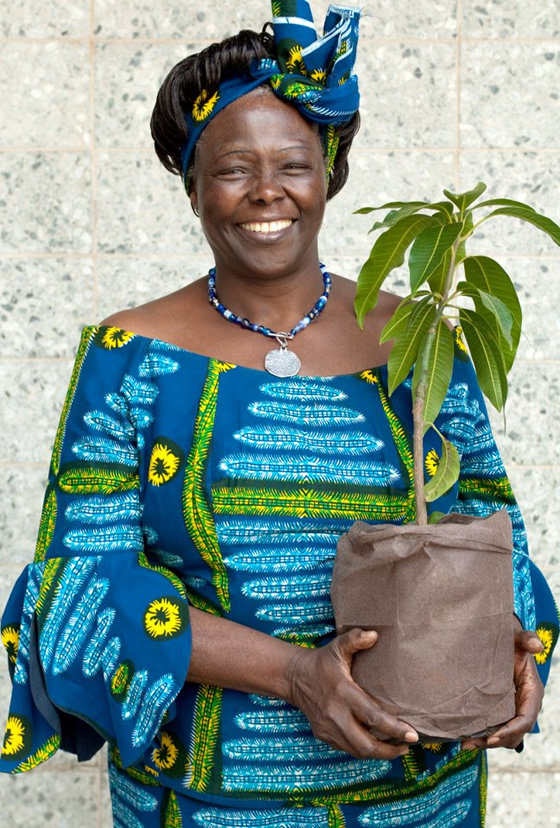 September 25, 2013 is the second anniversary of the death of environmental, peace, justice, and democracy advocate and Nobel Peace Prize recipient Wangari Muta Maathai.
Wangari Muta was born in 1940 in a round hut in rural tribal Kenya. Wangari’s tribe considered the fig tree to be holy, and she was taught that one is never to cut a fig tree down or to use its branches for firewood. Wangari spent many happy childhood hours in the shade of a fig tree that grew by a nearby stream. Fig trees play an important role in the ecological system of the Rift Valley of Kenya. Their roots penetrate the hard rock surface of the mountains to find underground water, thus opening channels where the water flows upward to fill streams and rivers.
As an adult Maathai learned that the fig tree she played under had been cut down by a settler with the result that the river had dried up. This was happening all over Kenya on a massive scale to make room for cash crop plantations. Rivers were silting up and widespread erosion threatened to turn the fertile Rift Valley into a desert. Crops were failing, animals were starving, there was no wood for cooking fires, and rural people were suffering.
Maathai says that as she was thinking about this problem “It just came to me: ‘Why not plant trees?’ … This is how the Green Belt Movement began.” Continue reading “WANGARI MUTA MAATHAI AND SACRED MOUNT KENYA by Carol P. Christ”
A New Glossary for Crete: The Power of Naming and the Study of History by Carol P. Christ
The words we use affect our thinking. In the case of ancient Crete the repetition of the terms “Palace,” “Palace of Knossos,” “King Minos,” “Minoan,” “Priest-King,” and “Prince of the Lilies” shape the way we understand history–even when we ourselves know these terms are incorrect. We must engage in “new naming.”
Ariadne. May have been a name of the Goddess of pre-patriarchal Crete. The ending “ne” signifies that Ariadne is not of Greek or Indo-European origin and thus predates the later Greek myths.
Ariadnian. The name I have given to the Old European pre-patriarchal culture of Crete, from arrival of the Neolithic settlers from Anatolia c.7000 BCE to the Mycenaean invasion c.1450 BCE. Arthur Evans named the Bronze Age (c.3000-1450 BCE) culture of Crete “Minoan” after King Minos of Greek mythology, son of Zeus and Europa, husband of Pasiphae, father of Ariadne, whose gift of the secret of the labyrinth to Theseus led to the downfall of her culture. Evans assumed that Minoan Crete was ruled by a King.
This image I call “Ariadne Dancing” could become the new “icon” of Ariadnian Crete.

It could and should replace the “icon” of the “Priest-King” Arthur Evans’ “imaginatively” reconstructed and named the “Prince of the Lilies.”
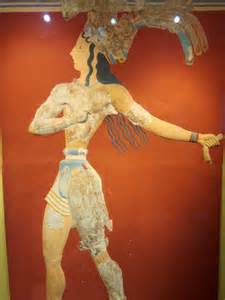
Once we remove the crown which probably belonged to a Sphinx, the figure’s white color and athletic body suggests it was intended to portray a young female bull-leaper leading a bull. Continue reading “A New Glossary for Crete: The Power of Naming and the Study of History by Carol P. Christ”
Earth Connection & Healing the Bees by Jassy Watson

I’m an avid gardener. I must, need, long to have my hands in the soil. The sweet smell and feel of the earth connects me to something greater, to a sense of ‘other’; a source divine. I am interwoven, connected, at one and in reverence of a greater mystery. When I think about my connection to the earth and its origins, I find it is a connection I have had my entire life. As a young girl I spent many hours, days, in fact years, exploring the Australian bush – it was my backyard. Some of my most prominent memories are the smell of Eucalypt and the crescendo of cicada song that would permeate my entire surroundings throughout summer. As a teen, time and time again, I bushwalked our families property that backed onto mountainous National forest. I often sensed the indigenous ancestral spirits of our land watching attentively.
It is this deep connection that I have to the earth that not only leaves me feeling exultant, it leaves me troubled. I am troubled by the continuing problems caused to the environment. I admit to feeling quite disturbed recently when I read a number of reports about the persisting problems with the Fukushima Nuclear plant – radiated water still leaking into the ocean. Birdlife and ocean animals found suffering from radiation burns. Should we even be eating fish from the pacific? I can’t begin to fathom the enormity of the repercussions from this disaster that will be seen for many generations to come. My inner activist wants to be out there on the frontline, riding the waves on the Rainbow Warrior, tied to an ancient tree in protest of lopping; but I know my place is here, nurturing my little ones. So what can I do with these troubled feelings, with the frustration and with the love I have for Mother earth and all her beings? Action starts from home. So I let it fuel my fire and I get creative. I paint, I write, I garden; with intention. My intention is to play a role, no matter how small, that aids in the healing of the planet. I hold hope that it inspires other to do the same. Continue reading “Earth Connection & Healing the Bees by Jassy Watson”
GODDESS WITH US: IS A RELATIONAL GOD POWERFUL ENOUGH? by Carol P. Christ
Last week I wrote about Protestant Neo-Orthodoxy’s deification of male power as power over. This week I want to ask why the relational Goddess or God* of process philosophy has not been more widely embraced, both generally and in feminist theologies.
Could it be that a relational God just isn’t powerful enough? Are some of us still hoping that an omnipotent God can and will intervene in history to set things right? Do we believe an omnipotent God can save us from death?
Process philosophy provides an attractive alternative to the concept of divine power modeled on male power as domination. According to leading process philosopher Charles Hartshorne, the power to coerce, power as power over and domination, is not the kind of power God has.
The concept of divine power as omnipotent (having all the power) leads to what Hartshorne called “the zero fallacy.” If God has all the power and can dominate in all situations, then the power of individuals* other than God is reduced to zero. In effect, this means that individuals other than God do not really exist, but at most are puppets whose strings are pulled by the divine power.
Moreover, as Hartshorne argued, the power to coerce is not the kind of power Goddess “should” have. Although many have been forced to submit to them, tyrants and bullies do not empower others. Should we not understand the “highest power in the universe” as empowering of others?
For process philosophy Goddess is understood to be the most sympathetic or empathetic of all relational beings. Continue reading “GODDESS WITH US: IS A RELATIONAL GOD POWERFUL ENOUGH? by Carol P. Christ”
Values of Respect and Compassion for Others by Deanne Quarrie
We live in an age when there are overall changes in our society in the values of respect and compassion. I no longer see people pulling back chairs or opening doors for others. Actually, I am constantly witness to a general lack of respect everywhere. From vulgar profanity in public places to downright abuse of others – this saddens me. Where I see this lack of respect most of all is within social media. There, people write anything they want – about anyone they want and to anyone they want without consideration of the grievous harm they might cause. Continue reading “Values of Respect and Compassion for Others by Deanne Quarrie”
Aine, Summer Goddess of Love, Light and Fertility by Judith Shaw
 Aine, (pronounced AW-neh), was originally worshipped as a Sun Goddess. Like so many goddesses and gods, Aine has assumed many other roles over the years, being seen as a Moon Goddess, a Goddess of Love, a Fertility Goddess, a Healing Goddess, and a Sovereignty Goddess. Aine is also known as a Faery Queen. She is often called Aine, Goddess of Love, Light, and Fertility. Her name means “brightness, glow, joy, radiance; splendor, glory, fame” and she is associated with the abundance of summer.
Continue reading “Aine, Summer Goddess of Love, Light and Fertility by Judith Shaw”
THE LABRYS: A RIVER OF BIRDS IN MIGRATION by Carol P. Christ
“There’s a river of birds in migration, a nation of women with wings.” —Goddess chant, Libana
On the Goddess Pilgrimage to Crete, I explain that many of the names given to “Minoan” (c. 3000-1450 BCE) Cretan artifacts and architecture are products of patriarchal and Eurocentric imaginations, and as such, are misleading. For example the name “Minoan” was given to the culture of Bronze Age Crete in honor of “King Minos,” who was said to have ruled in Crete a few generations before the Trojan War–several hundred years after the end of the culture to which his name was attached. In fact, despite his eagerness to find evidence that King Minos ruled at Knossos, the excavator Sir Arthur Evans finally had to concede that the best he could do was to produce a fresco of a “Prince of the Lilies” which he identifed as the image of the male ruler of the culture he called “Minoan.” Evans’ Prince had white skin, a fact that Evans conveniently overlooked–because according to his own interpretation of “Minoan” iconography, white skin would mark the figure as female. Mark Cameron, who reviewed Evans’ reconstruction of the fresco, suggested that the Prince is more likely to be a young woman who is perhaps leading a bull to take part in the bull-leaping games. He also stated that the “crown” belonged to another fresco altogether.
Evans’ failure to find evidence of a King or for that matter a Queen at the complex of buildings he called “The Palace of Knossos” calls into question his idea that these structures were palaces. Nanno Marinatos argued that the “palace” was instead a ritual center for the surrounding village, as well as a community gathering place, a place for storing grain, wine, and oil in a sacred way, and a place where ritual objects were fashioned of clay, bronze, stone, and gold. Following her lead, I renamed the “Palaces” “Sacred Centers.” In this blog I will experiment with renaming the “Minoan” culture “Ariadnian,” after the pre-Greek name Ariadne, which may be one of the names of the Goddess of Bronze Age Crete.
One of the most pervasive–and many would say–most enigmatic symbols of the Ariadnian culture is the labrys. Continue reading “THE LABRYS: A RIVER OF BIRDS IN MIGRATION by Carol P. Christ”
Tailtiu, Primal Earth Goddess for this Season by Deanne Quarrie
We are approaching the season of Lughnasadh, also known as Lammas. This is the first of three harvest festivals. This one focuses on what we call the “first fruits”, those fruits, vegetables and grains ripening early in the season. The other two are Mabon and Samhain, one celebrating the harvest of the last crops and the next that of the herd animals sacrificed to feed the tribes. Continue reading “Tailtiu, Primal Earth Goddess for this Season by Deanne Quarrie”
Two Ultimates: The Ground of Being and Goddess by Carol P. Christ
 The concept of two ultimates, the ground of being and Goddess, can be helpful in understanding differences of emphasis within and among religions. Some religions or strands within religions focus on relationship with or worship of a personal God, while other religions or strands within religions focus on identifying with or merging with the impersonal ground of being or the whole of which we are part. These two ultimates are found in feminist spiritualities and theologies.
In “Being Itself and the Existence of God”* process theologian John Cobb identifies two ultimates. The ground of being as the metaphysical principles that structure all of life is unchanging; as the whole of which individuals are part, the ground of being is impersonal. God, on the other hand, is an active presence in the world, is personal, and cares about individuals in the world. If God is understood to be in some sense an individual in relation to other individuals, then God cannot be identified with the whole, because the whole is made up of God and other individuals. Yet God is not simply one individual among other individuals. Only God has perfect knowledge of the world and every individual within it and only God cares for the world in light of perfect knowledge of it.
I find Cobb’s notion of two ultimates helpful in understanding some of the differences in feminist views of Goddess and God. Some spiritual feminists, especially Goddess feminists, view the sacred as the whole of which we are a part, structured by the seasons and cycles of birth, death, and regeneration. Starhawk’s tree of life meditation in which the individual identifying with the tree draws energy from its ground imagines Goddess as the ground of being and life. Z Budapest’s song “We all come from the Goddess, and to Her we shall return” connects us to the cycles of birth and death.
The view of Goddess as a personal presence who loves, understands, and inspires us to love is based on the notion of God as a person with whom individuals are in relation. Jennifer Berizan invokes a Goddess who cares in her song “She Who Hears the Cries of the World,” addressed to the Goddess in the form of Chinese Goddess Kwan Yin. Prayer to Goddess and a sense that She is always with us are based on the idea of a relational, personal God. According to Cobb religions do not have to choose between the two ultimates. If both are real, then religions can and should recognize both. Continue reading “Two Ultimates: The Ground of Being and Goddess by Carol P. Christ”
 Feminism and Religion