Aine, Summer Goddess of Love, Light and Fertility by Judith Shaw

judith Shaw photoAine, (pronounced AW-neh), was originally worshipped as a Sun Goddess. Like so many goddesses and gods, Aine has assumed many other roles over the years, being seen as a Moon Goddess, a Goddess of Love, a Fertility Goddess, a Healing Goddess, and a Sovereignty Goddess. Aine is also known as a Faery Queen. She is often called Aine, Goddess of Love, Light, and Fertility.  Her name means “brightness, glow, joy, radiance; splendor, glory, fame” and she is associated with the abundance of summer.

Continue reading “Aine, Summer Goddess of Love, Light and Fertility by Judith Shaw”

THE LABRYS: A RIVER OF BIRDS IN MIGRATION by Carol P. Christ

carol-christ“There’s a river of birds in migration, a nation of women with wings.” Goddess chant, Libanalabrys seal ring

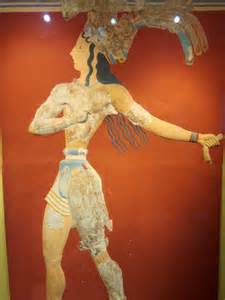
On the Goddess Pilgrimage to Crete, I explain that many of the names given to “Minoan” (c. 3000-1450 BCE) Cretan artifacts and architecture are products of patriarchal and Eurocentric imaginations, and as such, are misleading.  For example the name “Minoan” was given to the culture of Bronze Age Crete in honor of “King Minos,” who was said to have ruled in Crete a few generations before the Trojan War–several hundred years after the end of the culture to which his name was attached.  In fact, despite his eagerness to find evidence that King Minos ruled at Knossos, the excavator Sir Arthur Evans finally had to concede that the best he could do was to produce a fresco of a “Prince of the Lilies” which he identifed as the image of the male ruler of the culture he called “Minoan.”  Evans’ Prince had white skin, a fact that Evans conveniently overlooked–because according to his own interpretation of “Minoan” iconography, white skin would mark the figure as female.  Mark Cameron, who reviewed Evans’ reconstruction of the fresco, suggested that the Prince is more likely to be a young woman who is perhaps leading a bull to take part in the bull-leaping games.  He also stated that the “crown” belonged to another fresco altogether.

Evans’ failure to find evidence of a King or for that matter a Queen at the complex of buildings he called “The Palace of Knossos” calls into question his idea that these structures were palaces.  Nanno Marinatos argued that the “palace” was instead a ritual center for the surrounding village, as well as a community gathering place, a place for storing grain, wine, and oil in a sacred way, and a place where ritual objects were fashioned of clay, bronze, stone, and gold.  Following her lead, I renamed the “Palaces” “Sacred Centers.” In this blog I will experiment with renaming the “Minoan” culture “Ariadnian,” after the pre-Greek name Ariadne, which may be one of the names of the Goddess of Bronze Age Crete.

One of the most pervasive–and many would say–most enigmatic symbols of the Ariadnian culture is the labrys.  Continue reading “THE LABRYS: A RIVER OF BIRDS IN MIGRATION by Carol P. Christ”

Tailtiu, Primal Earth Goddess for this Season by Deanne Quarrie

Deanne QuarrieWe are approaching the season of Lughnasadh, also known as Lammas.  This is the first of three harvest festivals.  This one focuses on what we call the “first fruits”, those fruits, vegetables and grains ripening early in the season. The other two are Mabon and Samhain, one celebrating the harvest of the last crops and the next that of the herd animals sacrificed to feed the tribes. Continue reading “Tailtiu, Primal Earth Goddess for this Season by Deanne Quarrie”

Two Ultimates: The Ground of Being and Goddess by Carol P. Christ

carol p. christ 2002 colorThe concept of two ultimates, the ground of being and Goddess, can be helpful in understanding differences of emphasis within and among religions.  Some religions or strands within religions focus on relationship with or worship of a personal God, while other religions or strands within religions focus on identifying with or merging with the impersonal ground of being or the whole of which we are part.  These two ultimates are found in feminist spiritualities and theologies.

In “Being Itself and the Existence of God”* process theologian John Cobb identifies two ultimates.  The ground of being as the metaphysical principles that structure all of life is unchanging; as the whole of which individuals are part, the ground of being is impersonal.  God, on the other hand, is an active presence in the world, is personal, and cares about individuals in the world.  If God is understood to be in some sense an individual in relation to other individuals, then God cannot be identified with the whole, because the whole is made up of God and other individuals.  Yet God is not simply one individual among other individuals.  Only God has perfect knowledge of the world and every individual within it and only God cares for the world in light of perfect knowledge of it.

I find Cobb’s notion of two ultimates helpful in understanding some of the differences in feminist views of Goddess and God.  Some spiritual feminists, especially Goddess feminists, view the sacred as the whole of which we are a part, structured by the seasons and cycles of birth, death, and regeneration.  Starhawk’s tree of life meditation in which the individual identifying with the tree draws energy from its ground imagines Goddess as the ground of being and life.  Z Budapest’s song “We all come from the Goddess, and to Her we shall return” connects us to the cycles of birth and death.

The view of Goddess as a personal presence who loves, understands, and inspires us to love is based on the notion of God as a person with whom individuals are in relation.  Jennifer Berizan invokes a Goddess who cares in her song “She Who Hears the Cries of the World,” addressed to the Goddess in the form of Chinese Goddess Kwan Yin.  Prayer to Goddess and a sense that She is always with us are based on the idea of a relational, personal God.  According to Cobb religions do not have to choose between the two ultimates. If both are real, then religions can and should recognize both.  Continue reading “Two Ultimates: The Ground of Being and Goddess by Carol P. Christ”

Where Does Poetry Come From? By Barbara Ardinger

Poetry is a gift from our ever-creating goddess, but you know what? She also has a major sense of humor. Nearly every night, I go to bed, pet the cats awhile, and think I’m going to go right to sleep. And what happens? Words happen. Beginnings of blogs. (This one. Last night.) Lines of dialogue or description that will end up in my revisionist fairy tales. First lines of poems. Most nights, I “talk” myself to sleep.

 Because the Goddess is endlessly, continuously creative and her art is our blessed planet, so are all her children creative, and so am I also creative and kinda artsy, too. I learned to embroider when I was about seven years old. I learned to sew, I learned to knit, I learned to crochet. For years I crocheted granny-square afghans, but I ran out of people to give them to about ten years ago. As a child, I sat on my father’s workbench and learned to work a little with wood. I started taking piano lessons the day after my sixth birthday. Although my mother and my brother were artists, I missed out on that talent, but made up for it by taking a right-brain drawing class and doing a magnificent contour drawing of a brussels sprout. I don’t remember when I couldn’t read, and I’m told that I started writing fiction when I saw seven years old and wrote a story for my daddy. Along the way, of course, I’ve also learned a lot of very practical creative skills, of course, like touch typing. Continue reading “Where Does Poetry Come From? By Barbara Ardinger”

Fire, Her Bright Spirit by Deanne Quarrie

Deanne QuarrieIn Celtic Tradition our world is composed of Three Realms, those of Land, Sea, and Sky. In the midst of these Realms we find the Sacred Grove, the place of flowing together. There the Sacred Fire burns, by the Well of Wisdom, beneath the World Tree. Sacred Fire is that which weaves itself throughout the Three Realms.  It connects us and all of life to the Realms as well as to our gods and goddesses.  Fire is Sacred Spirit, Sacred Inspiration, without which life would have no meaning.

Fire is the spark, the flame, the heat of passion.  It is what ignites our creativity, fuels our passion and fires our hearts to love.  It is the Dance of Life, the joy found in movement, sexual energy and the warmth that germinates new life in seeds. It is the warmth of sunlight on our skin and the ecstatic pleasure of orgasm. Continue reading “Fire, Her Bright Spirit by Deanne Quarrie”

Serving Spirit by Wendy Griffin

Wendy Griffin, Cherry Hill Seminary To me, it isn’t the belief that is meaningful, it is the feeling I get in those magical moments when I am connected to spirit.

When I was young, my mother owned a girls’ camp on the shores of a string of small lakes in Northern Wisconsin. From the age of 2 until I was 16, I spent every summer surrounded by silver birch trees and strong women. We lived in Army surplus tents and learned to ride horses and paddle canoes, build campfires and treasure the female spirit. Sunday evenings we would walk two by two singing through the forest down to the lake, where we would sit on pine logs on a little point of land between two shores and listen to the waves lap against sand as my mother read to us from Gilbran and her favorite poets. Those were our “Sunday vespers services.”

So I was raised on a Goddess path, although neither my mother nor I knew it then.

I had no interest in religion, which to me was Big Daddy in the Sky. It never occurred to me that what I felt in the forest had anything to do with religion, and I thought being spiritual meant that one prayed a lot and didn’t have any fun. When I left home at 18 and moved to Greenwich Village, I left the feelings I had those summers, what I know now was the spiritual part of me, behind. The world seemed full of wonderful adventures, and I wanted to have my share. Continue reading “Serving Spirit by Wendy Griffin”

Menstruation for Buddhist Women by Oxana Poberejnaia

oxanaNot all, but many women menstruate. The menstrual cycle is a contentious areas for feminists. Even men who aspire to be a feminist tend to find it difficult to deal with it. Inappropriate jokes ensue, and completely ignoring the issue is also a popular option.

My journey along a feminist path and toward the Sacred Feminine necessarily included working with my menstrual cycle. In this, Women’s Wisdom and the Menstrual Cycles articles  and Womb Blessings by Miranda Gray have been most helpful.

Continue reading “Menstruation for Buddhist Women by Oxana Poberejnaia”

Birth as a Shamanic Experience by Molly

editMollyNov 083Childbirth is a rite of passage so intense physically, psychologically, emotionally, spiritually, that most other events in a woman’s life pale next to it. In our modern lives, there are few remaining rituals of initiation, few events that challenge a person’s mettle down to the very core. Childbirth remains a primary initiatory rite for a woman.” –Maren Hansen (MotherMysteries)

When I was pregnant with my first baby, I read an article with the theme of “Birth as a Shamanic Experience.” I can no longer find the exact article (online or printed), but I distinctly remember my feeling upon reading it: I was entering into a mystery. Giving birth was big. Bigger than anything I’d ever done before and it went beyond the realm of a purely biological process and into something else. Like shamanic experiences, giving birth is often described as involving a sense of connection to the larger forces of the world as well as being in an altered state of consciousness or even a trance state. While shamanic experiences may involve “journeying” to other realms of reality, giving birth requires the most thoroughly embodied rootedness of being that I’ve ever experienced. It, too, is a journey, but it is a journey into one’s own deepest resources and strongest places. The sensation of being in a totally focused, state of trance and on a soul work mission is intense, defining, and pivotal.

Shamanic journeys may be embarked upon for the purpose of soul retrieval and I can’t help but think that this is the purpose of giving birth as well—the birthing woman travels into herself to bring forth the soul of her child.  Continue reading “Birth as a Shamanic Experience by Molly”

The Breath of Goddess by Deanne Quarrie

Deanne Quarrie

I am a child of the Earth.
I live and breathe, walk and dance upon Her face.
She is my source and I learn from Her each day. This I know…

Life begins in the dark as Desire.
Deep in that dark place life begins to form, taking root and becoming…..

As life stirs…… deep in the Mother’s Belly,
there is a gentle quickening, movement
that alerts us to a “knowing”
of the presence of something yet to come.

As the Earth prepares Herself with warmth,
the rains and waters come to flood the land,
nourishing the soil in which She is creating new life.

Earth and Water and Fire
come together and Form continues to take shape.

One last thing is needed.
Just as new form emerges,
She breathes Air upon it.
Her Breath, giving Life to all. Continue reading “The Breath of Goddess by Deanne Quarrie”