Miriam Is For the Girls by Zoe Carlin

The Book of Exodus is a well-known scripture, and it is one that many Jews, Christians, and even people who are non-religious are very familiar with. Growing up, our family continued to tell this story year after year during Passover. It was one of many classic Torah readings shown to us in our temple. So, one of the key figures in this story is Miriam, Moses’ older sister. Most remember that she helped her mother deliver Moses in secret at the Nile River when he was an infant due to the Pharaoh setting an order to kill every Hebrew son because of concerns of the population growing too much (Exodus 11:5-6). She also assisted in leading the Israelites across the Red Sea when Moses opened it up for the Hebrews to cross (Exodus 14:21-22). An article titled “Miriam: Midrash and Aggadah” shares a deeper analysis of the roles that Miriam upheld as a sister, a daughter, and a woman during this time. It has also informed my understanding of Miriam’s story.

Continue reading “Miriam Is For the Girls by Zoe Carlin”
Priestesses of the Shtetl? The Jewish Women Spiritual Leaders of Eastern  Europe by Annabel Gottfried Cohen

‘Four thousand years ago, in the ancient Near East, women were poets, drummers, scholars, dancers, healers, prophets and keepers of sacred space.’ In The Hebrew Priestess (2015), Rabbi Jill Hammer argues that as the Israelite cult became more centralised, leadership roles were restricted to men and women’s spiritual leadership was gradually repressed. Yet, as Hammer and co-author Taya Shere demonstrate, ‘the remnants of the priestesshood remain for those who seek them out.’ Combining a close reading of biblical and rabbinic texts, alongside other contemporary sources and archaeological evidence, Hammer has identified thirteen models or netivot of feminine Jewish leadership, which she argues persisted, albeit in altered and marginalised forms, into the medieval, early modern and even modern periods. My own research supports these conclusions, suggesting that Hammer’s netivot framework provides a useful lens by which to better understand Jewish women’s traditions that, in a patriarchal culture, have often been marginalised.

Continue reading “Priestesses of the Shtetl? The Jewish Women Spiritual Leaders of Eastern  Europe by Annabel Gottfried Cohen”

Legacy of Carol P. Christ: “AS WE BLESS THE SOURCE OF LIFE, SO WE ARE BLESSED”

This was originally post May 7, 2012

Blessing the Source of Life harks back to the time when shrines were built near springs, the very literal sources of life for plants, animals, and humans.

The prayer “As we bless the Source of Life, so we are blessed,” based on a Hebrew metaphor which refers to a water source and set to music in a Jewish feminist context by Faith Rogow, has become one of the bedrocks of my Goddess practice.

In Minoan Crete, seeds were blessed on the altars of the Goddess and the first fruits of every crop were returned to Her. The ancient Minoans piled their altars high with barley, fruits, nuts, and beans, and poured libations of milk and honey, water and wine, over the offerings they placed on altars. Evidence of these actions is found in the large number of pouring vessels stored near altars.

Continue reading “Legacy of Carol P. Christ: “AS WE BLESS THE SOURCE OF LIFE, SO WE ARE BLESSED””

From the Archives: The Three Mothers: Feminine Elements and the Early Kabbalah by Jill Hammer

This was originally posted May 22, 2108

For over ten years, I’ve been teaching a work of early Jewish mysticism known as Sefer Yetzirah, or the Book of Creation.  There are widely differing opinions on the book’s origin and dating, but many scholars date it to the sixth century.  Its core concept can be described simply: the Divine used the Hebrew letters as metaphysical channels to create the different aspects of reality: the directions, the elements, the planets, the months of the year, and so forth.  Each letter is a channel by which God creates a unique form or entity, and meditating on the letters provides us with a connection to divine creative power. In its discussion of the letters, Sefer Yetzirah shows a strong connection to feminine imagery, and thus helps the later kabbalah develop its own link to the feminine.

Continue reading “From the Archives: The Three Mothers: Feminine Elements and the Early Kabbalah by Jill Hammer”

The Daughters of Zelophehad and the Five Feminine Powers of the Kabbalah by Rabbi Jill Hammer

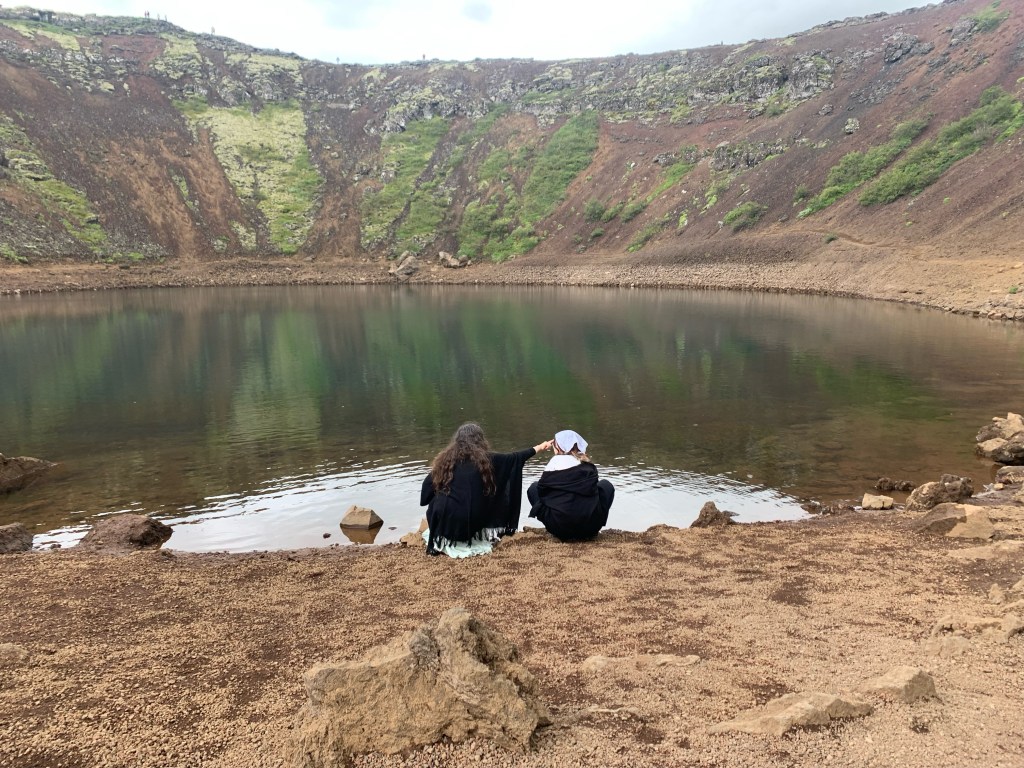
Jill anointing her daughter. photo by Shoshana Jedwab

This summer, I visited Iceland, a beautiful and magical land.  While I was there, I saw the Kerid Crater, which is a caldera: a volcanic crater with a lake inside.  My family and I hiked around the edge of the crater and then down close to the lake.  The perfect roundness of the crater-lake gave the impression of a circular container—a jewel-box shaped by some immense hand— or else a massive eye looking up from the earth.  My daughter and I sat by the lake’s waters and anointed one another, having the sense we were in a sacred place.

Later that summer, I grappled with a story that reminded me of the crater. In Numbers 27, five sisters—the daughters of a man named Tzelafchad—approach Moses with a question.  Their father had daughters, not sons, and it seems this means his family will receive no land allotment in Canaan.  The daughters ask that they be given land allotments: “Let our father’s name not be lost to his clan just because he had no son!” (Numbers 27:4).  Moses takes their complaint to God and brings back an answer: the daughters have spoken rightly, and will receive a land allotment as they request.  However, they must marry men of their own tribe so that the tribal land is not lost— if the women married men of another tribe, their heirs would belong to that other tribe and so the land would change its tribal designation.  Thus, patriarchy is mitigated but not ultimately contradicted—the women become heirs to their father, but primarily for their father’s sake, not their own. 

Continue reading “The Daughters of Zelophehad and the Five Feminine Powers of the Kabbalah by Rabbi Jill Hammer”

Reflections on Miriam’s Cup by Rabbi Jill Hammer


For many years, I’ve had a Miriam’s Cup on my Passover seder table, next to the Cup of Elijah. Our cup of Elijah is a kiddush cup belonging to my great-grandfather Joseph Frankel and inscribed with his name. Our cup of Miriam was created by a ceramic artist and bears the word “Miriam” at its base. The Cup of Elijah, filled with wine, is an old tradition—a cup on the seder table for the prophet Elijah, who according to legend visits every Passover seder. The cup of Miriam, filled with water, is a custom only a few decades old, honoring the prophetess Miriam, who watched over the infant Moses, danced in celebration at the crossing of the Sea, and who according to a famous ancient tale had a well of water that followed her through the wilderness.

According to scholar Annette Boeckler, the custom of the Cup of Miriam began at a Shabbat table in Boston in 1989, made its way to the post-Sabbath Havdalah ceremony, and eventually found its way to the seder table. The custom was intended to honor the prophetess Miriam as well as the contributions of women to the Exodus and to Jewish life. Many of the heroes early in the book of Exodus are women, yet their stories are not part of the seder. The Miriam’s Cup at the seder is a way to give the participants an opportunity to include those stories. Continue reading “Reflections on Miriam’s Cup by Rabbi Jill Hammer”

Judaism or Christianity: Which Tradition Is More Open to Feminist Change? by Carol P. Christ

Jill Hammer’s recent post on midrash surrounding the Biblical figure of Eve (Hava in Hebrew) sparked me to muse again about the fact that, despite its patriarchal roots and overlay, Judaism is a much more flexible tradition than Christianity and, therefore, much more open to feminist change.
Part of this is due to the fact that Judaism is midrashic while Christianity has been and remains a doctrinal tradition. Midrash is a form of Biblical interpretation that includes retelling the story to fill in the blanks and to answer contemporary questions left unanswered in the original text. Jews consider the Torah (the 5 books of Moses) to be the “Word of God” though opinions vary as to what this means. In the rabbinical tradition, the Torah is interpreted through the Talmud which is an extensive collection of discussions and disputes that draw on Biblical texts in relation to contemporary (to the rabbis) questions. Midrash included in the Mishnah (a collection of teachings that preceded the Talmud) and the Talmud are considered part of the “oral Torah.” which is also “the Word of God.”

The Talmud is considered to be authoritative, but it includes conflicting interpretations that were never resolved into a single definitive view. Though different Jewish groups have declared certain views to be normative, other groups have disagreed. There is no central authority (such as a Pope or council) to resolve these disputes. Though some Jewish groups disagree strongly with the beliefs or practices of others, in Judaism as a whole an attitude of “live and let live” leads to inclusion rather than exclusion. Indeed. The Talmud records that in the midst of a particularly vehement dispute between two rabbis, a voice intervened, stating: “These and these are the words of the Living God.” (Quoted by Judith Plaskow in Goddess and God in the World.) Continue reading “Judaism or Christianity: Which Tradition Is More Open to Feminist Change? by Carol P. Christ”

The Holy of Holies and the Umbilical Cord: The Evolution of a Ritual Object by Jill Hammer

In the Jewish calendar, we’re just past the holiday season—the High Holidays, the harvest festival of Sukkot, and the concluding festival of Simchat Torah when the last verses of the Torah are read and the first verses are started again. The Torah readings for these holidays speak often of the offerings once made on the altar in the Tabernacle in celebration of these festivals.  Particularly on Yom Kippur, the readings mention the kodesh kodashim: the holy of holies. This enclosed sacred space contained, according to legend: the tablets of the Commandments inside an ark, topped by two cherubim that held up an empty space between them—an empty space understood to be the amplified presence of an invisible God.  As I think back over my powerful summer, which was largely spent with Jewish priestesses on various retreats and adventures (in Connecticut, Mississippi, California, Costa Rica, England and Scotland), I am thinking about a unique ritual object we use, and realizing that in its own way, it is a kind of Holy of Holies.

Continue reading “The Holy of Holies and the Umbilical Cord: The Evolution of a Ritual Object by Jill Hammer”

The Three Mothers: Feminine Elements and the Early Kabbalah by Jill Hammer

For over ten years, I’ve been teaching a work of early Jewish mysticism known as Sefer Yetzirah, or the Book of Creation.  There are widely differing opinions on the book’s origin and dating, but many scholars date it to the sixth century.  Its core concept can be described simply: the Divine used the Hebrew letters as metaphysical channels to create the different aspects of reality: the directions, the elements, the planets, the months of the year, and so forth.  Each letter is a channel by which God creates a unique form or entity, and meditating on the letters provides us with a connection to divine creative power. In its discussion of the letters, Sefer Yetzirah shows a strong connection to feminine imagery, and thus helps the later kabbalah develop its own link to the feminine.

Sefer Yetzirah shows influences from Aristotle to Gnosticism, and is often viewed as a work of Jewish philosophy.  However, it is also a work of meditation, giving the reader instruction on how to focus and connect to the divine. Scholars such as Richard Hayman and Marla Segol have noted that the book’s structure and content connect it to magical literature: for example, the book has a deep concern with “sealing” the space of the world: letters of the Divine Name are used to seal the six directions of the universe.  In a similar way, ceremonial magicians of the ancient world used sealing ritual, including the incantation bowls that were buried in the corners of a home to keep out evil forces.  The book, like much ceremonial magic of the region, also discusses the elements.  However, Sefer Yetzirah has a three-element system rather than a four or five-element system.  The three formative elements are air, water, and fire.

Continue reading “The Three Mothers: Feminine Elements and the Early Kabbalah by Jill Hammer”

Queen Esther from The Goddess Project: Made in Her Image by Colette Numajiri

Queen Esther
An orphan child,
who became
a well respected queen,
Esther, the Queen of Persia,
was a woman of integrity,
Wisdom and courage,
a beautiful woman, truly supreme,
favored by God,
She had a awareness of dependability,
steady strong, long-suffering faithfulness, with vision foreseen
in courage to stand in times of trouble
with true self esteem,
wise above measure,
Esther, Queen of Persia.
Like many Goddess tales, Esther (from the Old Testament “Book of Esther” or the “Megillah”) took full control of a dangerous situation and against all odds created a miracle, saving the lives of ALL OF HER PEOPLE.
There is a yearly Jewish celebration because of Her called PURIM (today, March 1st this year) where people wear costumes, re-read the Megillah, feast and give gifts of food and money to the needy.

Continue reading “Queen Esther from The Goddess Project: Made in Her Image by Colette Numajiri”