There’s a pinnacle moment, I believe, when everyone’s path is laid before them. The funny thing about that, is that we usually don’t see that moment, until many years later. It is then, at that sudden moment of clarity, in that epiphany, that it all comes together.
My former husband was in the United States Air Force and from 1990-1992, we were stationed at RAF Greenham Common, in the United Kingdom. When we first received our orders, not even ten minutes after, other service members started to inform us: “You’re going to where all those crazy ass bitches are.” “You’re gonna have to deal with those dike peaceniks.” “Wait until you get a load of those nasty, dirty women. They live at the base, camp out there, never shower, stop the convoys – they’re disgusting pigs.” Continue reading “From Military Wife to Peacebuilder – Learning from the Greenham Common Peace Women by Karen Leslie Hernandez”
— for Alex, a nurse I met who is also a poet, and all nurses
I heard that you are a poet
and a nurse. I imagine all the nurses who also
are something else—a chef, a Mom, a painter… a race car driver.
I want to image your life, this poet – and a nurse, in the middle of a pandemic.
I want to appreciate your life—and your stewardship of life and earth and what is in between.
I never knew nurses took an oath.
And I was a friend’s nurse graduation
at Royce Hall at UCLA, where we had both been to school, and when the
graduating class read the oath for nurses,
all throughout the auditorium nurses
stood up and said the oath with them. So, moving. So surprising.
I loved those nurses, nurses rising, and committing to their oath again.
And again, at every graduation they go to, they say the oath.
Bless those nurses, I thought. So grateful for your service. Continue reading “Poem: An Ode for Nurses during a Pandemic by Marie Cartier”
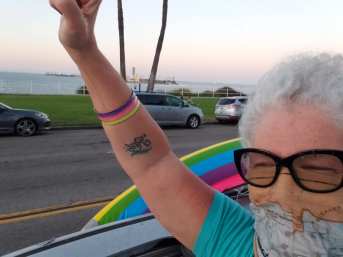
Dyke March Long Beach Drive March 2020!! did the regular route and then drove by elders who requested a drive-by ♡♡♡ two hours all over town ♡♡♡ We had 20 plus cars and a posse of dykes on bikes! 15 miles of driving and spilling our joy into the night sky
Photos from the author’s collection from the historic first driving Dyke March, May 15, 2020, Long Beach, CA.
Photo of the author and her wife by: Margaret Smith
In these United States and across the world we are in quarantine. Lockdown.
Shelter in place. We’re alone together.
And I miss it all: restaurants, coffee shops, movies, hanging out with friends in real time,
But mostly I miss hugs—and I live with my wife and we hug a lot
…but I miss hugs from friends and even sometimes strangers.
I’m a hugger.
I miss handshakes and whispers and rubbing shoulders and close smiles.
Are we embodied beings? Does the body need other bodies?
What is a “crowd of something called” is always my favorite thing to look up:
a pandemonium of parrots, a swarm of eels, a fever of sting rays,
a cauldron of bats, a gaggle of women,
a herd of sea horses, a clutch of vampires, a clowder of cats,
an army of frogs, a crash of rhinos, a business of ferrets,
a passel of possums….
It’s all mythical now, for humans anyway, groups and crowds.
We might as well be mermaids.
And if mermaids were fish, a group of us would be called a school.
If we were human mermaids, we would be a tribe.
And if we were sea mammals, like dolphins, we would be a pod.
I’m missing my pod,
my school, my tribe.
Like whales or manatees, or dolphins—we need a pod.
We are social creatures. We zoom our pod on social media.
And I worry for the elderly in my pod that they do not use this technology that keeps us whizzing
into each other’s homes.
Zooming in– in Brady Bunch boxes.
Here we are! Open your mic!
Toasting the edges of my Brady Bunch box with my glass of wine—Cheers!
Did God mean for us to need each other in bodies? As bodies.
In the same space?
What does it mean that we are here spinning on the planet in embodied forms?
Our experience and our consciousness of being in bodies—
the phenomenology of what it means to be in a body with other bodies.
We are bodies first I think; we are bodies.
Human bodies. A crowd of them, a group… a family, a band, a community,
a nation, a city, a town…a party.
So– I miss hugs, and handshakes and close spaces and smiles and whispers.
I miss sitting tight next to strangers at a sold-out play, a concert, a movie….
I miss crowded events, parades…a club where I am jostling my drink
across the floor to meet my friends.
I miss waiting for a table and making small talk with the other patrons
and chatting up the maître de.
I miss laughing with clerks at the convenience store and talking
to everyone. In person.
And I miss hugging. I’m a hugger.
And I miss, oh I miss
my pod.
–Marie Cartier
April 2020
Photos by the author: from the “sheltering at home” collection
Marie Cartier has a Ph.D. in Religion with an emphasis on Women and Religion from Claremont Graduate University. She is the author of the critically acclaimed book Baby, You Are My Religion: Women, Gay Bars, and Theology Before Stonewall (Routledge 2013). She is a senior lecturer in Gender and Women’s Studies and Queer Studies at California State University Northridge, and in Film Studies at Univ. of CA Irvine.
In these United States we are wondering
if a woman is electable.
Is she likeable enough?
I donate to a woman candidate and I have put a sign
on my front lawn with a woman’s name on it.
I’m a woman. My wife is a woman.
Over half of my students are women. I teach over two hundred
students a semester. I see that women can.
We do and we can. But…
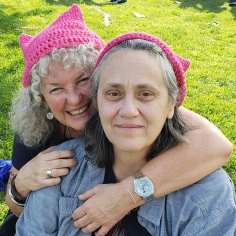
Photo of the author (left) and her wife Kimberly Esslinger
Here we are at the fourth now annual Women’s March. I have done a photo essay of the March every year for Feminism and Religion (FAR), the first two from the Los Angeles March, and the last two from Orange County.
I’m taking a break this month from the series “In These United States” poems I have been delivering to FAR (back with more poems next month) to showcase some of the activism, commitment, humor, and courage that showed up at the March I attended in Santa Ana in Orange County, California, January 18, 2020.
In this part of these United States the marchers chanted, danced, laughed, and were very serious. Santa Ana is a densely populated city where almost 62% of the population is Mexican. This evidenced itself in the March where for the first time I saw ballet folkloric by a company dressed in traditional folkloric costumes, in suffrage colors. Continue reading “2020 Women’s March by Marie Cartier”




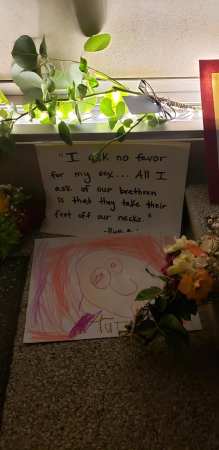
 Content Warning: Child abuse, domestic violence.
  — for Alex, a nurse I met who is also a poet, and all nurses