Goddess Pilgrimage to Crete – Reborn! by Laura Shannon

Thirty years ago, Carol P. Christ founded her Goddess Pilgrimage to Crete, which she wrote about in her book A Serpentine Path: Mysteries of the Goddess (original 1995 title Odyssey with the Goddess) and in numerous posts on this site over the years. She led over 40 groups of women Pilgrims to encounter the history and sacred sites of the peaceful, egalitarian civilisation of Bronze Age Crete. 

Here, the Goddess-honouring culture of Old Europe survived the longest, when patriarchal Indo-Europeans were taking over in the ‘Kurgan waves’ Marija Gimbutas has described. The sophisticated artworks of ‘Minoan’ Crete show women in positions of honour and authority, and do not depict violence, slavery, or war. People celebrated at ceremonial centres, made offerings at cave and mountain shrines, and worshipped the Goddess in sacred trees and stones.

Snake Goddess, Knossos, Crete, ca. 1600 BCE [photo: Heraklion Archaeological Museum]

As many readers know, before Carol passed away, she asked me to take on the leadership of her Goddess Pilgrimage, and to serve as her literary executor and the director of her Ariadne Institute for the Study of Myth and Ritual. Deeply moved by her trust in me, and guided by very clear dreams I received around the time of her death, I accepted Carol’s request. In October 2022, after a three-year delay due to the pandemic, the Goddess Pilgrimage to Crete was reborn. 

Continue reading “Goddess Pilgrimage to Crete – Reborn! by Laura Shannon”
A Celtic Pilgrimage: Becoming a Bard by Trelawney Grenfell-Muir

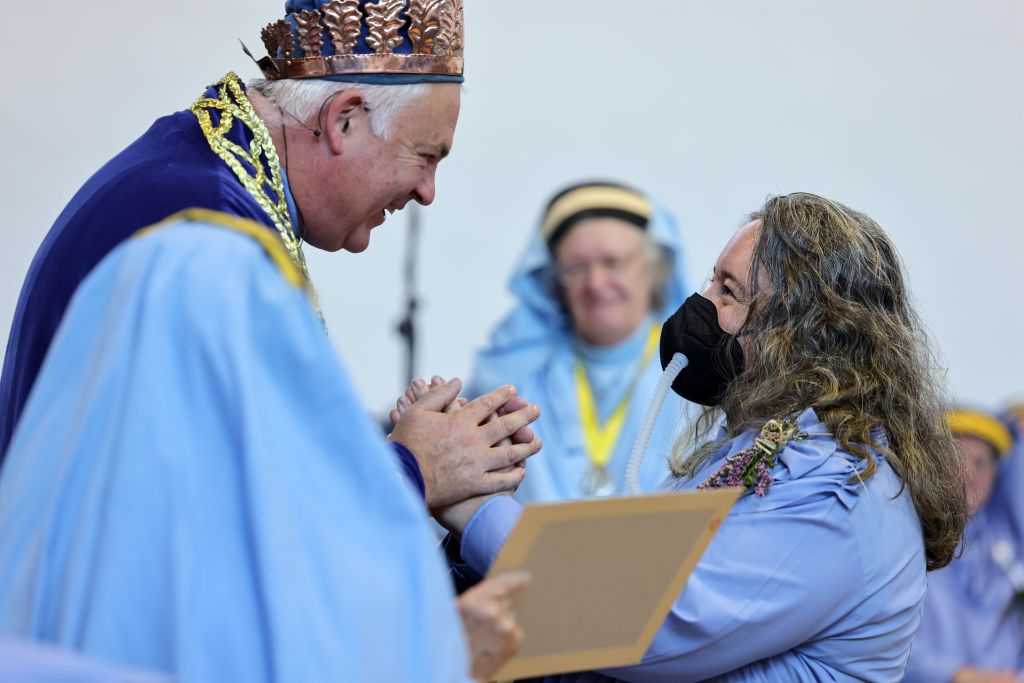
Trelawney at the moment of initiation. (Photo credit Greg Martin/Cornwall Live)

As I gazed up at Grand Bard Mab Stenak Veur, I could feel my eyes shining with joy, my gratitude, awe, love, and reverence for Kernow thrumming through me like the crescendo of a bright, glorious song. My whole world focused in that moment to the feel of his hands clasping mine — as though all Kernow were embracing me and holding me; the sight of his kind eyes and gentle smile— as though Kernow were lighting beacons to greet my homecoming; the sound of his voice proclaiming my new name, “Bleydh Ow Resek,”— as though Kernow herself were naming me to be her own child, come home at long last to my mother, who longs for me even as deeply and powerfully as I have always longed for her.

While I started learning Kernewek only four years ago, my journey to Bardhood started much earlier. I believe it began at birth, when my parents gave me the Christian name Trelawney, after the revered Cornish rebel leader who stood up against English oppression. Though no one in New England had heard of Kernow (Cornwall), my family’s joyful pride in our Cornish identity shaped my life. We were taught how my grandfather Jack left Kernow as a child because his parents responded to the call for more Methodist pastors to come to the United States.

Continue reading “A Celtic Pilgrimage: Becoming a Bard by Trelawney Grenfell-Muir”

Remembering Carol P. Christ: Online Memorial Gathering, December 20, 2021

Dear FAR community,

It’s been wonderful to read so many posts remembering Carol Christ. The FAR community was so important to Carol: as has been pointed out, she not only offered her own posts each Monday, she also read and responded to every post, every day. Through the FAR ‘family’ I feel comforted by connecting with others who knew and loved her and miss her as as I do.

Online Memorial Gathering On December 20, Carol’s birthday, all friends of Carol and friends of FAR are warmly invited to an online Memorial Gathering and ritual in Carol’s honour. Many of Carol’s friends will share cherished memories (please email me if you would like to say a few words) and I will show some photographs from her personal archive. (If you have photos of Carol you would like to share, please email them to me at laura@laurashannon.net.) We’ll also talk about the future of Carol’s Goddess Pilgrimage in Crete. Please register with your email address at this link.

Continue reading “Remembering Carol P. Christ: Online Memorial Gathering, December 20, 2021”

Me and Brother Francesco by Rachel Hollander

At the age of nine, I was taken to see the film Brother Sun, Sister Moon. It is a gorgeous film about the early life – and spiritual revelation – of Saint Francis of Assisi, or as I like to call him: Brother Francesco. As the final credits rolled, that first time seeing it, I couldn’t stop the tears from flowing. My Mom asked me what was wrong, and all I could say was, “I want to go be with him, I belong with him.” Her response was predictable: 1. I was Jewish. 2. He was dead. 3. I was a girl!

From that moment, though, I knew that in some past life I must have walked with Brother Francesco. I felt such a powerful kinship with him, with his connection to Spirit, with his rejection of “traditional religion” (and all its limitations and rules and exclusionary practices), and with his sense of Oneness with all beings, human and animal. He was always much more to me than “the patron saint of animals.” He heard a clear message from God/Spirit and listened to it, without question. And this listening brought him peace and purpose.  Continue reading “Me and Brother Francesco by Rachel Hollander”

The Modern Problematic Nature of the Sabarimala Temple, Part 2 by Anjeanette LeBoeuf

AnjeanetteThe Sabarimala Temple has received an influx of global attention since last October. In my last FAR post, I researched the origin story of the Sabarimala Temple and its dedicated deity, Ayyappan. Ayyappan’s unusual parentage and chosen attributes and patronage made him adverse to all forms of sexual activity and more importantly, not very keen in having female devotees.

Ayyappan, also known as Dharmasastha, is devoted to protecting the dharma, living a yogic life, and more importantly, a celibate life. Ayyappan demands that all his followers when undertaking his pilgrimage, take a vow of celibacy for the duration. No form of sexual impurity must enter Ayyappan’s Sabarimala temple. This is where the problematic elements really start to come to head. Due to the restriction of sexual impurities, females from the age of 10-50 are denied access, as their very biological state of being female, makes them sexually impure. Their ability to menstruate makes them vessels of this apparent sexual impurity that the god Ayyappan does not want. Continue reading “The Modern Problematic Nature of the Sabarimala Temple, Part 2 by Anjeanette LeBoeuf”

Part One: The God Ayyappan and The Sabarimala Temple by Anjeanette LeBoeuf

AnjeanetteThe Sabarimala Temple in Kerala, India has been recently thrown into the news. It has made world news due to the two centuries long tradition of denying females from the age of 10-50 entrance into the Temple. As of September 2018, the Indian Supreme Court ruled in favor of allowing women entrance into the Temple. Needless to say, this ruling was met by both large numbers of supporters and protestors.  But what makes the Sabarimala Temple so controversial?

Continue reading “Part One: The God Ayyappan and The Sabarimala Temple by Anjeanette LeBoeuf”

Goddess Pilgrimage: A Sacred Journey for Women by Carol P. Christ

A pilgrim leaves home and sets off on a journey, seeking healing, revelation, and direction in her life. She finds companions along the way whose stories reflect her own, validating her quest and shedding light on her journey. According to anthropologists Victor Turner and Edith Turner, pilgrimages have common structural elements. A pilgrim separates from family and friends, work and obligations. She steps across a threshold into “liminal space” in which daily routines are suspended, opening herself to discovering new ways of being and living.
For spiritual pilgrims, the goal is a place or places said by others to be a “sacred” because healing or revelation have occurred there through the intervention of a deity, a saint, or spirits. The place is often on a mountain, in a cave, or near a spring. Along the way, pilgrims meet and share stories as in the Canterbury Tales. Some pilgrims say that the experience of sharing community with other seekers is as important as the revelation gained at the destination. When the pilgrim returns home, she must re-integrate into the community she left behind or find a new one. Continue reading “Goddess Pilgrimage: A Sacred Journey for Women by Carol P. Christ”

Home: A New Pesach Reflection by Ivy Helman

In ancient times, Pesach was one of three pilgrimage holidays, the others being Sukkot and Shavuot.  According to the the Torah, Israelite men were required to travel to Jerusalem to bring offerings to the temple. Supposedly, this reconnected these Israelites to their religion, to each other and to the deity.  Participating in these pilgrimages brought about a deeper sense of community. In short, three times a year, Jerusalem became a home away from home.

What an interesting and quite awful definition of home: a male-only community focused on slaughtering animals to atone for sins.  Did ancient Israelites think that this religious obligation actually created a better home than where they lived most of the year? Or, was it just a religious obligation?  Did anyone bemoan the massacre of the animals?  In a related fashion, was Pesach alienating for women and children? Did the ancient Israelite home become less important during these festivals? Did women and children feel left out of their own religious traditions if they didn’t live in Jerusalem?  What did they do for Pesach?  Continue reading “Home: A New Pesach Reflection by Ivy Helman”

Sacred Water by Molly Remer

“Drinking the water, I thought how earth and sky are generous with their gifts and how good it is to receive them. Most of us are taught, somehow, about giving and accepting human gifts, but not about opening ourselves and our bodies to welcome the sun, the land, the visions of sky and dreaming, not about standing in the rain ecstatic with what is offered.”

–Linda Hogan in Sisters of the Earth

The women have gathered in a large open living room, under high ceilings and banisters draped with goddess tapestries, their faces are turned towards me, waiting expectantly. We are here for our first overnight Red Tent Retreat, our women’s circle’s second only overnight ceremony in ten years. We are preparing to go on a pilgrimage. I tell them a synopsis version of Inanna’s descent into the underworld, her passage through seven gates and the requirement that at each gate she lie down something of herself, to give up or sacrifice something she holds dear, until she arrives naked and shaking in the depths of the underworld, with nothing left to offer, but her life.
In our own lives, I explain, we face Innana’s descents of our own. They may be as difficult as the death of an adult child, the loss of a baby, the diagnosis of significant illness, or a destroyed relationship. They may be as beautiful and yet soul-wrenchingly difficult as journeying through childbirth and walking through the underworld of postpartum with our newborns. They may be as seemingly every day as returning to school after a long absence. There is value in seeing our lives through this mythopoetic lens. When we story our realities, we find a connection to the experiences and courage of others, we find a pattern of our own lives, and we find a strength of purpose to go on. Continue reading “Sacred Water by Molly Remer”

Our Ladies of Sea, Earth, and Sky by Joyce Zonana

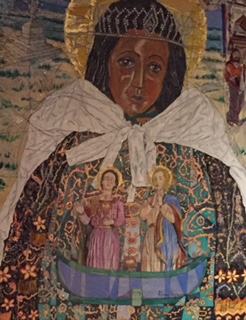
Sara and the Marys
Sainte Sara encompassing Sainte Marie-Salome and Sainte Marie-Jacobe

O Sainte Marie-Jacobe, priez pour nous.

O Sainte Marie-Salome, priez pour nous.

O gardeures de la Provence, priez pour nous.

The priest intoned the words in deep, liquid accents, his voice echoing from the ancient stone church in the remote village of Les Saintes-Maries-de-la-Mer, in the Camargue region of Southern France, where the waters of the Rhone River meet the Mediterranean Sea in a wild, wide, flat expanse populated by black bulls, pink flamingos, and white horses.

“O, Saint Mary-Jacobe, pray for us.”
“O, Saint Mary-Salome, pray for us.”
“O, guardians of the gates of Provence, pray for us.”

I could feel the words resonating through me, bringing sudden, hot tears. The people gathered in the small village square repeated the priest’s chant, their voices rising above the low, white-washed houses into the sunlit sky, out towards the shimmering sea where legend tells us the two Marys had drifted two thousand years ago in a boat without rudder or sail.

Continue reading “Our Ladies of Sea, Earth, and Sky by Joyce Zonana”