What I Believe (Post-2016) by John Erickson

Ever since the election of You-Know-Who, I have been doing a lot of creative writing.

Ever since the election of You-Know-Who, I have been doing a lot of creative writing. Unlike academic publications, policy reports, or my dissertation, creative writing, much like my mentor Dr. Marie Cartier has written about, provided me with a needed escape from a world that seems to grow darker with each passing day.  In college, I served as Poetry Editor for the Wisconsin Review, the oldest literary journal in Wisconsin. Continue reading “What I Believe (Post-2016) by John Erickson”

Memory Beneath the Coptic Roof by Nazia Islam

Memory Beneath the Coptic Roof

The past two years,
I’ve been trying to channel
the spirits my of ancestors.

Connecting them
to hymns of history and litanies of theory.
Searching for rootedness.

But I didn’t find a sense of rootedness
until they reminded me that
roots are more than remembering. Continue reading “Memory Beneath the Coptic Roof by Nazia Islam”

Moonlight Reflections by Elise M. Edwards

As I post this, May 10, a full moon, known as the “Bright Moon” or “Flower Moon” is in the sky. This full moon occurs during a season of transition when living thing things renew and bloom. For those of us in the Northern Hemisphere, it’s spring, but another transition is already underway. For many of us, spring is nearing close to summer in temperatures; in plant, animal, and insect life; and in our schedules. I am concluding a long, demanding spring semester and yearning for summer. Even though I welcome the transition, I know that like all change, it holds both opportunity and challenge. The full moon prompts me to look at the upcoming summer with clear, examining eyes

elise-edwardsAs I post this, May 10, a full moon, known as the “Bright Moon” or “Flower Moon” is in the sky.  This full moon occurs during a season of transition when living thing things renew and bloom.  For those of us in the Northern Hemisphere, it’s spring, but another transition is already underway.  For many of us, spring is nearing close to summer in temperatures; in plant, animal, and insect life; and in our schedules.  I am concluding a long, demanding spring semester and yearning for summer.  Even though I welcome the transition, I know that like all change, it holds both opportunity and challenge.  The full moon prompts me to look at the upcoming summer with clear, examining eyes.

It’s strange–perhaps downright heretical–for a Christian to talk about the power of the moon. Continue reading “Moonlight Reflections by Elise M. Edwards”

The Nature of Communal Pondering by Elise M. Edwards

elise-edwardsLast week, I listened to an episode of Krista Tippett’s series On Being that featured an interview with poet Marilyn Nelson.  I am not very knowledgeable about the world of modern poetry, but I am familiar with Nelson’s work.  A couple years ago, I wrote about Fortune’s Bones: The Manumission Requiem, Nelson’s poetic composition about Fortune, an enslaved man whose owner rendered his body into a skeleton for medical training.  Fortune’s identity and history had been erased across centuries as his remains were displayed.  Community concerns eventually led to a multi-disciplinary academic, artistic, and community effort to honor the man and, in 2013, put his bones to rest.  Isaye M. Barnwell, a musician formerly of Sweet Honey in the Rock, developed a cantata and choral work for Fortune’s Bones. These developed into a series of artistic performances and community events that demonstrate the power of art to speak through and for those who are marginalized—even in death.  Disparate communities joined together to ponder Fortune’s life, and it was powerful.

In the On Being interview, Nelson spoke about “communal pondering,” and I’ve been repeating this phrase to myself since then.  It identifies a form of creative activity and a spiritual way of being that I am deeply committed to, and have not been able to name.  Communal pondering occurs when a group of people are listening together and are opening up new paths for discourse and action by the engaged reflection that takes place within that listening.

Continue reading “The Nature of Communal Pondering by Elise M. Edwards”

Plato’s Diotima as a Symptom of Psychosis by Stuart Dean

Stuart WordPress photoAs I mentioned in my January 30, 2016 post, Grace Jantzen in Foundations of Violence makes a compelling case that Diotima is a fictional figure.  She does not, however, adequately distinguish her from the poetizing female figures Parmenides and Boethius portray as instructing them in their respective works.  If nothing else, the quality of the poetry of Parmenides and Boethius betrays the influence of a very real woman: Sappho.

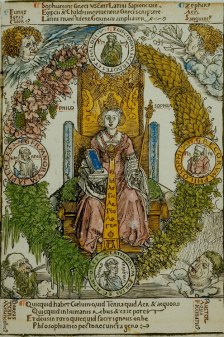
By contrast, Plato essentially portrays Diotima as the personification of his philosophy–his metaphysics–and it is hard to believe there was such an ancient Greek woman.  Although the term ‘metaphysics’ derives from a neologism coined in Greek centuries after Plato and Aristotle lived, its meaning (‘beyond’ (meta) the ‘natural,’ or ‘embodied’ world (physics)) appropriately characterizes what Diotima and hence Plato’s philosophy is all about.  A key passage is where she characterizes the most intense love as “gazing at and being with” the beloved, without even the need to “eat or drink.”  That leads her to ask rhetorically whether it would not be best to gaze at what is not “infected” by flesh and blood (Symposium (211 d-e)).

Philosophy, Albrecht Dürer (1502)(Die Bayerische Staatsbiliothek)

Continue reading “Plato’s Diotima as a Symptom of Psychosis by Stuart Dean”

Celebrating National Poetry Month by Elizabeth Cunningham

Elizabeth Cunningham headshot jpegOne of my morning practices is Lectio Divina, divine reading. Instead of reading scriptures, I read poems. The practice calls on me to be alert and contemplative. Recently, I have been reading The Shambhala Anthology of Women’s Spiritual Poetry, an extraordinarily diverse selection of poems from 2300 BCE to the late 20th century. I won’t be quoting from the collection, but I do recommend it to FAR readers as a sample of our literary, religious and feminist legacy.

Writing has always been one of the more accessible forms of expression for women. You don’t need expensive paints or canvas, clay or stone. To complete your work, you don’t need access to a theatre or an orchestra. Just a scrap of paper, a writing implement, a stolen moment, and, yes, the opportunity to be literate, not easily come by in many times and places for women or men. If you are literate, the act of writing itself does not require even Virginia Woolf’s much-to-be-desired room of one’s own. Jane Austen is said to have written at the dining room table surrounded by the chaos of family life. Continue reading “Celebrating National Poetry Month by Elizabeth Cunningham”

Ghosts by Lauren Raine

Florence's Hands by Lauren Raine
Florence’s Hands by Lauren Raine


GHOSTS

Where do the dead go?

The dead that are not corpses, cosmetically renewed

and boxed, their faces familiar and serene.

Or brought to an essence, pale ashes in elegant canisters.


I ask for the other dead

those ghosts that wander unshriven among our sleep,

haunting the borderlands of our lives.


Continue reading “Ghosts by Lauren Raine”

A Cornucopia Sometimes Curiously Stuffed With Nothing by Natalie Weaver

Natalie Weaver editedThe summer is getting late. School supplies are coming in, and it is time to try on the uniform pants in order to get them hemmed before the first day. I always feel a little funny at this time of year, almost queasy from my mixture of nostalgia for waning days at the pool and excitement for crisp plaids and fresh notebooks. I continually miss the scents of summer skin, chlorine and suntan lotion, even while I look forward to the autumnal fragrances of newly sharpened pencils, cinnamon sticks, and rubbery Halloween costumes. Time, at this transitional time, is always pregnant with the promises of both bounty and loss, so I am not surprised by my wistfulness as we turn to fall. I am, however, taken by its depth for me this year. For, this transition has been a little heavier than usual as I ask myself, “Where did it go?” and “What did I do?”

You see, I wanted to travel more with the kids, but I became sick, or rather, a sickness I already had presented itself unmistakably and irrevocably just as the summer was getting under way. So, I slept a lot, but it was not the sleep of rest and recovery; it was lost time. I felt bad about my crankiness and limitations, so I tried to make up the time by adding more play to the times of day when I felt good. The kids weren’t playing along though, and I just felt more exhausted. I was a broken record, as I kept asking what anyone wanted to do. And, I felt like I was failing when we couldn’t arrive at activities, or menus, or destinations. Continue reading “A Cornucopia Sometimes Curiously Stuffed With Nothing by Natalie Weaver”

Black and White Ball: A Poem to Honor Poodle Friends by Alla Bozarth

After Eucharist, the Sea of Galilee - alla
At the sea of Galilee


The following poem is in honor of Hank, the Rev. LouAnn and her wonderful husband Jim Pickering’s new puppy, a gorgeous black standard poodle, and his older brothers who are or were gorgeous and white.

All of them are or have been LouAnn’s pastoral assistants. I like to say they are the curates of her church of St. Gabriel the Archangel, because as therapy dogs whatever might be painful or lonesome in a person’s soul, the pups, at least for their visits, can cure it.


~~~~~~~~~~~~~~~~~~~~~~~~~~~~~~~~~~~~~~~~~~~~~

Black and White Ball

Give your dogs a black and white ball and tell them,
just to say it out loud, what it means.

Black is the color of mysterious things,
of the powerful regeneration and renewal
of Night in which Stars are born,
the universe delivering Beauty.

On Earth’s palette of color, black is all
the colors there are, blended variously
to the depth of Absolute Beauty. Continue reading “Black and White Ball: A Poem to Honor Poodle Friends by Alla Bozarth”

Sappho, Frankincense, and Female Spirituality by Stuart Dean

Frankincense

White Howjary Frankincense (photo: Trygve Harris (www.enfleurage.com))

Sappho is the first Greek author to attest to the usage of frankincense.  The word she uses to refer to it (libanos) is what comparative linguists call a ‘loan word,’ in this case from ancient South Arabic (the root meaning of which is ‘white’), the language spoken in the only region in the world still now, as then, where the trees grow that produce the resin that is frankincense (the finest being White Howjary from near Salalah Oman).

This was long before Amazon Same-Day Prime: that frankincense even made it to where Sappho was is astonishing given the thousands of miles of desert terrain that had to be covered.  That fact plus the fact that Sappho chose to use the Arabic word for frankincense suggests it must have been of special importance to her.  How important can be seen in the power she attributes to it.  In one prayer poem (S.2, composite translation and very brief notes here) she completes a stanza by referring to frankincense burning from Aphrodite’s altars; she completes the very next stanza with a reference to ‘sleep falling.’  The parallelism implies a reciprocity: the smoke goes up, the sleep comes down and a stanza later, there is Aphrodite. Continue reading “Sappho, Frankincense, and Female Spirituality by Stuart Dean”