Biblical Poetry, Continued by Janet Maika’i Rudolph

This is the 4th in a series of work I have been doing to translate passages of the bible into poetry that strips out the patriarchal overlays. You can read the previous ones here: Part 1, Part 2, and Part 3.

In this installment I have picked out some passages I really like but that I feel their power and beauty have been deeply hidden. I seek to reveal those hidden wisdoms.

To review; my usage of the 2 main names of divinity:

YHVH or LORD, I translate as Vibration.Being

EL or god, I translate as All-Potential Powers.

I discuss my reasons for these translations in my prior posts referenced above.

Genesis 3:6

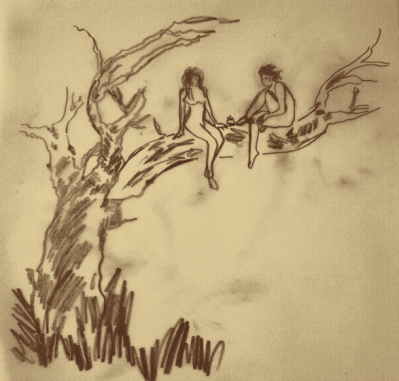
And when the woman saw that the tree was good for food,
 and that it was pleasant to the eyes,
and a tree to be desired to make one wise,
she took of the fruit thereof, and did eat,
and gave also unto her husband with her; and he did eat.
KJV (King James Version)

and the woman saw that the function of the tree
is for nourishment and that he is yearning to the eyes
and the tree was a craving to make calculations
and she took from his produce and she ate
and she gave also to the man with her and he ate
Benner Mechanical Translation[i]

When the woman saw the tree, she recognized herself
She recognized and remembered beauty and wisdom
She took its seeds within her in knowing wholeness
She gifted its seeds to her husband in knowing wholeness
MPV (Mystic Pagan Version – my own translations)

Note for Genesis 3:6 – the word for “food” in the KJV version of this passage is “maakal” (Strong’s 3978). The word used for to eat is “akal” (Strong’s 398). Both are built on the root word “kl” which means complete or whole and traditionally refers to how food or nourishment makes us whole.[ii] I would add that in the context of spirit, it is that essence or element that we fill ourselves with to achieve a sense of wholeness.  

Genesis 49:25

Even by the God of thy father,
who shall help thee;
and by the Almighty, who shall bless thee with blessings of heaven above,
blessings of the deep that lieth under,
blessings of the breasts, and of the womb:
KJV

from the mighty one of your father,
he will help you,
and with Shaddai [my breasts] he will respect you,
presents of the sky from upon
the presents of the deep sea stretching our underneath
presents of the breasts and bowels.
Benner

The All-Potential Powers of your ancestors
Who watches compassionately over you
With nourishment from the dripping milk of the cosmos
And blessings from the misty cauldrons of the goddess Tiamat
Blessings of the breast, and the loving womb
MPV

Notes on Genesis 49:25: this passage had to have been a very old pre-biblical blessing. We don’t often see blessings that are clearly given by female divinity figures, or in this case, a divinity that has breasts and womb. Even in the conservative, male-centric King James Version the blessing is of the breast and the womb. The word for breasts is “shad.” To take this theme a step further, the phrase El Shaddai or Shaddai appears 48 times in the Bible. In English, El Shaddai is usually translated as “God Almighty” and Shaddai as “Almighty.” Sometimes they are translated as “God, the One of the Mountain.”[iii] Both are almost always referred to in scholarly discussions with the pronoun “he.” 

I have put the following two passages together because they speak to the same theme. One is a Psalm and the other a Proverb. I really like them because they both speak to the condition of our hearts. As some of you know I am an alaka’i of Aloha International. That is a spiritual guide of Huna or Hawaiian Adventure Shamanism. I love the lessons of Huna which foremost and foundationally remind us to keep a loving and open heart. Aloha not only means hello and good-bye, it means “the breath [ha] we all share,” and it means LOVE. Picture this, the Hawaiian people greet and part from each other which a statement of connection and love. The first principle of Huna is “the world is what you think it is.” The lesson behind this is that what is in our hearts will shape our experiences and ultimately our world. I believe that this is the lesson behind these biblical passages. (I have also included the New International Version for Proverb 4:23 because I think it is particularly beautiful.)

Psalm 37:4

Delight thyself also in the LORD;
and he shall give thee the desires of thine heart.
KJV

Cherish thyself in harmony with Vibration.Being
And gifts will be returned as per the radiance of thy heart.
MPV 

Proverbs 4:23

Keep your heart with all diligence,
For out of it spring the issues of life. 
KJV

Above all else, guard your heart,
For everything you do flows from it.
 (New International Version)

Treasure your heart in lovingkindness,
For it is the wellspring of your life.

MPV 


[i] https://www.ancient-hebrew.org

[ii] Benner, Lexicon; 146-147.

[iii] The Jewish Study Bible; 37.

Bio

Janet Maika’i Rudolph. “IT’S ALL ABOUT THE QUEST.” I have walked the spirit path for over 25 years traveling to sacred sites around the world including Israel to do an Ulpan (Hebrew language studies while working on a Kibbutz), Eleusis and Delphi in Greece, Avebury and Glastonbury in England, Brodgar in Scotland, Machu Picchu in Peru, Teotihuacan in Mexico, and Giza in Egypt. Within these travels, I have participated in numerous shamanic rites and rituals, attended a mystery school based on the ancient Greek model, and studied with shamans around the world. I am twice initiated. The first as a shaman practitioner of a pathway known as Divine Humanity. The second ordination in 2016 was as an Alaka’i (a Hawaiian spiritual guide with Aloha International). I have written three books: When Moses Was a ShamanWhen Eve Was a Goddess, (now available in Spanish, Cuando Eva era una Diosa), and One Gods. In Ardor and Adventure, Janet.now available in Spanish. Cuando Eva era una Diosa

C.G. Jung and the Heroine’s Journey by Sally Abbott


I was intrigued by the discussions of Jung and Jungian motifs, such as the sacred marriage, that sprang up in response to Mary Sharratt’s wonderful post “The Via Feminina:  Revisioning the Heroine’s Journey,” partly based on Maureen Murdock’s book. Carol Christ pointed out the problematical nature of the whole notion of the sacred marriage, relying as it does on our stereotypes of the masculine and feminine.

Sara Wright reported that her sense of the dangers of Jungian thought led her to change her profession; she had once been a Jungian analyst. Barbara McHugh put forward a well-thought out and articulate version of the Heroine’s Journey, corrected for sexist thought.

Continue reading “C.G. Jung and the Heroine’s Journey by Sally Abbott”

Fragments of Beauty by Natalie Weaver


Can I empathize with your feeling,
your interest in this?
Be sound, my heart that feels
the beat of yours as my own.
I would like to be human one day.

Let my prayer be not please,
for, I fear I have been
an ungrateful guest,
sojourning pilgrim, refugee.
All this life, all will be,
a lesson in how to say
thank you.

These sides are not sharp antagonisms
that bring to points their points of view
but a pond’s surface under moonlight,
swirling like mercury, beneath which minnows,
fluid, do their works of harmonious disruption.

a city made of music
a city made of dreams
a city made of gardens
a city on a stream

oh, frontier Romana
who passes through the east
this is where my heart was cast
and carried out to deep

Darling, do you know me
Darling, do you see?
this is where I want you
where I long to be

how I yearn to see you
ruddied by the cool
Why were not you by me
then? then before I knew

yet, I trusted have you
trusted I could seek
now and wish to strew my ash
across the Blackest Sea

here to be uncluttered
here un’cumbered flesh
here our single soul to spread
and all the rest dispersed

I have come to you across the distance of years
That you might be redeemed in me
And know covenant by the measure of my love
I will comb your hair and bathe your soul
I will anoint you with my blood
I will mold and fire and decorate
The world beneath your feet
And I will dance until it is done
And broken into sleep


Natalie Kertes Weaver, Ph.D.is Chair and Professor of Religious Studies at Ursuline College in Pepper Pike, Ohio. Natalie’s academic books includeMarriage and Family: A Christian Theological Foundation (Anselm, 2009); Christian Thought and Practice: A Primer (Anselm, 2012); and The Theology of Suffering and Death: An Introduction for Caregivers (Routledge, 2013)Natalie’s most recent book is Made in the Image of God: Intersex and the Revisioning of Theological Anthropology (Wipf & Stock, 2014).  Natalie has also authored two art books: Interior Design: Rooms of a Half-Life and Baby’s First Latin.  Natalie’s areas of interest and expertise include: feminist theology; theology of suffering; theology of the family; religion and violence; and (inter)sex and theology.  Natalie is a married mother of two sons, Valentine and Nathan.  For pleasure, Natalie studies classical Hebrew, poetry, piano, and voice.

Archy and Mehitabel by Barbara Ardinger

Archy the Cockroach and Mehitabel the Cat were introduced to the world in 1916 by Don Marquis, a columnist for the New York Evening Sun. Marquis was more than a mere columnist; he was a social commentator and satirist admired by nearly every famous writer of the first quarter of the 20th century. Franklin P. Adams, for example, said Marquis was “far closer to Mark Twain than anybody I know” (see note).

As the story goes, Marquis said he came into his office one morning to find a big cockroach jumping about on his typewriter keys. The cockroach kept climbing up the metal frame and hurling itself headfirst onto a key, one slow letter after another. He couldn’t use the shift lock (except one time when he hit it accidentally and produced an entire uppercase column), so his writing is lowercase. After about an hour, Marquis reported, the cockroach fell to the floor, exhausted after typing just one page. He never could manage punctuation, and he also had trouble with the carriage return—how many of us remember how those old typewriters worked?—but he somehow hit it every time. (My grandfather had an old typewriter like this. The keys were very stiff. I felt like my little fingers were gonna break when I tried to type.)


In his previous life, Archy was a free verse poet. As he explains to Marquis,

expression is the need of my soul

i was once a vers libre bard

but i died and my soul went into the body of a cockroach

it has given me a new outlook upon life

i see things from the under side now

Continue reading “Archy and Mehitabel by Barbara Ardinger”

Double, double… rhymes are trouble by Katie M. Deaver

I never considered myself one of those people who gets really “into” Halloween. But, as one might expect having an eight year old, especially an eight year old who celebrates her birthday shortly before the holiday, has made me much more in tune with the excitement and preparation which surrounds Halloween.

One of the traditions that I do very much enjoy is watching Halloween movies like Hocus Pocus and Double, Double, Toil and Trouble and, new to us last year, drinking warm mulled wine after coming home from a chilly (and this year possibly snowy!) night of Trick or Treating.

In my work as a church musician Halloween is book-ended by the celebration of Reformation and All Saints Day, so it tends to be a fairly busy time for my work schedule. As a result this is often the time of year that I reconsider my self-care and centering routines in the hopes of somehow preparing myself for the coming holiday season and the end of the year. This year, as I checked in on my current practices I realized that I haven’t been reading as much poetry as I used to when I was in grad school. As a result I have been trying to get back in the habit of reading some poetry a few times each week to help center myself. As luck would have it the last few weeks have found me stumbling upon poetry with connections to the Halloween season. I want to share with you a portion of two seasonal poems that I have encountered and are sticking with me.

Continue reading “Double, double… rhymes are trouble by Katie M. Deaver”

Personal Musings by Deanne Quarrie

Deanne Quarrie

If I Tell You

If I tell you what I feel
Don’t be offended or take on some sort of guilt.
If I tell you what I feel
Don’t think that my feelings imply blame.

If my feelings rise to the surface
Allow space for the thought that they are mine
For in their expression, simply wish to be spoken.

As I learn to tell you my feelings
I will search for an honesty of expression
Sharing – simply sharing what is felt.

For without words coming to the surface
there will never be a way to know me. Continue reading “Personal Musings by Deanne Quarrie”

THREE POEMS OF LIFE by Janet Maika’i Rudolph

As Above So Below

Yes, I believe we are made in god’s image.

If god is the wild, passionate, loud, sexual, sizzling, dancing fires of creation.

And should I ever forget my fiery, heavenly vision, the sun comes out every day to remind me.


And I ask myself, which is more miraculous? Our local star feeding earthly life?

Or me, reflecting the sun, feeling the passion, sizzling in response?

Jacob Dreams and So Do We

(inspired by Genesis 28:12)

As darkness slips into light,

dawn,

with its unique melody,

grows brighter.

As light slips into darkness,

dusk,

with its mysterious possibilities,

settles softly upon the land.


Creation is oneness, but we need duality to experience sex, symphonies, hot fudge sundaes.

Creation is pure love, but it is to the passions of the human heart that we owe our earthwalk


Dawn and dusk hold open the thresholds of mystery inviting our human hearts to experience . . .

The sacred dance where one becomes two becomes three.

The sacred song where three becomes two becomes one.


Pele’s Birth Dance

Twinkling stars ignite waves of fire that explode into a tumultuous, joyful noise:

“EH YEH, EH YEH, EH YEH.”


And Mother Earth awakens.


Matter bathed in Pele’s cauldron flares up, erupting into waves of baby earth while roaring:

“EH YEH, I AM, EH YEH.”


As seeds rise from great watery oceans of fire, my heart swells, breathing air into newly forged matter and causing my breath to become song:

“I AM, EH YEH, I AM.”


Fire,

that reflects flame-drenched stars,

that reflects Pele’s dance,

that reflects the passionate seed,

echoes within my belly until I glow with waves of love which burst forth to sing:

“I AM, I AM, I AM.”


And then . . .

Riding a watery wave that gushes forth new life, my newborn erupts from my body, then twinkles, then cries tumultuous joyful noise:

“EH YEH, EH YEH, WAHHHHhhhhhh.”

(Note: “Eh yeh” is God’s name in phonetic Hebrew as given to Moses in Genesis 3:14. “I am” is its traditional translation into English)


Janet Rudolph has written three books on the subject of ancient Biblical Teachings.  One Gods: The Mystic Pagan’s Guide to the Bible, When Eve Was a Goddess: A Shamanic Look at the Bible, and the just recently released book, When Moses Was a Shaman. For more information visit her website at /www.mysticpagan.com/


Poem:  “How to Survive a Four Letter Word” by Marie Cartier

What is taken from a woman?

When someone breaks her open and fills her with nothing of herself,

and then leaves?

She has to find all the pieces of herself.

That’s why they call it—recovery.


You have to recover.

It doesn’t always happen. You’re not put back together

exactly the same. The pieces were broken.

Still are, just glued back together.

It’s a four letter word:  rape.

Continue reading “Poem:  “How to Survive a Four Letter Word” by Marie Cartier”

Birds, Their Song Stills My Heart by Deanne Quarrie

Bluejay

I see you perched on the tree
checking the perimeter for cats lurking.
The feeder below, inviting you down
but you, ever cautious,
make sure that none are about.

Suddenly the sparrows swarm in,
eagerly eating the seed offered.
They flit and flap, and fly about,
scattering seed as they cover the feeder.

Throwing caution to the wind,
down you fly,
eager for your share of the offerings.

You find treats on the ground,
seeds from the tallow above,
a seed so large,
from my window, I see it in your mouth.

I watch you prance, a friend joining you,
Your perky crest and colorful plumage,
your morning dance brings pleasure
as I ponder my coming day.
over my first cup of coffee.

Continue reading “Birds, Their Song Stills My Heart by Deanne Quarrie”

Slippery Package: A prayer poem by Isabella Ides

She speaks a various language.


Bound in the bardo bereft

vaguely present, almost dead.

For fucking shining aloud

let me


back in. Come again, sweet terror

Carve my shadow on your cave walls

Render me a soul, source me

mystify, crush, obscure me

in that deep gorge

confine, stretch, reveal me

Let me wobble

stand.

  Continue reading “Slippery Package: A prayer poem by Isabella Ides”