

 The White House Summit on Women was held this week on Tuesday, June 14, 2016 and it was a great privilege to be among those invited to participate in this inaugural event. There was an incredible line up of speakers and so much was shared. It proved to be an overwhelming day – in a very good way. Topics addressed included violence against women, economic empowerment, and education. In addition to the main event, there were breakout sessions on a myriad of topics presented by the most preeminent authorities in their fields. I walked away from the day with a sense of urgency to find news ways to engage gender issues and social policy. However, I also wondered how to bring religion into the dialogue and give greater attention to its impact on women’s issues in the US. Continue reading “Religion and the #StateofWomen by Gina Messina”
Tag: Women
Women Missing from the Pope’s Address to US Bishops by Gina Messina-Dysert
 Pope Francis offered many words of wisdom and discussed key issues in his address to US Bishops in Washington DC. He acknowledged the sex abuse scandal as a crime and called for bishops to be healers. He asked that bishops move beyond their own perspectives and be open to dialogue. And his personal call to act as pastors to immigrants in the US is one that we should all adhere to. However, I must ask, what about the women?
Noticeably absent from Pope Francis’ address are the many issues that are directly connected poverty and keep women suppressed in the Catholic Church. While he has addressed particular women’s issues on certain occasions, the pope’s comments have been brief and not followed with action. In addition, they do not honor the ongoing struggles women endure as a result of institutional violence that stems from Vatican teaching.
Refusing women’s ordination, denying reproductive rights, and maintaining a theology of complementarity, calling it an “anthropological fact,” continues a culture that perpetuates gender based violence; one that does not offer pastoral care. Continue reading “Women Missing from the Pope’s Address to US Bishops by Gina Messina-Dysert”
A Dance Between Fear and Trust by Jassy Watson
 I have been deep in thought about TRUST.
There was a moment of realization recently when I saw clearly how in every moment of every day we place trust in the hands of others, many of whom we do not even know. Every time we step onto a bus, train or plane or take a ride in a taxi, we are doing so in faith that they will get us to our destination safely. Every time we drive a car we trust that all those driving on the road with us are safe drivers. We place trust in schoolteachers and childcare workers to care for our children often without knowing anything of their background. We place trust in doctors and healthcare workers, many of us never even questioning treatments or procedures.
Every moment of our lives requires some level of trust and faith. Of course, I know this – we all do, but I have never really questioned this trust or taken the time to think about how much trust it actually takes just to do the everyday. Our lives are immeasurably built on trust. But what happens when fear and doubt start taking over? Continue reading “A Dance Between Fear and Trust by Jassy Watson”
Enemy of (H)Islam by Vanessa Rivera de la Fuente
 So, again, you, the most holy and enlightened man of the mosque have pointed your finger at me to declare, noisy and hysterical, that I am an “Enemy of Islam.” Then you, who preaches and recites best, have gone out there slandering me, “eating my flesh,” devotedly.
“Enemy of Islam.” Well, which Islam? Is there one unique Islam? Why is your Islam, THE Islam? There are so many ways to be Muslim, or, didn’t you know?
You seem to follow the principle “you believe like me or you believe against me,” especially when the discussion is about women. In your narrow view, I am an enemy of Islam because I’m a feminist, radical, progressive woman. I am engaged in interfaith dialogue and in political struggle against discrimination instead of “being at home serving [my] husband as a good Muslimah.” Continue reading “Enemy of (H)Islam by Vanessa Rivera de la Fuente”
The Difficult Truth: “Terrorists” are also Human by Hanadi Riyad
This past month Jordan has witnessed a lot of grief, as well as a certain shift in politics and popular opinion regarding Da’esh and the government’s position towards it. On 3 Feb, Da’esh released a video of the immolation of the Jordanian air force pilot Muath al-Kasasbeh.
The ensuing shock, grief, and outrage have only just started to ebb. Immediately after the video release, government officials started issuing statements promising “revenge,” appealing to a largely tribal society where values of revenge and “honor” are defining traits. In a matter of a few hours, a mostly male mass hysteria took hold and demands for “revenge” dominated the streets and the local media.
Chants and slogans about the Jordanian people being “all men” could be heard and seen everywhere including on social media. The only “emotion” present was rage, the only masculine emotion. Hardly any women were present in any of the rallies on that day or after. On social media, Da’esh combatants were called “women” for trying to intimidate the Jordanian forces so as not to have to confront them as “men” would and, conversely, “monsters” and “animals.” Some statements called for the killing of Da’esh “women and children” as well.
Continue reading “The Difficult Truth: “Terrorists” are also Human by Hanadi Riyad”
What is a Crone? By Deanne Quarrie
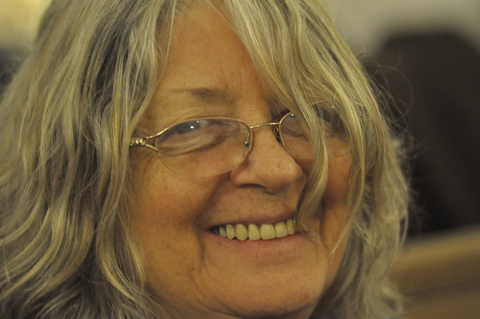 First of all a Crone is a woman. She has lived most of her life already and has accumulated many life experiences and therefore, can relate to those younger than her with greater understanding. She has acquired the wisdom associated with having had those life experiences. She has reached a place in her life when she may be slowing down. She may have retired from her career. She may want to devote more time to herself, serving more as an advisor rather than as the doer. We can read the poem, Warning by Jenny Joseph to get an idea, or watch her read it here or below…
“When I am an old woman I shall wear purple
With a red hat which doesn’t go, and doesn’t suit me.
And I shall spend my pension on brandy and summer gloves
And satin sandals, and say we’ve no money for butter.
I shall sit down on the pavement when I’m tired
And gobble up samples in shops and press alarm bells
And run my stick along the public railings
And make up for the sobriety of my youth.
I shall go out in my slippers in the rain
And pick flowers in other people’s gardens
And learn to spit.You can wear terrible shirts and grow more fat
And eat three pounds of sausages at a go
Or only bread and pickle for a week
And hoard pens and pencils and beermats and things in boxes.But now we must have clothes that keep us dry
And pay our rent and not swear in the street
And set a good example for the children.
We must have friends to dinner and read the papers.But maybe I ought to practice a little now?
So people who know me are not too shocked and surprised
When suddenly I am old, and start to wear purple.”
You Are What You Read by Martha Cecilia Ovadia
 When it comes to my family, I’ve always felt different. One of my earliest memories from when I was really young was being told that I felt things too passionately—that I felt too much. What was never said but was implied was that I felt dissent too much, too often, too vocally. It made people uncomfortable. It made my family uncomfortable. When it came to understanding my faith/religious path, my family and I started diverging early on, never really meeting again—at least not for now.
When I was about five, I remember asking why women could not be priests. My mother brushed it aside and said we could be nuns. She was blind to the inherent misogyny behind the same Church that so many of her female family members had built (we come from a long line of nuns and Jesuits). I thought maybe someday I could be a woman priest. I would change it all. I would be Pope Joan.
When I was thirteen, I started noticing the wealth involved in the Roman Catholic Church, the opulence of the lived Catholic life. When I asked my parents why the Church did not lead in example and live in poverty using its wealth to actively live the gospel, I was told, “ This wealth is a gift to humanity. It is there for all of us, a patrimony to those who open their hearts.” I wasn’t talking about art, I was talking about the RCC’s gold assets—valued in the billions —but it didn’t matter. I’ve seen my family donate to Church building funds my entire life—buildings that were then sold off to pay for the Church’s offenses later on. Still, I thought if I became more involved, with the “right kind of Catholics”, I would be able to change the Church from within. Continue reading “You Are What You Read by Martha Cecilia Ovadia”
ISIS and the Larger Muslim Crisis by Hanadi Riyad
 It is heartening to hear the many condemnations Muslim scholars have issued of ISIS and its methods and actions. One of the latest attempts comes in the form of an open letter addressed by a coalition of one hundred and twenty six Muslim “scholars” from across the world to Abu Bakr al Baghdadi and ISIS followers and supporters. The seventeen page letter is one of the most detailed responses to ISIS I have read. However, just like other responses, it fell short of my expectations as a Muslim woman. I checked the list of the signatories and I could not find any women amongst them.
I am saddened to note that the authors of the letter fall into the same mistake they accuse ISIS of: they quote some Quraanic verses and Hadiths selectively, out of context, and portray them as sufficient rebuttal against ISIS actions, never mind the sources, verses, and Hadiths ISIS has been quoting just as selectively to justify its crimes. The letter explains about the methodology of Islamic legal theory (usul al-fiqh) that it stipulates “to consider everything that has been revealed relating to a particular question in its entirety, without depending on only parts of it, and then to judge if one is qualified based on all available scriptural sources.” There’s no explicit logical explanation for why the parts of the scripture and interpretations quoted by the writers of the letter should be given precedence over the ones quoted by ISIS.
The implicit reason, however, resides in the authors’ assertion of their authority as Sunni “scholars” and their opinion as “a scholarly opinion.” We should take their word because they have the authority that ISIS does not. The assumption that ISIS cannot count amongst its ranks scholars is neither explained nor defended. The doctrinal connection between ISIS and Wahhabi ideology upheld by many Saudi scholars – like ibn Baz and his disciples— goes unacknowledged. Continue reading “ISIS and the Larger Muslim Crisis by Hanadi Riyad”
Are You Ready for Some Football? by John Erickson
Although putting women in charge of drafting new policies that address the “woman problem” currently facing the NFL, it too reeks of the similar dismissive and patronizing actions women face when trying to obtain leadership roles in their religious traditions. Supercilious progress for the sake of progress isn’t progress and progress under the guise of silence is still misogyny. We need women in positions of leadership in both the NFL as well as in religious traditions. The culture of violence and silence will only continue, albeit with a Band-Aid firmly in place, holding the painful experiences and histories of women, long forgotten and often overlooked, until society values their rights just as much as the men leading the prayers and those that are being prayed for on Sundays across America.
 There is never a reason for physical violence. There is never a reason to hit your partner or child to the point where they are unconscious or bruised. There is never a reason to inflict violence against someone else, but apparently there are exceptions to these rules if you’re an NFL football player.
In my native state of Wisconsin, watching football on Sunday is synonymous with attending church prior to the game. Watching football on Sunday is a cultural norm in many, if not all, different regions of the country where individuals, whether you like it or not, gather each Sunday to both praise and pray that your team ends up on top.
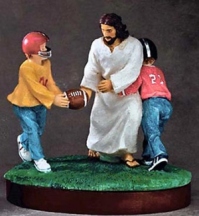
In Wisconsin, you attend church with your family and head to your desired destination where you gather with friends and family to eat, talk about your life, and of course watch your local football team battle their weekly rival. Although I am not much of a football fan these days, I have very fond memories of attending football games, watching them with my family and talking about the Green Bay Packers’ Super Bowl chances. It was my time to both bond with the men of my family as well as catch up on the gossip the women would whisper back and forth to each other at the dinner table while the men were in the other room screaming at the TV.
Although I’m sure I will watch more games in my future, lately, all I do is cringe when I think about the growing violence that women and children face and have faced in the large shadow of an organization worth north of $9 billion dollars.
The biggest scandal to hit the news waves lately is that of Baltimore Ravens running back Ray Rice’s assault of his wife in an Atlantic City elevator. Although Rice and the various other incidents regarding NFL players and violence is disturbing, the biggest problem facing the NFL isn’t just its treatment of women but its continual commodification of them as a disposable resource emblematic with the culture of violence that it has created.
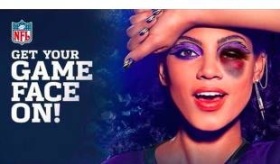
If you didn’t know, women make up an estimated 45% of the NFL‘s more than 150 million American fans and have, in recent weeks, become their most valuable resource and source of criticism. However, after a long string of incidents stemming back from NFL teams underpaying cheerleaders to the Ray Rice incident, one needs to ask what the roles of women, if any, are outside of the disturbing images of the abused wife, hypersexualized cheerleader? Is being dragged out of an elevator by your abusive husband the only way to get women’s issues addressed in the NFL by fans, league owners, and the NFL commission?
The roles of women in the NFL and religion have many similarities. Aside from end zone celebrations where players praise God for his apparent direct role in helping them score a winning touchdown or certain players edifications as gods on Earth, women make up the crux of both NFL fandom and attendance but are responsible for the gatherings similar to the ones I, and many others, grew up with.
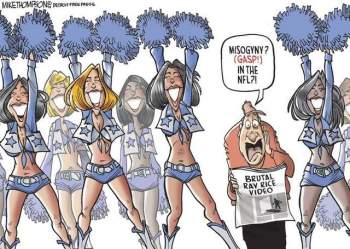
Although putting women in charge of drafting new policies that address the “woman problem” currently facing the NFL, it too reeks of the similar dismissive and patronizing actions women face when trying to obtain leadership roles in their religious traditions. Supercilious progress for the sake of progress isn’t progress and progress under the guise of silence is still misogyny. We need women in positions of leadership in both the NFL as well as in religious traditions. The culture of violence and silence will only continue, albeit with a Band-Aid firmly in place, holding the painful experiences and histories of women, long forgotten and often overlooked, until society values their rights just as much as the men leading the prayers and those that are being prayed for on Sundays across America.
Ann Braude said it best in her foundational text Sisters and Saints that “if we want to understand the history of American women, we need to examine the religious beliefs and activities that so many have found so meaningful.” Without women, we wouldn’t have many, if not all, of the religions that are present throughout the world today and in case we forget, without women, we too wouldn’t have the millions of little boys who grow up being taken to and from practice by their mothers with the hope that they too could one day become the professional football players that fans scream and pray for.
Without women, there is no NFL and without women, there is no religion. Kelly Brown Douglas said it best on this very blog when she stated, “It is the violence that violence creates.” Although I agree with her, I would only add that while violence does indeed create violence, the real sin isn’t the violence itself but rather the silence that follows.
Let us pray that we will continue to not be silent and that we will rise up and fight for the millions of women (and men) each day who do not live in fear that their significant other’s multimillion dollar contract will not be reinstated but rather that they and their children may not see another day on this Earth.
John Erickson is a Ph.D. Candidate in American Religious History at Claremont Graduate University. He holds a MA in Women’s Studies in Religion; an MA in Applied Women’s Studies; and a BA in Women’s Literature and Women’s Studies. The LGBTQ and women’s rights movements, masculinity studies, gender theory, and the utilization of technology in forming communities and creating new teaching methodologies influence his research interests. His work is inspired by the intersectionality of feminism, queer identity, LGBTQ history, and religious and sexual cultural rhetoric. He is a Non-Fiction Reviewer for Lambda Literary, the leader in LGBT reviews, author interviews, opinions and news since 1989 and the Co-Chair of the Queer Studies in Religion section of the American Academy of Religion’s Western Region, the only regional section of the American Academy of Religion that is dedicated to the exploration of queer studies in religion and other relevant fields in the nation. When he is not working on his dissertation, he can be found at West Hollywood City Hall where he is the City Council Deputy and Chief of Staff to Councilmember Abbe Land. He is the author of the blog From Wisconsin, with Love and can be followed on Twitter @JErickson85
From Evangelical Christianity to Feminist Evangelism by Andreea Nica
 I always knew I was a feminist, despite my lack of knowledge in the movement and philosophy growing up. I did, however, have the religious support of my family and community to be an Evangelical Christian. I knew all the right words, mannerisms, and behaviors to represent myself as the proper Christian woman. I went on mission trips abroad, wore purity rings, attended sexual purity retreats and church camps, prayed fervently, spoke in tongues (glossolalia), contributed 10 percent of my meager earnings, and above all, fell in love with God.
As a first-generation college student, I was thirsty for knowledge and ready to take on the world. Some of my favorite courses during my undergraduate career included: “Psychology of Women,” “Women, Gender, and Ethnicity,” and “Psychology of Sexuality.” My coursework in gender, sexuality, and the social sciences compelled me to pursue graduate studies in gender, culture, and media at a university abroad. My studies in gender theory and feminist philosophy, and how it intersects with religion and social institutions ignited my spirit.
As a result, my relationship with god suffered. My newfound feminist beliefs were not solely to blame, however. Rather, a variety of reasons contributed to my detachment from god and the Evangelical church which I explain in my post, “Leaving Behind My First Love.” My new feminist identity was the main driver for questioning my relationship with god. Everything from the male-dominated language and rhetoric used in the church, to the discrimination and prohibition of female pastors, to the stringent gender roles expected of congregants. Continue reading “From Evangelical Christianity to Feminist Evangelism by Andreea Nica”
 Feminism and Religion